
Looking for ad agencies in Texas? Explore what makes the Lone Star State's marketing landscape unique and how to choose the right partner for growth.
Texas isn’t just big in size. The state’s advertising and marketing industry is massive, generating billions in revenue annually and serving everything from Fortune 500 companies to local home service contractors. If you’re running a plumbing, HVAC, or electrical business in Texas, understanding the advertising landscape helps you make smarter marketing decisions. The right partnership can transform your lead generation, while the wrong one wastes money on strategies that don’t fit your market. Let’s break down what you need to know about ad agencies in Texas and how to find partners who actually understand your business.
The Texas Advertising Landscape in 2026
Texas hosts one of the largest concentrations of advertising and marketing agencies in the United States.
According to revenue forecasts for advertising agencies in Texas, the industry continues growing year over year, driven by the state’s booming economy and business-friendly environment.
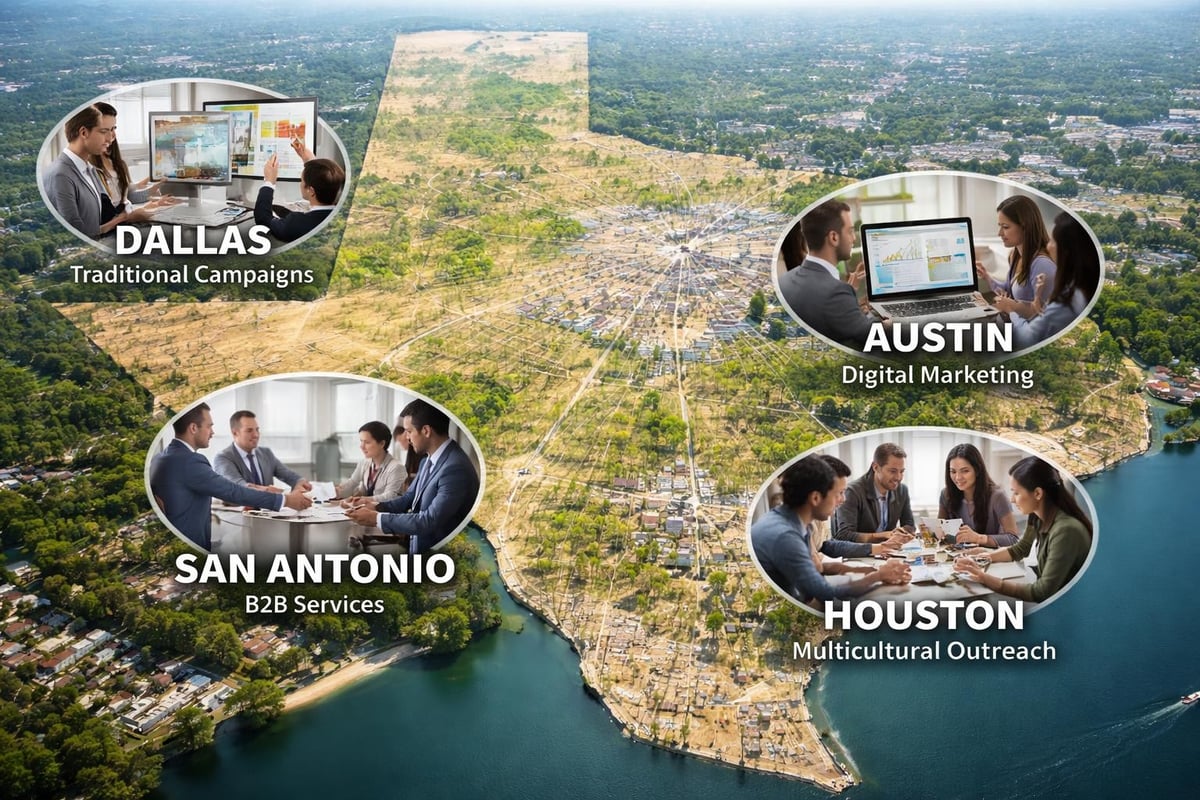
Major cities like Dallas, Houston, Austin, and San Antonio each developed distinct advertising cultures:
- Dallas became home to legendary agencies like The Richards Group, known for creating iconic national campaigns
- Austin attracted digital-first agencies and creative shops specializing in tech and startup marketing
- Houston developed strong B2B and energy sector expertise alongside consumer marketing
- San Antonio built a unique position in multicultural marketing, particularly with agencies like LatinWorks
The state’s diversity creates opportunities but also challenges.
Not every agency understands every market segment.
Why Geography Still Matters in Digital Marketing
You might think location doesn’t matter in 2026.
Everything’s digital, right?
Here’s what actually works: local market knowledge still drives results, especially for service businesses.
An agency in New York might understand brand strategy, but do they know how Houston homeowners search for emergency plumbers during hurricane season? Do they understand the difference between marketing HVAC services in El Paso versus Corpus Christi?
Texas covers 268,596 square miles with dramatically different climates, demographics, and economic conditions.
Climate variations affect service demand:
- South Texas needs year-round AC but minimal heating
- North Texas requires balanced HVAC systems
- West Texas faces extreme temperature swings
- Coastal areas deal with humidity and storm preparation
Economic differences shape purchasing behavior:
- Oil and gas boom-and-bust cycles in Houston and Midland
- Tech-driven growth in Austin
- Military and tourism economies in San Antonio
- Agricultural communities in the Rio Grande Valley
The best ad agencies in Texas understand these nuances without you having to explain them.
Types of Ad Agencies Operating in Texas
Texas hosts every type of advertising and marketing agency you can imagine.
Understanding the differences helps you pick the right partner.
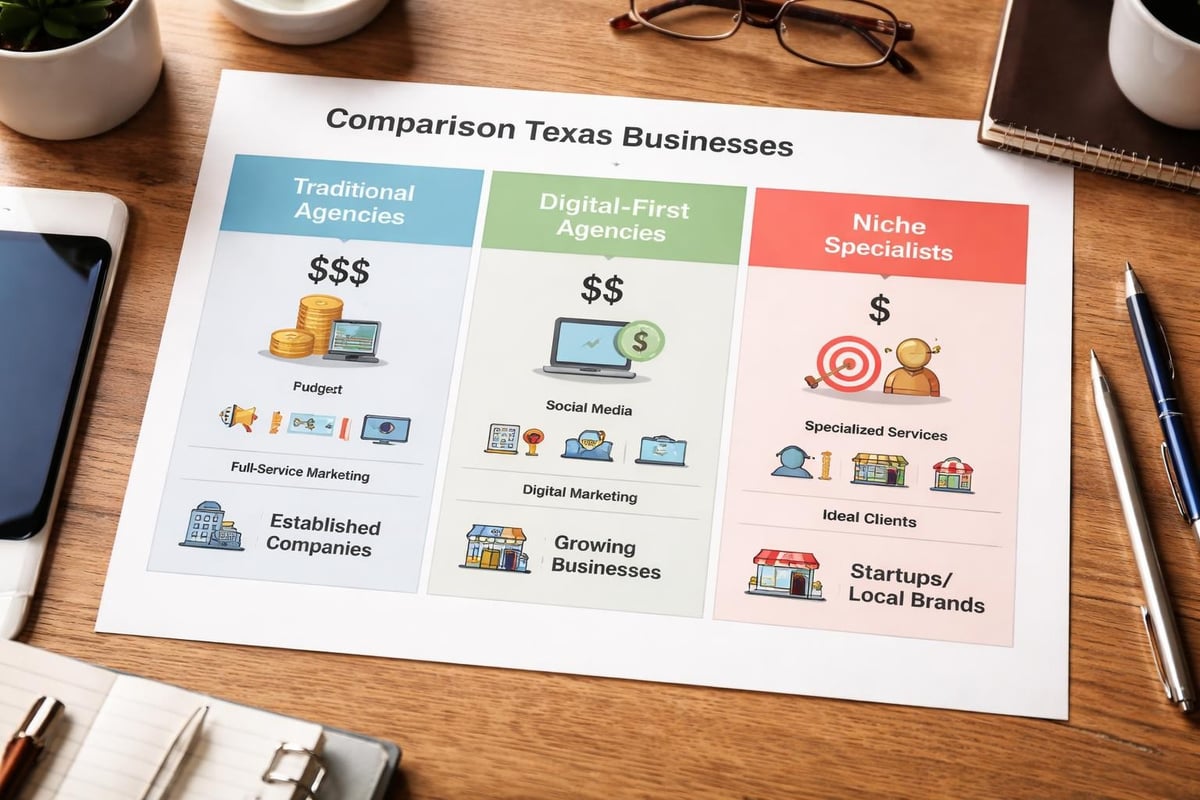
Full-Service Traditional Agencies
These shops handle everything from brand strategy to media buying.
They typically work with larger budgets and longer timelines. Most made their names in print, TV, and radio before adding digital services.
Strengths:
- Comprehensive brand development
- Large creative teams
- Established media relationships
- National campaign experience
Limitations for home service businesses:
- High minimum budgets (often $10,000+ monthly)
- Longer project timelines
- Less focus on direct response and lead generation
- Limited understanding of service business sales cycles
Digital-First Marketing Agencies
These agencies built their businesses around online marketing.
They focus on websites, SEO, PPC, social media, and conversion optimization. Many specialize in specific tactics or industries.
You’ll find directories of specialized agencies throughout Texas, each claiming expertise in different areas.
The challenge? Most digital agencies treat every business the same way. They apply cookie-cutter strategies whether you’re selling software or fixing water heaters.
What works for home services requires different thinking:
- Emergency call tracking, not just form fills
- Map pack rankings, not just organic positions
- Service area targeting, not broad demographic reaches
- Phone call optimization, not just website traffic
Niche Specialists
Some agencies focus exclusively on specific industries or services.
For home service businesses, this specialization matters more than agency size or location.
A plumbing-focused agency with five people will outperform a 50-person generalist shop every single time. They’ve already solved the problems you’re facing. They know which keywords convert, what landing pages work, and how to structure campaigns for maximum ROI.
| Agency Type | Best For | Typical Investment | Results Timeline |
|---|---|---|---|
| Traditional Full-Service | Brand building, large budgets | $10,000+ monthly | 6-12 months |
| Digital Generalist | Basic online presence | $2,000-5,000 monthly | 3-6 months |
| Niche Specialist | Industry-specific growth | $3,000-8,000 monthly | 2-4 months |
| Freelancer/Consultant | Tactical projects | $1,000-3,000 monthly | Varies widely |
What Home Service Businesses Actually Need from Marketing
Here’s the disconnect most business owners face.
Ad agencies in Texas love talking about brand awareness, engagement rates, and creative awards.
You need phone calls from people with real problems who are ready to pay for solutions.
The Lead Generation Reality
Your marketing exists for one purpose: generating qualified leads that turn into paying customers.
Everything else is noise.
A qualified lead for a home service business means:
- Someone in your service area
- With a problem you can solve
- Ready to hire now (or very soon)
- Able to pay your rates
Most general advertising agencies optimize for vanity metrics. They’ll show you increased website traffic, social media followers, or brand mentions.
None of that pays your technicians’ salaries.
Understanding the real cost for digital marketing means looking past surface-level metrics to actual revenue generation.
Local Search Dominance
When someone’s water heater floods their garage at 9 PM, they’re not browsing social media ads.
They’re typing “emergency plumber near me” into Google.
If you’re not in the top three map results, you’re invisible.
The agencies that understand this focus on:
- Google Business Profile optimization for maximum visibility
- Local citation building across directories and review sites
- Review generation systems that consistently earn 5-star ratings
- Service-specific landing pages targeting high-intent keywords
- Mobile-first website design that loads fast and converts clicks to calls
These tactical elements generate more revenue than any clever TV commercial or viral social campaign.
Red Flags When Evaluating Texas Advertising Agencies
Not every agency tells the truth about their capabilities.
Some warning signs appear repeatedly across the industry.
They Promise Overnight Results
“We’ll get you to #1 on Google in 30 days!”
Run away from anyone making that promise.
Legitimate SEO and local search optimization take time. Google’s algorithms don’t respond to magic tricks. They reward consistent, quality work over months, not days.
What you should hear instead: “We typically see initial movement in 60-90 days, with significant results in 4-6 months.”
They Use Vague Terminology
Pay attention when agencies start throwing around buzzwords without explaining what they mean.
“We’ll leverage synergistic brand positioning to create omnichannel engagement that drives awareness.”
That’s marketing speak for “we don’t have a clear plan.”
Good agencies explain strategies in plain language. If you’re running a plumbing business, they should be able to explain exactly how their work generates more service calls.
They Won’t Share Past Results
Any legitimate agency working in your industry has case studies and performance data.
They should show you:
- Specific campaigns they’ve run for similar businesses
- Before-and-after metrics (traffic, leads, revenue)
- How they solved problems similar to yours
- Client references you can actually contact
If they hide behind “confidentiality agreements” for everything, that’s a red flag.
They Lock You Into Long Contracts
Some agencies require 12-month commitments before you’ve seen any results.
That’s designed to protect them, not you.
Better agencies structure agreements around performance milestones. They’re confident enough in their work to allow reasonable exit terms if things aren’t working.
They Don’t Understand Your Sales Process
Ask a potential agency to walk through your customer journey.
If they can’t explain how someone goes from searching online to booking a service call to becoming a repeat customer, they don’t understand your business.
Critical questions they should ask you:
- What’s your average ticket value?
- How many estimates convert to jobs?
- What’s your customer lifetime value?
- Which services have the highest margins?
- What are your seasonal demand patterns?
These details should inform every marketing decision.
The Unique Advantages of Working with Texas-Based Agencies
Partnering with ad agencies in Texas offers specific benefits beyond just shared geography.
Time Zone Alignment
When your phone starts ringing at 7 AM because your PPC ads are already running, you want an agency that’s awake and monitoring performance.
California agencies are three hours behind. When you’re dealing with an emergency campaign adjustment at 4 PM Central, they’re still at lunch.
Texas-based teams work your hours.
Market Understanding
Agencies based in Texas inherently understand the state’s unique characteristics.
They know what “hard water” means in different regions. They understand how freeze events impact plumbing calls in North Texas. They’ve seen how hurricane prep drives HVAC and generator demand along the coast.
This knowledge gets built into campaigns automatically instead of requiring constant explanation.
Local Connections
Established Texas agencies have relationships with:
- Local media outlets for PR opportunities
- Industry associations and trade groups
- Complementary service providers
- Regional influencers and community leaders
These connections open doors that out-of-state agencies simply can’t access.
Easier Communication and Collaboration
Meeting face-to-face still matters for complex strategy discussions.
When you can drive to your agency’s office in Dallas, Houston, or San Antonio for quarterly planning sessions, communication improves. You build stronger relationships. Problems get solved faster.
Video calls work fine for routine check-ins, but nothing replaces sitting across a table from your marketing team when you’re planning major growth initiatives.

How Ad Agencies Price Their Services in Texas
Understanding pricing models helps you budget appropriately and compare options.
Ad agencies in Texas typically use one of several pricing structures.
Hourly Billing
Some agencies charge by the hour for project work.
Typical Texas rates in 2026:
- Junior staff: $75-125/hour
- Mid-level specialists: $125-200/hour
- Senior strategists: $200-350/hour
- Agency principals: $350-500/hour
This model works for one-off projects like website redesigns or brand strategy development. It’s terrible for ongoing marketing because costs become unpredictable.
Monthly Retainers
Most marketing relationships work on monthly retainers.
You pay a fixed amount each month for a defined scope of services.
| Service Package | Typical Monthly Range | What’s Included |
|---|---|---|
| Basic Digital Presence | $1,500-3,000 | Website maintenance, basic SEO, social posting |
| Local SEO Focus | $2,500-5,000 | GBP optimization, citations, review management, content |
| Comprehensive Marketing | $5,000-10,000 | SEO, PPC, content, web development, reporting |
| Full-Scale Growth | $10,000-25,000+ | Everything plus dedicated team, advanced strategies |
Performance-Based Pricing
Some agencies tie compensation directly to results.
This sounds great in theory. In practice, it creates alignment problems.
What counts as a result? A phone call? A booked appointment? Completed work? Collected payment?
The further down the funnel you measure, the less control the agency has over outcomes. Your sales team, pricing, and service quality affect conversion rates more than marketing does.
Most legitimate performance models include a base retainer plus bonuses for hitting specific KPIs.
Project-Based Fees
One-time projects get quoted as flat fees.
Common examples:
- Website redesign: $8,000-35,000
- Brand identity package: $5,000-20,000
- Marketing strategy development: $3,000-12,000
- Video production: $2,000-15,000 per video
The wide ranges reflect differences in scope, complexity, and agency positioning.
Questions to Ask Before Hiring an Agency
Interview multiple agencies before making a decision.
Come prepared with questions that reveal how they actually work.
About their experience:
- How many home service businesses do you currently work with?
- Can you share specific results you’ve achieved in our industry?
- What’s your experience with our specific trade (plumbing, HVAC, electrical)?
- How do you stay current with Google’s local search algorithm changes?
About their process:
- What does the first 90 days look like?
- How often will we communicate, and through what channels?
- Who will be our day-to-day contact?
- What reporting will we receive, and how frequently?
About their strategy:
- What specific tactics do you recommend for our business?
- How do you determine which marketing channels to prioritize?
- How do you balance quick wins with long-term growth?
- What role does our website play in your overall strategy?
About integration:
- How do you work with our existing tools (CRM, scheduling software, etc.)?
- Do you handle call tracking and attribution?
- Can you integrate with our current website, or do we need a new one?
- What access do you need to our business systems?
The quality of their answers matters more than the smoothness of their sales pitch.
Industry-Specific Considerations for Home Services
Generic advertising strategies fail for home service businesses.
Your marketing requires different approaches than retail, professional services, or e-commerce.
Emergency vs. Planned Services
Some of your work comes from emergencies. Water leaks don’t wait for business hours.
Other services are planned. Nobody replaces their HVAC system on impulse.
Your marketing mix needs to address both scenarios.
Emergency service marketing focuses on:
- 24/7 visibility in local search
- Fast-loading mobile websites
- Prominent phone numbers that click to call
- Service area coverage maps
- Response time guarantees
Planned service marketing emphasizes:
- Educational content that builds authority
- Comparison guides and buying criteria
- Financing options and payment plans
- Seasonal promotions and maintenance plans
- Customer reviews and project galleries
Most home service businesses need both approaches running simultaneously.
The Trust Factor
People let you into their homes.
That requires a level of trust that doesn’t exist in many other industries.
Your marketing must build credibility through:
- Authentic reviews from real customers across multiple platforms
- Professional branding that signals competence and reliability
- Team photos and bios that put faces to your business
- Licensing and insurance information displayed prominently
- Community involvement and local recognition
- Before-and-after project examples showing quality work
Agencies that don’t understand this trust requirement will push generic tactics that don’t move the needle.
Service Area Complexity
Unlike retail stores with fixed locations, you serve specific geographic areas.
Your marketing needs to target:
- Multiple cities and neighborhoods
- Different service zones with varying response times
- Areas where you want to grow versus established territories
- Locations where competition is heavy versus lighter
This geographic complexity requires sophisticated local SEO strategies.
You can’t just optimize for “plumber in Texas.” You need specific targeting for every area you serve, with content and citations that establish relevance in each location.
Agencies offering HVAC SEO service in Austin TX or other specific cities understand this requirement better than generalists.
The Role of Digital Marketing Versus Traditional Advertising
Texas has strong traditions in radio, print, and billboard advertising.
Drive through any major city and you’ll see home service companies on benches, buses, and highway billboards.
Do those still work in 2026?
Traditional Advertising Strengths
Certain traditional channels still deliver value for home service businesses.
Radio remains effective for:
- Building broad brand awareness in your market
- Reaching listeners during drive time (when people think about home projects)
- Creating personality through consistent messaging
- Supporting local sports teams and community events
Billboards work when:
- You want visibility in specific geographic corridors
- Your business name and number are simple and memorable
- You’re targeting commuters who pass the same location daily
- You combine them with strong digital retargeting
Direct mail has a place for:
- New mover targeting in growing neighborhoods
- Seasonal maintenance reminders to existing customers
- High-value neighborhood campaigns
- Supplement to digital strategies
Digital Marketing Advantages
Digital channels offer capabilities that traditional media can’t match.
Measurability: You know exactly how many people clicked, called, or converted from each campaign.
Targeting precision: Reach only homeowners in specific ZIP codes with household incomes above certain thresholds who have shown interest in your services.
Real-time optimization: Adjust campaigns immediately based on performance data.
Cost efficiency: Start with small budgets and scale what works instead of committing to monthly radio contracts.
Intent capture: Intercept people actively searching for solutions right now.
For most home service businesses in 2026, digital should represent 70-90% of your marketing budget. Traditional channels work best as supplements that reinforce your core digital presence.
Finding the Right Fit for Your Business
Not every great agency is right for your specific situation.
Consider these matching factors carefully.
Budget Alignment
Be honest about what you can invest consistently.
An agency requiring $10,000 monthly doesn’t fit if you can only budget $3,000. They’ll either turn you down or assign you to junior team members who can’t deliver their best work.
Better to find an agency where your budget puts you in their sweet spot. You’ll get better attention and results.
Communication Style
Some agencies prefer formal monthly presentations. Others text you campaign updates in real-time.
Some agencies bury you in data. Others focus on high-level summaries.
Make sure their communication approach matches your preferences and capacity. If you’re a hands-on owner who wants daily involvement, a hands-off agency will frustrate you.
Growth Stage Match
A startup agency building their portfolio has different needs than an established firm with dozens of clients.
Match your business stage to theirs:
- New businesses benefit from agencies willing to grow together, offering flexibility and hands-on attention
- Established businesses need agencies with proven systems and the capacity to scale campaigns quickly
- Mature businesses want agencies that can find incremental improvements and defend market position
Cultural Compatibility
You’ll work closely with this team for months or years.
Do their values align with yours? Do you like the people? Can you see yourself trusting them with major business decisions?
A brilliant strategist you can’t stand talking to won’t work long-term.
Current Trends Shaping Texas Advertising
The marketing landscape keeps evolving.
Understanding current trends helps you evaluate whether agencies are forward-thinking or stuck in outdated approaches.
AI and Automation Integration
Artificial intelligence now handles routine tasks that agencies used to charge thousands of dollars for.
Smart agencies use AI for:
- Content research and outline generation
- Data analysis and pattern recognition
- Bid optimization in PPC campaigns
- Customer segmentation and targeting
- Reporting automation and insight generation
This doesn’t replace human strategy and creativity. It frees up time for higher-value work.
Agencies not incorporating AI into their workflows are falling behind on efficiency and capabilities.
Video Content Dominance
Video continues expanding across every platform.
Your potential customers expect:
- Service explanation videos on your website
- Customer testimonial videos showing real projects
- Before-and-after transformations
- FAQ videos answering common questions
- Behind-the-scenes content humanizing your team
The agencies that help you create and distribute video content position you ahead of competitors still using only photos and text.
Privacy and Data Regulations
Tracking and targeting capabilities are shrinking as privacy regulations expand.
Third-party cookies are disappearing. Platform tracking is getting restricted. Privacy laws are multiplying.
Smart agencies are building first-party data strategies that don’t rely on tracking customers across the web. They focus on owned channels (your website, email list, customer database) instead of rented attention on social platforms.
Voice Search and Conversational Queries
People increasingly search using natural language.
Instead of typing “plumber Houston,” they ask their phone, “Who can fix my leaking toilet near me?”
This shift requires different content and optimization strategies. Agencies that still optimize only for traditional keyword phrases miss these conversational searches.
Working with Agencies Across Different Texas Markets
Each major Texas market has distinct characteristics that affect marketing strategies.
Dallas-Fort Worth Metroplex
The DFW market combines multiple distinct cities and suburbs into one massive metro area.
Competition is fierce across all home service categories. Standing out requires sophisticated targeting and strong differentiation.
Key considerations:
- Highly educated, affluent suburbs demand premium positioning
- Wide geographic spread requires clear service area boundaries
- Multiple competitors mean you need sharp messaging
- Strong local media presence offers PR opportunities
Houston and Surrounding Areas
Houston’s size and diversity create both challenges and opportunities.
The energy sector’s boom-bust cycles affect residential spending patterns. Understanding these economic rhythms helps with budget planning and campaign timing.
Marketing factors:
- Extreme weather drives emergency service demand
- Multicultural population requires diverse messaging approaches
- Suburban expansion creates opportunities in growing areas
- Hurricane preparation and recovery create seasonal demand spikes
Austin and Central Texas
Austin’s rapid growth attracts both new residents and businesses.
The tech-influenced culture means digital adoption is higher than other Texas markets. People expect sophisticated online experiences.
Strategic elements:
- New construction neighborhoods offer virgin territory
- Tech workers expect modern, seamless digital interactions
- Environmental consciousness influences messaging
- Premium services command higher prices than many Texas markets
San Antonio and South Texas
San Antonio offers unique demographic and cultural characteristics.
Military presence, tourism, and strong Hispanic culture create distinct marketing requirements. Companies like LatinWorks built their reputations understanding these dynamics.
Working with the right SEO company in San Antonio means finding partners who understand these cultural nuances.
Market specifics:
- Bilingual marketing capabilities are often essential
- Military population creates steady demand and relocations
- Tourism industry affects seasonal patterns
- Community and family values drive trust-building approaches
Building Long-Term Marketing Partnerships
The best results come from sustained relationships, not one-off projects.
Think of your marketing agency as a long-term business partner, not a vendor.
The First Year Timeline
Year one with a new agency follows a predictable pattern.
Months 1-3: Foundation Building
- Audit current marketing assets and performance
- Develop comprehensive strategy
- Fix critical website and technical issues
- Launch initial campaigns with baseline tracking
Months 4-6: Optimization Phase
- Analyze early performance data
- Adjust targeting and messaging
- Scale what’s working, cut what’s not
- Expand content and citation building
Months 7-9: Growth Acceleration
- Campaigns hit their stride with optimized performance
- Seasonal patterns become clear
- Customer lifetime value data informs bidding
- Advanced strategies get layered in
Months 10-12: Strategic Planning
- Review full year performance
- Set goals for year two
- Identify new opportunities and markets
- Plan budget allocation for next phase
Most businesses that abandon agencies before six months never see what real results look like. Search engine optimization and authority building simply take time.
Communication Cadence
Establish regular touchpoints from the start.
Recommended schedule:
- Weekly updates via email or project management system
- Bi-weekly check-in calls (15-30 minutes)
- Monthly performance reviews (45-60 minutes)
- Quarterly strategy sessions (90-120 minutes)
This rhythm keeps everyone aligned without creating meeting overload.
Performance Expectations
Set realistic benchmarks based on your starting point.
If you’re starting from zero online presence, expecting 100 leads in month one isn’t realistic. But you should see:
- Month 1: Tracking and infrastructure in place, campaigns launched
- Month 2: Initial traffic increases, first tracked conversions
- Month 3: Clear performance trends, optimization adjustments
- Months 4-6: Meaningful lead volume increases, improving cost per acquisition
- Months 6-12: Sustained growth, expanding market share, strong ROI
Document these expectations in writing so both parties know what success looks like.
DIY Marketing Versus Agency Partnership
Some business owners try handling marketing themselves.
This can work for simple tactics but usually hits a ceiling quickly.
What You Can Realistically Handle In-House
Manageable tasks for most business owners:
- Responding to reviews
- Posting occasional social media updates
- Basic email communications to existing customers
- Local networking and community involvement
- Managing vendor relationships once established
What quickly becomes overwhelming:
- Technical SEO and website maintenance
- PPC campaign management and optimization
- Content creation at scale
- Tracking and analytics setup
- Competitive analysis and market research
The Hidden Costs of DIY
Your time has value.
If you spend 15 hours per week trying to figure out Google Ads when you could be running service calls worth $500 each, you’re losing money even if you don’t write checks to an agency.
Add in:
- Mistakes from inexperience that waste ad spend
- Missed opportunities because you don’t know they exist
- Slow implementation because it’s not your full-time focus
- Tools and software subscriptions you need but underutilize
Most business owners discover that working with a near me digital marketing agency costs less than the revenue they lose trying to DIY everything.
The Hybrid Approach
Some businesses find success with a hybrid model.
You handle customer-facing communications and relationship elements. The agency handles technical execution, strategy, and specialized skills.
This works best when roles are clearly defined and both parties respect boundaries.
Regional Resources and Industry Connections
Beyond individual agencies, Texas offers extensive marketing resources.
Professional Organizations
Several organizations support advertising and marketing professionals across Texas.
These groups host conferences, share best practices, and create networking opportunities.
Agencies deeply involved in industry organizations tend to stay current on trends and maintain higher professional standards.
Educational Institutions
Texas universities and colleges produce steady streams of marketing talent.
Schools like UT Austin, SMU, Texas A&M, and Texas Tech have strong advertising and marketing programs. Agencies recruiting from these programs bring fresh perspectives and current digital skills.
Industry Events and Conferences
Texas hosts numerous marketing conferences throughout the year.
These events showcase emerging trends, tools, and strategies. Agencies that invest in ongoing education for their teams deliver better results than those coasting on outdated knowledge.
Local Media Opportunities
Each Texas market offers unique media opportunities.
From local news coverage to community publications, these channels help home service businesses build local authority and visibility.
Agencies with established media relationships can secure coverage that independent businesses struggle to access.
Making Your Final Decision
You’ve researched options, interviewed agencies, and gathered information.
Now comes the decision.
Creating Your Evaluation Matrix
Build a simple scoring system across key criteria.
| Criteria | Weight | Agency A | Agency B | Agency C |
|---|---|---|---|---|
| Industry Experience | 25% | 8/10 | 6/10 | 9/10 |
| Proven Results | 25% | 7/10 | 9/10 | 8/10 |
| Communication Fit | 15% | 9/10 | 7/10 | 8/10 |
| Strategic Approach | 20% | 8/10 | 8/10 | 7/10 |
| Budget Alignment | 15% | 7/10 | 9/10 | 6/10 |
| Total Score | 7.85 | 7.90 | 7.80 |
This removes emotion and forces objective comparison.
Trust Your Instincts
Data matters, but so does gut feeling.
If everything looks good on paper but something feels off, trust that instinct. You’ll be working closely with these people. Misalignment on values, communication style, or approach creates friction that undermines results.
Start with a Trial Period
Ask about pilot projects or trial periods.
A three-month trial with clear success metrics lets both parties test the relationship without massive long-term commitment. If things work well, extending to a full partnership is easy. If not, you’ve limited your risk.
Document Everything
Once you’ve chosen an agency, get clear agreements in writing.
Your contract should specify:
- Exact services included
- Deliverables and timelines
- Communication schedule and contacts
- Performance metrics and reporting
- Payment terms and schedule
- Termination clauses and notice periods
- Ownership of created assets (website, content, etc.)
Clear documentation prevents misunderstandings that damage relationships later.
Finding the right partner among ad agencies in Texas makes all the difference between marketing that drains your budget and marketing that fills your schedule with qualified leads. The Lone Star State offers incredible options, but home service businesses need specialists who understand the unique challenges of plumbing, HVAC, and electrical marketing. If you’re ready to work with a team that focuses exclusively on home service businesses across Texas and builds revenue-focused digital growth systems, Aim Set Win combines local SEO, conversion-focused web design, and data-driven strategy to generate consistent inbound calls and qualified leads for contractors who want to dominate their markets.
Jean runs growth strategy at AimSetWin, a performance marketing agency specializing in local service businesses across Texas. he's helped plumbers, HVAC companies, pest control operators, and home service brands build predictable revenue systems using data-driven advertising and conversion optimization.


