
Learn how ads home services drive qualified leads for plumbers, HVAC, and contractors. Proven 2026 strategies for Texas home service businesses.
Running ads home services campaigns isn’t like advertising retail products or e-commerce brands. When a homeowner’s air conditioner dies at 2 AM or a pipe bursts in their kitchen, they’re not browsing casually. They’re looking for immediate help, qualified professionals, and local providers who can solve their problem fast. Your advertising strategy needs to match that urgency while building trust in a matter of seconds. The home services industry in Texas is incredibly competitive in 2026, which means your ads need to do more than just show up. They need to convert cold searchers into paying customers through strategic targeting, compelling messaging, and smart budget allocation that prioritizes high-intent opportunities.
Why Traditional Advertising Fails for Home Services
Most contractors waste thousands on generic advertising approaches.
They run Facebook ads targeting everyone within 30 miles. They create display campaigns with beautiful imagery that gets clicks but zero phone calls. They spend money on brand awareness when they should be capturing people ready to book right now.
Here’s what actually works: ads home services campaigns that match search intent with the right message at the right time.
When someone searches “emergency plumber near me” at midnight, they don’t want to see a branding campaign about your 50 years in business. They want your phone number, your availability, and proof you can help immediately.
Traditional advertising treats all customers the same. Home services advertising recognizes three distinct customer types:
- Emergency customers who need help within hours and will pay premium prices
- Planned service customers researching options for scheduled maintenance or installations
- Future customers who aren’t ready yet but might need you in 6-12 months
Your advertising budget should reflect these priorities. Most of your money should target the first two groups.
The Real Cost of Poor Advertising Strategy
Bad ads home services campaigns don’t just waste money on clicks.
They damage your reputation by showing up for irrelevant searches. They burn through budgets targeting people outside your service area. They create confusion about your pricing, availability, and expertise.
Digital marketing for home services has evolved significantly, and strategies that worked five years ago are bleeding contractors dry today.
The average cost per click for home services keywords in Texas cities ranges from $15 to $75 depending on the trade and urgency. If your ads aren’t converting at least 20% of clicks into phone calls, you’re losing money.
Building a Full-Funnel Ads Strategy
Most contractors only advertise at the bottom of the funnel.
They target “emergency AC repair” and “24-hour plumber” and ignore everyone else. That’s leaving money on the table.
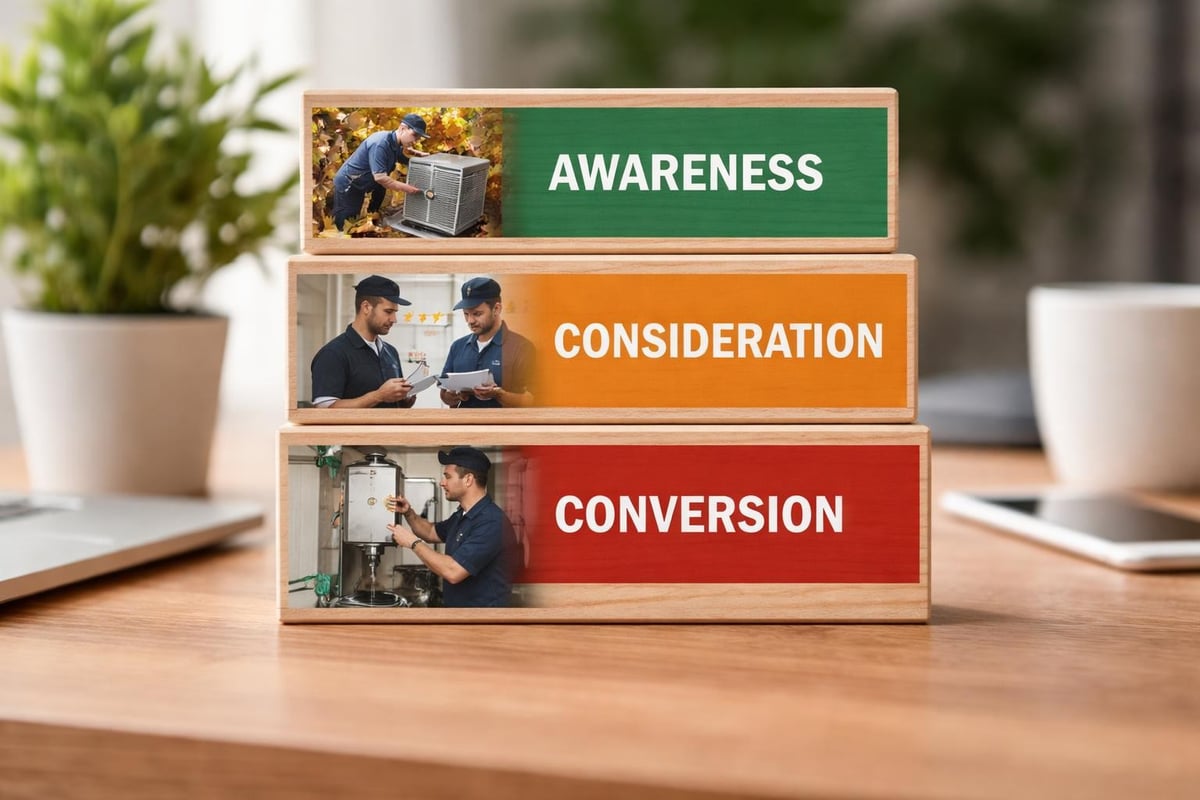
A complete ads home services strategy covers three stages:
Top of funnel: Awareness campaigns that introduce your brand to homeowners who will need services eventually. Think seasonal content, preventative maintenance education, and soft-sell messaging.
Middle of funnel: Consideration campaigns targeting people researching options. They’re comparing contractors, reading reviews, and trying to understand pricing.
Bottom of funnel: Conversion campaigns focused exclusively on immediate bookings. Emergency keywords, call-only ads, and aggressive messaging about availability.
Home services advertising strategies should guide customers smoothly through this journey, even if each stage requires separate campaigns and budgets.
Google Ads for Emergency Services
Google Search is where you capture high-intent customers.
Someone searching “broken water heater Houston” wants immediate help. Your ad needs to appear first, communicate availability clearly, and make calling easier than clicking.
Here’s your Google Ads structure for ads home services:
| Campaign Type | Target Keywords | Bidding Strategy | Budget Priority |
|---|---|---|---|
| Emergency | 24/7, emergency, urgent | Maximize conversions | Highest (40%) |
| Service-specific | AC repair, drain cleaning | Target CPA | Medium (35%) |
| Installation | New HVAC, water heater install | Manual CPC | Lower (15%) |
| Brand defense | Your company name + competitors | Manual CPC | Lowest (10%) |
Your emergency campaigns should run 24/7 with mobile bid adjustments of +50% or higher. Most emergency searches happen on phones.
Use call-only ads during your service hours. When someone clicks, their phone immediately dials your number. No landing page, no form fills, just a direct connection.
Your ad copy must answer the three questions every emergency customer asks:
- Are you available now?
- Do you serve my area?
- Can you actually fix this problem?
Bad example: “Quality plumbing services since 1985. Family owned and operated.”
Good example: “Emergency Plumber | Available Now in Houston | 30-Min Response | Water Heater Experts | Call Now”
Local Service Ads: The Game Changer
Google Local Service Ads (LSAs) changed everything for home services contractors.
These ads appear above regular search ads with the green “Google Guaranteed” badge. You only pay when someone calls directly from the ad.
For ads home services campaigns in 2026, LSAs are non-negotiable. They typically convert 2-3x better than standard search ads because of the trust factor.
Setting up LSAs properly requires:
- Background checks for all technicians
- Proper licensing verified by Google
- Insurance documentation that meets Google’s requirements
- Review management since your star rating displays prominently
The cost per lead averages $25-$60 for most home services trades in Texas. That’s dramatically cheaper than search ads when you factor in conversion rates.
Your LSA profile needs constant optimization. Respond to every review within 24 hours. Update your service areas quarterly. Adjust your budget based on call quality, not just volume.
Meta Ads for Home Services Awareness
Facebook and Instagram aren’t where people find emergency plumbers.
But they’re perfect for building awareness with homeowners who will need services eventually. Your ads home services strategy needs both immediate conversion campaigns and longer-term relationship building.
Meta ads excel at targeting based on demographics and homeownership data. You can reach:
- New homeowners in specific ZIP codes
- Households with older HVAC systems (based on purchase behavior)
- People who recently searched for home improvement content
- Neighborhoods with homes built in certain decades
Our Houston HVAC digital marketing case studies show Meta ads work best for scheduled services like maintenance agreements, system replacements, and seasonal tune-ups.
Retargeting Website Visitors
Most people who visit your website won’t call immediately.
That’s fine. They’re researching options, comparing prices, or waiting for the right time.
Retargeting ads keep your company visible after they leave. When they’re finally ready to book, you’re already familiar instead of a stranger.
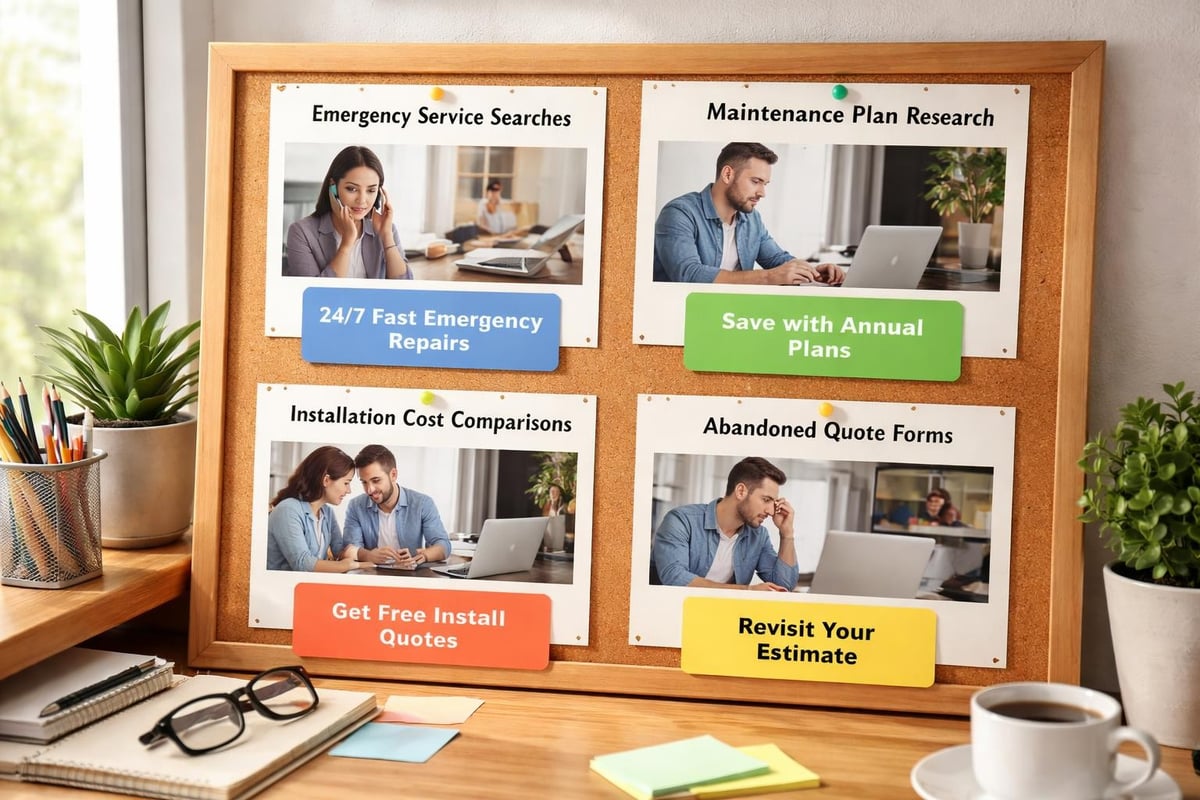
Your retargeting campaigns should segment visitors by behavior:
- Service page visitors: Show ads about that specific service with customer testimonials
- Blog readers: Offer educational content and position yourself as the expert
- Quote request abandoners: Remind them about their incomplete request with an incentive
- Repeat visitors: Push harder with limited-time offers or urgency messaging
Run retargeting campaigns with a 30-60-90 day window. Someone who visited once six months ago isn’t a qualified prospect anymore.
Seasonal Campaign Planning
Home services demand fluctuates dramatically by season.
HVAC contractors in Texas know July and August are peak months for AC emergencies. Plumbers see pipe bursts spike during rare winter freezes.
Your ads home services budget should shift with these patterns. Don’t spend the same amount every month.
HVAC seasonal priorities:
- March-May: Spring maintenance campaigns and early cooling season messaging
- June-August: Emergency AC repair at maximum budget with aggressive bidding
- September-November: Fall maintenance and heating system checks
- December-February: Emergency heating repair and preventative messaging
Plumbing seasonal priorities:
- Year-round baseline: Emergency services maintain consistent presence
- Pre-winter surge: Water heater replacement before high-demand season
- Holiday periods: Increased budget for garbage disposal, drain cleaning
- Spring: Sewer line inspections and outdoor plumbing preparation
Home services marketing strategies emphasize the importance of predictive budget allocation based on historical data and weather forecasts.
Landing Pages That Actually Convert
Your ads might be perfect, but they’re worthless if your landing page doesn’t convert.
Home services landing pages need radical simplicity. Homeowners in crisis don’t want to scroll through your company history or read testimonials from 2019.
Every landing page needs:
- Clear headline matching the ad promise exactly
- Phone number above the fold, clickable on mobile, repeated multiple times
- Service area confirmation so visitors know you serve them
- Trust signals like licenses, insurance, years in business, review stars
- Simple form asking only essential information (name, phone, address, issue)
- Availability statement being specific about response times
Bad landing page: Generic “Contact Us” page with a 12-field form, no phone number prominence, stock photos, and vague service descriptions.
Good landing page: Service-specific page with “Call Now: (210) 555-0123” as the main headline, 3-field form, clear pricing expectations, and availability promise.
Your call-to-action needs urgency without desperation. “Schedule Your Free Estimate” works better than “Submit Form.” “Call Now for Same-Day Service” beats “Contact Us Today.”
Mobile Optimization Is Non-Negotiable
Over 70% of emergency home services searches happen on mobile devices.
If your landing page doesn’t load in under 2 seconds on a phone, you’re losing customers before they even see your offer.
Mobile optimization for ads home services means:
- Click-to-call buttons as the primary CTA
- Minimal scrolling with all critical information in the first viewport
- Large form fields that accommodate thumbs, not precise mouse clicks
- Location detection that auto-fills address information
- Fast loading with compressed images and minimal scripts
Test your landing pages on actual phones, not just Chrome’s mobile emulator. Load them on slow 4G connections, not your office WiFi.
Tracking and Attribution
You can’t improve what you don’t measure.
Most contractors track basic metrics like clicks and impressions. That tells you almost nothing about campaign performance.
What you actually need to track:
| Metric | Why It Matters | Target Benchmark |
|---|---|---|
| Cost per call | Direct measure of ad efficiency | $15-$50 depending on service |
| Call-to-booking rate | Shows lead quality | 30-50% for emergency services |
| Average job value | Determines acceptable CPA | Varies by trade |
| Customer lifetime value | Justifies higher acquisition costs | 3-5x first job value |
| Geographic performance | Identifies profitable service areas | Varies by location |
Marketing strategies for home service professionals emphasize attribution modeling that connects ad spend to actual revenue, not just vanity metrics.
Use call tracking numbers unique to each campaign. When someone calls the number from your Google Ads, you know exactly which keyword triggered that lead.
Dynamic number insertion displays different phone numbers based on traffic source. Facebook visitors see one number, Google visitors see another, but all calls route to your main line.
The ROI Calculation That Matters
Return on ad spend (ROAS) is simple math, but most contractors calculate it wrong.
They divide total revenue by ad spend. That ignores customer lifetime value, repeat business, and referral potential.
Here’s the real calculation:
Total customer value = (Average first job value × 1) + (Average repeat business × probability) + (Referral value × average referrals)
Acceptable cost per acquisition = Total customer value ÷ 3
Required conversion rate = (Cost per click × 100) ÷ Acceptable CPA
If your average HVAC installation is $8,000 and customers typically return for maintenance ($400/year for 5 years), your total customer value is $10,000. You can afford to spend $3,333 to acquire that customer.
Budget Allocation Across Platforms
Where should your advertising dollars actually go?
The answer depends on your business goals, service area density, and competitive landscape.
For most Texas home services contractors, this is the optimal starting distribution:
- Google Search Ads: 40-50% of total budget
- Google Local Service Ads: 25-35% of total budget
- Meta Ads: 10-15% of total budget
- Retargeting: 5-10% of total budget
- Testing new platforms: 5% of total budget
Emergency-focused businesses should weight more heavily toward Google. Businesses selling scheduled services or installations can increase Meta spend.
Never put all your budget into one platform. Algorithm changes, policy violations, or account suspensions happen. Diversification protects your lead flow.
Our PPC case studies across Texas show contractors who diversify across 3+ platforms maintain steadier lead volume through market fluctuations.
When to Increase Ad Spend
More money doesn’t always equal more leads.
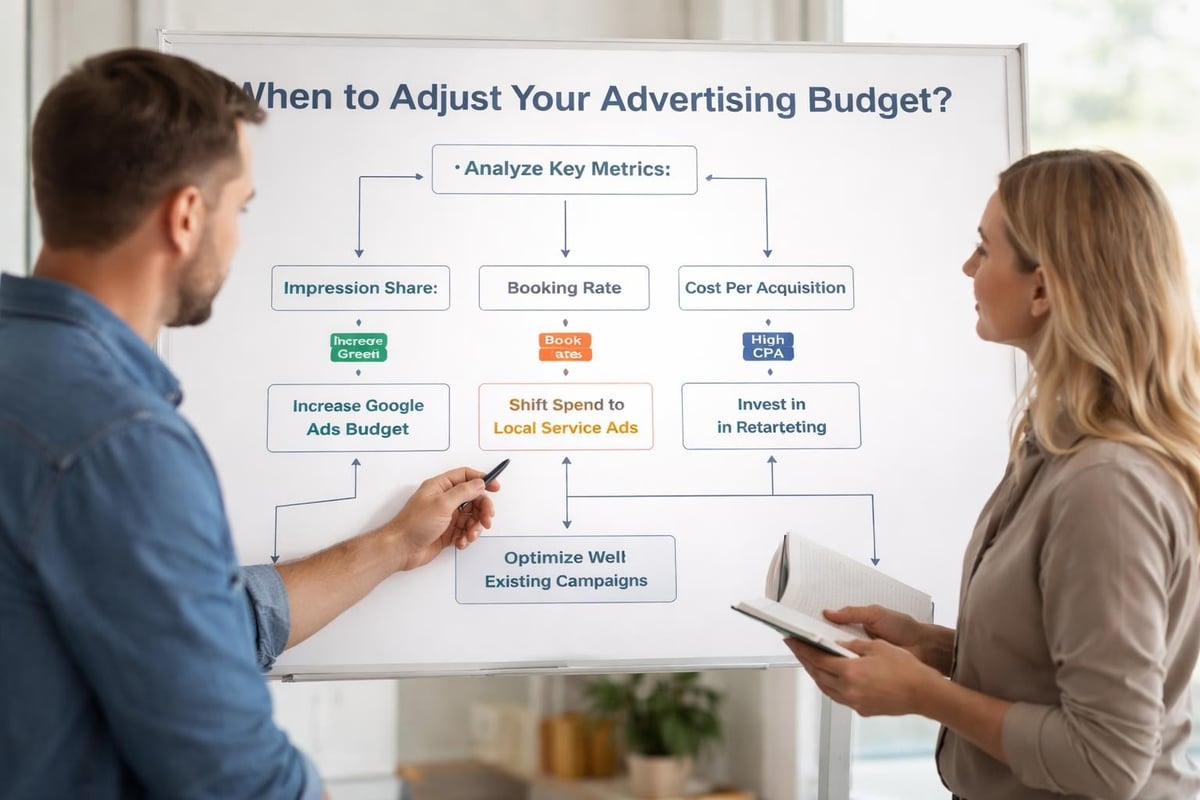
Increasing your ads home services budget makes sense when:
- You’re maxing out impression share on profitable campaigns
- Your booking calendar has consistent availability
- Cost per acquisition is below your target threshold
- Call-to-booking rate exceeds 40% consistently
- You have capacity to handle additional volume
It doesn’t make sense when:
- You’re already booked solid for weeks
- Your cost per call is rising without conversion improvement
- You haven’t optimized existing campaigns yet
- Your team can’t handle current lead volume effectively
Scale intelligently. Increase budgets by 20% increments and monitor for 2-3 weeks before additional changes.
Competitor Analysis and Differentiation
Your competitors are running ads too.
In competitive Texas markets like Houston, Dallas, and San Antonio, you’re bidding against 20+ other contractors for the same keywords.
You can’t just match their bids and hope for the best. You need differentiation that makes homeowners choose you.
Audit competitor ads monthly by searching your own keywords:
- What promises do they make?
- What pricing information do they reveal?
- What trust signals do they emphasize?
- What’s their call-to-action?
- What landing page experience do they provide?
Find gaps in their messaging. If everyone emphasizes “24/7 service,” that’s not a differentiator anymore. Look for what they’re not saying.
Maybe nobody talks about financing options. Maybe warranty terms aren’t mentioned. Maybe they all use generic stock photos instead of real technician photos.
Your ads home services campaigns should own unique positioning:
- Speed: “30-minute response time, guaranteed”
- Expertise: “Certified in all major brands”
- Pricing: “Upfront pricing, no surprises”
- Availability: “Never an overtime charge”
- Specialization: “Water heater experts since 1998”
Pick one primary differentiator and hammer it in every ad, every headline, every extension.
Review Integration in Ad Campaigns
Customer reviews are your most powerful advertising asset.
They provide social proof that overrides skepticism. Home services advertising strategies in 2026 integrate reviews directly into ad creative and targeting.
Google automatically pulls reviews into your LSA profile and can show them in search ads through seller ratings extensions. But you need at least 100 reviews to qualify.
For ads home services campaigns, reviews serve multiple purposes:
In ad copy: “★★★★★ Rated 4.9/5 by 300+ Texas homeowners”
In landing pages: Feature recent reviews prominently with customer names and photos
In retargeting: Show specific reviews to people who visited but didn’t book
In video ads: Create testimonial compilations from happy customers
Ask every satisfied customer for a Google review. Send a follow-up text within 24 hours of job completion with a direct review link.
Respond to every review, positive and negative. Your response shows up in search results and demonstrates customer service quality.
Advanced Targeting Techniques
Basic location and keyword targeting isn’t enough anymore.
Advanced ads home services campaigns layer multiple targeting criteria to reach the most valuable prospects.
Demographic targeting: Focus on homeowners aged 35-65 who are more likely to pay for professional services rather than DIY solutions.
Income targeting: In affluent neighborhoods, emphasize premium services and faster response times rather than budget options.
Life event targeting: New homeowners need comprehensive systems checks, inspections, and often immediate repairs from deferred maintenance.
Weather-triggered ads: Increase bids automatically when temperatures exceed 95°F for AC services or drop below freezing for heating and plumbing.
Time-of-day adjustments: Emergency searches spike in early morning (6-8 AM) and evening (6-10 PM) when people discover problems.
Use Google’s audience segments to reach people actively researching home services. In-market audiences for “HVAC services” or “plumbing repair” convert 2-3x better than cold traffic.
Custom intent audiences let you target people who searched specific phrases recently, even if they didn’t click your ads. Build audiences around competitor names, industry terms, and problem symptoms.
Creative Testing and Iteration
Your first ad is never your best ad.
Continuous testing separates profitable campaigns from money pits. Professional home services marketing requires systematic experimentation.
Test these elements individually:
- Headlines: Promise vs. feature vs. question formats
- Descriptions: Short and punchy vs. detailed and informative
- CTAs: “Call now” vs. “Schedule service” vs. “Get pricing”
- Images: Technicians vs. equipment vs. results
- Offers: Discount vs. free inspection vs. financing
Run at least 3 ad variations simultaneously. Pause the worst performer weekly and create a new variation that tests a different element.
Don’t test multiple variables at once. If you change both the headline and image, you won’t know which drove the performance change.
Your ads home services creative should refresh every 60-90 days minimum. Ad fatigue sets in when people see the same message repeatedly, causing click-through rates to decline.
Common Advertising Mistakes to Avoid
Most home services contractors make the same errors repeatedly.
Mistake 1: Setting and forgetting campaigns. Digital advertising requires weekly optimization at minimum.
Mistake 2: Targeting too broad. “Plumber in Texas” wastes money on people 200 miles outside your service area.
Mistake 3: Ignoring negative keywords. If you don’t do residential work, add “DIY,” “how to,” and “tips” as negatives.
Mistake 4: Sending all traffic to your homepage. Service-specific landing pages convert 3-5x better.
Mistake 5: Not tracking phone calls. If you can’t attribute calls to campaigns, you’re optimizing blind.
Mistake 6: Competing on price in ads. When you advertise discounts, you attract price shoppers who won’t become loyal customers.
Mistake 7: Copying competitors blindly. What works for their business might not work for yours.
Learn from creative advertising ideas for home services that prioritize testing, data analysis, and strategic iteration over random tactics.
Integration with Organic Marketing
Paid ads work better when combined with organic strategies.
Your ads home services campaigns should complement your SEO, content marketing, and reputation management efforts, not replace them.
When prospects search for your company name after seeing an ad, they should find:
- Top-ranked website in organic results
- Optimized Google Business Profile with current information and reviews
- Active social media showing recent projects and customer interactions
- Educational content demonstrating expertise
SEO and web design for service businesses creates a foundation that makes paid advertising more effective and efficient.
Contractors who invest in both paid and organic see 40-60% better overall ROI than those relying on one channel exclusively.
Use ads to test messaging that you later incorporate into organic content. If “same-day water heater installation” generates strong ad response, create blog content and service pages around that promise.
Measuring Long-Term Impact
Campaign success isn’t just about this month’s numbers.
Track trailing indicators that show sustainable growth:
- Month-over-month lead volume trends: Are you growing consistently or seeing volatile swings?
- Customer acquisition cost over time: Is it rising (bad) or declining (good) as you optimize?
- Repeat customer percentage: Are ad-generated customers coming back for future services?
- Review acquisition rate: Are new customers leaving reviews at the same rate as organic customers?
Build historical benchmarks for every metric. Compare December 2026 to December 2025, not to November 2026, since seasonal factors distort month-to-month comparisons.
Your ads home services strategy should show clear ROI within 90 days, but optimal performance takes 6-12 months of consistent optimization and testing.
Marketing tips for home services emphasize patience and persistence in building advertising systems that compound over time rather than seeking quick wins that don’t scale.
Platform-Specific Best Practices
Each advertising platform has unique requirements and opportunities.
Google Search Ads best practices:
- Use all available ad extensions (call, location, callout, sitelink)
- Create tightly themed ad groups with 10-20 related keywords max
- Write ads that mirror the search query language
- Bid more aggressively on mobile during business hours
- Use ad scheduling to pause campaigns when you can’t answer calls
Local Service Ads best practices:
- Respond to leads within 5 minutes for better ranking
- Keep your calendar updated to avoid missed opportunities
- Dispute invalid leads immediately through Google’s process
- Maintain 4.5+ star average across all review platforms
- Complete your profile 100% with photos, services, and business details
Meta Ads best practices:
- Use video creative whenever possible (50% higher engagement)
- Test multiple audience segments simultaneously
- Create lookalike audiences from your best customers
- Run campaigns year-round to stay visible, not just seasonal pushes
- Include clear CTAs in both ad copy and creative
Adapt these principles to your specific situation rather than following them blindly. Winning strategies for home services marketing vary based on market dynamics, competitive intensity, and business maturity.
Scaling Successfully
Once you’ve found winning campaigns, scaling is the next challenge.
Growth isn’t linear. Doubling your budget won’t double your results because you start targeting less qualified prospects as you expand.
Smart scaling follows this sequence:
- Max out top-performing campaigns in your primary service area
- Expand to adjacent ZIP codes with similar demographics
- Add secondary services that complement your core offering
- Test new platforms with small budgets to find additional channels
- Increase budget on proven winners incrementally
Monitor cost per acquisition closely during scaling. If it increases more than 20%, pause expansion and optimize existing campaigns before continuing growth.
Some contractors scale by hiring agencies to manage campaigns. Others build in-house teams. Both work if you maintain control over strategy and closely monitor performance metrics.
Working with specialized home services marketing teams who understand your industry ensures campaigns stay profitable as they scale because they’ve solved these challenges for dozens of similar businesses.
Effective ads home services campaigns require strategic planning, consistent optimization, and patience to build systems that generate reliable lead flow. The tactics that work in 2026 prioritize customer intent matching, mobile-first experiences, and integration across multiple advertising platforms to capture both emergency and planned service opportunities. If you’re ready to build a revenue-focused advertising system that actually delivers qualified leads and booked appointments, Aim Set Win specializes in creating data-driven campaigns exclusively for Texas home service contractors that combine paid advertising, local SEO, and conversion optimization into profitable growth systems.
Jean runs growth strategy at AimSetWin, a performance marketing agency specializing in local service businesses across Texas. he's helped plumbers, HVAC companies, pest control operators, and home service brands build predictable revenue systems using data-driven advertising and conversion optimization.


