
Learn how automation tools like STACK and BIM help Texas plumbing contractors boost revenue by $1.5M, cut errors, and scale operations efficiently.
TL;DR:
- Automation enables Texas plumbers to increase revenue and reduce workforce costs through efficiency.
- Key tools include estimating platforms, field apps, BIM, CRM, and automated invoicing.
- Human expertise remains essential, with automation supporting tasks rather than replacing skilled plumbers.
One Texas plumbing company added $1.5M in revenue while cutting its workforce by nearly ten employees, not by working harder, but by automating the tasks that were quietly draining time and money every single day. That result is not a fluke. Across Texas, plumbing contractors are discovering that automation is the fastest path from reactive, margin-thin operations to predictable, scalable revenue. This guide breaks down exactly which technologies drive those gains, where the real risks hide, and how you can apply these tools to your business starting now.
Table of Contents
- Why automation matters for Texas plumbing contractors
- Core automation technologies transforming plumbing
- Design and field execution: BIM, AI, and beyond
- Challenges, risks, and realities: what automation can’t solve
- Our take: Automation augments, not replaces, Texas plumbers
- Boost your Texas plumbing business with smart automation and digital visibility
- Frequently asked questions
Key Takeaways
| Point | Details |
|---|---|
| Revenue and efficiency boost | Plumbing contractors see win rates jump by 30% and revenue rise when using automation tools. |
| Augmentation, not replacement | Automation handles repetitive tasks but skilled human judgment remains irreplaceable in complex field work. |
| Best technologies for Texas | Scheduling, estimation, and BIM automation make the biggest difference for competitive Texas plumbing businesses. |
| Balance tech and expertise | Success comes from blending the latest software with experienced tradespeople’s know-how, not choosing one over the other. |
Why automation matters for Texas plumbing contractors
Texas is one of the most competitive plumbing markets in the country. You are dealing with a skilled labor shortage that shows no signs of easing, customers who expect same-day responses, and competitors who are already using technology to undercut your bids and win more jobs. Standing still is not a neutral choice. It is a slow retreat.
The pressures stacking up on Texas contractors right now include:
- Labor shortages that force you to do more with fewer experienced hands
- Rising material costs that make accurate estimating more critical than ever
- Customer expectations shaped by app-driven service industries where speed and transparency are the baseline
- Bid competition from larger firms using software to produce faster, tighter proposals
These pressures are not going away. But contractors who lean into automation are pulling ahead fast. Estimating automation alone has helped Texas plumbing businesses increase win rates by 30% while generating significant additional revenue and reducing overhead staff. That is a compounding advantage: you win more jobs, spend less on labor, and protect your margins.
“The contractors who treat automation as a core business tool, not just a nice-to-have, are the ones outperforming their peers in both revenue and bookings.”
Building a strong lead generation workflow alongside your automation stack means those efficiency gains translate directly into booked jobs, not just saved hours. And pairing automation with the right digital tools for plumbing creates a system where every part of your business, from the first customer touchpoint to final invoice, runs smoother and faster.
The bottom line is simple. Automation is no longer a luxury for large commercial contractors. It is the baseline for any Texas plumbing business that wants to grow in 2026 and beyond.
Core automation technologies transforming plumbing
Not all automation tools are created equal, and not every platform will fit your operation. The key is knowing which categories of tools solve your biggest problems first.
Here is a breakdown of the main automation categories and what each one does for your business:
| Tool category | Primary benefit | Best for |
|---|---|---|
| Estimating platforms (e.g., STACK) | Faster, more accurate bids | Residential and commercial bidding |
| Field management apps (e.g., Fieldwire) | Centralized scheduling and communication | Multi-crew field operations |
| BIM and modeling software | Clash detection, design accuracy | Commercial and new construction |
| CRM and client management | Follow-ups, job history, retention | Service and replacement work |
| Automated invoicing and payments | Faster cash collection | All business sizes |
Digital tools for mechanical subcontractors like Fieldwire centralize schedules, automate notifications, improve on-site problem-solving, and enhance overall ROI by reducing the back-and-forth that kills productivity on job sites.

The biggest wins come from combining these tools. When your estimating platform talks to your scheduling app, which connects to your CRM, you stop losing jobs to slow follow-ups and missed callbacks. Centralization means fewer mistakes and higher client satisfaction across the board.
Key outcomes contractors report after implementing core automation:
- Fewer missed appointments and scheduling conflicts
- Faster proposal turnaround that impresses commercial clients
- Real-time field updates that reduce supervisor check-in calls
- Automated payment reminders that improve cash flow without awkward conversations
Pro Tip: Start with estimating automation before anything else. It has the fastest, most measurable ROI, and winning more bids funds every other technology investment you want to make.
If you want to see how these tools connect to revenue recovery, the revenue recovery systems used by top Texas contractors show exactly how automation closes the gap between completed work and collected payment. And if you are wondering how HVAC automation parallels apply to plumbing, the crossover in scheduling and field communication tools is significant. Working with a focused marketing agency support partner ensures your digital presence keeps pace with your operational upgrades.
Design and field execution: BIM, AI, and beyond
Once your core business tools are running smoothly, the next frontier is automating the design and field execution phases. This is where the gains get dramatic, and where the risks require the most attention.
Building Information Modeling, or BIM, is a digital process that creates detailed 3D models of plumbing systems before a single pipe is installed. The real power comes from automation layered on top of those models. Automation in MEP BIM enables clash detection, rule-based checks, and significant reductions in manual quality control time and coordination errors.
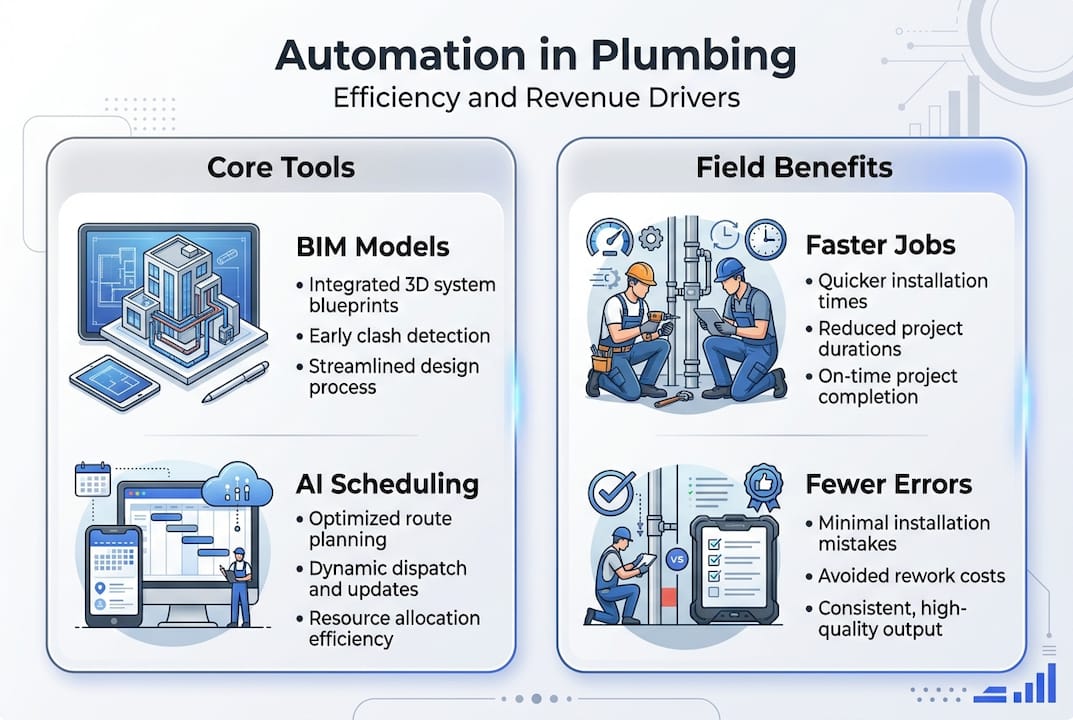
Here is what that looks like in practice:
| Process | Manual approach | Automated approach |
|---|---|---|
| Clash detection | Engineer reviews drawings by hand | Software flags conflicts instantly |
| Code compliance checks | Manual review against code books | Rule-based automated scanning |
| Quantity takeoffs | Counted manually from plans | Auto-generated from BIM model |
| Change order tracking | Spreadsheets and emails | Integrated model updates |
For Texas contractors working on commercial builds or large residential projects, these tools mean fewer costly surprises during installation.
Here is a practical process for adopting BIM and AI tools without getting burned:
- Start with clash detection only. It delivers immediate value and requires minimal workflow change.
- Validate every AI recommendation before acting on it. AI tools can generate errors that look convincing.
- Train your lead estimator on the software before rolling it out to the whole team.
- Run parallel processes for the first three projects, comparing automated outputs against your traditional method.
- Document your wins and errors so you can refine the process based on your specific project types.
Pro Tip: AI-generated takeoffs are a starting point, not a final answer. Always have an experienced estimator review the output before submitting a bid. One unchecked error on a large commercial job can wipe out months of efficiency gains.
If you want to see how these principles apply across mechanical trades, the automation in HVAC framework offers directly transferable lessons for plumbing contractors.
Challenges, risks, and realities: what automation can’t solve
Automation is powerful. But it is not magic, and treating it like magic is one of the most expensive mistakes a Texas contractor can make.
The honest reality is that AI hallucinations and edge cases require human verification, cultural resistance from tradespeople who value craft judgment is real, and liability risks do not disappear just because software made the recommendation.
Common pitfalls Texas plumbers face when adopting automation:
- Over-trusting software outputs without field verification, especially on older buildings with non-standard plumbing configurations
- Ignoring crew input during rollout, which creates resistance and poor adoption rates
- Skipping the validation step on AI-generated estimates or BIM clash reports
- Assuming automation handles exceptions when most tools are built for standard scenarios
- Neglecting liability documentation when automated tools influence design or installation decisions
“The field is messy. Pipes are in the wrong place. Slabs are thicker than the drawings show. No software has seen your exact job site.”
Your experienced plumbers carry knowledge that no platform can replicate. They know how to adapt when the plan meets reality. They know which shortcuts create callbacks and which ones are safe. That judgment is a competitive asset, not a cost to be automated away.
The smart approach is blending technology with hands-on expertise. Use automation for repeatable, high-volume tasks like estimating, scheduling, and invoicing. Keep humans in charge of field decisions, client relationships, and anything that requires reading a situation rather than reading a screen.
Building strong customer re-engagement tools into your workflow ensures that even when automation handles routine follow-ups, your team stays connected to clients in ways that build long-term loyalty.
Our take: Automation augments, not replaces, Texas plumbers
Here is something the automation hype cycle consistently gets wrong: the hardest part of plumbing automation is not the software. It is the integration work that accounts for roughly 80% of the real effort.
Optimists point to AI and automation boosting revenue, while skeptics correctly note that robots cannot adapt to the messy, unpredictable realities of real-world jobs. Both sides are partially right. The truth is that automation handles volume and repetition brilliantly, and fails spectacularly when the situation requires improvisation.
The Texas plumbers who will win over the next decade are not the ones who automate everything. They are the ones who automate the right things and protect the human elements that clients actually pay a premium for. Trust, accountability, and the confidence that comes from a skilled technician who has seen your exact problem before. Those are not features any software can replicate.
Use automation to free your best people from paperwork and scheduling headaches. Then let those people do what they do best. That is the growth framework that actually scales.
Boost your Texas plumbing business with smart automation and digital visibility
Automation gives you operational efficiency. But efficiency only generates revenue when the right customers can find you first. That is where digital visibility becomes the multiplier.

At Aim Set Win, we build revenue-focused digital growth systems specifically for Texas plumbing contractors. From Texas plumber SEO strategies that put you at the top of local search results, to conversion-focused web design that turns visitors into booked jobs, we connect your operational upgrades to consistent inbound leads. If you are ready to combine smart automation with the digital presence that makes it pay off, learn why SEO is essential for every growing plumbing business, and see how Aim Set Win builds scalable growth systems for contractors across Texas.
Frequently asked questions
What are the best automation tools for plumbing contractors in Texas?
Estimating platforms like STACK and Fieldwire improve win rates, communication, and ROI, while BIM tools such as Revit and Navisworks deliver significant efficiency gains on commercial projects. Combining these with a CRM creates a connected system that reduces manual work across your entire operation.
Can automation fully replace skilled plumbers in Texas?
No. Automation handles repeatable tasks well, but physical repairs, field judgment, and client trust require human expertise that robots cannot replicate in real-world plumbing scenarios. Skilled plumbers remain the core differentiator for any Texas contractor.
How much revenue increase can plumbing automation bring?
Contractors have seen up to $1.5M in added revenue and a 30% win rate boost after adopting estimating automation tools like STACK, with additional gains from scheduling and field management platforms.
What pitfalls should Texas plumbers watch when adopting automation?
The biggest risks are over-relying on software outputs, skipping human verification of AI-generated recommendations, and ignoring crew resistance during rollout. Plan for a validation step on every automated output, especially on complex or older job sites.
Recommended
- Automation in HVAC: Boosting Revenue and Efficiency
- Plumbing Lead Generation Workflow for Predictable Bookings
- Best 6 Revenue Recovery Systems for Plumbers 2026
- 7 Plumbing Marketing Tips to Re-Engage Customers Fast
- Enterprise Automation Software | PODTECH
Jean runs growth strategy at AimSetWin, a performance marketing agency specializing in local service businesses across Texas. he's helped plumbers, HVAC companies, pest control operators, and home service brands build predictable revenue systems using data-driven advertising and conversion optimization.


