
Master B2B copywriting in 2026 with expert strategies, proven frameworks, and actionable SEO techniques that drive engagement, conversions, and measurable results.
B2B copywriting is at the center of a rapidly changing digital landscape, where every word can influence high-stakes business decisions. In 2026, standing out requires more than just persuasive language, it demands a deep understanding of evolving buyer behaviors and sophisticated strategies.
This guide is designed to give marketers, copywriters, and business leaders actionable insights and proven frameworks for b2b copywriting success. The stakes are higher than ever, with informed buyers and fierce competition making clarity, authority, and impact essential.
Explore why traditional techniques are no longer enough, discover the strategies top brands use to connect and convert, and learn step-by-step tactics that will set your team apart. From foundational principles to advanced trends, you will gain the tools to master b2b copywriting in 2026.
Understanding the B2B Copywriting Landscape in 2026
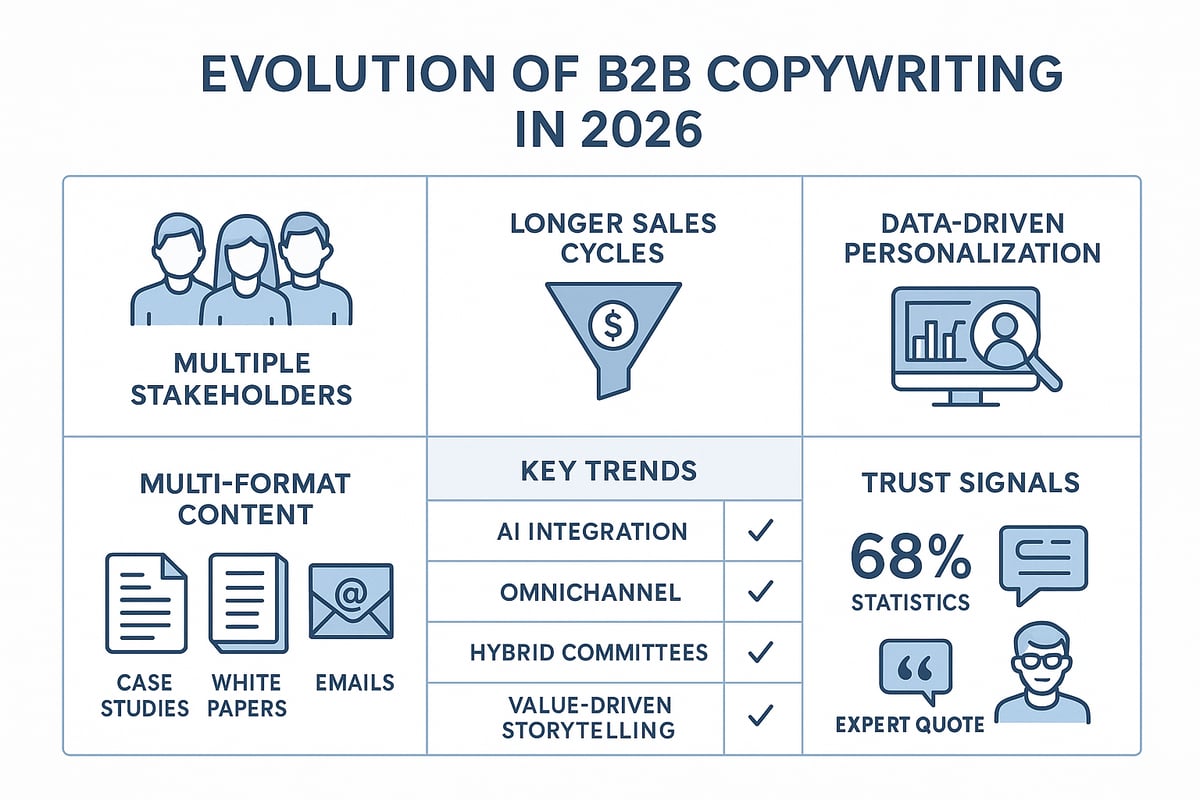
B2B copywriting is evolving rapidly as we approach 2026. Unlike business-to-consumer messaging, B2B copywriting must address longer sales cycles, higher transaction values, and complex decision-making processes. In B2B, a single purchase often involves multiple stakeholders, each with unique priorities and concerns.
This complexity means that effective b2b copywriting must deliver clarity and relevance at every touchpoint. Marketers face the challenge of synthesizing technical details, industry jargon, and nuanced business needs into compelling narratives. Success requires balancing authority and accessibility, ensuring every message resonates with both technical and executive audiences.
What Sets B2B Copywriting Apart
B2B copywriting stands out due to the unique nature of business audiences. Buyers are well-informed and risk-averse, making trust and credibility critical. Key challenges include:
- Navigating multiple decision-makers with different roles
- Addressing long, consultative sales cycles
- Communicating high-value, often technical solutions
- Meeting the demand for measurable ROI
To address these challenges, b2b copywriting must be rooted in data, empathy, and a deep understanding of organizational pain points. The stakes are higher, so every word must deliver value and drive action.
2026 Trends Reshaping B2B Copywriting
Several trends are transforming b2b copywriting in 2026. Data-driven personalization now tailors content to individual roles within buying committees. AI-powered tools assist with content creation, optimization, and distribution, while omnichannel strategies ensure consistency across platforms.
Buyer expectations are shifting rapidly, with trust signals and transparency playing a central role in purchase decisions. According to Dentsu’s Superpowers Index 2025, trust and AI adoption are now top priorities for B2B buyers, influencing which brands make the shortlist.
| Trend | Impact on B2B Copywriting |
|---|---|
| Data Personalization | Tailored messaging for each role |
| AI Integration | Faster, optimized content creation |
| Omnichannel Delivery | Unified brand voice everywhere |
| Trust & Authority | More data, stats, and expert input |
Navigating Buyer Committees and Messaging
The modern B2B purchase rarely comes down to a single decision-maker. Hybrid buying committees, often spanning departments and locations, require b2b copywriting to adapt messaging for diverse stakeholders. Each group—finance, IT, operations—needs tailored content that addresses their specific concerns.
A successful approach involves mapping out stakeholder motivations and pain points. Messaging must shift seamlessly between strategic value and technical detail, ensuring relevance at every stage. This tailored communication builds consensus and accelerates the path to purchase.
Value-Driven Storytelling and Trust
B2B copywriting is shifting from product-centric pitches to value-driven, solution-focused storytelling. Buyers want to understand real-world impact, not just features. Effective copy uses industry data, case studies, and expert voices to demonstrate authority and build confidence.
Optimized content now delivers 2.6 times more clicks, proving the measurable impact of strategic b2b copywriting. Incorporating statistics and testimonials adds credibility, while clear, concise language ensures messages are understood quickly. Trust is built through transparency and consistent delivery of promised value.
Digital Transformation and Content Formats
Digital transformation continues to reshape how B2B content is consumed. Remote decision-making and virtual collaboration mean buyers expect information on demand, in formats that suit their workflow. Top brands leverage multi-format content—white papers, case studies, interactive demos—to engage buyers at every stage.
B2B copywriting must adapt to these digital realities by providing accessible, authoritative resources across channels. The focus is on clarity, actionable insights, and supporting complex sales journeys with the right content at the right time.
Step 1: Deep Audience Research & Persona Development
Understanding your audience is the foundation of effective b2b copywriting. Today’s B2B buyers expect messaging that speaks directly to their daily challenges and objectives. Decision-makers are time-pressed and cautious, so copy must address their pain points, motivations, and job responsibilities with precision.
Developing accurate user personas is essential. For example, consider “Lucy, marketing manager for an e-commerce startup.” Her concerns might include budget constraints, scaling campaigns, and proving ROI. In b2b copywriting, mapping these real-world issues through interviews, surveys, and analytics ensures content resonates. Research shows that personalized B2B content drives higher engagement and conversions, highlighting the value of deep audience insights.
A common pitfall is writing for abstract roles rather than real people. Avoid generic messaging by grounding your b2b copywriting in specific, relatable experiences. This approach builds trust and relevance, which are critical in today’s competitive landscape.
Building Effective B2B Personas
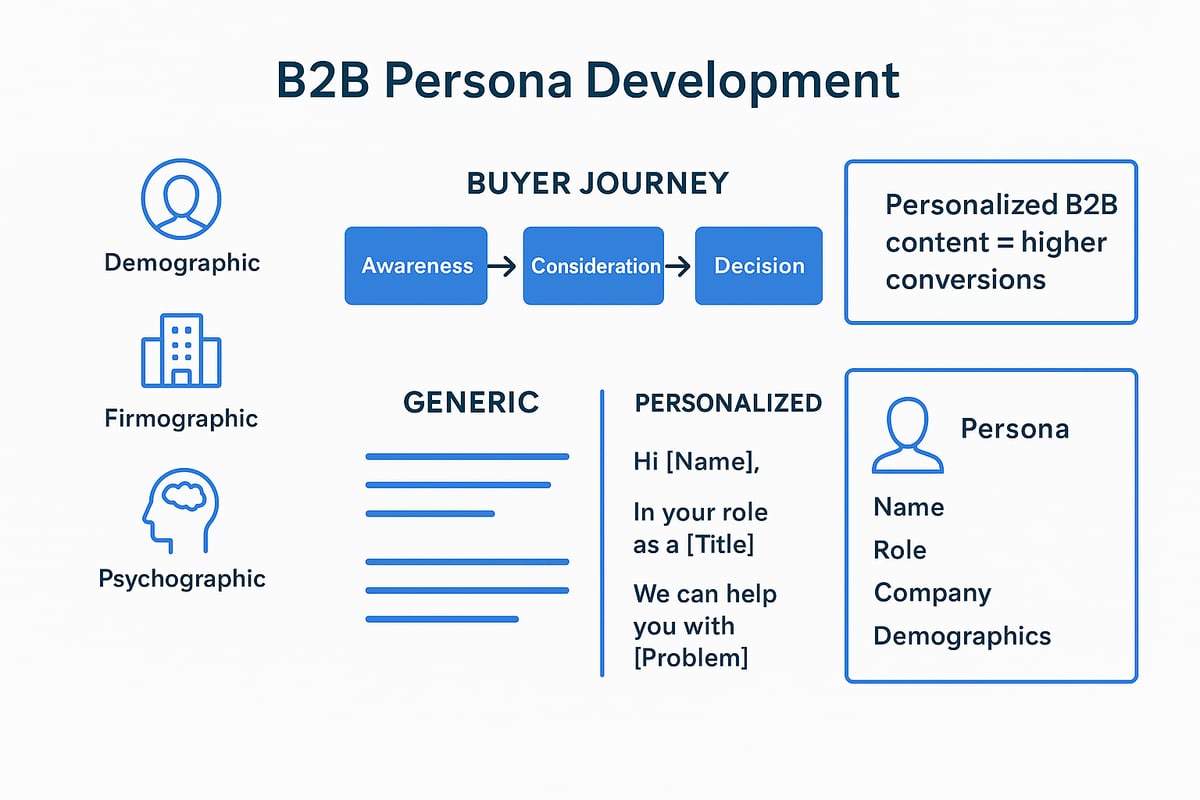
Building actionable personas is a multi-step process in b2b copywriting. Start by collecting demographic data (age, job title), firmographic information (company size, industry), and psychographic insights (values, goals, pain points). This data forms the backbone of your persona profiles.
Next, align each persona with the stages of the B2B funnel:
| Funnel Stage | Persona Needs | Example Content |
|---|---|---|
| Awareness | Problem Identification | Educational blog posts |
| Consideration | Solution Exploration | Comparison guides |
| Decision | Vendor Selection | Case studies, demos |
In complex sales, incorporate stakeholder mapping. Identify all decision-makers and influencers, then tailor messaging to address their unique perspectives. For instance, technical buyers may focus on product features, while executives value ROI.
Use tools like CRM data, LinkedIn insights, and feedback from your sales team to enrich personas. These sources reveal hidden pain points and content preferences, ensuring your b2b copywriting is always relevant.
For more on aligning copy with lead generation, explore B2B lead generation strategies that demonstrate how in-depth audience research fuels effective campaigns.
Mapping Copy to Buyer Stages
Tailoring your b2b copywriting to each stage of the buyer journey is vital. At the top of the funnel, buyers need educational content that clarifies their problems. In the middle, solution-oriented messaging helps them compare options. At the bottom, conversion-focused assets like case studies and white papers reinforce trust and support decisions.
For example, late-stage buyers benefit from detailed case studies that showcase results. Email sequences and retargeting campaigns nurture leads, moving them closer to purchase. Effective b2b copywriting ensures every message matches the buyer’s current mindset, boosting engagement and conversion rates.
Step 2: Crafting High-Impact B2B Copy
B2B copywriting in 2026 demands a blend of clarity, authority, and strategic storytelling to break through the digital noise. As buyers face more choices and information than ever, every sentence must serve a purpose. Let’s explore how to elevate your b2b copywriting and drive results.
Writing With Clarity, Authority, and Purpose
Effective b2b copywriting always starts with clarity. Even when addressing technical audiences, straightforward language ensures your message lands. Avoid jargon unless it adds precision, and always prioritize the reader’s understanding.
Trust signals build authority. Incorporate statistics, expert testimonials, and data to show credibility. For example, referencing industry benchmarks or client success stories can validate your claims.
Brand voice matters as well. Develop an authentic, consistent tone that reflects your brand’s values. Whether formal or conversational, ensure your voice remains clear and authoritative.
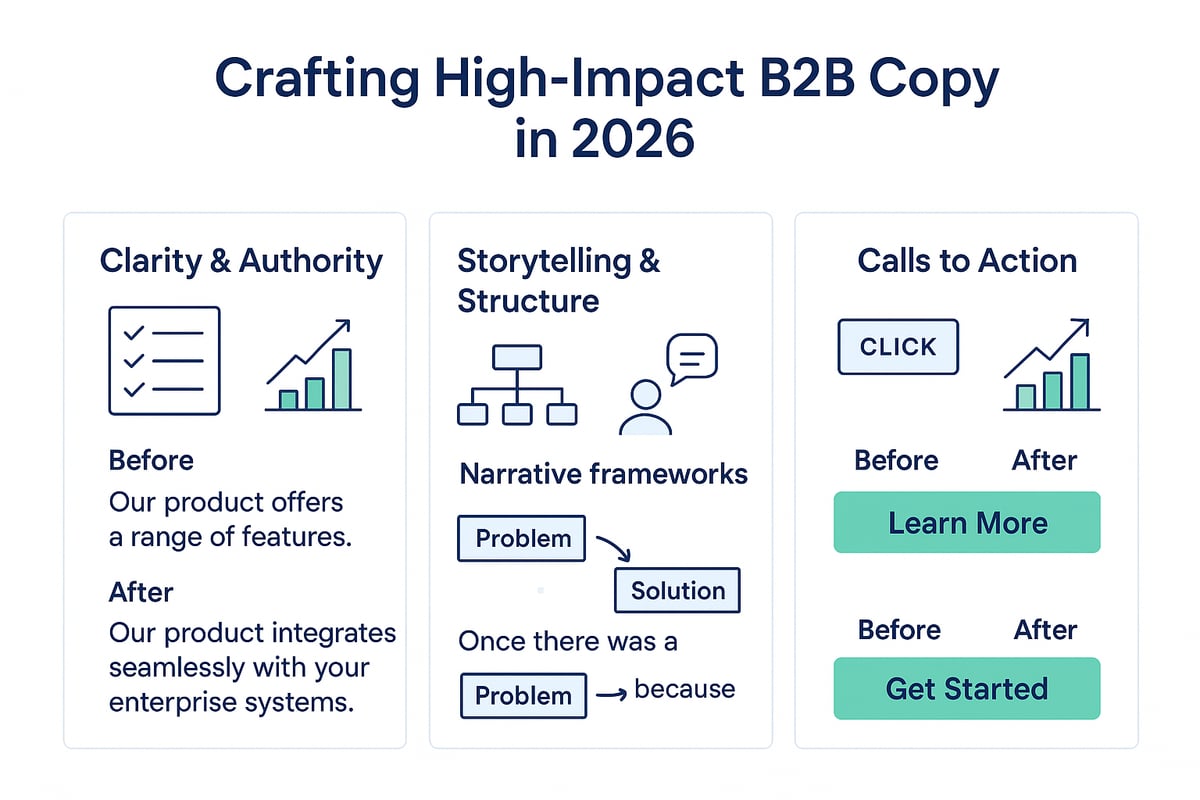
Consider this before-and-after example:
| Original Copy | Improved Copy |
|---|---|
| Our platform offers scalable tools. | Grow your revenue with tools trusted by 1,000+ brands. |
Notice how the improved version adds clarity and authority.
Common pitfalls in b2b copywriting include over-explaining features while neglecting benefits. Always focus on how your solution impacts the reader’s goals. With every revision, ask: does this sentence help the buyer move forward?
Storytelling and Structure in B2B
Storytelling sets high-impact b2b copywriting apart. Buyers remember stories that connect emotionally and illustrate real-world outcomes. Use frameworks like problem-solution, the hero’s journey, or data-backed narratives to guide your content.
Structure is just as important as story. Organize your arguments logically, leading the reader from challenge to resolution. For instance, tech brands often use case studies to simplify complex solutions and showcase results.
Here’s a simple narrative structure for b2b copywriting:
- Identify the customer’s problem.
- Show the consequences of inaction.
- Present your solution.
- Share evidence of success.
Avoid being formulaic or overly verbose. Each story should serve a strategic purpose and resonate with your audience.
Real-world examples bring authority to your message. Explore case studies in digital marketing for inspiration on how brands use storytelling to engage and persuade.
Calls to Action That Convert
A strong call to action is the linchpin of effective b2b copywriting. Your CTA must offer clear value and a reason to act now. Phrases like “Download your free report” or “Schedule a strategy call” communicate specific benefits.
Placement matters. In long-form content, sprinkle CTAs where engagement peaks, such as after a compelling story or data point. Test different CTA styles and positions using A/B testing to find what works best.
Compare these examples:
| Weak CTA | Strong CTA |
|---|---|
| Learn more | See how your team can double productivity |
| Contact us | Get your personalized B2B growth roadmap |
Ensure every CTA aligns with the buyer’s stage in the journey. Early-stage readers may respond to educational offers, while decision-stage buyers need clear next steps.
Regularly review your b2b copywriting performance. Use analytics to refine CTAs for higher conversions and measurable impact.
Step 3: Mastering B2B Content Formats & Channels
Navigating the evolving world of b2b copywriting requires mastery of diverse content formats and channels. In 2026, brands are expected to engage buyers across multiple touchpoints, with each format serving a unique role in complex sales cycles.
Core B2B Copywriting Formats
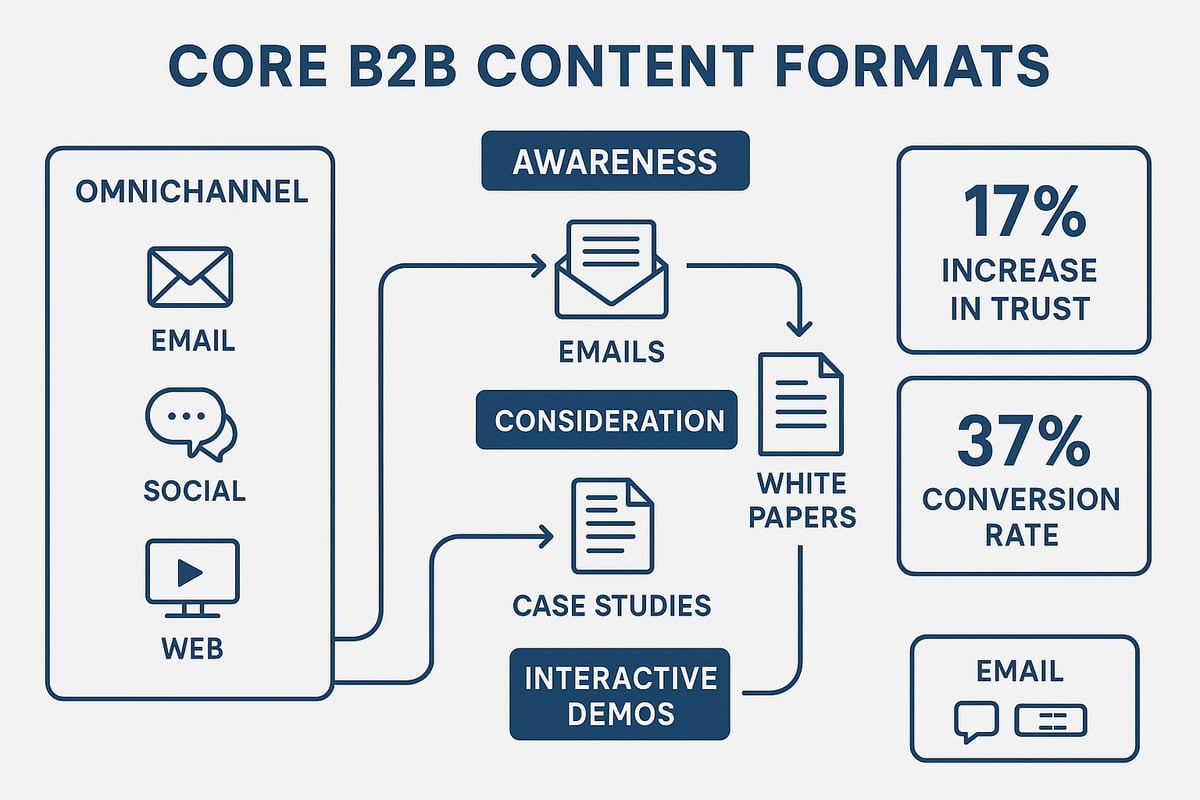
B2b copywriting is most effective when tailored to the chosen format and the buyer’s journey stage. Websites and landing pages act as digital storefronts, guiding prospects with benefit-focused messaging and clear navigation. Sales and nurture emails build relationships, delivering personalized value and driving conversions through targeted sequences.
Long-form assets like white papers and case studies are essential tools for establishing authority. They address intricate pain points and support high-stakes decisions. A well-structured case study typically follows a three-part flow: challenge, solution, and quantifiable result. This structure demonstrates the business impact of your offering, reinforcing trust with data and real-world outcomes.
| Format | Purpose | Best Use Case |
|---|---|---|
| Website/Landing | Guide, inform, convert | Early to mid-funnel |
| Nurture, personalize, convert | Ongoing engagement | |
| White Paper | Educate, build authority | Consideration stage |
| Case Study | Prove value, support decisions | Late-stage buyers |
According to industry statistics, in-depth b2b copywriting increases trust and accelerates decision-making. Brands that master these formats see measurable gains in lead quality and conversion rates.
Omnichannel and Platform-Specific Strategies
Modern b2b copywriting extends beyond a single channel. Success hinges on adapting content for each platform—web, email, social media, and emerging digital spaces. Messaging should remain consistent, yet tailored to the unique context and audience expectations of each channel.
For example, a comprehensive white paper can be repurposed into a multi-part email series, social posts, and LinkedIn articles. This not only maximizes your content investment but also ensures your message reaches buyers wherever they are in their journey. Utilizing tools for content distribution streamlines this process and helps maintain brand coherence.
Adopting these Optimizing marketing campaigns strategies ensures your b2b copywriting consistently delivers value, regardless of channel. Repurposing and optimizing content across platforms leads to broader reach and deeper engagement with diverse buying committees.
Leveraging Interactive and Multimedia Content
Interactive formats are reshaping b2b copywriting in 2026. Quizzes, calculators, and video explainers capture attention, foster engagement, and provide valuable data for lead qualification. These elements not only make complex solutions more digestible but also encourage buyers to take the next step.
Consider a B2B SaaS provider using interactive demos or ROI calculators. These tools empower prospects to visualize outcomes, increasing trust and shortening sales cycles. The best practice is to integrate concise, persuasive copy with strong visual elements, ensuring that every piece of content works together to drive results.
As interactive content becomes more prevalent, b2b copywriting must balance clarity with creativity. Engaging buyers in meaningful ways will set top brands apart in a crowded digital marketplace.
Step 4: Advanced SEO & Optimization for B2B Copywriting
Mastering advanced SEO is essential for b2b copywriting success in 2026. The digital landscape is crowded, and buyers expect content that is both discoverable and genuinely valuable. To stand out, marketers need to go beyond surface-level optimization, focusing on both technical and human-centered strategies.
SEO Best Practices in 2026
SEO for b2b copywriting now demands a strategic approach. It begins with granular keyword research tailored to every stage of the B2B funnel, from awareness to decision. Use tools to identify high-intent phrases relevant to your audience’s needs.
Natural integration of keywords is vital. Avoid keyword stuffing, which can harm both readability and rankings. Instead, weave keywords into engaging headlines, meta descriptions, and schema markup, making sure your content remains accessible and valuable.
Leverage authoritative sources and outbound links to build trust. For instance, referencing practical resources like No-nonsense marketing tips can reinforce your authority and provide actionable insights for readers. Outbound links also signal credibility to search engines.
On-page optimization extends beyond keywords. Prioritize clear structure—use bullet points, tables, and concise paragraphs. Here is a quick comparison:
| Element | Before Optimization | After Optimization |
|---|---|---|
| Headline | Vague, generic | Keyword-rich, compelling |
| Meta Description | Missing, too long | Concise, actionable |
| Outbound Links | None | Credible, relevant sources |
Content that ranks and converts is always aligned with the buyer’s journey. Use analytics to monitor which pages attract and convert leads, then iterate for continual improvement. In b2b copywriting, optimized content is proven to drive more qualified traffic and conversions.
Readability, E-E-A-T, and Trust
Google’s E-E-A-T framework—Expertise, Experience, Authoritativeness, and Trustworthiness—plays a pivotal role in b2b copywriting SEO. B2B buyers are discerning, often seeking content that demonstrates deep knowledge and reliability.
Readability is not just a user preference, it is a ranking factor. Use tools like Hemingway and Grammarly to simplify complex language without losing technical accuracy. Short sentences, active voice, and logical flow improve engagement and comprehension.
Trust signals are equally important. Support claims with statistics, case studies, and expert commentary. According to Gartner’s 2025 B2B Buyer Preferences Report, most B2B buyers now prioritize content from sources they trust and that feel human-centric.
Consider this example: A technical article with jargon and dense blocks may lose readers. After a readability revamp—shorter sentences, clear headings, and verified data—the same article becomes approachable and authoritative. This improvement directly impacts both SEO and buyer trust.
Analytics and Continuous Improvement
Optimization is never a one-time effort in b2b copywriting. Use analytics to track key metrics: clicks, conversions, and time on page reveal what resonates with your audience. Heatmaps and behavior analytics tools such as Hotjar visualize where users engage or drop off.
A/B testing is indispensable. Experiment with headlines, CTAs, and content layouts to find what drives results. For example, swapping a generic CTA for a specific, benefit-driven message can increase conversion rates significantly.
Data-driven updates are crucial. Review performance regularly and refresh content based on real user behavior. This iterative process ensures your b2b copywriting remains relevant and effective as search algorithms and buyer expectations evolve.
By combining robust analytics with ongoing content refinement, you will maximize ROI and maintain a competitive edge in B2B markets.
Step 5: Avoiding Common B2B Copywriting Pitfalls
In the fast-paced world of b2b copywriting, even experienced marketers can fall into traps that undermine results. As digital transformation accelerates and buyers become more discerning, the risks of ineffective messaging have only grown. Avoiding these pitfalls is essential for building trust, driving conversions, and standing out in a crowded market.
The Most Common Pitfalls in B2B Copywriting
Many teams rely on jargon and complex language, believing it demonstrates expertise. In reality, this often alienates readers and reduces clarity. Another frequent error in b2b copywriting is overusing templates and formulas, which can stifle creativity and make content feel generic. Writing for job titles instead of real people is another trap, resulting in messages that lack empathy and fail to connect.
Here’s a quick table summarizing major pitfalls and their impact:
| Pitfall | Impact on B2B Copywriting |
|---|---|
| Excessive Jargon | Decreases clarity and trust |
| Formulaic Templates | Reduces engagement, feels dull |
| Role-based Messaging | Misses emotional resonance |
| Feature-Focused Copy | Overlooks customer benefits |
| Poor Structure | Confuses the reader |
Real-World Examples and Solutions
Consider a case where a landing page is loaded with technical terms and lengthy feature lists. Prospects are likely to bounce, missing the value your solution provides. Instead, successful b2b copywriting uses clear, concise language and focuses on outcomes. For example, replacing “robust automation protocols” with “save your team hours every week” instantly clarifies the benefit.
Engaging copy also aligns with the buyer’s journey. Early-stage prospects need educational content, while late-stage buyers value case studies and proof points. Always tailor your message to the reader’s stage and intent.
Digital Shift and the Importance of Engagement
With the growth of digital channels, the stakes for b2b copywriting are rising. As highlighted in Astute Analytica’s B2B E-commerce Market Forecast, the B2B e-commerce market is expanding rapidly, intensifying competition and making engaging, relevant copy more important than ever.
Neglecting engagement value by making copy dry or overly formal can result in lost opportunities. Instead, use data, storytelling, and testimonials to build credibility and trust. Logical flow and structured arguments help guide buyers through complex decisions.
Continuous Improvement for Lasting Results
Avoiding b2b copywriting pitfalls is not a one-time task. Regular reviews, A/B testing, and updates based on analytics ensure your messaging stays effective. Real-world rewrites, such as simplifying technical explanations or shifting from features to benefits, consistently increase conversion rates and shorten sales cycles. Engaging, audience-centric copy is the key to measurable success in today’s evolving B2B landscape.
Jean runs growth strategy at AimSetWin, a performance marketing agency specializing in local service businesses across Texas. he's helped plumbers, HVAC companies, pest control operators, and home service brands build predictable revenue systems using data-driven advertising and conversion optimization.


