
Master digital marketing for plumbing with proven strategies that generate consistent leads. Local SEO, PPC, and web design tactics that work.
The plumbing industry has fundamentally changed over the past decade. Homeowners don’t flip through the Yellow Pages anymore when their water heater breaks at 10 PM. They grab their phone, search “emergency plumber near me,” and call whoever shows up first on Google. If that’s not your business, you’re losing thousands of dollars in revenue every single month. Digital marketing for plumbing isn’t optional in 2026, it’s the difference between a fully booked calendar and scrambling for jobs. The good news? Most plumbing companies are still doing it wrong, which means there’s massive opportunity for contractors who get it right. This guide breaks down exactly what works, what doesn’t, and how to build a system that generates consistent inbound calls without relying on referrals or expensive lead generation services.
Why Digital Marketing for Plumbing Actually Matters
Let me be blunt about something most marketing agencies won’t tell you.
Your competition is already online. They’re ranking on Google, running ads, and capturing the customers who would have called you five years ago.
The statistics are pretty clear. Over 97% of consumers search online for local services before making a decision. That number jumps even higher for emergency plumbing services where people need immediate help.
Here’s what makes digital marketing different from traditional advertising:
- You target people actively searching for plumbing services instead of interrupting them during dinner with a radio ad
- Every dollar spent is trackable so you know exactly which campaigns generate revenue
- Results compound over time as your SEO rankings improve and your reputation builds
- You control the message from the first Google search to the phone call
Traditional marketing methods like direct mail, billboards, and newspaper ads still work in some markets. But they’re expensive, hard to track, and reach people who may not need a plumber right now.
Digital marketing for plumbing puts you in front of homeowners at the exact moment they’re looking for your services. That’s the difference between cold outreach and warm leads who are ready to book.
Building a High Converting Plumbing Website
Your website is the foundation of everything else you’ll do online.
It doesn’t matter how good your SEO is or how much you spend on ads if your website looks like it was built in 2008. Homeowners make snap judgments about your business based on your website in less than three seconds.
Essential Website Elements
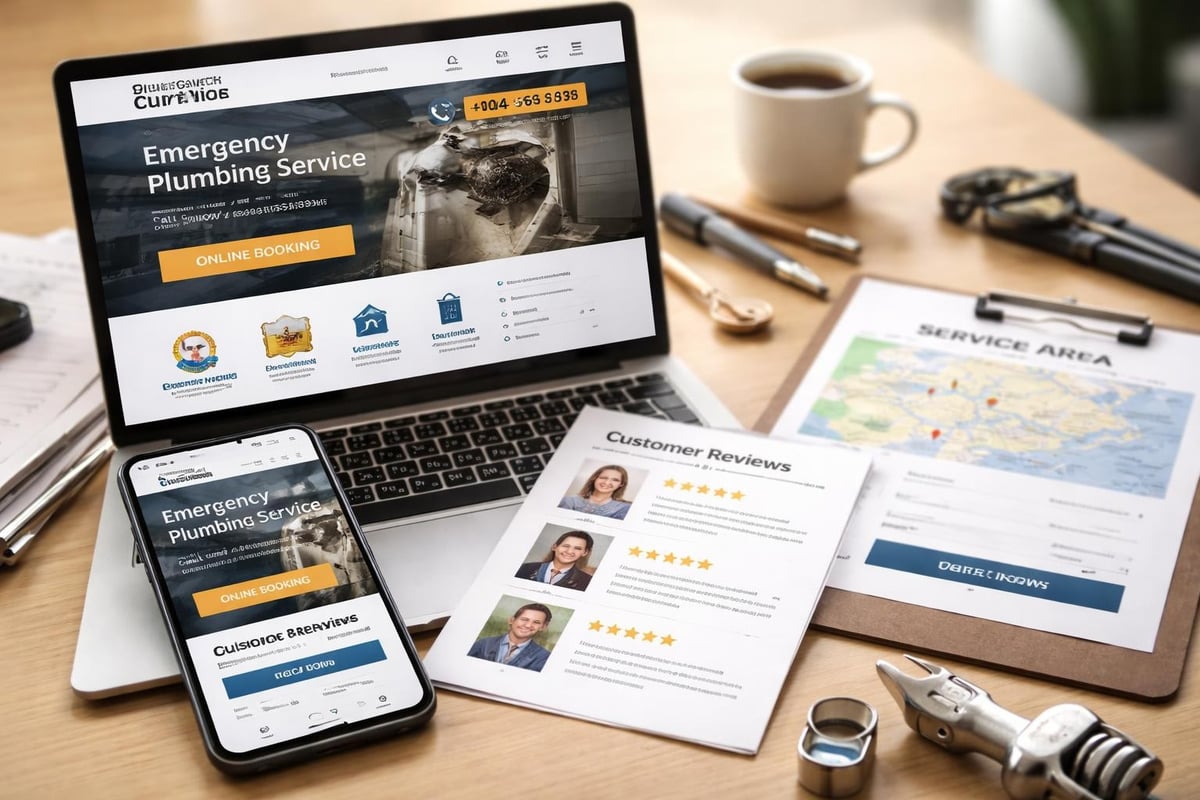
A conversion-focused plumbing website needs these core components:
Click-to-call phone number prominently displayed in the header, sticky on mobile, and visible on every single page. Most plumbing calls happen from mobile devices, so make it effortless.
Service area pages for every city you serve. Don’t just list cities in a footer. Create dedicated pages for “Plumbing Services in Austin” or “Emergency Plumber in Dallas” with unique content.
Clear service descriptions that explain what you do, how much it costs (ranges are fine), and why you’re better than the competition. Skip the generic fluff about “quality service” and get specific.
Trust signals including license numbers, insurance information, years in business, certifications, and real customer photos. Stock photos of models holding wrenches don’t build trust.
Online booking capability for non-emergency services. Younger homeowners prefer scheduling online rather than calling during business hours.
| Website Element | Impact on Conversions | Priority Level |
|---|---|---|
| Mobile-responsive design | 40-60% increase | Critical |
| Click-to-call buttons | 30-45% increase | Critical |
| Service area pages | 25-35% increase | High |
| Customer reviews display | 20-30% increase | High |
| Live chat feature | 15-25% increase | Medium |
| Online scheduling | 10-20% increase | Medium |
Website Speed and Mobile Optimization
Google prioritizes fast websites in search rankings. But speed isn’t just about SEO.
A one-second delay in page load time reduces conversions by 7%. When someone’s dealing with a burst pipe, they’re not waiting around for your website to load.
Your website needs to load in under three seconds on mobile devices. Test it right now using Google’s PageSpeed Insights tool. If you’re scoring below 70 on mobile, you’re losing customers.
Mobile optimization goes beyond just speed. Your entire website should be designed mobile-first since that’s where most traffic comes from.
Buttons need to be large enough to tap easily. Forms should be simple and autofill-friendly. Images need to scale properly without horizontal scrolling.
Local SEO: The Biggest Opportunity for Plumbers
Local SEO is where plumbing companies see the fastest return on investment.
When someone searches “plumber near me” or “plumbing services in Houston,” Google shows a map pack with three local businesses before any organic results. Landing in that top three can completely transform your business.
Google Business Profile Optimization
Your Google Business Profile (formerly Google My Business) is the single most important asset for local visibility.
Here’s exactly what you need to optimize:
Complete every section including business hours, service areas, attributes, products, and services. Google rewards profiles that are 100% complete.
Choose the right categories with “Plumber” as your primary category and relevant secondary categories like “Emergency Plumbing Service” or “Water Heater Installation Service.”
Upload high-quality photos of your team, trucks, completed jobs, and service areas. Profiles with photos get 42% more requests for directions and 35% more click-throughs.
Post regular updates about seasonal services, promotions, or helpful plumbing tips. Weekly posts signal to Google that your business is active.
Respond to every review within 24 hours, both positive and negative. Your response shows potential customers how you handle service issues.
According to research from Broadly’s digital marketing guide for plumbers, businesses that actively manage their online presence see significantly higher conversion rates than those that don’t.
Getting More Google Reviews
Reviews directly impact your local rankings and conversion rates.
A plumbing company with 50+ reviews and a 4.5-star average will outrank a competitor with ten reviews, even if that competitor has better technical SEO.
The challenge is most customers don’t leave reviews unless you make it extremely easy.
Here’s the system that works:
- Ask immediately after completing a job while the positive experience is fresh in their mind
- Send a text message with a direct link to your Google review page (not your homepage)
- Make the request personal with the technician’s name in the message
- Follow up once if they don’t review within 48 hours
- Never offer incentives for reviews as it violates Google’s terms
The Weave platform offers specific strategies for automating this process while keeping it compliant and effective.
Local Link Building Strategies
Backlinks from other local businesses and organizations tell Google your plumbing company is embedded in the community.
These links are easier to get than you think:
- Sponsor local sports teams and get a link from the league website
- Join the Chamber of Commerce and claim your profile link
- Partner with real estate agents and property managers who need reliable plumbing contractors
- Get listed in local business directories specific to your city and county
- Contribute expert quotes to local news sites covering home improvement topics
Quality matters more than quantity. One link from a reputable local news site carries more weight than 50 links from random directories.
Content Marketing That Generates Plumbing Leads
Content marketing feels like a waste of time to most plumbers.
You’d rather be fixing pipes than writing blog posts. I get it. But here’s what changes the equation: the right content brings in high-value customers who trust you before they even call.
High-Intent Blog Topics
Not all content is created equal for lead generation.
Writing generic articles about “The History of Plumbing” won’t generate calls. You need content that targets people actively searching for solutions to plumbing problems.
High-intent topics that convert:
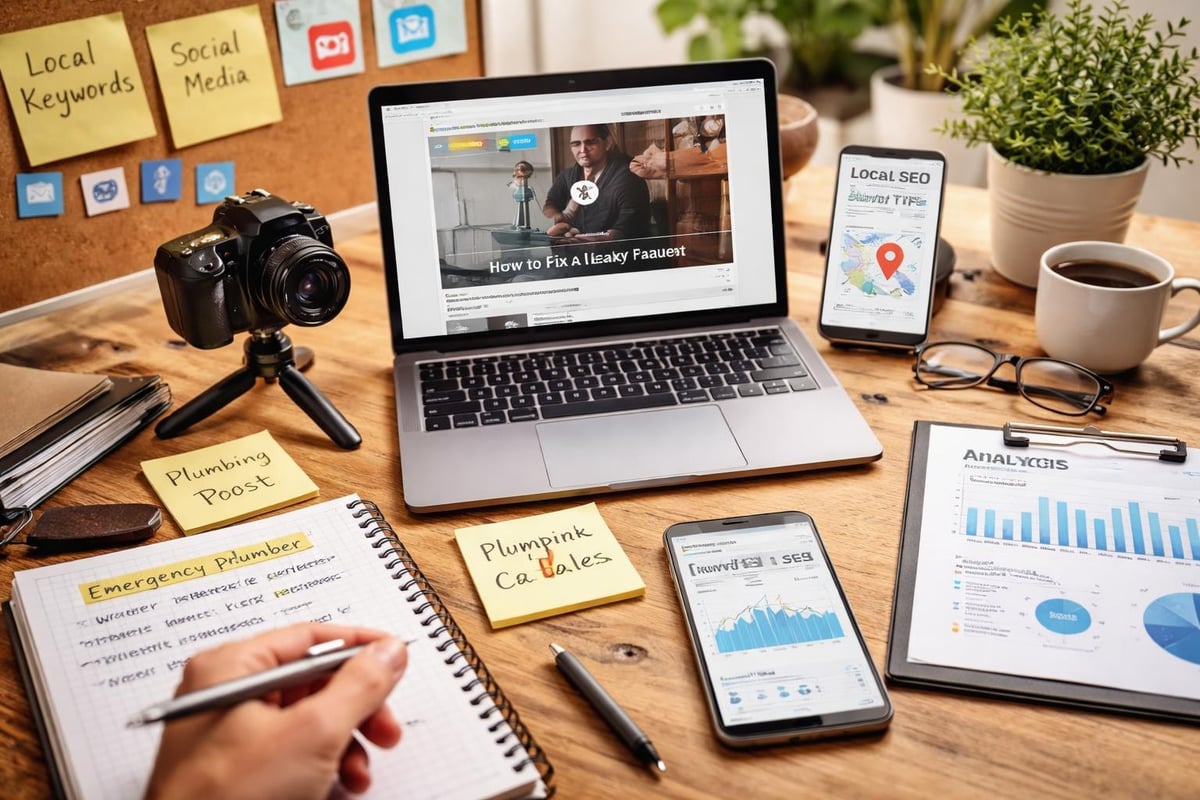
- Emergency-focused content: “What to Do When Your Water Heater Is Leaking” or “How to Shut Off Water to Your House”
- Buyer’s guides: “Water Heater Replacement Cost in Austin” or “Should I Repair or Replace My Sewer Line?”
- Seasonal content: “Preparing Your Plumbing for Texas Winter” or “Summer Plumbing Problems in Houston”
- Local content: “Common Plumbing Issues in Older San Antonio Homes” or “Dallas Plumbing Code Requirements”
Each piece should include clear calls-to-action, your service area, and internal links to relevant service pages.
The strategy outlined in UADV’s plumber marketing guide emphasizes creating content that addresses specific customer pain points at different stages of the buying journey.
Video Content Strategy
Video is becoming increasingly important for local search rankings.
Google owns YouTube, and they heavily favor video content in search results. A well-optimized video can rank for competitive keywords faster than a blog post.
Video ideas that work for plumbers:
- Before and after transformations of bathroom or kitchen plumbing upgrades
- Quick tips and how-tos for simple maintenance tasks (with a disclaimer to call for complex issues)
- Meet the team videos that build trust and personality
- Customer testimonial videos filmed on-site after job completion
- Common problem explainers showing what’s happening inside walls or under slabs
You don’t need expensive equipment. Modern smartphones shoot excellent video. Focus on good lighting, clear audio, and valuable information.
Upload videos to YouTube with keyword-optimized titles, descriptions, and tags. Then embed them on relevant pages of your website.
Pay-Per-Click Advertising for Immediate Results
SEO takes time to build momentum. PPC ads put you at the top of Google immediately.
Digital marketing for plumbing works best when you combine organic and paid strategies. SEO builds long-term equity while PPC generates immediate cash flow to fund your growth.
Google Ads for Plumbers
Google Ads (formerly AdWords) shows your business above organic results when people search for plumbing services.
You only pay when someone clicks your ad. The cost per click varies dramatically based on your location and competition, ranging from $15 to $150+ for high-intent keywords like “emergency plumber.”
Campaign structure that works:
Create separate campaigns for different service types (emergency plumbing, water heater replacement, drain cleaning, etc.) rather than lumping everything together. This allows you to write more specific ads and track which services are most profitable.
Use location targeting to focus on your actual service area. Don’t waste budget on clicks from people 50 miles away that you can’t serve.
Schedule ads to run during your business hours or when you have emergency availability. Pausing ads at night when you don’t offer emergency service saves money and improves conversion rates.
Landing page strategy:
Never send PPC traffic to your homepage. Create dedicated landing pages for each service that match the ad copy exactly.
Someone searching “water heater installation Dallas” should land on a page specifically about water heater installation in Dallas, not a general plumbing services page.
Remove navigation from PPC landing pages to focus attention on one action: calling or filling out a form.
Local Service Ads (Google Guaranteed)
Local Service Ads appear above regular Google Ads with a green “Google Guaranteed” badge.
These ads work differently than traditional PPC. You pay per lead (phone call or message) rather than per click, and Google screens businesses before approval.
The verification process requires background checks, license verification, and insurance confirmation. It’s worth the hassle because the Google Guaranteed badge significantly increases trust and click-through rates.
LSAs work particularly well for emergency plumbing services where customers need immediate help and want reassurance they’re calling a legitimate, vetted company.
Real-world examples from successful plumbing PPC campaigns demonstrate how properly structured ads can generate 300-500% ROI in competitive markets.
Facebook and Instagram Ads
Social media ads work differently than Google Ads because people aren’t actively searching for a plumber.
But they’re incredibly effective for:
- Brand awareness in your service area so you’re top-of-mind when plumbing issues arise
- Retargeting people who visited your website but didn’t call
- Promoting special offers on seasonal services like water heater maintenance or drain cleaning
- Recruiting technicians when you’re hiring (often cheaper than Indeed or ZipRecruiter)
Target homeowners in your service area with interests in home improvement, DIY projects, or home ownership. Exclude renters if you primarily serve homeowners.
Use video content when possible. Facebook’s algorithm heavily favors video, giving you more reach for your budget.
Managing Your Online Reputation
Your online reputation is your most valuable asset in digital marketing for plumbing.
Think about your own behavior. When you need any service, you check reviews first. Your customers do the same thing.
Review Generation Systems
Waiting for customers to voluntarily leave reviews doesn’t work.
You need a systematic approach that makes it easy and expected:
Timing matters. Ask for reviews within 24 hours of job completion while the positive experience is fresh. Waiting a week cuts your response rate in half.
Make it mobile-friendly. Text a direct link to your Google review page. Don’t make customers search for your business or navigate through multiple pages.
Personalize the request. Include the technician’s name and reference specific work completed. Generic review requests feel like spam.
Follow up once. If they don’t leave a review within two days, send one gentle reminder. After that, let it go.
According to Valve+Meter’s research on plumber marketing, businesses with automated review systems generate 10x more reviews than those relying on manual requests.
Responding to Negative Reviews
Negative reviews happen to every business. How you respond matters more than the review itself.
Potential customers read your responses to gauge how you handle problems. A professional, helpful response to a negative review can actually improve your reputation.
Response template that works:
- Acknowledge their frustration without admitting fault initially
- Apologize for their experience regardless of who’s at fault
- Offer to make it right with specific next steps
- Take the conversation offline with your direct phone number
Never argue with reviewers publicly. Never accuse them of lying. Never ignore negative reviews hoping they’ll disappear.
Multi-Platform Review Strategy
Google reviews matter most for local rankings, but customers check multiple platforms:
- Yelp for consumer service reviews
- Facebook for community recommendations
- Better Business Bureau for legitimacy verification
- Angie’s List/HomeAdvisor if you advertise on those platforms
Maintain active profiles on each platform relevant to your market. Respond to reviews on all platforms, not just Google.
The goal is dominance. When someone searches “your company name + reviews,” you want the first page of results filled with 4-5 star ratings across multiple platforms.
Email and SMS Marketing for Customer Retention
Acquiring new customers costs 5-7x more than retaining existing ones.
Yet most plumbing companies focus all their marketing on new customer acquisition and ignore the goldmine of repeat business.
Building Your Customer Database
Every service call should add a customer to your database with:
- Name and contact information
- Property address
- Services performed and dates
- Equipment installed (water heater brand/age, etc.)
- Preferred contact method
This data becomes incredibly valuable for retention marketing.
Seasonal Maintenance Campaigns
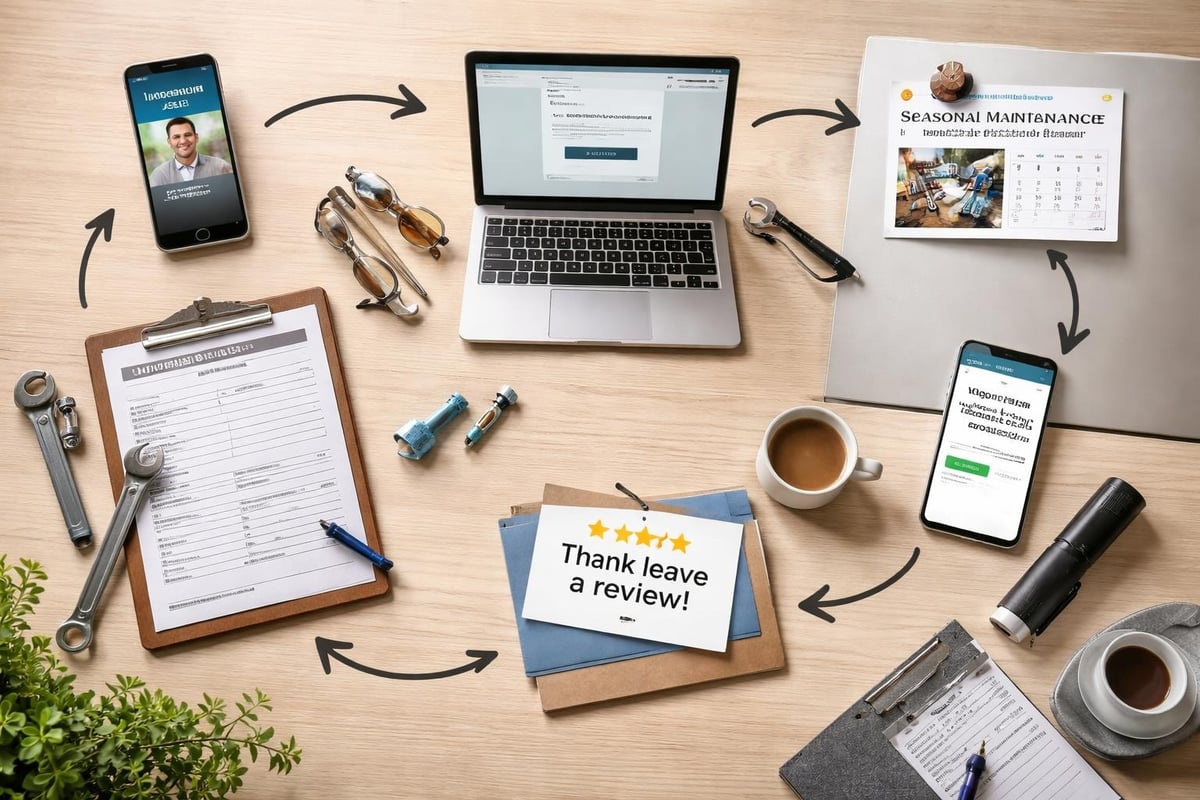
Send targeted emails or texts based on services previously performed:
Water heater maintenance reminders one year after installation encouraging annual flushing and inspection.
Winterization reminders in November for Texas customers to protect outdoor faucets and pipes.
Drain cleaning offers in spring when tree roots become most problematic.
Sewer line inspection reminders for older homes on a three-year cycle.
These aren’t pushy sales messages. They’re helpful reminders that protect the customer’s home and equipment while generating revenue for your business.
SMS Marketing for Emergency Services
Text messaging has a 98% open rate compared to 20% for email.
For emergency plumbing services, SMS is the most effective channel:
- 24-hour emergency availability reminders during winter storms or heat waves
- Appointment confirmations and technician arrival updates
- Post-service follow-ups asking if everything is working properly
- Review requests with direct links to your Google profile
Keep messages short, valuable, and compliant with TCPA regulations by obtaining explicit consent before texting.
Tracking and Analytics That Actually Matter
Most plumbing companies track the wrong metrics.
Website traffic, social media followers, and page views don’t matter if they’re not generating revenue. You need to track metrics that directly correlate with business growth.
Call Tracking Implementation
Call tracking assigns unique phone numbers to different marketing channels so you know exactly which campaigns generate calls.
Use different tracking numbers for:
- Organic search traffic (SEO)
- Paid search ads (Google Ads)
- Facebook/Instagram ads
- Print materials if you still use them
- Vehicle wraps
This reveals your actual cost per lead and return on investment for each channel. You might discover your $2,000/month Google Ads spend generates 50 calls while your $5,000/month SEO investment generates 200 calls.
That data changes everything about how you allocate budget.
Conversion Rate Optimization
Getting more traffic doesn’t help if your conversion rate is terrible.
Track these website metrics:
| Metric | Industry Benchmark | What It Means |
|---|---|---|
| Conversion rate (call or form) | 3-8% | Percentage of visitors who contact you |
| Average time on site | 2-4 minutes | Engagement level with your content |
| Bounce rate | 40-60% | Percentage who leave immediately |
| Mobile conversion rate | 2-6% | Mobile user experience quality |
| Form completion rate | 15-25% | Form usability and trust level |
If your conversion rate is below 3%, you have a website problem, not a traffic problem. Fix your site before spending more on advertising.
Revenue Attribution
Connect your marketing data to actual revenue, not just leads.
Not all leads are equal. Ten leads from Google Ads might generate $15,000 in revenue while 20 leads from a lead generation service might generate $3,000.
Track which campaigns generate:
- Highest average ticket value
- Best close rate (leads that become paying customers)
- Most repeat business
- Fastest time to conversion
This requires integrating your CRM or job management software with your marketing analytics. The effort is worth it because you’ll make dramatically better budget decisions.
Social Media Marketing for Plumbing Companies
Social media won’t generate emergency calls at 2 AM, but it plays an important role in digital marketing for plumbing.
The key is understanding what social media actually does well for service businesses.
Platform Selection
You don’t need to be on every social platform. Focus your energy where your customers actually spend time:
Facebook remains the primary platform for local service businesses. Your audience is there, and Facebook’s local business features are robust.
Instagram works well for visual before/after content and company culture posts that humanize your brand.
YouTube is technically social media and functions as the second-largest search engine. Optimize your plumbing videos here.
LinkedIn only matters if you’re targeting commercial property management or B2B services.
Skip TikTok, Twitter, and Pinterest unless you have specific evidence your target customers are active there.
Content That Actually Engages
Post content that educates, entertains, or builds trust:
- Quick maintenance tips homeowners can do themselves (builds goodwill)
- Common plumbing myths debunked
- Behind-the-scenes content showing your team and culture
- Customer success stories with permission
- Seasonal warnings about freeze protection or summer water conservation
Post consistently (3-5 times per week minimum) but prioritize quality over quantity. One valuable post per week beats seven mediocre ones.
Community Engagement
Social media’s real value is relationship building, not broadcasting.
Respond to every comment and message within a few hours. Join local Facebook groups and provide helpful advice without being salesy. Support other local businesses by sharing and engaging with their content.
This positions you as a helpful community member rather than just another business trying to sell something.
The strategies outlined in Omni Funnel Marketing’s plumber guide emphasize building authentic community connections through consistent engagement.
Technical SEO Fundamentals
Technical SEO sounds complicated, but it’s just making sure Google can properly crawl, index, and understand your website.
Get the technical foundation wrong, and all your content and link building won’t matter.
Site Structure and Navigation
Your website should be organized logically with clear hierarchy:
- Homepage (main services and service area overview)
- Service pages (one page per major service type)
- Location pages (one page per city you serve)
- Blog/resources (helpful content and guides)
- About/contact pages
Every page should be accessible within three clicks from the homepage. Create a logical internal linking structure that guides both users and search engines through your site.
Schema Markup for Local Business
Schema markup is code that helps Google understand your business information and display rich results in search.
At minimum, implement:
- LocalBusiness schema with your business name, address, phone, hours, and service area
- Review schema to display star ratings in search results
- Service schema for each plumbing service you offer
- FAQPage schema for common questions and answers
This isn’t as technical as it sounds. Most modern website platforms have plugins that generate schema automatically.
Mobile-First Indexing
Google now uses the mobile version of your website for indexing and ranking.
If your mobile site is slower, has less content, or provides a worse experience than your desktop site, your rankings will suffer.
Test your site on multiple devices and screen sizes. Ensure all features work properly on mobile, including:
- Phone number click-to-call functionality
- Form submissions and input fields
- Image loading and sizing
- Navigation menu usability
- Pop-up and chat widget behavior
Don’t hide content on mobile to save space. Google counts that against you.
Competitive Analysis and Market Positioning
You’re not operating in a vacuum. Understanding what your competitors are doing online helps you identify opportunities they’re missing.
Analyzing Competitor Strategies
Start by searching for your main service keywords and location combinations.
“Plumber in Austin”
“Emergency plumbing Houston”
“Water heater replacement Dallas”
Who consistently appears in the top three map results? Who’s running ads? What does their website look like?
Analyze their:
- Google Business Profile (categories, photos, review count, response rate)
- Website structure (service pages, location pages, content depth)
- Content strategy (blog topics, video content, social media activity)
- Paid advertising (ad copy, offers, landing pages)
- Review generation (volume, recency, response quality)
The goal isn’t to copy them. It’s to identify gaps you can exploit.
If every competitor has a basic website with ten service pages and no blog, a comprehensive content strategy becomes your competitive advantage.
Differentiation Strategy
“Quality service” and “licensed and insured” aren’t differentiators. Every plumber claims that.
Identify what actually makes you different:
- Specialization in specific services like repiping or commercial plumbing
- Speed with guaranteed response times for emergencies
- Transparency with upfront pricing and detailed estimates
- Technology like camera inspections or hydro jetting equipment
- Guarantees that go beyond industry standard
- Experience with specific property types (historic homes, high-rises, etc.)
Build your digital marketing message around authentic differentiators that customers actually care about.
Budget Allocation and ROI Expectations
Digital marketing for plumbing requires investment, but it should be viewed as revenue generation, not an expense.
Marketing Budget Guidelines
Industry benchmarks suggest service businesses should invest 5-10% of gross revenue in marketing.
A plumbing company doing $1 million annually should budget $50,000-$100,000 for marketing. A company targeting $5 million should budget $250,000-$500,000.
Within that budget, allocation typically breaks down:
| Marketing Channel | Budget % | Timeline for Results | Expected ROI |
|---|---|---|---|
| Local SEO | 30-40% | 3-6 months | 300-800% |
| Google Ads/LSAs | 25-35% | Immediate | 200-500% |
| Website/Tech | 15-20% | Ongoing | Foundation |
| Content creation | 10-15% | 2-4 months | 250-600% |
| Social media | 5-10% | 6-12 months | 150-300% |
These percentages shift based on market maturity and competitive intensity.
A new plumbing company might invest heavily in PPC for immediate leads while building SEO for long-term growth. An established company might shift more budget to SEO and content once they dominate paid search.
Measuring Return on Investment
Calculate ROI by tracking revenue generated from each marketing channel minus the cost of that marketing.
If you spend $5,000 on Google Ads and generate $25,000 in revenue, that’s a 5x return or 400% ROI.
The challenge is accurate attribution. That customer who called from your website might have seen your truck around town, heard about you from a neighbor, and then searched for your company name.
Give marketing credit for any customer who interacted with your digital presence before calling. Use conservative attribution to avoid inflating numbers.
Set realistic ROI expectations:
- Month 1-3: Paid advertising should generate 2-4x ROI immediately; SEO shows minimal results
- Month 4-6: SEO begins generating leads; total marketing ROI reaches 3-5x
- Month 7-12: Combined channels generate 5-8x ROI as SEO momentum builds
- Year 2+: Mature digital marketing systems generate 8-15x ROI
These numbers assume proper execution. Bad marketing loses money regardless of channel.
Common Mistakes to Avoid
Let’s talk about what doesn’t work in digital marketing for plumbing.
These mistakes waste thousands of dollars and months of time:
Treating your website as a business card. Your website is a 24/7 sales tool, not a digital brochure. It needs compelling copy, clear calls-to-action, and conversion optimization.
Focusing on vanity metrics. Website traffic and social media followers don’t pay your bills. Track leads, conversions, and revenue.
Inconsistent effort. Posting on Facebook for three weeks, stopping for two months, then starting again creates zero momentum. Consistency beats intensity.
Ignoring mobile users. Over 70% of plumbing searches happen on mobile devices. If your mobile experience is poor, you’re losing most of your potential customers.
Buying cheap website templates. That $500 WordPress theme isn’t optimized for conversions or local SEO. Professional web design for home service businesses pays for itself quickly.
Neglecting Google Business Profile. This free tool generates more leads than almost anything else you’ll do. Optimize it completely and keep it updated.
Using inconsistent NAP information. Your business name, address, and phone number must be identical across every online listing. Inconsistencies confuse Google and hurt rankings.
Paying for worthless directories. Focus on high-authority directories like Yelp, BBB, and industry-specific sites. Skip the random directories that email you promising “page one rankings.”
Ignoring negative reviews. Responding professionally to negative reviews shows potential customers you care about service quality and makes you more trustworthy than businesses that ignore problems.
Expecting instant results from SEO. Search engine optimization takes 3-6 months minimum to generate meaningful results. Plan accordingly and don’t quit too early.
Integration with Traditional Marketing
Digital marketing works better when integrated with offline marketing efforts.
Your truck wrap should include your website URL. Your business cards should have a QR code linking to reviews. Your radio ads should drive people to a specific landing page with tracking.
Direct mail still works for plumbing companies, especially for neighborhood saturation campaigns. But send people to a custom landing page rather than your homepage so you can track response rates.
Yard signs at current job sites generate calls. Include your website and Google review prompt so people can research you while they’re standing in the neighbor’s yard.
Community sponsorships build brand recognition offline while generating backlinks online when the organization features sponsors on their website.
Vehicle graphics create thousands of impressions daily. Track their effectiveness by using a unique phone number on your trucks separate from other marketing.
The most successful plumbing companies don’t choose between digital and traditional marketing. They use both strategically with proper tracking to measure what works.
Scaling Your Digital Marketing Efforts
What works at $500,000 in annual revenue doesn’t work at $5 million.
As your business grows, your digital marketing strategy needs to scale:
Expand service area coverage. Add location pages for nearby cities. Increase PPC targeting radius. Build content around larger geographic areas.
Increase content production. One blog post per month works initially. Scaling to $5 million+ requires weekly content plus video production.
Hire specialists instead of generalists. Early-stage marketing might be handled by one person or agency. Growth requires dedicated SEO specialists, PPC managers, content writers, and web developers.
Invest in marketing technology. CRM systems, marketing automation, call tracking, and analytics platforms become essential rather than optional.
Build a dedicated marketing budget. Stop treating marketing as an afterthought funded by whatever’s left over. Budget it as a percentage of revenue and protect that investment.
Real examples from successful plumbing campaigns in competitive Texas markets show how companies scale from local operations to regional dominance through systematic digital marketing investment.
Digital marketing for plumbing isn’t about complicated tactics or expensive tools. It’s about consistently executing the fundamentals: making your website convert, dominating local search results, generating reviews, and tracking what actually drives revenue. Most plumbing companies leave massive opportunity on the table because they treat marketing as an expense rather than the growth engine it should be. If you’re ready to build a system that generates consistent inbound calls and qualified leads without relying on referrals or lead generation services, Aim Set Win specializes in revenue-focused digital marketing exclusively for home service businesses across Texas. We combine local SEO, conversion-optimized web design, and data-driven strategy to help plumbing contractors dominate their markets.
Jean runs growth strategy at AimSetWin, a performance marketing agency specializing in local service businesses across Texas. he's helped plumbers, HVAC companies, pest control operators, and home service brands build predictable revenue systems using data-driven advertising and conversion optimization.


