
Master end to end marketing in 2026 with advanced strategies, data-driven insights, and actionable steps to drive growth, boost ROI, and optimize every customer journey.
In 2026, marketing leaders face a complex landscape where scattered tactics no longer deliver results. Modern buyers expect seamless, personalized experiences at every touchpoint, making end to end marketing essential for real growth.
This guide unpacks how to master end to end marketing, providing actionable strategies to connect every stage of the customer journey. You will discover how to overcome attribution challenges, leverage data-driven insights, and achieve measurable revenue impact.
Ready to transform your approach? Explore the key concepts, step-by-step frameworks, and future trends that will give your business the competitive edge in 2026.
What is End-to-End Marketing?
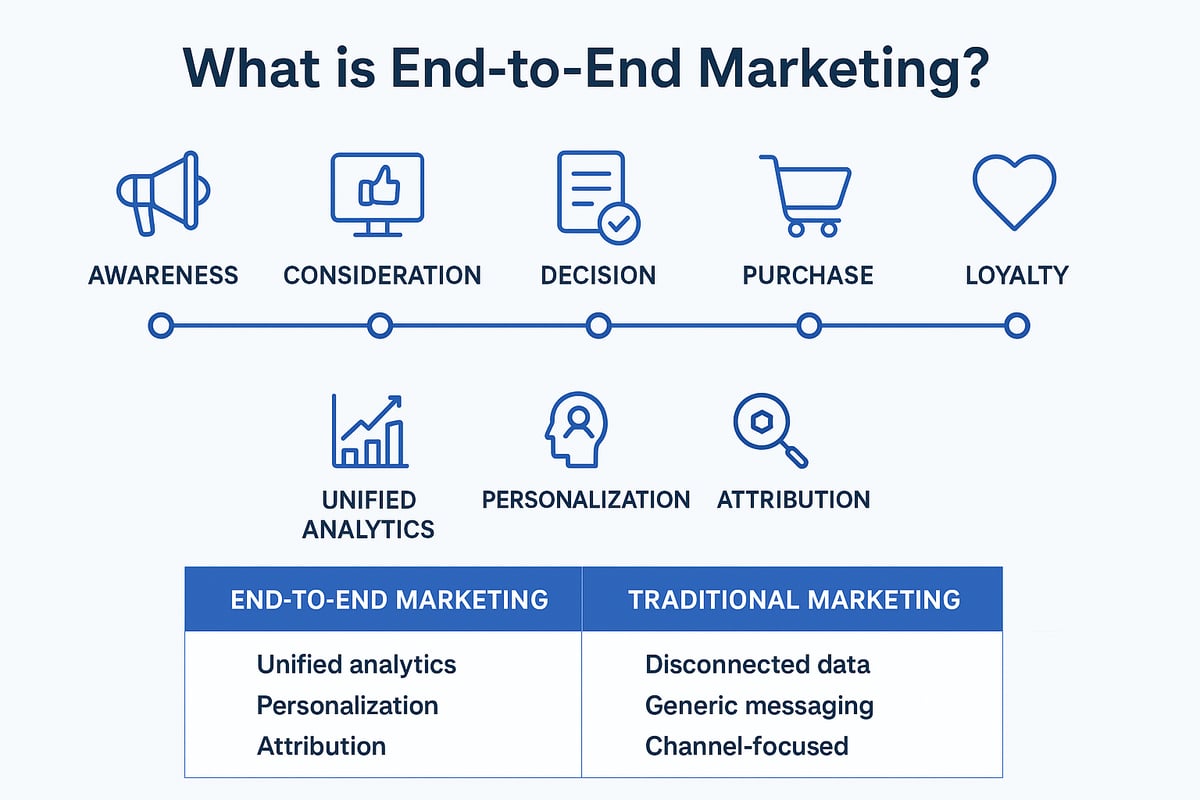
End to end marketing represents a holistic strategy that manages every phase of the customer journey. Rather than focusing on isolated campaigns, this approach ensures every touchpoint, from first impression to post-purchase, is tracked and optimized. Businesses adopting end to end marketing can guide prospects with precision, tailoring interactions at each stage to boost engagement and drive results.
Defining End-to-End Marketing
End to end marketing is a comprehensive approach that oversees every stage of the customer journey, from the initial awareness phase to the post-purchase experience. Sometimes called full-funnel marketing, it integrates all marketing, sales, and retention activities into a single, connected strategy. The focus is on tracking and optimizing each touchpoint individually, not just relying on high-level data.
Unlike siloed campaigns, end to end marketing provides a connected view of how prospects interact across channels. For example, a B2B company might analyze a buyer’s path through email, social media, website visits, and sales calls. This granular visibility enables precise interventions at every step.
Core Principles and Components
The foundation of end to end marketing lies in several key principles:
- Customer journey mapping: Identify all possible interactions a prospect may have with your brand.
- Unified data collection: Centralize analytics from every channel for a holistic view.
- Personalization: Tailor messages and offers based on real-time behavior and preferences.
- Attribution modeling: Link specific marketing actions to revenue outcomes with accuracy.
- Continuous optimization: Use live data to refine and improve strategies.
By unifying these elements, end to end marketing empowers organizations to deliver relevant experiences and maximize return on investment.
How E2E Marketing Differs from Traditional Approaches
Traditional marketing methods often analyze results at the campaign or channel level, using summary data or last-click attribution. In contrast, end to end marketing relies on multi-touch attribution and closed-loop reporting, following each customer’s journey in detail.
This approach allows marketers to spot bottlenecks or points where prospects drop out at any funnel stage. For instance, moving from basic Google Analytics reports to in-depth, user-level journey analysis is a hallmark of end to end marketing. When companies can directly connect marketing actions to revenue, marketing shifts from being a cost center to a strategic revenue driver.
| Traditional Marketing | End to End Marketing |
|---|---|
| Siloed data | Unified, cross-channel data |
| Last-click attribution | Multi-touch attribution |
| Aggregate reporting | Touchpoint-level analysis |
| Limited optimization | Continuous, real-time refinement |
Why E2E Marketing is Essential for 2026
Customer journeys are becoming more complex, spanning digital and offline channels. With rising demands for marketing accountability and ROI clarity, end to end marketing is no longer optional. Advances in analytics and AI-driven personalization make granular tracking possible, supporting a shift to customer-centric business models.
Recent statistics highlight this trend. According to Customer Journey Mapping Market Growth, the market for journey mapping tools is expanding rapidly, underscoring the necessity of end to end marketing for modern organizations. As B2B buying cycles grow longer and more intricate, only those who master this approach will achieve sustained growth in 2026.
Key Challenges Solved by End-to-End Marketing
Bridging the Gap Between Marketing and Revenue
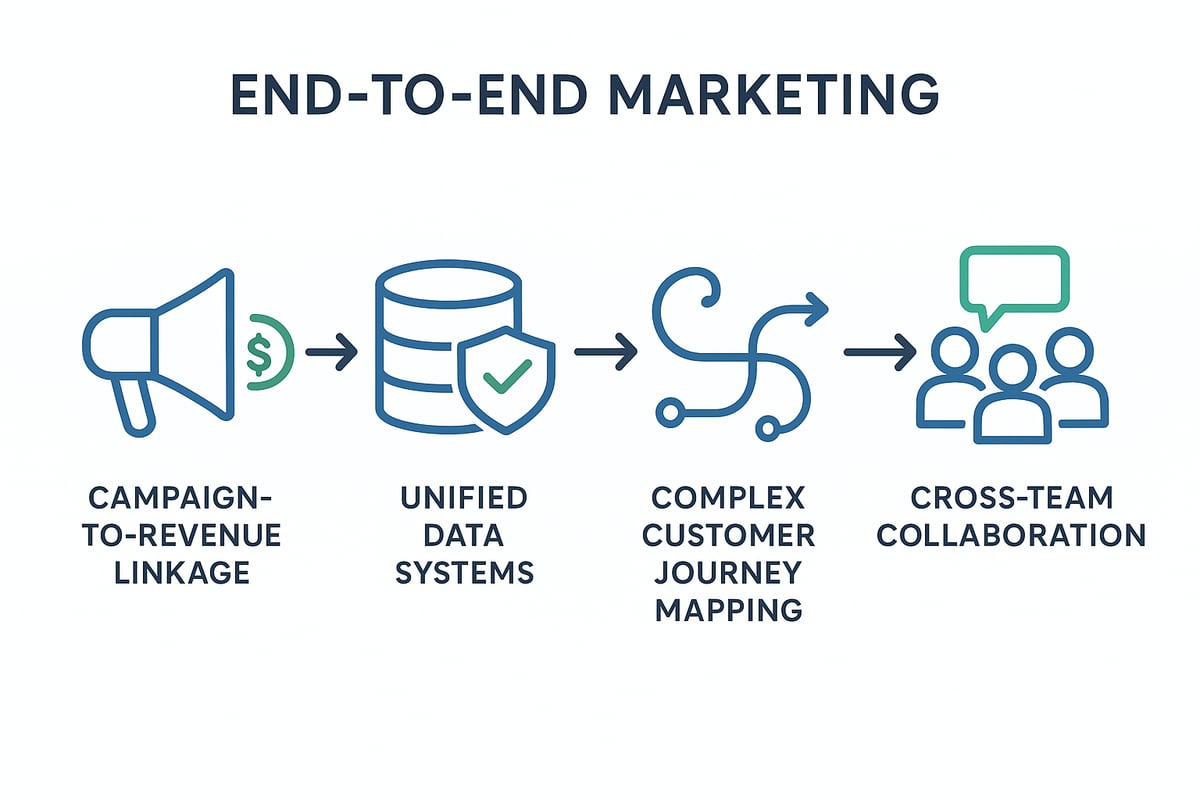
Many organizations struggle to connect marketing campaigns directly to sales results. Traditional attribution often overlooks the multiple touchpoints influencing a purchase. With end to end marketing, every interaction is tracked, offering clear visibility from the first ad click to final conversion.
This approach enables companies to attribute revenue to specific actions, improving accountability. For example, a business can now follow a lead from a paid advertisement, through email nurturing, and all the way to a closed sale. Companies that optimize your marketing strategy with end to end marketing report generating 38 percent more leads thanks to full journey visibility.
Overcoming Weak Tracking and Data Silos
Fragmented data across platforms can hide crucial insights and hinder decision-making. End to end marketing solves this by unifying tracking for all touchpoints, including web activity, ads, emails, and calls. This holistic view makes it easier to identify which strategies are effective and which channels need improvement.
For example, B2B firms using advanced CRM integrations benefit from cross-channel attribution, breaking down data silos. Centralized analytics allow marketers to quickly spot patterns and optimize campaigns for better results.
Navigating Long and Complex Customer Journeys
Modern buyers engage with brands across numerous channels before making a decision. In B2B and high-value B2C contexts, journeys are even more complex, involving multiple stakeholders and decision points. End to end marketing provides detailed journey mapping, highlighting where prospects drop off or lose interest.
Marketers can use this insight to deploy targeted interventions. Automated lead nurturing, for example, can re-engage prospects who stall in the consideration phase. This ensures no opportunity slips through the cracks, keeping the pipeline healthy.
Improving Collaboration Across Teams
Often, marketing, sales, and service teams operate independently, resulting in inconsistent messaging and poor hand-offs. End to end marketing fosters cross-functional alignment by sharing unified data and common goals.
With shared dashboards and metrics, teams can coordinate their efforts more effectively. This collaboration leads to smoother customer experiences and faster response times, ultimately driving better business outcomes. When teams work together under a unified strategy, the impact of end to end marketing is maximized.
Benefits of End-to-End Marketing
Implementing end to end marketing unlocks a new level of control and insight across the entire customer journey. By connecting every touchpoint, businesses can engage prospects more effectively and drive measurable growth. Below, we explore the core benefits that make end to end marketing essential for 2026 success.
Granular Control Over the Funnel
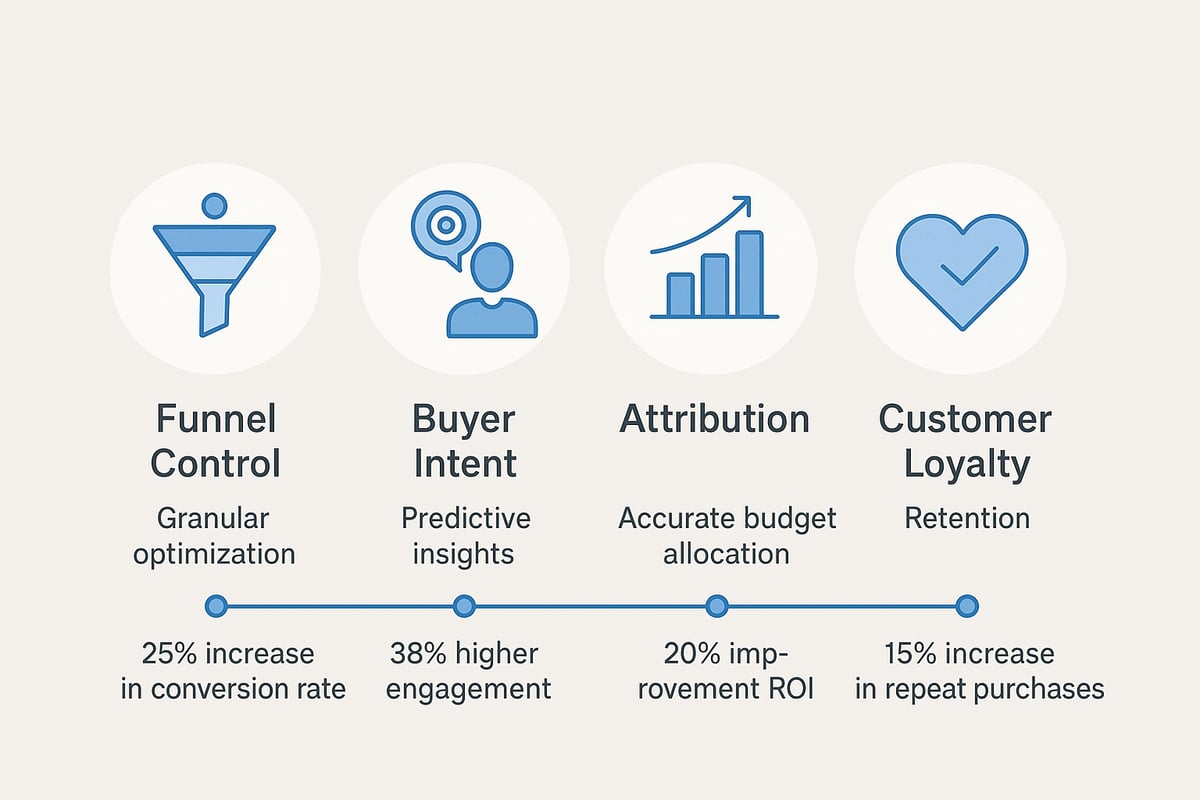
End to end marketing provides unparalleled control at each stage of the sales funnel. Instead of relying on blanket messaging, marketers can tailor every interaction based on where prospects are in their journey. This approach minimizes drop-offs and ensures that each touchpoint is relevant and timely.
For instance, dynamic content adapts in real time to user behavior, presenting offers or information that resonate with buyers’ current needs. As a result, businesses can nurture leads more effectively, moving them smoothly from awareness to decision.
- Control messaging for every funnel stage
- Reduce prospect drop-off with relevance
- Optimize conversion paths based on data
By leveraging end to end marketing, organizations see higher engagement and conversion rates throughout the funnel.
Enhanced Understanding of Buyer Intent
With end to end marketing, all customer interactions are aggregated and analyzed, revealing true buyer motivations. This unified view empowers marketers to segment audiences precisely and target them with hyper-personalized campaigns.
Companies using intent data can predict what customers are likely to do next, allowing for proactive engagement. Predictive targeting powered by analytics increases the odds of delivering the right message at the right time.
- Aggregate touchpoint data for deeper insights
- Identify high-intent prospects quickly
- Personalize outreach for better response
End to end marketing transforms scattered data into actionable intelligence, supporting smarter decisions and better outcomes.
Accurate Attribution and Budget Allocation
A major benefit of end to end marketing is the ability to accurately attribute revenue to specific campaigns, channels, and content. Rather than guessing which activities drive results, marketers can see the direct impact of every action.
Multi-touch attribution models highlight the role of each touchpoint, guiding smarter budget allocation. Businesses can invest more confidently in high-performing strategies, reducing wasted spend and maximizing ROI.
| Attribution Model | Description | Benefit |
|---|---|---|
| First-touch | Credits first interaction | Good for awareness |
| Last-touch | Credits final action | Simple, but limited |
| Multi-touch (E2E) | Credits all interactions | Full journey visibility |
End to end marketing empowers organizations to make data-driven investment decisions.
Improved Customer Retention and Loyalty
End to end marketing continues to deliver value even after the sale. By tracking customer behavior post-purchase, businesses can identify churn risks and upsell opportunities early.
Lifecycle marketing strategies become much more effective with ongoing data collection. Proactive, personalized outreach helps retain customers and increases their lifetime value.
- Monitor satisfaction and engagement trends
- Address issues before they lead to churn
- Upsell or cross-sell based on real-time insights
With end to end marketing, companies build stronger relationships and foster long-term loyalty.
Step-by-Step Guide: Implementing End-to-End Marketing in 2026
Implementing end to end marketing in 2026 requires a clear, systematic approach. Each step builds on the last, creating a seamless path from strategy to execution. Follow these eight essential steps to ensure your business delivers a connected, data-driven customer experience at every stage.
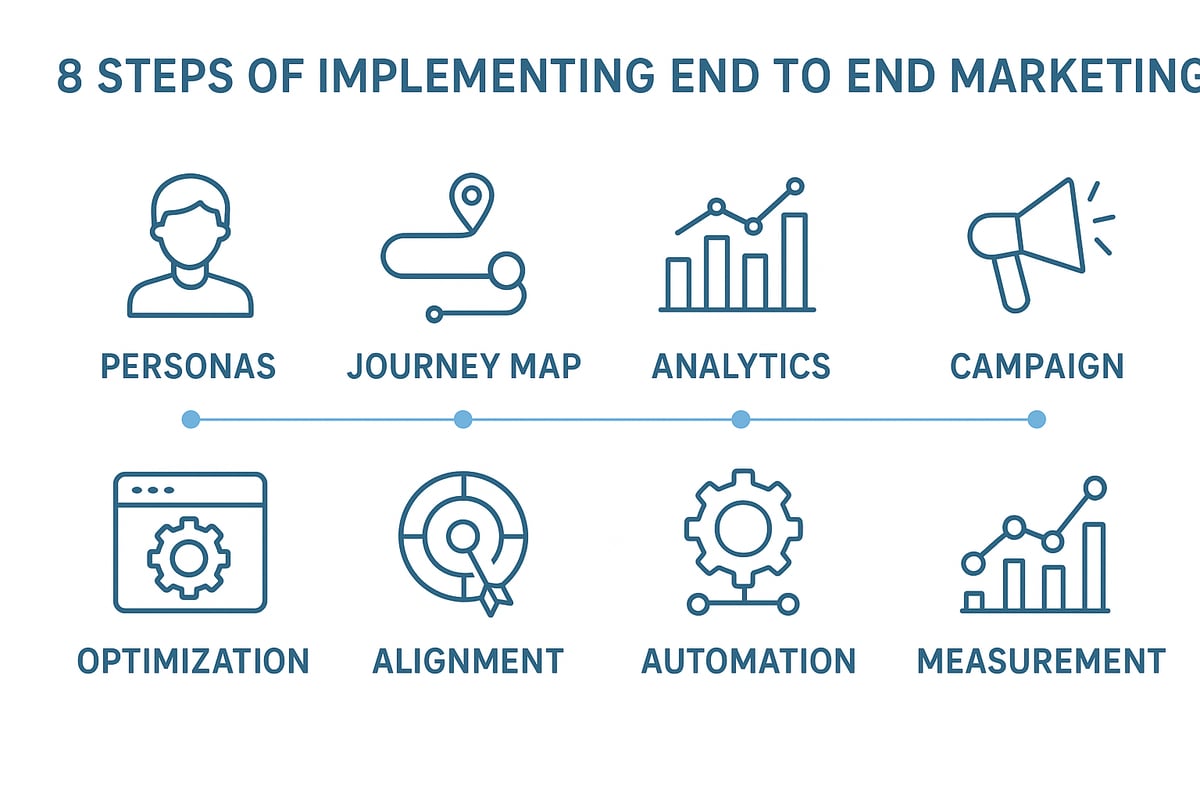
1. Develop Detailed Buyer Personas
Begin your end to end marketing journey by defining who you want to reach. Create detailed buyer personas based on real data, not assumptions. Gather insights from your CRM, website analytics, and direct customer interviews.
Include demographics, pain points, motivations, and typical buying triggers. For example, an HVAC business might focus on homeowners aged 35 to 55 in specific neighborhoods, noting seasonal needs and service preferences.
A table can help organize persona data:
| Attribute | Details |
|---|---|
| Age Range | 35-55 |
| Location | Suburban neighborhoods |
| Pain Points | High energy bills, old systems |
| Motivations | Comfort, savings, reliability |
By building accurate personas, you set the foundation for personalized end to end marketing that resonates at every touchpoint.
2. Map the Complete Customer Journey
The next step in end to end marketing is to visualize every possible interaction a customer might have with your brand. Identify all touchpoints: ads, search engines, review sites, your website, phone calls, and even in-person visits.
Document the journey from initial awareness to loyal repeat business. Note key actions, emotions, and decision factors at each stage. For a plumbing service, this could mean mapping a path from a Google search, to reading reviews, to booking a call.
Journey mapping helps reveal gaps and opportunities in your end to end marketing strategy. Use visual flowcharts or tables to keep the process clear.
3. Establish a Robust Tracking and Analytics Framework
Unified data is at the heart of end to end marketing. Integrate tools like CRMs, analytics platforms, call tracking, and ad reporting systems to collect data from every channel.
Set up UTM parameters for campaigns, implement event tracking on your website, and use offline attribution for phone or in-person interactions. Always ensure GDPR and privacy compliance.
Leverage AI-powered analytics for real-time journey analysis. This level of detail allows you to measure the effectiveness of your end to end marketing at every step.
4. Design and Execute Multi-Touchpoint Campaigns
To maximize end to end marketing impact, orchestrate campaigns across all relevant channels. Combine paid ads, organic search, social media, email, and offline efforts with consistent messaging and branding.
Personalize content and offers based on each persona’s journey stage. For example, a local detailing business may use Google Ads for awareness, Facebook retargeting for consideration, and SMS follow-ups for conversion.
A multi-touch strategy ensures your end to end marketing engages prospects wherever they are, increasing both reach and relevance.
5. Analyze Data and Optimize Continuously
Continuous improvement is the engine of successful end to end marketing. Monitor funnel performance, identify drop-off points, and use A/B testing to refine your messaging and offers.
Apply predictive analytics to anticipate customer behavior and improve conversion rates. Adapt your strategy based on real-time insights from unified data.
According to Salespanel, businesses optimizing with end to end marketing data see reduced churn and higher ROI. Make data-driven decisions a routine part of your workflow.
6. Align Marketing, Sales, and Service Teams
Effective end to end marketing breaks down internal silos. Share unified data dashboards and key performance indicators (KPIs) across all departments.
Define clear hand-off processes and set shared goals between teams. Foster collaboration through regular cross-team meetings and reviews.
Consider adopting fractional marketing strategies to scale expertise and maintain alignment as your marketing efforts grow. This integrated approach ensures everyone works toward a common objective and delivers a seamless customer experience.
7. Leverage Automation and AI for Scale
To scale end to end marketing efficiently, implement automation for lead nurturing, segmentation, and follow-ups. Use AI for predictive lead scoring, dynamic content creation, and chatbot engagement.
For example, a 24/7 AI voice receptionist can capture leads after hours, ensuring no opportunity is missed. Automation frees your team to focus on strategy and creative work while maintaining high-touch engagement.
Select tools that integrate with your existing stack to maintain a unified end to end marketing ecosystem.
8. Measure Success and Attribute Revenue
Finally, establish multi-touch attribution models to track the ROI of every action within your end to end marketing strategy. Use dashboards and detailed reports to monitor performance regularly.
Review which campaigns, channels, and content drive the most revenue and adjust your strategy accordingly. This transparency transforms marketing from a questioned cost center into a proven revenue driver.
A clear measurement framework ensures your end to end marketing efforts are always aligned with growth, allowing you to double down on what works.
Advanced Strategies and Tools for End-to-End Marketing in 2026
Staying ahead in end to end marketing means leveraging sophisticated strategies and tools that unite data, personalization, and compliance. As 2026 approaches, businesses must adopt cutting-edge solutions to orchestrate seamless customer experiences, drive revenue, and build trust. Here’s how to elevate your marketing approach for the future.
Embracing AI and Predictive Analytics
Artificial intelligence is revolutionizing end to end marketing by enabling smarter decision-making and deeper personalization. Machine learning models analyze customer behavior in real time, predicting future actions and optimizing touchpoints automatically. These systems score leads, recommend content, and even automate follow-ups, making every interaction more relevant.
For example, AI chatbots can qualify leads and schedule appointments 24/7, while predictive analytics identify the best time to engage prospects. To see how AI is shaping the future of end to end marketing, explore this overview of AI in digital marketing.
Embracing these technologies ensures your marketing is proactive, not just reactive.
Omnichannel Orchestration and Experience Management
Delivering a unified customer experience is essential for end to end marketing success. Omnichannel orchestration means coordinating digital, phone, and in-person touchpoints to ensure consistency at every stage. By using customer data platforms (CDPs), businesses gain a single view of each buyer, enabling tailored interactions across all channels.
Consider a service provider that synchronizes online bookings with phone calls and face-to-face meetings. This holistic approach reduces friction, strengthens brand perception, and increases conversion rates.
End to end marketing thrives when every channel works together, creating a seamless journey for every customer.
Multi-Touch Attribution and Revenue Analytics
Understanding which efforts truly drive results is at the heart of end to end marketing. Multi-touch attribution models replace outdated last-click tracking, distributing credit across all meaningful interactions. This method reveals which campaigns, channels, and messages influence conversions and customer loyalty.
With advanced analytics, marketers can visualize the impact of each touchpoint and optimize spend accordingly. For instance, a business might discover that early-stage emails plus targeted ads generate more revenue than either alone.
By embracing multi-touch attribution, organizations make smarter investments and maximize the return from end to end marketing.
Future-Proofing with Privacy and Compliance
As privacy regulations continue to evolve, end to end marketing strategies must prioritize ethical data practices. This involves adopting robust consent management systems, focusing on first-party data, and being transparent about data usage. Building trust is not just about compliance, it’s a competitive advantage.
Companies that lead with privacy gain customer loyalty and reduce risk. Adapting to GDPR, CCPA, and new policies ensures long-term success.
In 2026 and beyond, sustainable end to end marketing will depend on respecting user privacy and demonstrating accountability at every step.
Real-World Examples and Case Studies
Examining successful end to end marketing in practice helps bring strategy to life. The following case studies highlight how businesses across industries are using end to end marketing to drive measurable results, from increased lead generation to improved ROI and customer loyalty.
B2B Example: SaaS Company Full-Funnel Attribution
A fast-growing SaaS provider adopted end to end marketing to connect every user interaction across its digital ecosystem. By integrating CRM, website analytics, and sales call data, the company tracked prospects from initial ad clicks through demos and, ultimately, to subscription.
Key steps included multi-touch attribution, continuous journey analysis, and tailored nurturing sequences. The result was a clear view of how marketing actions directly influenced revenue. This level of insight enabled the team to reallocate budget toward the highest-performing campaigns, reducing acquisition costs and maximizing return on investment. End to end marketing transformed their decision-making and growth trajectory.
Local Service Business: HVAC Lead Generation
A regional HVAC service faced challenges tracking leads from digital ads through to booked service calls. Implementing end to end marketing, they mapped the complete customer journey, unifying website analytics, call tracking, and automated follow-ups.
- Identified high-value touchpoints like Google searches and online booking forms
- Used data-driven insights to optimize underperforming channels
- Improved collaboration between marketing and dispatch teams
By leveraging search engine marketing strategies, the business increased qualified leads by 38 percent. End to end marketing enabled precise attribution, revealing which campaigns drove real bookings and revenue growth.
E-Commerce: Multi-Channel Personalization
An online retailer implemented end to end marketing to unify customer data from email, social media, and website interactions. Using AI-powered product recommendations and automated cart recovery, they delivered a seamless, highly personalized buying experience at every stage.
Key results included higher conversion rates and increased customer lifetime value. The brand orchestrated campaigns across multiple touchpoints, ensuring messaging consistency and relevance. End to end marketing gave the e-commerce team granular visibility into buyer intent, allowing for rapid optimization and more effective resource allocation. These improvements translated directly into measurable sales growth and loyalty.
B2B Services: Using Advanced Tools for E2E Marketing
A B2B services firm took end to end marketing further by integrating advanced platforms for journey tracking, attribution, and targeted content delivery. Leveraging solutions like Salespanel, the team gained a 360-degree view of every lead’s progression, from first contact to deal closure.
With the adoption of AI and analytics, they continuously refined their funnel, identifying bottlenecks and automating personalized outreach. For organizations seeking to scale, expert resources such as End-to-End Reinvention with GenAI offer in-depth analysis of how to implement transformative end to end marketing initiatives. The result was streamlined analysis, actionable insights, and ongoing optimization for sustained growth.
Trends and Predictions: The Future of End-to-End Marketing
The landscape of end to end marketing is evolving rapidly, and the coming years will see transformative shifts that redefine how businesses connect with customers. Emerging technologies, changing consumer expectations, and new privacy standards are setting the stage for the next era of marketing excellence. Staying ahead of these trends is essential for any organization seeking sustainable growth and competitive advantage.
AI-Driven Personalization Takes Center Stage
Artificial intelligence is revolutionizing end to end marketing by enabling hyper-personalized experiences across every touchpoint. AI systems now analyze real-time data to predict individual customer needs and deliver tailored content instantly. This means marketers can move from generic messaging to dynamic, one-to-one engagement at scale.
Key applications include:
- Predictive product recommendations based on historical and behavioral data
- Automated content adaptation for different buyer personas
- Real-time segmentation and targeting
According to Digital Marketing Trends for 2026, businesses embracing AI-driven personalization see stronger engagement and higher ROI. As AI becomes the backbone of end to end marketing, expect these capabilities to become standard rather than optional.
Rise of Voice, Chat, and Conversational Marketing
Conversational interfaces are rapidly gaining traction in end to end marketing. Customers now expect immediate, personalized responses—whether through AI-powered chatbots, voice assistants, or messaging platforms. These tools are not only available 24/7 but also collect valuable data for refining marketing strategies.
Benefits include:
- Faster lead qualification and customer support
- Seamless transitions between channels (chat, phone, email)
- Enhanced customer satisfaction through instant answers
Businesses using AI voice receptionists report increased conversion rates and reduced missed opportunities. As conversational marketing matures, integrating these solutions into end to end marketing strategies will be critical for staying ahead.
Integration of Offline and Online Data
Bridging the gap between online and offline channels is a cornerstone of future-ready end to end marketing. Modern buyers interact with brands across digital platforms, phone calls, and in-person visits. Integrating these touchpoints creates a unified view of the customer journey.
| Channel Type | Key Data Points | Attribution Method |
|---|---|---|
| Online | Web, ads, email, social | Click tracking, analytics |
| Offline | Calls, store visits | Call tracking, QR codes |
By synchronizing data from all sources, marketers can accurately attribute revenue, uncover hidden trends, and personalize outreach. End to end marketing that unites offline and online insights will drive more effective campaigns and deeper customer relationships.
Privacy, Trust, and First-Party Data
With stricter privacy regulations and the decline of third-party cookies, trust is becoming a defining factor in end to end marketing. Companies must prioritize ethical data practices, transparent consent, and robust first-party data strategies.
Key trends include:
- Implementing consent management tools
- Collecting data directly from customer interactions
- Communicating clearly about data use
Businesses that lead in privacy and transparency will build stronger customer loyalty and enjoy a competitive edge. As end to end marketing evolves, trust will be as important as technology in driving long-term success.
Jean runs growth strategy at AimSetWin, a performance marketing agency specializing in local service businesses across Texas. he's helped plumbers, HVAC companies, pest control operators, and home service brands build predictable revenue systems using data-driven advertising and conversion optimization.


