
Discover a step-by-step guide to scaling HVAC business 2026 in Texas. Learn proven strategies to drive revenue and grow operations efficiently.
Every Texas HVAC business owner with a growing customer list knows the challenge of finding new ways to drive revenue without spending more on ads. Staying competitive means looking beyond the obvious and finding smart ways to make the most out of every customer relationship. This guide spotlights high-impact revenue recovery and customer activation strategies proven to maximize your current customer base and reveal hidden growth opportunities, no matter your advertising budget.
Table of Contents
- Step 1: Assess Existing Customer Base And Revenue Gaps
- Step 2: Install A Proven Revenue Recovery System
- Step 3: Activate Google Ads And Optimize Local Seo
- Step 4: Enhance Website Conversion And Implement Ai Call Handling
- Step 5: Monitor Growth Metrics And Verify System Effectiveness
Quick Summary
| Key Insight | Explanation |
|---|---|
| 1. Assess Existing Customer Base | Analyze your customer database to identify gaps and potential revenue opportunities. Focus on service frequency and equipment age. |
| 2. Implement a Revenue Recovery System | Develop automated follow-up protocols to reactivate dormant customers, maximizing missed revenue. Maintain detailed interaction logs. |
| 3. Optimize Local SEO and Google Ads | Enhance your online visibility through localized advertising and a well-optimized Google Business Profile to attract local customers. |
| 4. Improve Website Conversion Strategies | Optimize website elements and integrate AI call handling to streamline customer interactions and increase service bookings. |
| 5. Monitor Growth Metrics Regularly | Track key performance indicators to gain insights into customer acquisition costs and service call volumes for better strategic decisions. |
Step 1: Assess existing customer base and revenue gaps
To effectively scale your HVAC business and recover missed revenue, you need a strategic approach to understanding your current customer landscape. This step involves diving deep into your existing database to identify potential revenue opportunities and service gaps that might be costing you thousands in untapped income.
Start by pulling a comprehensive report of your customer history. HVAC service market analysis reveals that preventive maintenance alone captures 39% of industry revenue. You’ll want to categorize your customers across several key dimensions:
- Frequency of service – customers who haven’t had maintenance in 12+ months
- Equipment age – systems nearing replacement age
- Service history – one-time customers versus regular contract holders
- Geographic clustering – identify potential neighborhood service opportunities
Your database audit should focus on quantifying these potential revenue streams. By mapping out these segments, you can develop targeted re-engagement strategies that transform dormant customer relationships into active revenue generators.

Here’s a summary of common HVAC customer segments and their revenue potential:
| Customer Segment | Typical Characteristics | Revenue Opportunity |
|---|---|---|
| Inactive Maintenance Clients | No service in 12+ months | Re-engagement, new contracts |
| Aging Equipment Owners | Systems nearing replacement | Equipment upgrade, upsell |
| Regular Contract Holders | Consistent service usage | Upselling premium services |
| High-Density Neighborhoods | Multiple customers in same area | Group offers, localized marketing |
Identifying revenue gaps isn’t just about finding new customers – it’s about reactivating and maximizing value from your existing customer base.
To conduct this assessment effectively, leverage your customer management software or CRM to generate detailed reports. Look for patterns like:
- Customers with outdated equipment
- Clients who haven’t scheduled annual maintenance
- Potential upgrade or replacement candidates
- Geographic areas with concentrated customer density
Pro tip: Cross-reference your customer database with industry market reports to benchmark your current service mix against regional demand trends.
Step 2: Install a proven revenue recovery system
Installing a revenue recovery system transforms your HVAC business from reactive service provider to strategic revenue generator. The goal is creating a systematic approach that automatically reactivates dormant customer relationships and turns missed opportunities into predictable income streams.
HVAC revenue strategies recommend implementing follow-up sequences that capture missed leads and maximize customer retention. Your revenue recovery system should include several core components:
- Automated follow-up sequences for service calls and estimates
- Segmentation strategies to categorize customer potential
- Upsell mechanisms integrated into service workflows
- Reactivation campaigns targeting inactive customers
To build an effective system, map out your customer touchpoints and create standardized re-engagement protocols. This means developing clear scripts, email templates, and tracking mechanisms that transform every interaction into a potential revenue opportunity.
A well-designed revenue recovery system doesn’t just capture lost revenue – it builds a predictable, scalable growth engine for your business.
Implement these key strategies systematically:
- Create detailed customer interaction logs
- Design targeted communication workflows
- Establish clear reactivation protocols
- Track conversion rates and refine approach
Pro tip: Invest in a customer relationship management (CRM) system that supports automated follow-ups and provides detailed analytics on customer engagement patterns.
Here’s how the core components of a revenue recovery system impact an HVAC business:
| Component | Function | Business Impact |
|---|---|---|
| Automated Follow-Ups | Sends timely reminders | Boosts retention, recovers leads |
| Segmentation | Sorts customers by potential | Enables targeted campaigns |
| Upsell Mechanisms | Promotes higher-value services | Increases average revenue |
| Reactivation Campaigns | Engages dormant customers | Revives lost relationships |
Step 3: Activate Google Ads and optimize local SEO
Activating Google Ads and optimizing local SEO will transform your HVAC business’s online visibility and attract high-intent local customers. This strategic approach combines targeted advertising with hyper-local search optimization to capture more service opportunities in your specific market.
Local SEO strategies for HVAC businesses reveal critical tactics for dominating local search results. Your optimization strategy should focus on several key areas:
- Google Business Profile optimization with complete, accurate information
- Geo-targeted Google Ads campaigns specific to service areas
- Customer review management to boost credibility
- Localized website content targeting specific service regions
- Mobile-responsive design for seamless user experience
Implement your Google Ads strategy by developing highly specific ad groups that target different service types and customer needs. Create separate campaigns for emergency repairs, seasonal maintenance, and equipment installations to maximize relevance and conversion potential.
Successful local marketing isn’t about being everywhere – it’s about being precisely where your ideal customers are searching.
Execute your local SEO optimization through these systematic steps:
- Verify and optimize Google Business Profile
- Generate consistent customer reviews
- Create location-specific service pages
- Build local citation consistency
- Implement schema markup for local businesses
Pro tip: Allocate at least 20% of your marketing budget to continuous testing and refinement of your Google Ads and local SEO strategies to stay ahead of competitive market shifts.
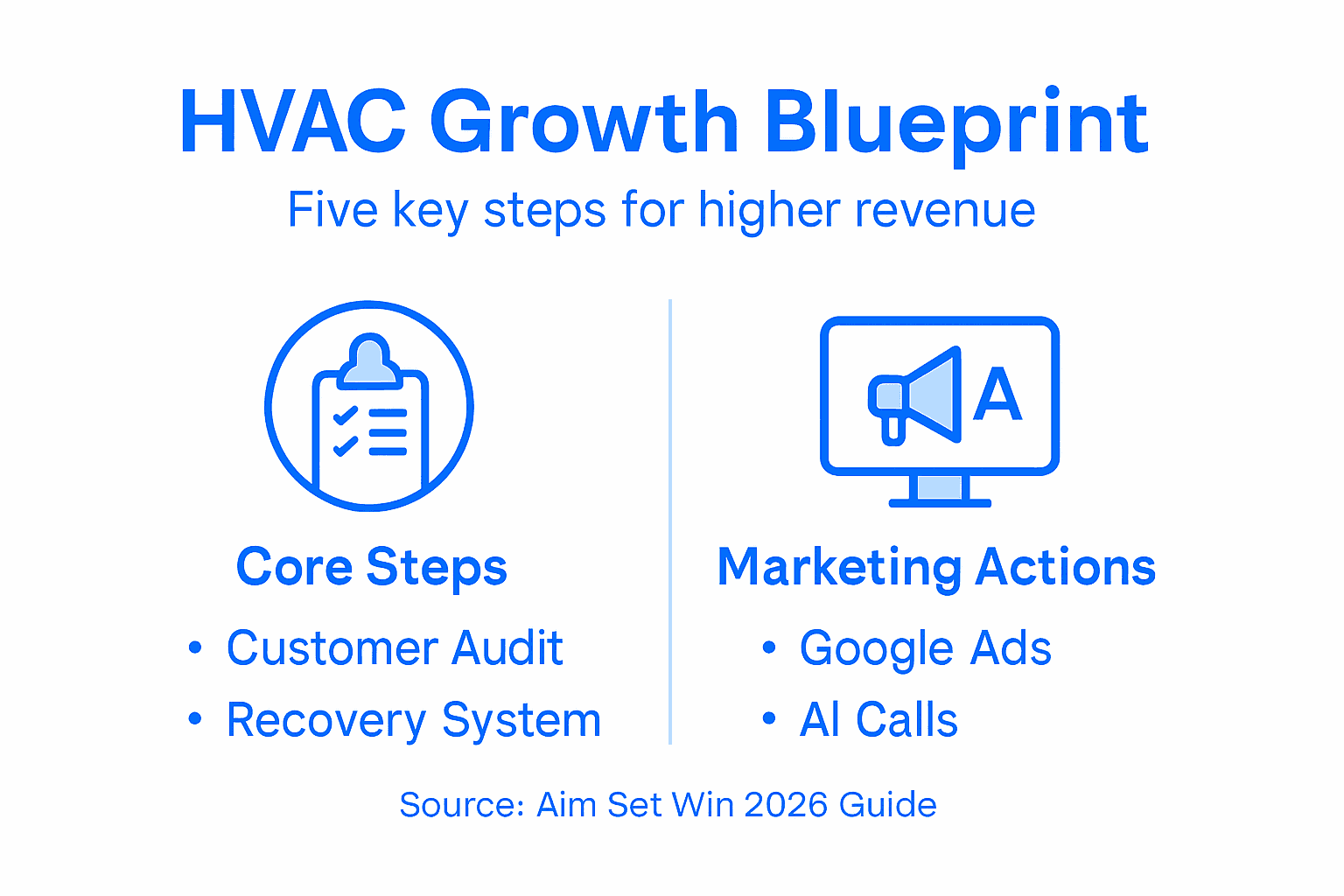
Step 4: Enhance website conversion and implement AI call handling
Transforming your HVAC business’s digital presence requires a strategic approach to website conversion and intelligent customer interaction. The goal is creating a seamless online experience that turns website visitors into booked service appointments with minimal friction.
Improve your website’s conversion potential by implementing strategic design elements that guide potential customers toward taking action. Conversion strategies for service businesses demand a laser-focused approach to capturing customer interest and converting website traffic into real revenue opportunities.
Key conversion optimization tactics include:
- Clear call-to-action buttons with compelling messaging
- Mobile-responsive design for seamless user experience
- Service pricing and transparent information
- Customer testimonial integration
- Fast-loading page performance
AI call handling represents the next frontier of customer service efficiency. Implement intelligent systems that can:
- Automatically route incoming service requests
- Provide instant preliminary service estimates
- Schedule appointments outside normal business hours
- Capture detailed customer information
Effective digital transformation isn’t about replacing human interaction – it’s about enhancing your team’s capabilities and responsiveness.
Integrate AI technologies that streamline customer communication and reduce administrative overhead. Look for solutions that can handle initial screening and scheduling while maintaining a personalized touch.
Pro tip: Test and measure your website’s conversion rate monthly, making incremental improvements to continuously reduce customer acquisition costs and increase booked service rates.
Step 5: Monitor growth metrics and verify system effectiveness
Measuring your HVAC business’s performance requires a systematic approach to tracking key performance indicators that reveal your true growth potential. The objective is transforming raw data into actionable insights that drive strategic decision making.
Critical HVAC performance metrics provide a comprehensive view of your business health. You’ll want to establish a robust tracking system that captures multiple dimensions of performance:
- Customer acquisition cost tracking
- Average revenue per customer analysis
- Maintenance agreement conversion rates
- First-time fix rate monitoring
- Service call volume assessment
Develop a consistent reporting framework that allows you to compare performance across different time periods. This means creating standardized dashboards that highlight:
- Monthly revenue growth percentages
- Customer retention rates
- Marketing campaign effectiveness
- Operational efficiency metrics
- Profit margin trends
Success in the HVAC industry isn’t about working harder – it’s about measuring smarter and responding quickly to data-driven insights.
Utilize business intelligence tools specifically designed for service-based businesses to streamline your metric tracking and reduce manual reporting overhead.
Pro tip: Schedule a quarterly deep-dive review of your key performance metrics, treating this analysis as a strategic planning session rather than a routine administrative task.
Unlock Predictable Growth for Your HVAC Business in 2026
If you are struggling with missed revenue from inactive customers or looking to build a scalable system that turns existing demand into booked jobs, you are not alone. Many HVAC businesses face challenges like reactivating dormant clients, optimizing local visibility, and converting website visitors efficiently. This guide highlighted critical strategies like installing a Revenue Recovery System and leveraging Google Ads alongside local SEO to boost revenue with measurable outcomes.
At Aim Set Win, we specialize in helping Texas-based HVAC businesses recover lost income fast and develop proven growth systems. By starting with a tailored Revenue Recovery System, we re-engage past customers to fill your schedule within 30 days without increasing ad spend. Then, we elevate your online presence with targeted Google Ads, local SEO strategies, and AI call handling to maximize conversions and customer retention. Discover how implementing these clear systems consistently leads to revenue you can count on.
Ready to transform your HVAC business with actionable marketing solutions? Explore our proven approaches and success stories in the HVAC Archives – Aim Set Win to see exactly how we turn potential into profit. Don’t wait for missed opportunities to slip away. Visit Aim Set Win today to start scaling smarter and growing faster.
Frequently Asked Questions
How can I assess my existing customer base to find revenue gaps?
To assess your existing customer base, generate a comprehensive report reviewing your customer history. Focus on segments such as inactive maintenance clients and aging equipment owners, which may reveal potential revenue opportunities; aim to identify at least three different segments within 30 days.
What are the core components of a revenue recovery system for HVAC businesses?
The core components of a revenue recovery system include automated follow-up sequences, segmentation strategies, upsell mechanisms, and reactivation campaigns. Implement these elements systematically to boost customer retention and turn missed opportunities into predictable revenue streams.
How do I optimize my Google Ads for better local visibility?
To optimize your Google Ads for local visibility, create geo-targeted campaigns that focus on specific service needs in your area, ensuring your ads resonate with potential customers. Track conversion rates bi-weekly and refine your campaigns based on performance data to maximize your reach.
What strategies should I use to enhance website conversion?
To enhance website conversion, focus on clear call-to-action buttons, mobile-responsive design, and integrating customer testimonials. Implement these strategies and monitor your conversion rate monthly, aiming for at least a 15% increase in booked service appointments within three months.
How do I effectively monitor my HVAC business growth metrics?
To effectively monitor your HVAC business growth metrics, establish a consistent reporting framework that captures key performance indicators like customer acquisition costs and average revenue per customer. Review these metrics quarterly to adjust your strategies based on trends and data-driven insights.
What are the benefits of implementing AI call handling in my HVAC business?
Implementing AI call handling can significantly streamline customer interactions, providing instant preliminary service estimates and scheduling appointments. This could reduce your administrative workload by approximately 30%, allowing your team to focus more on direct customer service.
Recommended
- 7 Types of HVAC Marketing Strategies for Reliable Growth
- HVAC Industry Trends 2026: Growth, AI, and Revenue Impact
- 7 Steps HVAC Marketing Checklist 2026 for Revenue Growth
- 7-Step HVAC Marketing Checklist for Booking High-Value Jobs
Jean runs growth strategy at AimSetWin, a performance marketing agency specializing in local service businesses across Texas. he's helped plumbers, HVAC companies, pest control operators, and home service brands build predictable revenue systems using data-driven advertising and conversion optimization.


