
Explore home service business systems, revenue recovery methods, proven growth strategies, and AI-powered tools for HVAC and plumbing firms.
Most American home service businesses waste thousands each year by missing out on revenue already within reach. If you run a thriving HVAC or plumbing company in Texas making over $30,000 a month, you know that simply chasing more leads adds stress and cost. This guide sheds light on proven systems designed to help you recover lost income from your existing customer base, revealing why the right approach can dramatically improve your bottom line without expanding your marketing budget.
Table of Contents
- Defining Home Service Business Systems
- Core Types of Systems And Their Functions
- How Revenue Recovery Systems Work
- Layered Growth Tactics: Seo, Paid Search, Ai
- Common Pitfalls In System Implementation
Key Takeaways
| Point | Details |
|---|---|
| Importance of Systematization | Implementing structured systems in home service businesses enhances service quality and operational efficiency. |
| Revenue Recovery Strategies | Utilizing automated revenue recovery systems helps identify financial losses and reclaim missed opportunities. |
| Digital Marketing Integration | A cohesive approach combining SEO, paid search, and AI optimizes online visibility and user engagement. |
| Addressing Implementation Challenges | Proactively managing common pitfalls in system adoption strengthens technology integration and ensures successful outcomes. |
Defining Home Service Business Systems
Home service businesses represent specialized enterprises providing direct residential services that maintain, repair, and enhance property functionality. These businesses cover a dynamic range of professional activities essential to modern community infrastructure.
At their core, home service business systems encompass structured approaches for delivering consistent, high-quality services across multiple residential maintenance domains. These systems typically include standardized operational protocols, customer management strategies, scheduling frameworks, and technological integrations designed to streamline service delivery. Key sectors include plumbing, electrical work, HVAC maintenance, cleaning services, landscaping, and emergency property repairs.
The evolution of home service businesses reflects broader societal transformations. Where once informal local networks handled household maintenance, today’s professional service ecosystems leverage advanced technologies, data-driven insights, and rigorous operational methodologies. Modern home service businesses require sophisticated systems that balance technical expertise, customer relationship management, and efficient operational execution.
Successful home service business systems distinguish themselves through several critical attributes:
- Predictable service quality
- Transparent pricing models
- Rapid response capabilities
- Advanced scheduling technologies
- Comprehensive customer communication channels
Pro tip: Develop a standardized operational manual that documents every service process, creating consistency and reducing potential variability in service delivery.
Core Types of Systems and Their Functions
Home service businesses rely on multiple sophisticated systems that enable seamless operational performance. Diverse system types support different functional requirements across the service delivery ecosystem, each addressing specific organizational needs and customer interaction points.
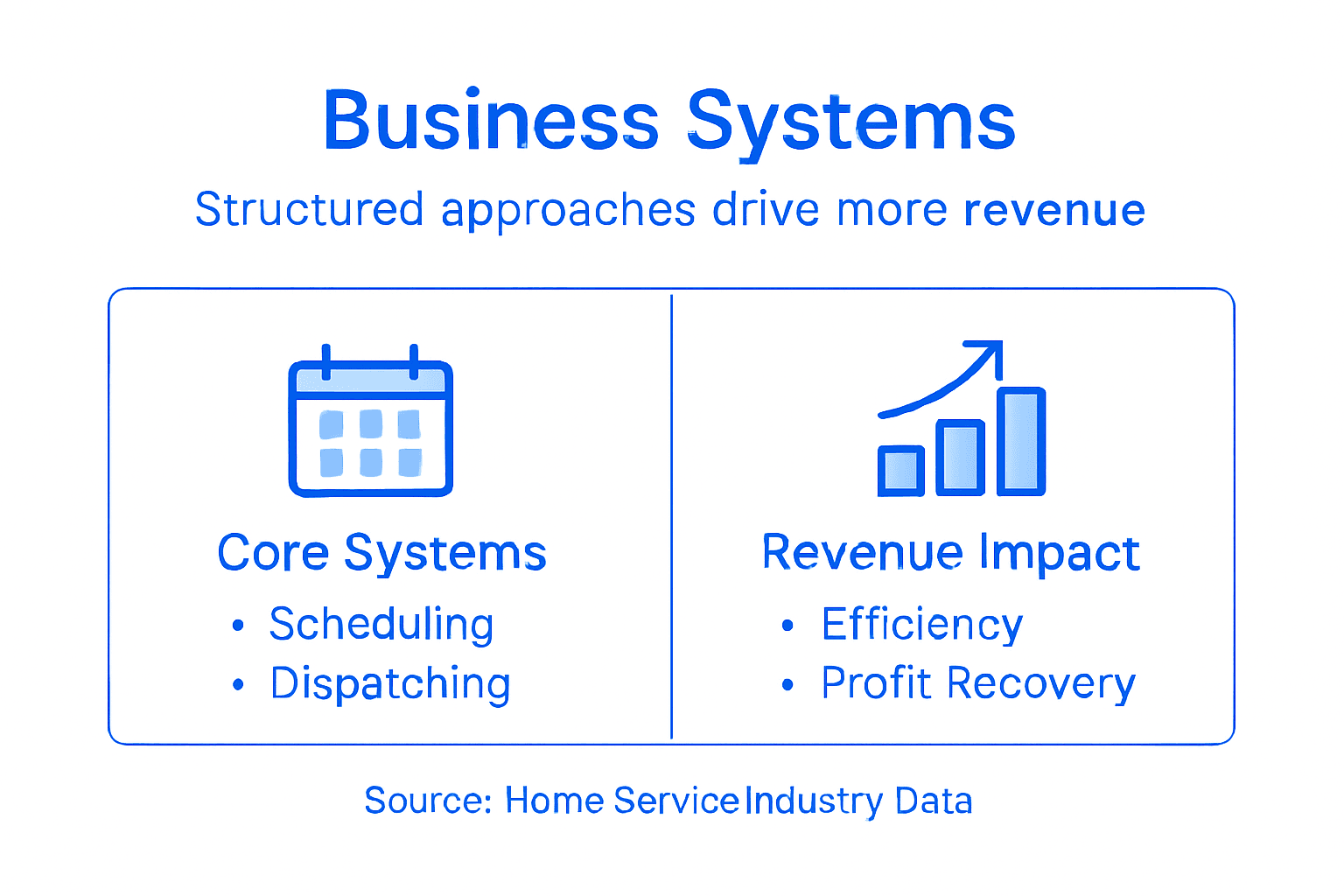
Fundamental system categories include scheduling and dispatching platforms, which optimize technician assignments and route management. These systems utilize advanced algorithms to match customer requests with available technicians, minimizing response times and maximizing operational efficiency. Customer relationship management (CRM) systems represent another critical infrastructure, tracking client interactions, service histories, and enabling personalized communication strategies that enhance overall customer satisfaction.

Financial and administrative systems form the backbone of home service business operations. These include comprehensive billing platforms, payment processing technologies, and inventory control mechanisms. By integrating these systems, businesses can streamline revenue collection, manage resource allocation, and maintain accurate financial records. On-demand service platform models further demonstrate the complexity of these integrated operational frameworks.
Key system types in home service businesses encompass:
- Scheduling and dispatching systems
- Customer relationship management platforms
- Billing and payment processing technologies
- Inventory and resource tracking systems
- Quality assurance and performance monitoring tools
- Communication and reporting infrastructures
Pro tip: Invest in integrated system solutions that communicate seamlessly across different operational domains, reducing manual data entry and minimizing potential errors.
Below is a comparison of core home service systems and their unique business impacts:
| System Type | Main Function | Business Impact |
|---|---|---|
| Scheduling & Dispatching | Assigns jobs and routes technicians | Faster response, cost efficiency |
| CRM Platforms | Manages customer data and history | Higher client retention |
| Billing & Payments | Handles invoicing and payments | Improved cash flow, fewer errors |
| Inventory Tracking | Monitors tools and material usage | Reduced shortages, cost control |
| QA & Performance Tools | Evaluates service and staff | Consistent quality improvement |
| Communication Infrastructure | Coordinates teams and clients | Smoother interactions, less confusion |
How Revenue Recovery Systems Work
Revenue recovery systems represent sophisticated technological approaches designed to identify and reclaim missed financial opportunities within home service businesses. Identifying lost revenue sources becomes critical for maintaining financial health and operational sustainability.
These systems operate through multiple strategic mechanisms, primarily focusing on detecting and addressing potential revenue leakage points. Automated technologies analyze billing records, payment histories, and customer interactions to pinpoint discrepancies that might prevent full revenue collection. Key functions include tracking incomplete transactions, managing failed payment attempts, analyzing customer churn patterns, and implementing proactive communication strategies to reconnect with past clients or resolve billing inconsistencies.
Home service revenue recovery solutions typically encompass comprehensive workflows that address various revenue capture challenges. These workflows integrate advanced data analysis, automated retry mechanisms for failed transactions, and intelligent customer engagement protocols. By systematically auditing accounts receivable and implementing strategic intervention techniques, businesses can transform potential revenue losses into recoverable income streams.
Core components of effective revenue recovery systems include:
- Automated payment retry mechanisms
- Comprehensive billing error detection
- Customer communication and re-engagement tools
- Predictive analytics for potential revenue risks
- Integrated reporting and tracking dashboards
- Compliance and documentation management
Pro tip: Implement a monthly revenue recovery audit process that cross-references billing records, payment histories, and service completion logs to identify and address potential income gaps.
Layered Growth Tactics: SEO, Paid Search, AI
Home service businesses must adopt sophisticated digital marketing strategies that leverage multiple interconnected channels to maximize online visibility and customer acquisition. Layered SEO approaches enable businesses to create comprehensive digital marketing ecosystems that adapt to evolving search technologies and user behaviors.
The integration of Search Engine Optimization (SEO), paid search, and artificial intelligence represents a powerful strategy for expanding digital market presence. By combining these tactics, home service companies can create targeted, intelligent marketing approaches that capture user intent more precisely. AI-driven search algorithms now interpret complex user queries with unprecedented accuracy, requiring businesses to develop more nuanced, semantically rich content strategies.
Successful implementation involves creating a multi-dimensional approach that includes:
- Semantic content optimization
- AI-friendly structured data markup
- Intelligent paid search targeting
- Machine learning-enhanced audience segmentation
- Predictive content development
- Automated performance tracking and adaptation
Pro tip: Develop a quarterly digital strategy review process that evaluates your SEO, paid search, and AI integration performance, allowing for rapid tactical adjustments based on emerging technological trends.
Common Pitfalls in System Implementation
Implementing new business systems requires strategic planning and awareness of potential challenges that can derail technology adoption. Comprehensive project planning becomes critical to navigating complex technological transitions and minimizing operational disruptions.
Home service businesses frequently encounter systemic implementation challenges that can compromise technological investments. These challenges often stem from inadequate stakeholder engagement, poor communication frameworks, and unrealistic performance expectations. Software implementation failures typically result from weak governance, insufficient testing protocols, and misalignment between technological capabilities and organizational needs.
Critical pitfalls that home service businesses must proactively address include:
- Insufficient user training and onboarding
- Lack of clear implementation timelines
- Underestimating change management requirements
- Poor integration with existing technological ecosystems
- Inadequate performance monitoring mechanisms
- Weak vendor communication and support strategies
- Overlooking potential scalability constraints
- Neglecting continuous system optimization processes
Pro tip: Create a dedicated cross-functional implementation team with representatives from operations, technology, and customer service to ensure comprehensive system adoption and minimize potential resistance.
Here is a summary of major pitfalls in system implementation and how to address them:
| Pitfall | Why It Happens | Prevention Strategy |
|---|---|---|
| Inadequate Training | Staff not prepared for new tech | Provide structured onboarding |
| Weak Change Management | Resistance to new processes | Involve all stakeholders early |
| Poor System Integration | Legacy tools not compatible | Assess fit and plan integrations |
| Unrealistic Timelines | Rushed rollout or fixes | Set phased, achievable milestones |
| Neglected Performance Review | No ongoing system evaluation | Establish regular monitoring cycles |
Unlock Hidden Revenue and Build Reliable Systems for Your Home Service Business
The article highlights key challenges like revenue leakage, inconsistent service systems, and difficulty recovering missed income that many home service businesses face. If you are an HVAC, plumbing, or local service professional struggling with revenue recovery or inefficient operational systems such as scheduling, billing, and customer communication, you are not alone. These issues often lead to lost income and wasted effort despite having existing demand from past customers.
Aim Set Win specializes in installing a Revenue Recovery System that works quietly in the background to re-engage former clients and convert existing demand into booked jobs in 30 days or less — all without costly new leads or ad spend. This system aligns perfectly with the article’s emphasis on automated payment retry mechanisms, customer re-engagement tools, and operational consistency. We then amplify your growth by layering in proven solutions like paid search, SEO optimization, website conversion improvements, and AI call handling for scalable results. Our approach focuses on simple, clear processes that produce measurable revenue growth without wasting resources or experimenting unnecessarily.
Stop letting missed revenue drain your home service business. Visit Aim Set Win today to learn how our tailored systems can help you unlock predictable income streams and improve your operational execution. Discover the future of service business growth by exploring our Revenue Recovery System and comprehensive service solutions designed specifically for professionals like you.
Frequently Asked Questions
What are home service business systems?
Home service business systems refer to structured approaches used by businesses that provide maintenance, repair, and enhancement services for residential properties. These systems include standardized protocols, customer management strategies, and technological integrations to ensure consistent service delivery.
How do revenue recovery systems work in home service businesses?
Revenue recovery systems identify and reclaim missed financial opportunities by analyzing billing records, payment histories, and customer interactions. They focus on detecting discrepancies and address revenue leakage points, often using automated technologies to track and manage these issues.
What are some common challenges when implementing home service business systems?
Some common challenges include insufficient user training, weak change management, poor system integration, and unrealistic implementation timelines. Addressing these pitfalls requires strategic planning, stakeholder engagement, and ongoing performance monitoring.
How can home service businesses leverage SEO and digital marketing strategies?
Home service businesses can utilize layered SEO approaches, paid search, and AI-driven strategies to expand their online visibility. This involves creating targeted, optimized content, utilizing intelligent audience segmentation, and implementing automated performance tracking for continuous improvement.
Recommended
- Stop the Seasonal Slowdown: Keep Your Lawn Care Business Busy Year-Round – Aim Set Win
- Top Digital Marketing Strategies For Your HVAC Business – Aim Set Win
- Stop Losing Customers to Your Competitors: Master Local SEO and Become the #1 HVAC Choice in Your Area – Aim Set Win
- contentmarketing Archives – Aim Set Win
Article generated by BabyLoveGrowth
Jean runs growth strategy at AimSetWin, a performance marketing agency specializing in local service businesses across Texas. he's helped plumbers, HVAC companies, pest control operators, and home service brands build predictable revenue systems using data-driven advertising and conversion optimization.


