
Learn how Google Ads auctions, bidding strategies, and campaign optimization work for Texas plumbing and HVAC contractors to reduce cost per lead and drive qualified service calls.
Texas plumbing, HVAC, and home service contractors face intense local competition where traditional marketing falls short. Google Ads offers a direct path to high-intent customers actively searching for emergency repairs, installations, and maintenance services in your service area. This guide breaks down how Google Ads auctions work, which bidding strategies deliver the best results for contractors, and proven optimization tactics that reduce cost per lead while increasing qualified calls. You’ll learn the mechanics behind ad placement, campaign structure best practices, and tracking methods that turn ad spend into measurable revenue for your contracting business.
Table of Contents
- How Google Ads Auction And Ad Rank Work
- Choosing The Right Bidding Strategy For Texas Contractors
- Optimizing Google Ads Campaigns For Texas Plumbing And HVAC Contractors
- Measuring Success: Tracking And Improving Your Google Ads Results
- Enhance Your Google Ads With Expert SEO And PPC Services
- Frequently Asked Questions
Key takeaways
| Point | Details |
|---|---|
| Auction mechanics | Google Ads uses real-time auctions where Ad Rank combines your bid amount with Quality Score to determine placement and cost. |
| Bidding control | Manual CPC bidding gives contractors direct cost control for campaigns under 30 monthly conversions, while Smart Bidding optimizes at scale. |
| Lead pricing models | Local Services Ads charge per qualified lead rather than per click, offering predictable costs for emergency service calls. |
| Campaign optimization | Structured campaigns with negative keywords and service-specific landing pages can reduce cost per lead by 60% or more. |
How Google Ads auction and ad rank work
Every time someone in Dallas searches for “emergency plumber near me,” Google runs a split-second auction among advertisers bidding on that keyword. Your ad doesn’t simply appear because you bid the highest amount. Google calculates an Ad Rank using bid and Quality Score, which determines if your ad shows and in what position. This system rewards relevance and user experience, not just deep pockets.
Quality Score measures three core factors: expected click-through rate based on historical performance, ad relevance to the search query, and landing page experience including load speed and content match. A plumber with a highly relevant ad and fast-loading service page can outrank competitors bidding twice as much. Including ad extensions like call buttons, location details, and service callouts boosts your Ad Rank without increasing your bid.
The cost advantage is substantial. Higher Quality Scores reduce your cost per click by 20 to 50%, meaning you pay less for the same ad position compared to competitors with lower scores. For HVAC contractors running seasonal campaigns, this efficiency multiplies across thousands of clicks during peak demand periods.
Google uses a second-price auction model where you pay just enough to beat the next competitor’s Ad Rank, not your full bid amount. If you bid $15 per click but the next advertiser’s Ad Rank only requires $9.50 to beat, you pay around $9.51. This structure encourages realistic bidding rather than arbitrary high bids. Contractors new to paid search strategies for HVAC often overbid initially, then refine based on actual auction dynamics.
Ad Rank calculation factors:
- Maximum CPC bid amount
- Quality Score from 1 to 10
- Ad extension impact on click-through rate
- Search context including device, location, and time
- Competitive landscape in your service area
Quality Score component breakdown:
| Component | Weight | Optimization Focus |
|---|---|---|
| Expected CTR | 40% | Write compelling ad copy with clear service offers |
| Ad Relevance | 30% | Match keywords tightly to ad group themes |
| Landing Page | 30% | Fast load times, mobile optimization, service-specific content |
Pro Tip: Check your Google Ads Quality Score weekly for each keyword. Scores below 5 signal misalignment between your keyword, ad copy, or landing page. Pause low performers and restructure campaigns around tighter keyword themes to improve relevance and reduce wasted spend.
Choosing the right bidding strategy for Texas contractors
Bidding strategy determines how Google spends your daily budget across auctions. For contractors just starting with Google Ads or running campaigns with fewer than 30 conversions per month, manual CPC bidding provides essential control over costs while you learn which keywords and ad copy convert best. You set maximum bids at the keyword level and adjust based on performance data, preventing runaway spending on untested campaigns.
Smart Bidding strategies like Target CPA or Maximize Conversions use machine learning to adjust bids in real time based on over 200 signals including device type, location, time of day, and user behavior patterns. These automated strategies work best once you have conversion tracking data and at least 30 conversions per month to train the algorithm. An HVAC company in Houston running year-round maintenance campaigns benefits from Smart Bidding’s ability to identify high-value opportunities humans miss.
The second-price auction structure means you rarely pay your full bid. If you set a $20 maximum CPC but competitors bid lower, you might pay $12 to secure the top position. This creates room for strategic bid caps that prevent overspending during testing phases while maintaining competitive ad positions. Contractors should start with conservative bids, then increase for high-performing keywords that generate actual service calls.
Seasonal bid adjustments matter significantly for HVAC contractors. Summer cooling emergencies and winter heating failures create demand spikes where higher bids capture urgent, high-value customers willing to pay premium rates. Setting bid multipliers 30 to 50% higher during peak months maximizes revenue from seasonal search volume. Plumbing contractors see similar patterns during freeze events or holiday weekends when emergency calls spike.
Manual CPC advantages for new campaigns:
- Direct control over individual keyword bids
- Easy budget management during testing phases
- Clear visibility into which keywords drive costs
- Ability to pause spending instantly on underperformers
- No algorithm learning period required
When to switch to Smart Bidding:
- Campaign generates 30+ conversions monthly
- Conversion tracking accurately captures calls and form fills
- Historical data spans at least 30 days
- Budget supports algorithm testing fluctuations
- Time constraints limit manual bid management
Pro Tip: Use bid simulators in Google Ads to preview how bid changes affect impression share and cost. For PPC ads for HVAC businesses, test bid increases of 10 to 20% on your top three converting keywords first. Monitor cost per lead for one week before scaling changes across the entire campaign to avoid budget surprises.
Optimizing Google Ads campaigns for Texas plumbing and HVAC contractors
Keyword selection separates profitable campaigns from money pits. Use exact and phrase match keywords with clear local intent like “emergency plumber Dallas” or “AC repair Fort Worth” to capture searchers ready to book service. Broad match keywords pull in tangential searches that rarely convert, wasting budget on clicks from people researching DIY solutions or comparing general information. Excluding negative keywords like DIY improves quality by filtering out non-buyers before they click your ad.
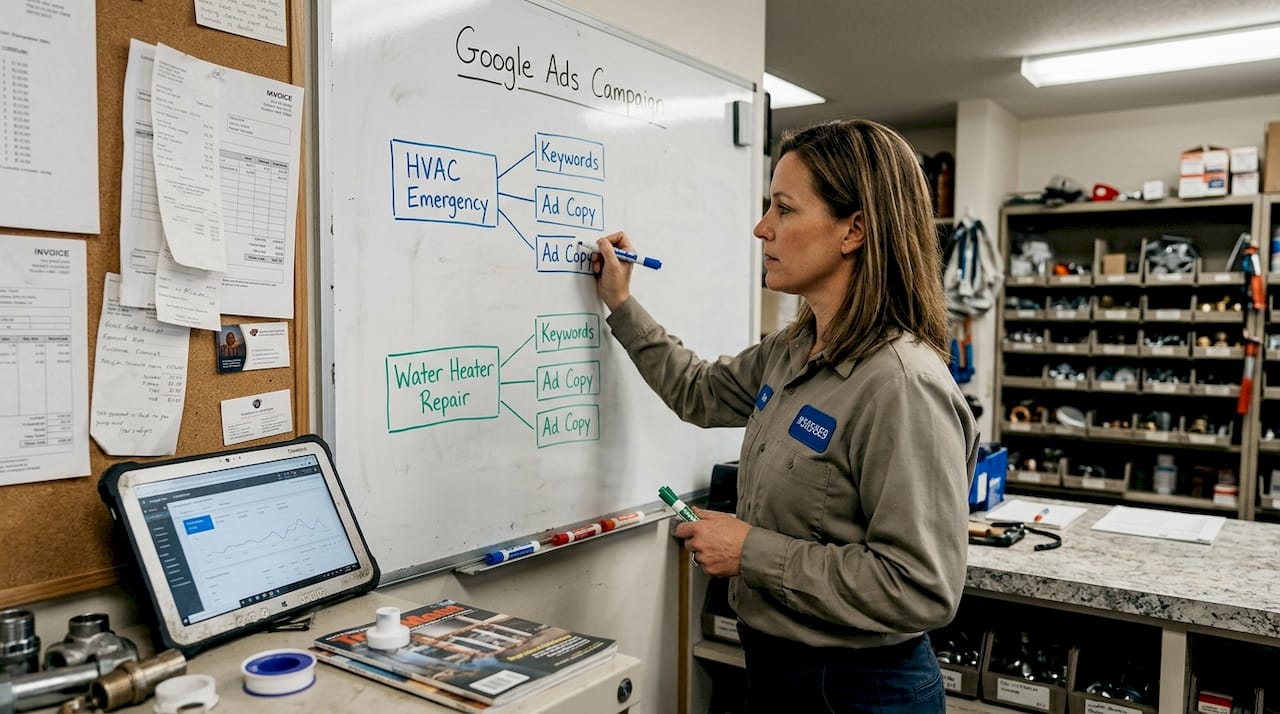
Campaign structure directly impacts relevance scores and cost efficiency. Create separate campaigns for distinct services rather than lumping all offerings into one campaign. A plumbing contractor should run independent campaigns for drain cleaning, water heater repair, and emergency services, each with tightly themed ad groups. This structure allows service-specific ad copy and landing pages that match search intent precisely, boosting Quality Score and conversion rates.
Landing pages make or break conversion performance. Sending all traffic to your homepage forces visitors to hunt for relevant information, increasing bounce rates and killing conversions. Service-specific landing pages with clear calls to action, local trust signals like Google reviews, and mobile-optimized contact forms convert 3 to 5 times better than generic homepage funnels. An HVAC contractor promoting AC repair should land clicks on a dedicated AC repair page, not a general services overview.
Local Services Ads offer an alternative pricing model worth comparing to standard PPC. You pay per qualified lead rather than per click, with Google screening calls to verify legitimacy. For emergency services where phone calls drive 80% of bookings, this lead-based model provides cost predictability. However, Local Services Ads require Google Guaranteed status and limit creative control compared to standard search ads. Many contractors run both simultaneously, using Local Services Ads for emergency keywords and standard PPC for maintenance and installation campaigns.
High-converting keyword characteristics:
- Include service type and location
- Signal immediate need or urgency
- Use buyer intent language
- Avoid informational qualifiers
- Match your actual service offerings
Standard PPC vs Local Services Ads comparison:
| Feature | Standard PPC | Local Services Ads |
|---|---|---|
| Pricing Model | Cost per click | Cost per qualified lead |
| Average Cost | $15 to $50 per click | $20 to $80 per lead |
| Ad Position | Search results with extensions | Top of page, above PPC ads |
| Requirements | Google Ads account | Google Guaranteed badge, background checks |
| Best Use Case | Maintenance, installations, broad services | Emergency calls, immediate service needs |
Pro Tip: Review your Houston plumbing PPC case study examples to see how campaign restructuring around service-specific themes cuts cost per lead. Implement negative keyword lists across all campaigns immediately, starting with “free,” “DIY,” “how to,” “salary,” and “jobs” to eliminate 15 to 25% of wasted clicks. Check Local Service Ads for plumbers if you want lead-based pricing for emergency services.
Measuring success: tracking and improving your Google Ads results
Tracking phone calls accurately is non-negotiable for home service contractors where 70 to 90% of conversions happen over the phone, not through web forms. Tools like CallRail assign unique tracking numbers to your ads, capturing which keywords and campaigns drive actual service calls. Without call tracking, you’re blind to your true cost per lead and risk cutting profitable campaigns while scaling losers. Google’s conversion tracking only captures on-page actions, missing the phone calls that generate your revenue.
Cost per lead benchmarks help evaluate campaign performance against industry standards. HVAC contractors typically see CPLs between $50 and $150 depending on service type and market competition, while plumbing emergency calls may cost $75 to $200 per lead in major Texas cities. Case studies show CPL reductions from $231 to $56 through systematic optimization of keywords, ad copy, and landing pages. Track your CPL weekly and compare against your average job value to ensure positive ROI.
Geographic performance data reveals which ZIP codes and cities deliver the best leads at the lowest cost. A Dallas HVAC contractor might discover that northern suburbs generate leads at $60 each while downtown areas cost $180 per lead. Use these insights to adjust bids by location, increasing spend in profitable areas and reducing or pausing campaigns in expensive zones with lower conversion rates. Location reports in Google Ads show exactly where your budget goes and which areas produce revenue.
Seasonal bid modifiers become critical for HVAC contractors facing dramatic demand swings. Increase bids 30 to 50% during summer cooling season and winter heating emergencies when customers pay premium rates and competition intensifies. Decrease bids during shoulder seasons when demand drops and lower-cost leads become available. Plumbing contractors should raise bids during holiday weekends and freeze events when emergency calls spike and customers need immediate service regardless of price.
Essential tracking metrics for contractors:
- Cost per lead including both form fills and phone calls
- Conversion rate from click to qualified lead
- Average job value from Google Ads leads
- Return on ad spend calculated as revenue divided by ad spend
- Geographic performance by city or ZIP code
- Time of day and day of week conversion patterns
Continuous optimization checklist:
- Test 2 to 3 ad copy variations per ad group monthly
- Add negative keywords weekly based on search term reports
- Pause keywords with zero conversions after 50 clicks
- Adjust bids based on device performance data
- Update landing pages quarterly with fresh reviews and offers
- Review competitor ads and adjust messaging accordingly
Pro Tip: Set up automated rules in Google Ads to pause keywords that exceed your target cost per lead after 20 clicks. This prevents runaway spending on underperformers while you focus on scaling winners. Export your search terms report weekly to find new negative keywords and discover unexpected high-performing search phrases to add as exact match keywords. Consistent weekly optimization compounds into major cost savings and lead volume increases over time. Connect with plumbing PPC services experts if you need help setting up tracking and optimization systems.
Enhance your Google Ads with expert SEO and PPC services
Google Ads delivers immediate visibility, but combining PPC with strong local SEO creates a dominant market presence that captures customers at every stage of their search journey. When your business ranks organically for key service terms while also running targeted ads, you occupy multiple positions on page one, dramatically increasing click-through rates and brand recognition. This dual approach builds trust faster than either channel alone.
Aim Set Win specializes in building integrated marketing systems for Texas plumbing, HVAC, and home service contractors. Our team combines technical PPC management with local SEO optimization, using data-driven strategies and AI-powered tools to maximize lead generation from every marketing dollar. We handle campaign setup, keyword research, ad copywriting, landing page optimization, and ongoing performance tracking so you can focus on running service calls.

Whether you need plumbing PPC services to scale lead volume or HVAC SEO services to build long-term organic visibility, our Texas-focused approach delivers measurable ROI through consistent inbound calls and qualified leads. We understand the competitive landscape in Houston, Dallas, Austin, and San Antonio, building location-specific strategies that align with local search intent and seasonal demand patterns. Learn why every plumbing business needs SEO to stay competitive and schedule a strategy consultation to discuss your growth goals.
Frequently asked questions
What budget should Texas contractors set for Google Ads?
Start with $1,500 to $3,000 monthly for single-location contractors testing Google Ads in competitive Texas markets. This budget allows enough click volume to gather meaningful performance data and optimize campaigns effectively. Multi-location contractors or those in highly competitive cities like Houston or Dallas should budget $5,000 to $10,000 monthly to maintain competitive ad positions and capture sufficient lead volume. Scale spending based on positive ROI once you identify which campaigns and keywords generate profitable service calls.
Should I use manual CPC or Smart Bidding for my contracting business?
Use manual CPC bidding when starting out or if your campaigns generate fewer than 30 conversions per month. Manual bidding gives you direct control over costs while learning which keywords convert best for your specific services and market. Switch to Smart Bidding strategies like Target CPA once you have at least 30 conversions monthly and accurate conversion tracking in place. Smart Bidding optimizes bids in real time using machine learning, but requires sufficient data to perform effectively.
How do Local Services Ads compare to standard Google Ads for contractors?
Local Services Ads charge per qualified lead rather than per click, offering more predictable costs for emergency service calls. You pay $20 to $80 per lead depending on service type and market, with Google screening calls to verify legitimacy. Standard PPC ads cost $15 to $50 per click with no guarantee of lead quality, but offer more creative control and work better for maintenance services and installations where customers research before calling. Many contractors run both simultaneously, using Local Services Ads for emergency keywords and standard PPC for planned service campaigns.
How important is call tracking for measuring Google Ads success?
Call tracking is absolutely essential for home service contractors where 70 to 90% of conversions happen over the phone. Without call tracking tools like CallRail assigning unique numbers to your campaigns, you cannot accurately measure cost per lead or determine which keywords and ads drive actual service calls. Google’s standard conversion tracking only captures on-page form submissions, missing the phone calls that generate most of your revenue. Accurate call tracking data prevents you from cutting profitable campaigns or scaling underperformers based on incomplete information.
Recommended
- Home service advertising: local SEO strategies for Texas contractors 2026
- Texas Advertising Agencies: 2026 Guide for Home Services – Aim Set Win
- West Texas HVAC Company Meta Ads Case Study – Aim Set Win
- Plumbing ads for Facebook in Texas: get more local leads
Jean runs growth strategy at AimSetWin, a performance marketing agency specializing in local service businesses across Texas. he's helped plumbers, HVAC companies, pest control operators, and home service brands build predictable revenue systems using data-driven advertising and conversion optimization.


