

Learn how many Google reviews Texas plumbers and HVAC contractors need to rank in the local Map Pack, with market data, velocity tips, and actionable benchmarks.
TL;DR:
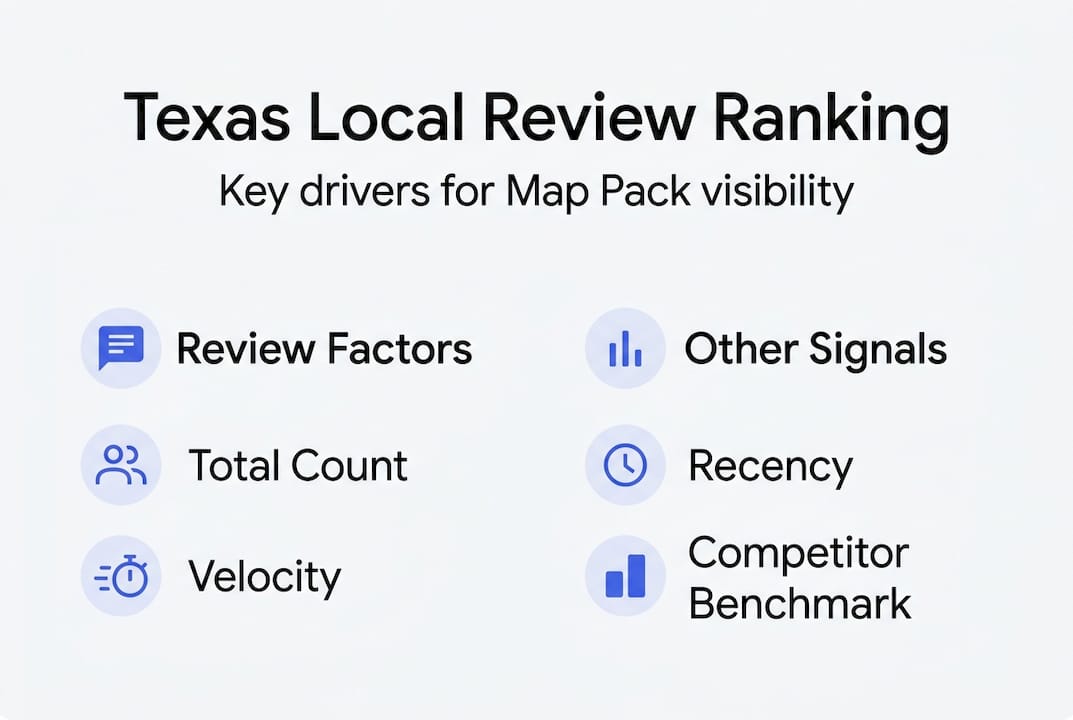
- Google reviews influence about 20% of local Map Pack rankings, weighing recency, velocity, and quality.
- Competitive review benchmarks vary by market, typically requiring 100 to 200 reviews for top placement.
- Consistent review velocity and profile optimization are more important than total review count alone.
Some Texas HVAC businesses sitting in the top 3 on Google Maps have over 1,000 reviews. Others hold that same spot with fewer than 100. That single fact destroys the myth that more reviews always means better rankings. The real question is not how many reviews you can collect, it is how many you need relative to your specific market. Whether you serve Dallas, Houston, or a smaller Texas city, the answer changes. This guide breaks down the actual data, Texas-specific benchmarks, and the exact steps you can take to build a review strategy that drives real local rankings.
Table of Contents
- How Google reviews influence local rankings
- What is the ‘right’ number of Google reviews? Texas data breakdown
- Review velocity and recency: The overlooked ranking advantage
- Common pitfalls: Why review count alone won’t guarantee Map Pack wins
- How to benchmark your review goals and build a winning local review plan
- The truth most Texas contractors miss about reviews and local SEO
- Ready to boost your local rankings? Get expert help
- Frequently asked questions
Key Takeaways
| Point | Details |
|---|---|
| Relative review targets | Ranking depends on matching or exceeding the review counts of your top 3 local competitors, not a preset number. |
| Review velocity matters | Consistently earning fresh reviews each month impacts local rankings more than a high total volume. |
| Texas market benchmarks | In DFW and Houston, top HVAC and plumbing firms usually have 100-1,000+ reviews, while rural areas may need just 25-75. |
| Avoid common pitfalls | A high review count alone won’t secure top rankings—business profile optimization and proximity are essential. |
| Set actionable goals | Benchmark your market’s Map Pack leaders and build a plan for steady, quality review growth to climb local rankings. |
How Google reviews influence local rankings
Before we talk numbers, let’s get clear on what we mean by “local ranking.” When someone searches “plumber near me” or “AC repair Houston,” Google shows two types of results: organic listings and the Map Pack. The Map Pack, sometimes called the Local Pack, is the block of three business listings that appears near the top of the search results with a map. Getting into those top three spots is where the real phone calls come from.
Google uses several signals to decide who earns those spots. Proximity (how close the business is to the searcher), relevance (how well the business matches the search), and prominence (how well-known and trusted the business appears online) all play a role. Reviews live inside that prominence category.
Reviews are not the only factor, but they are one of the most controllable ones available to you as a business owner.
According to Whitespark’s 2026 Local Pack ranking data, reviews account for roughly 20% of Local Pack ranking factors, landing in the top ten signals Google measures. That is a significant slice of the pie. But here is what many contractors miss: Google does not just count reviews. It weighs recency, velocity (how fast you earn them), ratings, and the quality of the content in those reviews.
Understanding Map Pack ranking factors in full helps you see the bigger picture. Reviews work alongside your Google Business Profile (GBP) optimization, website authority, and location data to push you up or hold you back.
Here is a quick look at the major local ranking signals you need to manage:
- Google Business Profile completeness (categories, hours, photos, services)
- Review quantity, recency, and ratings
- On-page local SEO (city-specific pages, NAP consistency)
- Website authority and backlinks
- Proximity to the searcher
- Behavioral signals (click-through rate, calls, direction requests)
Reviews are powerful, but they work best when every other signal is also firing correctly.
What is the ‘right’ number of Google reviews? Texas data breakdown
Here is the honest answer: there is no magic number. Rankings are relative to your competitors in your exact market, service category, and city. A plumber in Laredo does not need the same review count as one competing in Dallas.
That said, Texas data gives us useful benchmarks. Research from the HVAC GBP study for DFW shows that top-3 Map Pack businesses in Texas metro areas typically have between 100 and 1,000+ reviews, though some businesses make the cut with as few as 65. The table below gives you a practical snapshot of competitive thresholds across major Texas markets.
| Market | Service | Typical Min (Top 3) | Median (Top 3) | Max Observed |
|---|---|---|---|---|
| Dallas/Fort Worth | HVAC | 65 | 280 | 1,200+ |
| Houston | Plumbing | 90 | 320 | 1,500+ |
| Austin | HVAC | 75 | 210 | 900+ |
| San Antonio | Plumbing | 60 | 195 | 800+ |
| Small Texas City | Either | 25 | 65 | 200 |
Check out Dallas plumbing SEO data to see how these numbers translate into actual ranking strategy for that market.

Also, explore review benchmark data across industries to see where home services fall compared to other local businesses.
Here are the practical thresholds to keep in mind:
- 25 to 75 reviews: Viable in small or rural Texas markets
- 65 to 100 reviews: Competitive floor in mid-size cities
- 100 to 200 reviews: Strongly competitive in most Texas metros
- 200+ reviews: Essential for consistent top-3 in DFW and Houston
The key insight is this: chasing an arbitrary number wastes your energy. Your real target is the median review count of your top 3 local competitors, plus 20%. That is your benchmark. Google Business Profile tips can help you maximize what you already have while you build toward that number.
Review velocity and recency: The overlooked ranking advantage
Now let’s talk about the factor most contractors completely ignore: velocity. Review velocity means how consistently you earn new reviews over time. Google treats a business earning 5 fresh reviews per month as more active and trustworthy than a business sitting on 300 old ones with nothing new coming in.
Earning 2 to 10 new reviews per month consistently outperforms having a high total count but stagnant activity. Recency signals to Google that your business is active, serving customers right now, and relevant to today’s searches. Think of it like a heartbeat. You want Google to see a steady pulse, not a flat line with one big spike from three years ago.
Here is how different monthly velocities compare in terms of ranking strength:
| Monthly Review Rate | 12-Month Total Added | Expected Ranking Impact |
|---|---|---|
| 2 per month | 24 | Minimal but consistent signal |
| 5 per month | 60 | Solid competitive advantage |
| 10 per month | 120 | Strong signal in most TX markets |
For most Texas plumbing and HVAC businesses, a target of 5 to 8 new reviews per month is realistic and highly effective. Use monthly review targets as a KPI just like you track leads or calls.
Here is a simple numbered process to build consistent velocity:
- Ask every satisfied customer for a review at job completion, in person
- Follow up with a direct Google review link via text message within 24 hours
- Train your technicians to mention reviews naturally at the end of every call
- Add the review request to your invoice email or follow-up message
- Track your review count weekly and celebrate team milestones
Support your broader plumbing business growth by treating review collection as a core business process, not an afterthought.
Pro Tip: Build a simple checklist into your CRM or job management software that prompts techs to request a review before closing out every job ticket. Consistent staff reminders beat seasonal pushes every time.
Common pitfalls: Why review count alone won’t guarantee Map Pack wins
Here is something that surprises a lot of contractors: some businesses with 2,000+ Google reviews are not even in the top 3. How is that possible? Because the relationship between reviews and rankings is non-linear. Review count is just one piece. If your GBP is incomplete, your categories are wrong, or your ratings average is below 4.5 stars, you will lose to a better-optimized competitor with fewer total reviews.
Check out what other ranking factors play into your overall Map Pack position beyond just review volume.
Here are the most common mistakes Texas contractors make when chasing reviews:
- Ignoring GBP completeness: Missing services, outdated hours, or no photos send weak signals
- Wrong primary category: Listing as “Contractor” instead of “Plumber” or “HVAC Contractor” kills relevance
- Low average star rating: Anything below 4.5 stars hurts you, even with high volume
- Fake or incentivized reviews: Google penalizes unnatural review patterns
- No responses to reviews: Replying to reviews adds engagement signals Google values
- Chasing quantity without quality: Rushing customers to leave reviews before they are satisfied leads to mediocre 3-star ratings
You can learn exactly how to start outperforming competitors by focusing on the full picture, not just the numbers. And if you want proven SEO strategies for plumbers that go beyond reviews, there is a full roadmap available.
Pro Tip: Quality drives quantity naturally. When you deliver outstanding service, customers want to leave great reviews. Train your team to create memorable experiences, not just complete transactions.
How to benchmark your review goals and build a winning local review plan
Now let’s make this practical. Here is the methodology that actually works: analyze your top competitors, set a smart target based on their median review count plus 20%, and then build velocity toward that number month by month.
Here is your five-step process:
- Search your exact service and city on Google Maps (example: “HVAC repair Dallas”) and record the review count for each of the top 3 results
- Calculate the median of those three numbers, then add 20% to get your target
- Subtract your current count from that target to find your gap
- Divide the gap by 6 months to set a monthly velocity goal that closes the distance within half a year
- Track weekly using a simple spreadsheet or your CRM, and adjust your outreach if you fall behind
Repeat this analysis every 90 days because competitor counts change. Markets shift. A business that had 150 reviews last quarter may now have 220. Your target moves, so your plan needs to move with it.
For SEO for Texas plumbers, this benchmark-and-track approach is one of the fastest ways to gain measurable ground in competitive local markets.
Pro Tip: Use a free tool like Google Sheets or your job management CRM to log competitor review counts monthly. A simple tracking habit turns vague goals into clear weekly actions.
The truth most Texas contractors miss about reviews and local SEO
Here is our honest take after working with plumbing and HVAC businesses across Texas. Most contractors are playing the wrong game. They obsess over hitting some round number, whether that is 100 or 500 or 1,000 reviews, without ever looking at what their actual competitors have right now in their own zip code. That is like training for a race without knowing the distance.
The contractors who win in 2026 are not the ones with the most reviews. They are the ones with a complete, optimized GBP, a steady stream of fresh reviews, and a profile that matches exactly what local searchers are looking for. Velocity and precision beat volume every time.
Stepping back from the numbers, what we see daily in this market is that the biggest gains come from combining smart review velocity with expert strategies for Texas contractors that treat the entire local SEO ecosystem as one connected system. Reviews feed rankings. Rankings generate calls. Calls drive revenue. That chain only works when all the links are strong.
Ready to boost your local rankings? Get expert help
If reading this made you realize your review strategy has been guesswork, you are not alone. Most Texas contractors are leaving real ranking potential on the table. Aim Set Win specializes in building data-driven local SEO systems for plumbing and HVAC businesses across Texas, from Dallas to Houston to smaller markets you might not think are competitive yet.
Explore our SEO for plumbers solutions or check out our HVAC SEO services to see exactly how we build review systems that actually move rankings. Ready to see what your market looks like and where the gaps are? Explore our local plumbing SEO strategies and connect with our team for a focused audit of your current position.
Frequently asked questions
Is there a minimum number of Google reviews needed to rank locally?
No fixed number guarantees local ranking. You need to match or exceed the review counts of your top 3 competitors in your exact local market to be competitive.
Do new reviews matter more than having a large total review count?
Yes. Earning 2 to 10 new reviews each month consistently has a greater impact on local rankings than simply holding a large but stagnant total, especially in competitive Texas cities.
What review goal should a small-town Texas contractor set?
In smaller Texas markets, 25 to 75 reviews is often enough to be competitive, but you should always analyze the top 3 businesses in your exact local search results first before setting a target.
Can I rank in the Map Pack with fewer than 100 reviews in Texas?
While uncommon, some businesses rank in the top 3 with as few as 65 reviews. However, in cities like Dallas or Houston, having over 100 is typically the minimum to compete consistently.
What else should I focus on besides reviews to rank locally?
Focus on fully completing your Google Business Profile, using the correct primary business category, maintaining consistent NAP (name, address, phone) data across the web, and keeping your star ratings above 4.5 to stay competitive.
Recommended
- How to rank on Google Maps for HVAC in Texas
- Local service SEO best practices for Texas contractors 2026
- How to Rank Higher in Google Local Search | Aim Set Win
- Home service advertising: local SEO strategies for Texas contractors 2026
Jean runs growth strategy at AimSetWin, a performance marketing agency specializing in local service businesses across Texas. he's helped plumbers, HVAC companies, pest control operators, and home service brands build predictable revenue systems using data-driven advertising and conversion optimization.


