
Discover what SEO costs for small businesses in 2026. Learn about pricing models, what to expect at each tier, and how to budget for results.
If you’re running a plumbing, HVAC, or electrical business in Texas, you’ve probably wondered how much does SEO cost for small business. The answer isn’t as straightforward as you’d like. SEO pricing varies wildly depending on who you work with, what services you need, and how competitive your local market is. Some agencies charge $500 a month, others want $5,000, and a few charge hourly rates that make your head spin. But here’s what actually matters: what you get for your money and whether it moves the needle for your business. In this guide, we’ll break down the real costs of SEO for small businesses in 2026, explain what you should expect at each price tier, and help you figure out what makes sense for your budget. Ready to stop guessing and start planning? Let’s dive in.
Understanding SEO Pricing Models
Before you can answer how much does SEO cost for small business, you need to understand how agencies actually charge for their work.
There are four main pricing models you’ll encounter, and each has pros and cons depending on your situation.
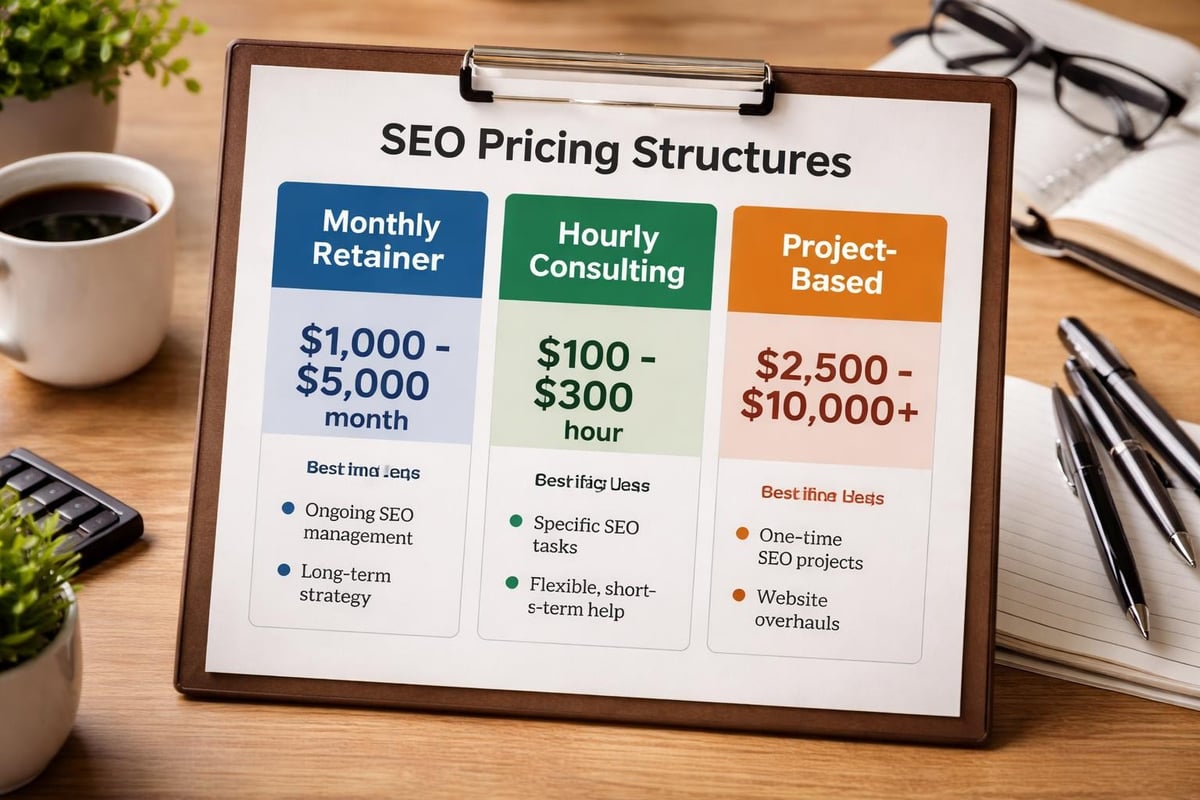
Monthly Retainer Pricing
This is the most common model you’ll see. You pay a fixed monthly fee, and the agency handles an agreed-upon scope of work.
Monthly retainers typically range from:
- $500 to $1,500 for basic local SEO (often limited to citation building and minor on-page work)
- $1,500 to $3,000 for comprehensive local SEO with content and technical optimization
- $3,000 to $7,500 for competitive markets with aggressive content strategies and link building
- $7,500+ for enterprise-level or highly competitive national campaigns
Most home service businesses in Texas fall into that $1,500 to $3,000 range if they’re working with a specialized agency. According to recent industry data on SEO pricing, this tier typically includes keyword research, Google Business Profile optimization, technical SEO fixes, monthly content creation, and local citation management.
The benefit of retainers is predictability. You know what you’re paying each month, and the agency can plan long-term strategies instead of chasing quick wins.
Hourly Consulting Rates
Some SEO consultants charge by the hour instead of offering packages.
Hourly rates typically run between $75 and $300 per hour, depending on the consultant’s experience and location. A seasoned expert in a major city might charge $200+ per hour, while someone newer to the field might start at $75 to $100.
This model works well if you need specific help, like an SEO audit, technical troubleshooting, or strategy planning. But it can get expensive fast if you need ongoing work. Most small businesses find hourly consulting useful for one-time projects but switch to retainers for long-term growth.
Project-Based Pricing
Instead of ongoing work, some agencies offer one-time projects with a fixed price.
Common project-based services include:
- Website SEO audit: $500 to $3,000
- Complete site migration or redesign: $2,500 to $10,000
- Local SEO setup (citations, GBP optimization, on-page): $1,000 to $5,000
- Content cluster creation: $2,000 to $8,000
This pricing model makes sense when you have a specific goal or problem. Maybe you’re launching a new website and need it optimized from day one. Or maybe you just want to fix technical issues that are holding you back.
The downside is that SEO isn’t really a one-and-done thing. Understanding what SEO costs for small businesses means recognizing it requires ongoing attention to maintain and improve rankings.
Performance-Based Pricing
A few agencies offer performance-based models where you pay based on results, like rankings achieved or leads generated.
Sounds great in theory, right? You only pay when they deliver.
The reality is trickier. Performance-based SEO often comes with higher fees when results do come in, and defining “success” can get complicated. What counts as a qualified lead? Do you pay for ranking #3 or only #1? And what happens if Google makes an algorithm change that tanks everyone’s rankings temporarily?
Most reputable agencies avoid pure performance pricing because too many variables are outside their control. That said, some offer hybrid models with a lower base retainer plus performance bonuses.
What Impacts How Much Does SEO Cost for Small Business
Not all SEO costs are created equal. Several factors push pricing up or down depending on your specific situation.
Your Market Competition Level
If you’re a plumber in a small Texas town with two competitors, ranking locally is much easier than competing in Dallas or Houston with hundreds of other contractors.
More competition means more work. Your SEO provider needs to create better content, build more backlinks, optimize more aggressively, and monitor more closely. All of that translates to higher monthly costs.
| Market Type | Typical Monthly SEO Cost | Competitive Level |
|---|---|---|
| Small town (under 50K population) | $800 – $1,800 | Low |
| Mid-sized city (50K – 300K) | $1,500 – $3,500 | Medium |
| Major metro (300K+) | $2,500 – $7,500+ | High |
Your industry matters too. HVAC and plumbing tend to be extremely competitive in cities because the lifetime value of customers is high. That competition drives up costs compared to less lucrative service categories.
Your Current Website Condition
Starting from scratch costs more than improving an existing foundation.
If your website is a mess with slow load times, broken pages, duplicate content, and zero mobile optimization, the agency needs to fix all that before they can even start optimizing for rankings. That initial cleanup can add $1,000 to $5,000 to your first few months of work.
On the other hand, if you already have a solid website built with conversion-focused web design and just need ongoing optimization and content, your costs will be lower.
Service Scope and Deliverables
What exactly are you paying for? That’s the question most business owners don’t ask clearly enough.
Basic local SEO packages typically include:
- Google Business Profile optimization and management
- NAP consistency fixes across directories
- Basic on-page optimization (title tags, meta descriptions, headers)
- Monthly citation building
- Basic monthly reporting
Comprehensive SEO packages add:
- Keyword research and strategy planning
- Regular content creation (blog posts, service pages)
- Technical SEO fixes and ongoing monitoring
- Link building and digital PR outreach
- Competitor analysis
- Conversion rate optimization
- Advanced analytics and ROI tracking
The more services included, the higher the cost. But here’s the thing: comprehensive packages usually deliver better ROI because SEO isn’t just about one thing. It’s a system where technical optimization, content, links, and local signals all work together.
Understanding SEO pricing structures helps you compare apples to apples when evaluating different providers.
Geographic Targeting Scope
Are you trying to rank in one city, or across multiple Texas markets?
A plumber focusing only on Austin has a narrower target than one trying to rank in Austin, Round Rock, Cedar Park, and Georgetown. More locations mean more content to create, more local citations to build, and more ongoing optimization work.
Multi-location SEO can easily double or triple your monthly costs compared to single-location strategies.
Agency Experience and Specialization
General marketing agencies typically charge less than specialized SEO firms. And specialists who focus exclusively on your industry (like agencies working only with home service businesses) often charge premium rates.
But here’s what you get for that premium: they already know what works in your industry. They understand your customer journey, your seasonal fluctuations, your competitor tactics, and your most profitable keywords. That expertise shortens your timeline to results dramatically.
A generalist might spend three months figuring out your industry while a specialist hits the ground running. When you calculate ROI based on how quickly you start getting more calls, the specialist often delivers better value even at higher monthly costs.
Typical SEO Cost Ranges for Small Businesses in 2026
Let’s get specific about what you’ll actually pay and what you should expect at each tier.
Budget Tier: $500 to $1,500 Per Month
This is the entry level for professional SEO services.
What you typically get:
- Basic Google Business Profile management
- Manual citation building (5-10 citations per month)
- Basic on-page optimization for existing pages
- Monthly ranking reports
- Limited communication (often just monthly email reports)
What you don’t get:
- Custom content creation
- Technical SEO fixes
- Link building
- Competitive keyword research
- Strategic planning
Is this tier worth it? Sometimes, if you’re in a very low-competition market or if you already have solid SEO foundations and just need maintenance. But most home service businesses in Texas cities won’t see meaningful results at this level.
According to detailed SEO pricing research, this tier works best for brand-new businesses just establishing their online presence, not for those trying to compete for valuable service calls.
The risk here is paying monthly for work that doesn’t move the needle. You spend $1,200 over six months and still don’t rank for anything that drives actual business.
Mid-Range Tier: $1,500 to $3,500 Per Month
This is the sweet spot for most small home service businesses asking how much does SEO cost for small business.
What you get:
- Comprehensive Google Business Profile optimization
- Ongoing citation building and management (15-25 per month)
- Technical SEO audits and fixes
- Monthly content creation (2-4 optimized blog posts or service pages)
- Basic link building (2-5 quality backlinks per month)
- Keyword research and strategy updates
- Regular communication and reporting
- On-page optimization for new and existing content
This tier typically delivers measurable results within 3 to 6 months for most markets. You’ll start seeing ranking improvements, more website traffic, and increased call volume if the strategy is executed well.
For a plumbing or HVAC company in a mid-sized Texas city, this investment usually pays for itself through just 2-4 additional service calls per month. When your average job value is $500 to $2,000, the math works out quickly.

Premium Tier: $3,500 to $7,500+ Per Month
This is for businesses in highly competitive markets or those with aggressive growth goals.
What you get:
- Everything from mid-range tier, but more of it
- Weekly or bi-weekly content publishing
- Aggressive link building campaigns (10-20+ quality backlinks per month)
- Advanced technical optimization
- Conversion rate optimization
- Dedicated account management
- Custom reporting dashboards
- Multi-location strategies
- Competitive intelligence and market analysis
- Strategic consulting beyond just SEO
Companies in Dallas, Houston, or San Antonio often need this level of investment to compete effectively. The markets are saturated with competitors who are also investing heavily in SEO.
But here’s the reality: if you’re doing $50,000+ per month in revenue and want to scale to $100,000+, this tier can absolutely get you there. The question isn’t whether it costs more, it’s whether you’re ready to capitalize on the increased lead flow.
DIY and Hybrid Options
Not everyone needs a full-service agency. Some business owners prefer a hybrid approach where they handle some SEO tasks themselves and hire help for specific pieces.
DIY tools you can use:
- Moz Local for citation management ($129-$249/year)
- Yoast SEO or Rank Math for on-page optimization (free or $99/year)
- Google Search Console and Analytics (free)
- SEMrush or Ahrefs for keyword research ($119-$449/month)
Hybrid approach costs:
- $200 to $800 per month for an SEO consultant who reviews your work and provides guidance
- One-time training session ($500 to $2,000) to learn the fundamentals
- Project-based help for technical issues ($500 to $3,000 per project)
The DIY route works if you have time and willingness to learn. The reality is that most business owners who try this route eventually hire help because they realize their time is better spent running service calls and managing crews.
If you’re considering tools like Moz Pro for your SEO efforts, factor in not just the subscription cost but the learning curve and time investment required.
What Should Be Included in Your SEO Investment
When you’re evaluating how much does SEO cost for small business, the price tag only tells part of the story. What matters more is what you get for that investment.
Essential Components of Effective Small Business SEO
Every legitimate SEO strategy for home service businesses should include these core elements:
Local SEO Optimization
Your Google Business Profile is your most valuable digital asset. It should be fully optimized with accurate business information, service categories, service areas, regular posts, review management, and Q&A monitoring.
Beyond GBP, you need consistent NAP (name, address, phone number) across all online directories. Inconsistencies confuse Google and hurt your local rankings.
Understanding local SEO strategies for small businesses gives you a foundation for what to expect from your SEO provider.
Technical SEO Foundation
Your website needs to be technically sound. That means:
- Fast load times (under 3 seconds)
- Mobile-responsive design
- Secure HTTPS connection
- Proper site structure and internal linking
- Clean, crawlable code
- Fixed broken links and redirect chains
- Structured data markup for local business information
Technical SEO for plumbers addresses speed, site structure, and local signals that impact rankings, all of which should be included in your SEO package.
Content Creation Strategy
Google ranks websites that provide value to users. That requires regular, high-quality content targeting the keywords your customers actually search for.
This isn’t about stuffing keywords into thin blog posts. It’s about creating comprehensive resources that answer questions, solve problems, and establish your expertise.
For example, content strategies that boost plumbing conversions focus on commercial intent keywords like “emergency plumber near me” or “water heater replacement cost” rather than informational fluff.
Your SEO provider should be creating:
- Service-specific landing pages optimized for high-intent keywords
- Location-specific pages for each area you serve
- Blog content addressing common customer questions
- FAQ content that appears in featured snippets
Link Building and Authority Development
Backlinks from other reputable websites signal to Google that your business is trustworthy and authoritative.
Quality matters far more than quantity here. One link from a local chamber of commerce or industry association is worth more than 100 links from spammy directories.
Building high-quality backlinks for plumbing SEO takes time and strategic outreach, which is why it’s often the most expensive component of comprehensive SEO packages.
Keyword Research and Targeting
Before creating content or optimizing pages, your SEO provider should conduct thorough keyword research to identify:
- High-volume keywords your customers are searching
- Commercial intent keywords that drive conversions
- Local modifiers specific to your service areas
- Long-tail opportunities with less competition
How to conduct keyword research for local SEO is foundational work that should happen before any optimization begins. If your provider skips this step, you’re likely wasting money on the wrong targets.
Red Flags in SEO Pricing
Not all SEO services are created equal. Here are warning signs that you’re not getting what you pay for:
Guaranteed rankings in specific timeframes. No legitimate SEO can guarantee #1 rankings in 30 days. Google’s algorithm is too complex and constantly changing.
Extremely low pricing. If someone offers “full SEO services” for $299 per month, they’re either outsourcing to low-quality providers or using automated tools that can actually hurt your rankings.
No clear deliverables. If an agency can’t explain exactly what they’ll do each month and how they’ll measure success, walk away.
Focus only on rankings, not conversions. Rankings matter, but what really matters is whether those rankings turn into phone calls and booked jobs.
No communication or reporting. You should receive at minimum monthly reports showing rankings, traffic, leads generated, and work completed.
How to Budget for SEO as a Small Business
So how do you actually figure out what to spend? Here’s a practical framework.
Calculate Your Customer Lifetime Value
Start by understanding what a new customer is worth to your business.
If your average plumbing job is $800 and the typical customer calls you 2-3 times over their lifetime (plus referrals), your customer lifetime value might be $2,500 or more.
Now ask yourself: what would you pay to acquire a customer worth $2,500? If you’d pay $200 to $500 for a customer through paid ads, then investing $2,000 to $3,000 per month in SEO that generates 10-15 new customers makes perfect financial sense.
Align Budget with Business Goals
What are you trying to accomplish?
Maintenance and stability: If you’re already ranking well and just want to maintain position, you might only need $1,000 to $1,500 per month.
Moderate growth: If you want to improve rankings and generate more leads, plan for $2,000 to $3,500 per month.
Aggressive expansion: If you’re trying to dominate your market or expand into new service areas, budget $4,000 to $7,500+ per month.
Your SEO budget should scale with your revenue goals. Many successful home service businesses allocate 5% to 10% of their revenue to marketing, with 30% to 50% of that going to SEO.
Consider Your Timeline
SEO is not instant. Depending on competition and your starting point, meaningful results typically take:
- 3 to 4 months to see initial ranking improvements
- 6 to 9 months to see consistent lead flow increases
- 12+ months to achieve dominant market positions
That means you need to budget for at least six months of consistent investment before judging whether SEO is working. Stopping at three months because you haven’t seen results yet is like planting a garden and giving up before harvest.
According to comprehensive SEO cost analysis, businesses that commit to 12-month SEO campaigns see average ROI improvements of 250% to 400% compared to those who stop at six months.
Compare to Alternative Marketing Channels
SEO costs should be evaluated against what you’re spending on other marketing.
| Marketing Channel | Typical Monthly Cost | Lead Quality | Sustainability |
|---|---|---|---|
| Google Local Service Ads | $1,500 – $5,000+ | High | Pay-per-lead only |
| Google Ads PPC | $2,000 – $8,000+ | Medium-High | Stops when budget stops |
| Facebook Ads | $800 – $3,000 | Medium | Stops when budget stops |
| Direct Mail | $1,000 – $4,000 | Low-Medium | One-time impact |
| SEO | $1,500 – $5,000 | High | Compounds over time |
The key difference with SEO is that it builds equity. When you stop paying for ads, your leads stop immediately. When you pause SEO after building authority, your rankings and traffic continue (though they’ll eventually decline without maintenance).
Over a 2-3 year timeline, SEO typically delivers the best cost-per-acquisition of any marketing channel for home service businesses.

How to Choose the Right SEO Provider for Your Budget
You know what SEO costs. Now how do you pick someone who’ll actually deliver results?
Questions to Ask Before Signing a Contract
Don’t just pick the cheapest option or the one with the slickest sales pitch. Ask these questions:
“What specific deliverables will I receive each month?”
They should provide a clear list: X blog posts, Y backlinks, Z technical fixes, etc.
“How do you measure success?”
Look for answers focused on business metrics (calls, form submissions, booked jobs) not just vanity metrics (traffic, impressions).
“Can you show me examples of results you’ve achieved for similar businesses?”
Any agency working with home service companies should have case studies showing ranking improvements and lead increases.
“What happens if I need to cancel?”
Understand the contract terms. Some agencies require 6-12 month commitments, others work month-to-month.
“Who will actually be doing the work?”
Will you work with the person selling you, or will your account be passed to junior staff? Will work be outsourced overseas?
Industry Specialization Matters
Generic marketing agencies can do decent SEO. But specialists who work exclusively with plumbing, HVAC, electrical, and home service companies deliver faster results because they already know:
- Which keywords convert best in your industry
- How to structure service pages for maximum conversions
- The seasonal trends that affect search volume
- Common technical issues in home service websites
- What types of content resonate with your audience
Agencies like Aim Set Win that focus exclusively on home service SEO in Texas understand the unique challenges of ranking in competitive markets like Dallas, Houston, and San Antonio.
Understanding Contracts and Commitments
Most legitimate SEO providers require some form of commitment because SEO takes time to show results.
Common contract structures include:
- Month-to-month with 30-day cancellation notice (rare, but preferred if available)
- 3-month minimum commitment (common for project-based work)
- 6-month minimum commitment (standard for comprehensive SEO)
- 12-month contracts (often with slightly reduced monthly rates)
Longer commitments typically come with lower monthly rates, but they also lock you in. If you’re working with a new provider, consider starting with a shorter commitment and extending once you see results.
Watch out for auto-renewal clauses that require 60-90 day cancellation notices. These can trap you into paying for months after you decide to leave.
Evaluating Proposals and Pricing
When comparing SEO proposals, create a spreadsheet listing:
- Monthly cost
- Contract length and terms
- Specific monthly deliverables
- Reporting frequency and detail
- Communication structure (weekly calls, monthly reviews, etc.)
- What’s included vs. what costs extra
The cheapest option is rarely the best value. Look for the provider offering the best combination of deliverables, expertise, and communication at a price that fits your budget.
Industry guides on SEO pricing often include calculators and comparison tools to help you evaluate whether you’re getting fair value.
Common SEO Cost Mistakes Small Businesses Make
Even when businesses understand how much does SEO cost for small business, they often make expensive mistakes.
Choosing Based Only on Price
The $299-per-month SEO package sounds attractive until you realize it delivers zero results. Six months later, you’ve spent $1,794 and have nothing to show for it.
Meanwhile, the business owner who invested $2,500 per month with a reputable provider is now getting 20+ qualified leads monthly and has more work than they can handle.
Cheap SEO is like cheap tools. It seems like a bargain until it breaks and you have to buy the right one anyway.
Expecting Overnight Results
SEO takes time. Period.
Business owners who expect to rank #1 for “plumber in Dallas” after 30 days of SEO work are setting themselves up for disappointment. When results don’t match unrealistic expectations, they cancel and switch providers, starting the whole timeline over again.
The most successful SEO clients understand they’re making a medium to long-term investment. They judge success on 6-month and 12-month trajectories, not week-to-week fluctuations.
Stopping Too Soon
This is the most expensive mistake of all.
You invest for 3-4 months, you’re starting to see movement in rankings, maybe a few more calls are coming in, but it’s not exploding yet. So you cancel.
What you don’t realize is that you were on month 4 of a 6-month curve. Another 2 months would have put you in the exponential growth phase where leads start flooding in.
Now all that investment is partially wasted, and you’re back to square one.
SEO compounds over time. The value in month 12 is exponentially higher than month 3, but you have to get through months 3-11 to reach it.
Not Tracking ROI Properly
Many business owners can’t actually tell you whether SEO is working because they’re not tracking the right metrics.
They look at website traffic or keyword rankings but don’t track:
- How many phone calls came from organic search
- How many web forms came from organic visitors
- How many of those converted to booked jobs
- What the revenue was from SEO-generated customers
Without tracking these metrics, you’re flying blind. You might be getting incredible ROI and not realize it, or you might be wasting money with zero return.
Set up proper call tracking, form tracking, and revenue attribution from day one. Your SEO provider should help with this.
Ignoring the Importance of Reviews
Your SEO budget shouldn’t stop at rankings and content. Reviews are a critical ranking factor for local businesses.
Google heavily weights review quantity, quality, recency, and response rate when determining local pack rankings. A business with 200 positive reviews will almost always outrank a competitor with 20 reviews, even if the competitor has better traditional SEO.
Ask your SEO provider how they’ll help you generate more reviews. If they don’t have a strategy for this, you’re missing a critical piece.
Focusing Only on Rankings, Not Conversions
Ranking #1 for “plumber in Austin” is useless if your website doesn’t convert visitors into calls.
Your SEO investment should include attention to:
- Clear, prominent phone numbers on every page
- Click-to-call buttons on mobile
- Simple, short contact forms
- Trust signals (licenses, insurance, years in business, certifications)
- Customer testimonials and case studies
- Clear calls-to-action
Why websites don’t convert and how to fix it is just as important as driving traffic to your site in the first place.
The Real ROI of SEO for Home Service Businesses
Let’s talk about what actually matters: return on investment.
Calculating Expected Returns
Here’s a realistic example for a plumbing company in a mid-sized Texas city:
Monthly SEO Investment: $2,500
Timeline to Results: 6 months
Total Investment (First Year): $30,000
Results After 12 Months:
- 30 additional organic leads per month
- 50% close rate (15 new customers per month)
- Average job value: $1,200
- Monthly revenue from SEO: $18,000
- Annual revenue from SEO: $216,000
ROI Calculation:
$216,000 (revenue) – $30,000 (cost) = $186,000 net gain
ROI: 620%
This is conservative. Many successful SEO campaigns for home service businesses deliver 10:1 ROI or higher once they hit their stride.
The key is patience and consistency. Those results don’t show up in month 2. They build gradually through months 6-12 and continue growing in year 2.
Long-Term Value vs. Short-Term Costs
The beauty of SEO is that it builds equity over time. Your rankings, content, and authority don’t disappear when you pause investment (though they will decline if neglected too long).
Compare that to paid advertising where every dollar you stop spending means leads stop immediately.
After 2-3 years of consistent SEO investment, many home service businesses reach a point where they dominate their market so thoroughly that they can reduce SEO spending to maintenance levels and still generate massive lead flow.
That’s when the real magic happens. You’ve built a lead generation asset that continues producing with minimal ongoing investment.
Case Study Examples
While specific numbers vary, the pattern is consistent across successful home service SEO campaigns:
Months 1-3: Technical fixes, content foundation, initial optimization
Months 4-6: Rankings start improving, traffic increases 30-50%, leads up 15-25%
Months 7-12: Compound growth kicks in, traffic up 100-200%, leads up 50-150%
Year 2+: Market dominance, traffic up 300-500%, leads up 200-400%
Looking at actual plumbing SEO case studies shows this trajectory playing out repeatedly across different markets and company sizes.
SEO Costs for Specific Home Service Industries
Different home service industries face different SEO challenges and costs.
Plumbing SEO Investment Ranges
Plumbing is one of the most competitive home service categories online. Why? Because the customer lifetime value is high, emergency calls convert immediately, and everyone needs a plumber eventually.
Typical monthly investment ranges for effective plumbing SEO:
- Small towns: $1,200 – $2,000
- Mid-sized markets: $2,000 – $4,000
- Major metros: $3,500 – $7,500
Dallas plumbing SEO requires significantly more investment than SEO in smaller Texas markets because of fierce competition from dozens of established companies all fighting for the same keywords.
HVAC SEO Costs
HVAC follows a similar pattern to plumbing but often faces even higher competition during peak seasons (summer and winter).
Monthly costs typically run:
- Small markets: $1,500 – $2,500
- Medium markets: $2,500 – $4,500
- Large markets: $4,000 – $8,000
Seasonal content strategies for HVAC require more frequent updates and refresh cycles, which can increase costs. Companies offering both heating and cooling need to optimize for two seasonal peaks instead of one.
HVAC marketing strategies in Austin and other growing Texas cities require aggressive content production and local SEO tactics to compete effectively.
Electrical, Roofing, and Remodeling SEO
These industries typically face slightly less search competition than plumbing and HVAC but still require substantial investment for results:
- Electrical: $1,500 – $4,500 per month
- Roofing: $1,800 – $5,000 per month
- Remodeling: $2,000 – $5,500 per month
Roofing SEO often costs more because storm-related emergency keywords are extremely competitive, and roofing companies tend to have higher average job values, making the market more attractive (and competitive).
Understanding how much does SEO cost for small business helps you budget realistically and avoid both overpaying and expecting miracles from bargain providers. For most home service businesses in Texas, investing $2,000 to $4,000 per month delivers solid returns within 6-12 months when executed properly. The key is choosing a provider who specializes in your industry, setting realistic timelines, and tracking actual business results, not just rankings. Aim Set Win builds revenue-focused SEO systems specifically for home service contractors across Texas, combining local optimization, technical excellence, and conversion-focused strategies that turn search visibility into qualified calls and booked jobs.
Jean runs growth strategy at AimSetWin, a performance marketing agency specializing in local service businesses across Texas. he's helped plumbers, HVAC companies, pest control operators, and home service brands build predictable revenue systems using data-driven advertising and conversion optimization.


