
Learn how Texas home service businesses can launch cost-effective paid ad campaigns using Google Local Services Ads and Facebook to drive qualified local leads and booked jobs.
If you run a plumbing or HVAC business in Texas, you know how hard it is to stand out when homeowners search for emergency repairs or seasonal maintenance. Paid advertising cuts through the noise by putting your services directly in front of high-intent customers the moment they need help. This guide walks you through setting up cost-effective paid ad campaigns that drive local leads without draining your budget, from optimizing your online presence to launching Google Local Services Ads and Facebook campaigns that convert.
Table of Contents
- Key takeaways
- Preparing your business for effective paid ads
- Step-by-step guide to launching your first paid ads
- Avoiding common pitfalls and optimizing performance
- Measuring success and scaling your paid advertising
- Boost your Texas home service leads with expert SEO and paid ads
- Frequently asked questions
Key Takeaways
| Point | Details |
|---|---|
| GBP optimization | Claim and verify your Google Business Profile, select exact service categories, set service areas by zip code, upload high quality photos, and collect 20+ reviews each month to improve trust and rankings. |
| LSA and Google Ads | Use Google Local Services Ads for predictable pay per lead pricing and pair with Google Ads for high intent to capture both awareness and direct inquiries. |
| Initial budget testing | Begin with a weekly LSA budget around 100 to 200 dollars to control spend while testing. |
| Precise geo targeting | Avoid broad keywords and misaligned geo targeting by defining city level or zip code service areas and keeping consistent NAP across listings. |
| Facebook ads branding | Combine Google Ads for high intent with Facebook Ads to build brand awareness. |
Preparing your business for effective paid ads
Before you spend a dollar on ads, you need a solid foundation. Your Google Business Profile is the cornerstone of local visibility for home service contractors. Set up Google Business Profile first, optimize with specific categories, service areas, photos, and collect 20+ reviews monthly for trust and rankings. Without this baseline, your paid ads will send traffic to an unprepared online presence that fails to convert.
Start by claiming and verifying your GBP listing if you haven’t already. Select the most specific service categories that match what you offer, whether that’s emergency plumbing, HVAC installation, or drain cleaning. Add your exact service areas by city or zip code so Google knows where to show your business. Upload high-quality photos of your team, trucks, and completed jobs to build credibility before prospects even call.
Reviews are your secret weapon. Businesses that collect 20+ reviews per month see dramatic improvements in map pack rankings and click-through rates. Set up a simple process to request reviews after every completed job, whether through text message, email, or a QR code on your invoice. Respond to every review, positive or negative, to show you care about customer experience. For detailed optimization strategies, check out our Google Business Profile optimization tips and local service SEO best practices for Texas contractors.
Consistency matters across the web. Make sure your business name, address, and phone number match exactly on your website, social profiles, and directory listings. Inconsistent information confuses Google and dilutes your local authority. Once your GBP is dialed in, your paid ads will amplify an already strong local presence instead of compensating for a weak one. This synergy between organic visibility and paid campaigns creates a multiplier effect that drives more qualified leads at lower costs. Learn more about comprehensive optimization in our Google Business Profile optimization guide.
Step-by-step guide to launching your first paid ads
Now that your online foundation is set, it’s time to launch campaigns that generate immediate leads. Small businesses should start paid ads with Google Local Services Ads for predictable pay-per-lead pricing, combined with Google Ads using exact/phrase match keywords and manual CPC bidding. This dual approach captures both top-of-funnel awareness and bottom-of-funnel intent.
Google Local Services Ads setup:
- Create your LSA account through Google and complete background checks for your business and technicians
- Set your weekly budget starting around $100-$200 to control spend while testing
- Define your service areas by zip code, focusing on neighborhoods with high homeownership rates
- Upload license and insurance documentation to earn the Google Guaranteed badge
- Monitor incoming leads through the LSA dashboard and respond within minutes for best conversion rates
LSA pricing typically ranges from $15-$50 per lead depending on your market and service type. Emergency plumbing leads in Dallas might cost $30-$40, while routine HVAC maintenance leads in smaller Texas cities run $15-$25. You only pay when someone contacts you directly through the ad, making it ideal for businesses new to paid advertising.
Google Ads campaign structure:
- Start with Search campaigns targeting high-intent keywords like “emergency plumber near me” or “AC repair Dallas”
- Use exact match and phrase match keywords to control who sees your ads and avoid wasted clicks
- Set manual CPC bidding starting at $3-$8 per click for competitive Texas markets
- Create tightly themed ad groups with 5-10 keywords each, grouping by service type and urgency
- Write ad copy that emphasizes speed, licensing, and local expertise with clear calls to action
- Build negative keyword lists immediately, excluding terms like “DIY,” “how to,” and “salary” to filter unqualified searches
Facebook Ads for brand awareness:
While Google captures active searchers, Facebook reaches homeowners before they have an emergency. Target users by zip code, homeownership status, and home value range. Promote seasonal services like AC tune-ups in spring or furnace checks in fall. Use video ads showing your team in action or carousel ads highlighting customer testimonials. Budget $200-$300 monthly for Facebook to complement your Google campaigns. For specialized strategies, explore our plumbing PPC services, Southwest HVAC PPC campaigns, and plumbing Facebook ads for Texas local leads.
Pro Tip: Start with manual CPC bidding instead of automated strategies when launching in competitive Texas markets like Houston or Dallas. This gives you direct control over costs while you gather performance data. After 30 days and 100+ conversions, you can test automated bidding strategies like Target CPA or Maximize Conversions with confidence.
Allocate your initial $500-$1000 monthly budget across platforms: 40% to LSA, 40% to Google Search Ads, and 20% to Facebook. Test for 30 days, track which campaigns deliver the lowest cost per booked job, then reallocate budget toward winners.
Avoiding common pitfalls and optimizing performance
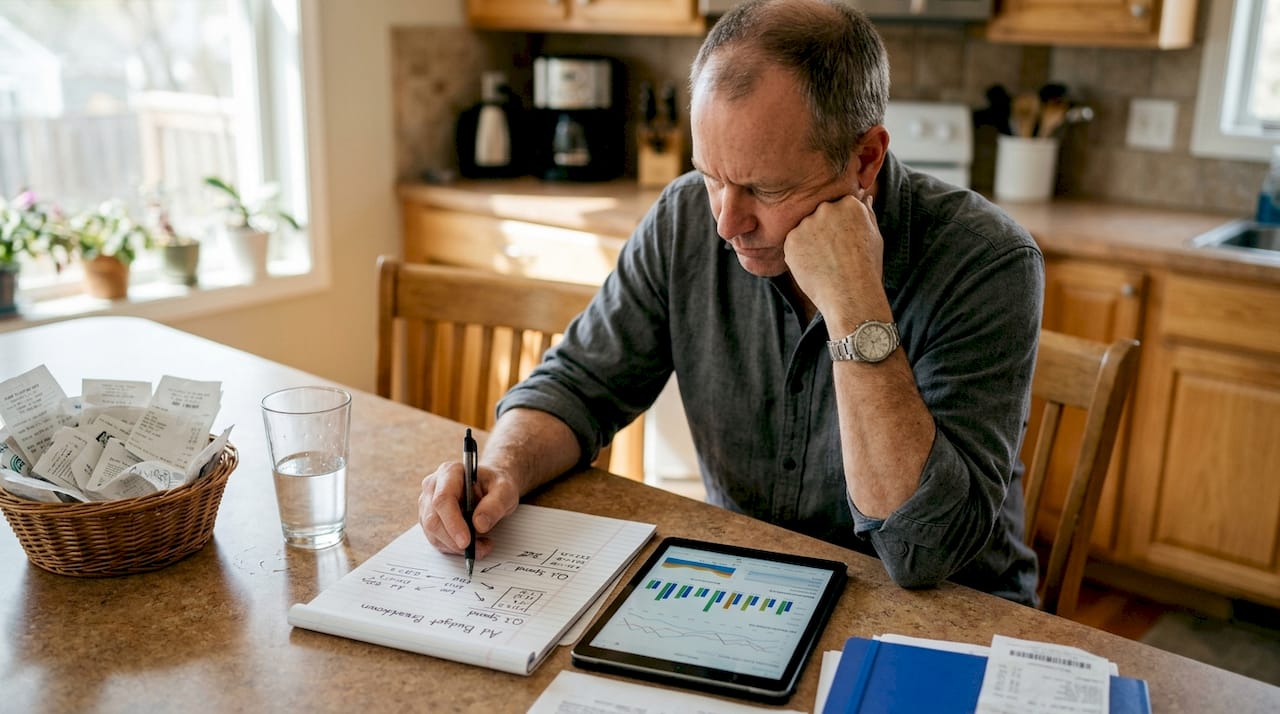
Even well-intentioned campaigns fail when you make preventable mistakes. Avoid broad match keywords, poor geo-targeting, no call tracking, and generic landing pages; LSA works better for beginners while PPC offers control and scale. Understanding these pitfalls saves you thousands in wasted ad spend.
Common mistakes that drain budgets:
- Using broad match keywords that trigger ads for irrelevant searches like “plumbing jobs” or “HVAC school”
- Setting geo-targeting too wide, showing ads to users 50+ miles outside your service area
- Running ads to your homepage instead of service-specific landing pages with clear conversion paths
- Failing to implement call tracking, making it impossible to know which campaigns drive actual phone calls
- Ignoring mobile optimization when 70%+ of local service searches happen on smartphones
- Not setting up conversion tracking for form submissions and calls, flying blind on ROI
LSA vs Google Ads comparison:
For beginners, LSA removes much of the complexity. You set your budget, Google manages the rest, and you pay only for legitimate leads. There’s no keyword research, no ad copywriting, and minimal ongoing optimization. However, you sacrifice control over exactly when and how your ads appear.
Google Ads demands more expertise but rewards you with granular control. You decide which keywords trigger ads, what your maximum bid is, and exactly what your ad says. This precision allows you to target ultra-specific searches like “tankless water heater installation Plano” and craft messaging that speaks directly to that intent. As you gain experience, Google Ads typically delivers better ROI at scale.
Texas home service ad performance benchmarks:
| Platform | Average CPL | Conversion Rate | Best Use Case |
|---|---|---|---|
| Google LSA | $25-$45 | 15-25% | Immediate leads, new advertisers |
| Google Search Ads | $30-$60 | 8-15% | High-intent keywords, scale |
| Facebook Ads | $15-$35 | 3-8% | Brand awareness, seasonal services |
These benchmarks vary by city, service type, and season. Emergency services command higher CPLs but convert faster. Maintenance services cost less per lead but require longer nurture cycles.
Pro Tip: Build a negative keyword list before launching any campaign. Start with obvious exclusions like “free,” “DIY,” “jobs,” “training,” “salary,” and “school.” Add to this list weekly as you review search term reports and identify wasted spend. A well-maintained negative keyword list can reduce irrelevant clicks by 30-40%.
Implement call tracking through providers like CallRail or CallTrackingMetrics to attribute phone calls to specific campaigns and keywords. Create dedicated landing pages for each major service with prominent phone numbers, trust signals like licenses and reviews, and simple contact forms. These tactical improvements often double conversion rates without increasing ad spend. For broader marketing support, review our Texas advertising agencies guide and Facebook ads performance for plumbing in Texas.
Measuring success and scaling your paid advertising
Launching campaigns is just the beginning. Sustainable growth comes from rigorous tracking, continuous testing, and strategic scaling. Start with a small budget, track calls and CRM data for ROAS; scale winning campaigns by 20-30% while maintaining 3x+ ROAS benchmarks.
Essential KPIs to monitor:
Cost per lead tells you how much you spend to generate each inquiry, but it’s incomplete without conversion rate. A $20 CPL that converts at 5% is worse than a $40 CPL that converts at 20%. Track both metrics together. Return on ad spend is your north star metric. Calculate it by dividing revenue from ad-generated jobs by total ad spend. Aim for 3x ROAS minimum, meaning every dollar spent returns three dollars in revenue. Top-performing campaigns hit 5-8x ROAS once optimized.
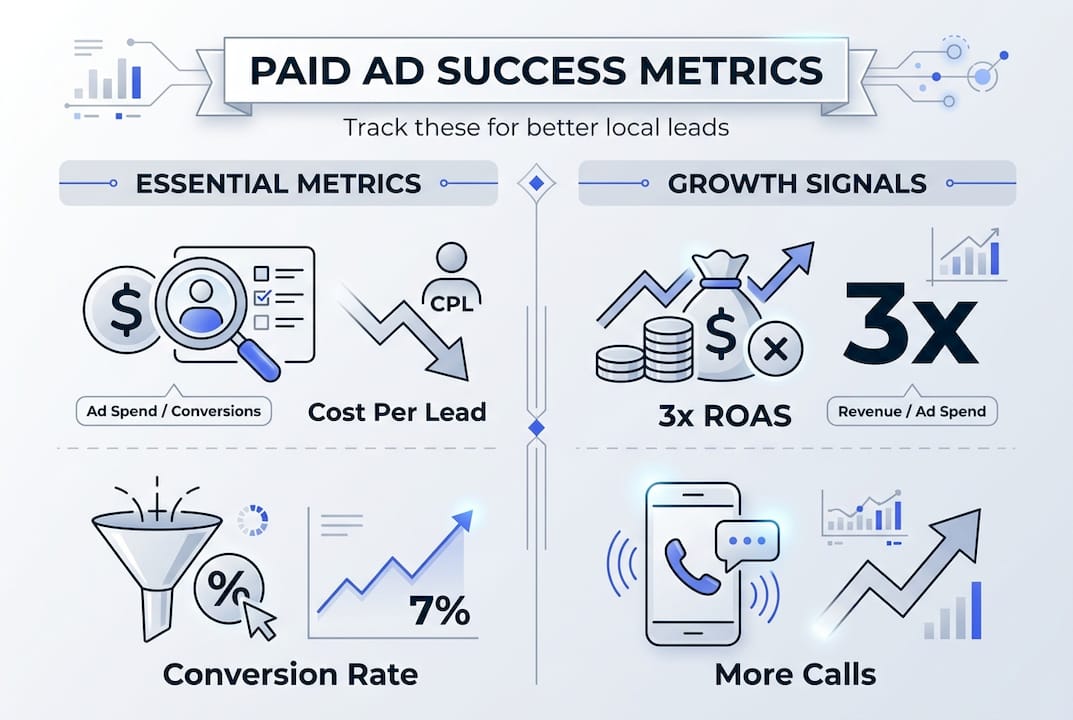
Cost per acquisition measures what you spend to book an actual job, not just generate a lead. This accounts for leads that don’t answer, aren’t in your service area, or choose competitors. Track customer lifetime value for services with recurring revenue like maintenance contracts. A $100 CPL is reasonable if that customer is worth $2000 over three years.
Tracking and attribution tools:
Integrate your CRM with ad platforms to track the complete customer journey from click to booked job to payment. Platforms like ServiceTitan, Jobber, or Housecall Pro offer native integrations with Google Ads and Facebook. Use UTM parameters on all landing page URLs to identify traffic sources in Google Analytics. Set up conversion tracking pixels on your thank-you pages to measure form submissions accurately.
Call tracking assigns unique phone numbers to each campaign so you know exactly which ad drove each call. Dynamic number insertion shows different numbers to visitors from different sources, enabling precise attribution even when multiple campaigns run simultaneously. Record calls for quality assurance and to identify common objections or questions that should be addressed in your ad copy.
Steps to analyze and optimize:
- Review campaign performance weekly, focusing on CPL, conversion rate, and ROAS by campaign and ad group
- Identify top-performing keywords and increase bids by 10-20% to capture more traffic
- Pause or reduce spend on keywords with CPL above your target threshold after sufficient data (50+ clicks minimum)
- A/B test ad copy variations, changing one element at a time like headlines, descriptions, or calls to action
- Analyze search term reports to discover new keyword opportunities and add irrelevant terms to negative lists
- Test different landing page elements including headlines, images, form length, and trust signals
- Adjust geo-targeting based on conversion data, increasing bids in high-performing zip codes
Scaling without sacrificing efficiency:
Once you identify winning campaigns with consistent 3x+ ROAS over 30 days, increase budgets gradually. A 20-30% monthly increase allows algorithms to adjust without disrupting performance. Doubling budgets overnight often tanks conversion rates as you move beyond your ideal audience.
Expand into new service areas or service types using the same campaign structure that worked initially. If emergency plumbing ads perform well, test drain cleaning or water heater installation with similar targeting and messaging. Add new keyword themes incrementally, monitoring performance closely before committing significant budget.
Daily and weekly optimization tasks:
- Check campaign budgets daily to ensure you’re not capped out early and missing evening or weekend traffic
- Review LSA lead quality daily and dispute spam leads immediately to protect your budget
- Monitor call recordings weekly to identify training opportunities for your team
- Update negative keyword lists weekly based on search term reports
- Adjust bids weekly on top keywords based on performance trends
- Test new ad copy variations bi-weekly to prevent creative fatigue
- Analyze competitor ads monthly using tools like SEMrush or SpyFu to identify messaging gaps
Integrate paid ads with your organic SEO efforts for maximum impact. When you rank organically and run ads for the same keywords, you dominate the search results page and dramatically increase click-through rates. Prospects who see your brand multiple times across LSA, paid ads, and organic listings perceive you as the market leader. Explore our SEO for plumbers to drive booked jobs and benefits of SEO for plumbing businesses to build this comprehensive approach.
Boost your Texas home service leads with expert SEO and paid ads
Paid advertising delivers immediate results, but combining it with a strong SEO foundation creates unstoppable momentum. When your business ranks organically for local searches and runs targeted paid campaigns simultaneously, you capture every possible touchpoint in the customer journey.
Aim Set Win specializes in building integrated marketing systems for Texas plumbing and HVAC contractors. We optimize your Google Business Profile, build authority through local SEO, and manage high-performance paid ad campaigns that deliver measurable ROI. Our clients see consistent lead growth because we focus on revenue, not vanity metrics.
Whether you need to understand why every plumbing business needs SEO, want expert HVAC SEO service in Dallas, or need proven plumbing PPC services that generate qualified leads, we build customized strategies for your market and goals. Let’s turn your ad spend into predictable revenue growth.
Frequently asked questions
What is the best paid ad platform for Texas home service businesses?
Google Local Services Ads offer pay-per-lead pricing that’s ideal for immediate leads and businesses new to paid advertising. Facebook Ads work well for brand awareness and promoting non-emergency services like seasonal maintenance to homeowners before they need urgent help.
How much should small businesses budget for paid ads?
Start with a $500-$1000 monthly budget to test campaigns across Google LSA, Google Search Ads, and Facebook. After 30 days of data, scale your budget by 20-30% on top-performing campaigns while maintaining your target cost per lead and ROAS benchmarks.
How can businesses track the effectiveness of their paid ads?
Use call tracking software to attribute phone calls to specific campaigns and keywords. Integrate your CRM with ad platforms to monitor the complete journey from click to booked job. Track key metrics like cost per lead, conversion rate, and return on ad spend to measure true campaign performance.
Why is optimizing Google Business Profile important before running ads?
An optimized Google Business Profile increases trust through reviews, improves local rankings, and complements your paid ads by dominating search results. When prospects see your business in LSA, paid ads, and organic map results simultaneously, conversion rates increase significantly because you appear as the established local authority.
Recommended
- Social Media Ads Pricing – Aim Set Win
- Paid Search in Local Services: Boosting Booked Jobs Fast
- Paid Search for Services: Turning Clicks Into Booked Jobs
- Google Local Service Ads for Plumbers Aim Set Win’s Expert Tips
- Paid Advertising: Πλήρης Οδηγός για Επιχειρήσεις – maverix.gr
Jean runs growth strategy at AimSetWin, a performance marketing agency specializing in local service businesses across Texas. he's helped plumbers, HVAC companies, pest control operators, and home service brands build predictable revenue systems using data-driven advertising and conversion optimization.


