
Learn how to recover lost HVAC revenue with local SEO steps, digital strategy, and proven marketing tactics to boost service calls and maximize profits.
Losing revenue can feel like a constant battle for Dallas HVAC business owners. As digital marketing grows more competitive, understanding where your income slips away is a first step toward recovery. With guidance rooted in industry statistics from the Air Conditioning, Heating, & Refrigeration Institute and local SEO methods, this article shows how a comprehensive audit and localized marketing strategies help you uncover hidden revenue channels and secure more service calls right in your Dallas community.
Table of Contents
- Step 1: Audit Your Current Revenue Channels
- Step 2: Identify Missed Local Search Opportunities
- Step 3: Optimize Google Business Profile For Dallas Leads
- Step 4: Revamp Website For High-Intent Conversions
- Step 5: Track Results And Refine Digital Strategy
Quick Summary
| Key Insight | Explanation |
|---|---|
| 1. Audit Your Revenue Channels | Identify underperforming revenue streams through a detailed analysis of your financial records over the past 12-24 months. |
| 2. Optimize Local Search Visibility | Use geo-specific keywords and local SEO strategies to attract more customers searching for HVAC services in your area. |
| 3. Enhance Google Business Profile | Optimize your profile with complete details and local keywords to improve visibility among Dallas customers seeking HVAC services. |
| 4. Focus on Website Conversion | Design your website with user experience in mind to convert visitors into high-intent customers effectively. |
| 5. Track and Refine Marketing Metrics | Implement a strategy to continuously monitor key performance indicators and adjust your marketing approach based on data insights. |
Step 1: Audit Your Current Revenue Channels
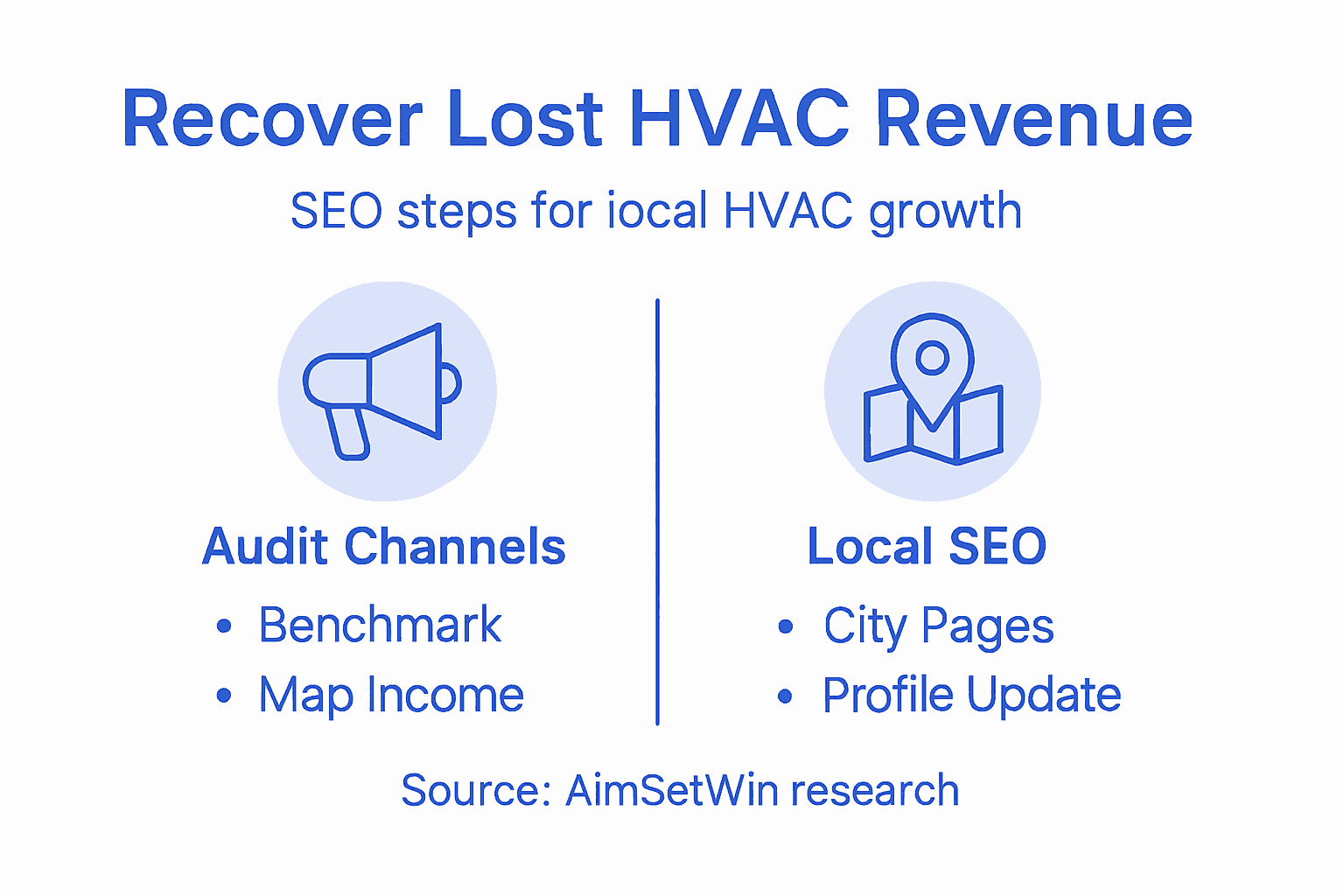
Recovering lost HVAC revenue starts with a comprehensive audit of your existing income streams. This critical process helps you identify where money might be slipping through the cracks and reveals opportunities for strategic optimization.
Begin by gathering detailed financial records from the past 12-24 months. You’ll want to categorize your revenue sources carefully, examining each channel’s performance using specific metrics. Focus on tracking these key revenue segments:
- Residential service calls
- Commercial maintenance contracts
- New system installations
- Emergency repair services
- Seasonal maintenance programs
- Extended warranty services
Utilize HVAC market performance data to benchmark your revenue against industry standards. This comparative analysis will help you pinpoint areas of underperformance or potential growth.
Create a spreadsheet that maps out each revenue channel’s total income, frequency of services, average ticket value, and profit margins. Look for patterns such as seasonal fluctuations, repeat customer rates, and service type profitability. This granular approach allows you to identify hidden revenue opportunities and strategic improvement areas.
Here’s a breakdown of common HVAC revenue channels and typical risks that affect their performance:
| Revenue Channel | Major Risk Factor | Example Impact |
|---|---|---|
| Residential service calls | High seasonality | Slow winters lower cash flow |
| Commercial maintenance contracts | Lengthy sales cycles | Lost renewals reduce revenue |
| New system installations | Economic downturns | Project deferrals increase |
| Emergency repair services | Inefficient dispatching | Long wait times lose leads |
| Seasonal maintenance programs | Low customer buy-in | Poor signups cause shortfall |
| Extended warranty services | Under-promotion | Missed upselling opportunity |
Tracking revenue channels isn’t just about numbers – it’s about understanding the story behind your business performance.
Pay special attention to low-performing segments. Sometimes, a channel might seem unproductive because of inefficient marketing, pricing strategies, or service delivery rather than genuine lack of demand.
Pro Tip: Implement a quarterly revenue channel audit to continuously optimize your HVAC business strategy and catch potential revenue leaks early.
Step 2: Identify Missed Local Search Opportunities
Unlocking hidden revenue potential for your HVAC business starts with strategic local search optimization. This step involves discovering untapped geographic markets and search queries that can transform your digital visibility and attract more potential customers.

Begin by conducting a comprehensive local search engine optimization analysis. Your goal is to map out exactly where and how potential customers are searching for HVAC services in your service area. This means diving deep into geo-specific keyword research and understanding local search behaviors.
Focus on these critical local search optimization strategies:
- Analyze Google Business Profile performance
- Investigate long-tail local keywords
- Examine competitor local search rankings
- Review service area coverage in online directories
- Track local search volume for specific HVAC services
Use tools like Google Keyword Planner and local SEO analytics platforms to uncover hidden search opportunity niches. Pay special attention to location-specific phrases like “emergency HVAC repair in [your city]” or “AC installation near me” that potential customers might use.
Local search isn’t just about visibility – it’s about connecting with customers precisely when they need your services.
Break down your local search research by service type, targeting areas where your competitors might have overlooked potential customer segments. This granular approach helps you capture underserved market segments and expand your revenue potential.
Pro Tip: Create location-specific service pages for each major city or neighborhood in your service area to maximize local search visibility and attract more targeted leads.
Step 3: Optimize Google Business Profile for Dallas Leads
Turning your Google Business Profile into a lead-generating powerhouse requires strategic optimization specifically tailored to the Dallas HVAC market. Your goal is to stand out among competitors and attract more local customers searching for reliable heating and cooling services.
Start by setting up a comprehensive business profile that showcases your HVAC expertise. This involves more than just basic information – you want to create a profile that speaks directly to Dallas homeowners and highlights your unique service advantages.
Critical optimization elements for your Google Business Profile include:
- Complete and accurate business information
- High-quality service photos and action shots
- Detailed service area coverage
- Compelling business description
- Regular posts about seasonal HVAC services
- Prompt response to customer reviews
Pay special attention to service area specifics for Dallas. Include neighborhoods, zip codes, and specific local service regions to improve your local search visibility. Use location-specific keywords that Dallas residents might use when searching for HVAC services.
Optimizing your Google Business Profile is like creating a digital storefront that attracts customers 24/7.
Track your profile’s performance using Google’s analytics tools. Monitor metrics like profile views, customer actions, and search queries that lead people to your listing. This data helps you continuously refine your local search strategy.
Pro Tip: Update your Google Business Profile at least weekly with new photos, posts, or service information to signal active engagement and improve local search rankings.
Step 4: Revamp Website for High-Intent Conversions
Transforming your HVAC website into a powerful lead generation machine requires strategic design focused on capturing and converting high-intent customers. Your website should serve as a digital sales representative that speaks directly to potential clients and compels them to take action.
Begin by optimizing your website for user experience with a laser focus on converting visitors into paying customers. This means creating a clean, intuitive design that guides potential clients exactly where you want them to go.
Key website conversion elements include:
- Clear and prominent service call-to-action buttons
- Mobile-responsive design
- Fast loading speed
- Compelling service descriptions
- Client testimonial sections
- Easy-to-find contact information
- Service area and pricing transparency
Develop targeted landing pages for specific HVAC services like emergency repairs, seasonal maintenance, or new system installations. Each page should address specific customer pain points and offer clear solutions that demonstrate your expertise.
Your website isn’t just an online brochure – it’s your most powerful sales tool.
Focus on creating trust-building content elements such as certifications, awards, and detailed service explanations. Use high-quality images of your team, service vehicles, and completed projects to build credibility and show potential customers you’re a professional HVAC provider.
See how key website conversion elements contribute to HVAC lead generation:
| Website Feature | Conversion Benefit | Trust Signal Example |
|---|---|---|
| Prominent call-to-action | Increases contact requests | “Get Quote” buttons |
| Mobile-friendly design | Captures mobile leads | Responsive layout |
| Customer testimonials | Boosts credibility | Posted 5-star reviews |
| Fast loading speed | Reduces abandonment | Loads under 2 seconds |
| Transparent pricing | Builds buyer confidence | Clear pricing tables |
Pro Tip: Implement heat mapping and user behavior tracking tools to understand exactly how visitors interact with your website and continuously optimize your conversion strategy.
Step 5: Track Results and Refine Digital Strategy
Measuring and analyzing your digital marketing performance is crucial for recovering lost HVAC revenue and creating a sustainable growth strategy. Your goal is to transform raw data into actionable insights that continuously improve your marketing approach.
Begin by developing a comprehensive digital tracking strategy that captures key performance indicators across multiple channels. This means setting up robust analytics that go beyond surface-level metrics and provide deep insights into your marketing effectiveness.
Critical metrics to track include:
- Organic search traffic
- Keyword ranking positions
- Website conversion rates
- Cost per lead
- Customer acquisition cost
- Revenue per service call
- Google Business Profile engagement
Implement advanced tracking tools that provide granular data about your digital marketing performance. Use platforms like Google Analytics, Google Search Console, and specialized HVAC marketing analytics software to gather comprehensive insights.
Digital strategy refinement is a continuous journey, not a one-time destination.
Schedule monthly review sessions to analyze these metrics and identify trends. Look for patterns in high-performing services, most effective marketing channels, and areas requiring strategic adjustments. Compare current performance against historical data to understand your progress and make informed decisions.
Pro Tip: Create a standardized monthly reporting template that tracks your key performance indicators, making it easy to quickly assess and communicate your digital marketing progress.
Boost Your HVAC Revenue with Proven Local SEO Strategies
Recovering lost HVAC revenue requires more than guesswork. This article highlights common challenges like missed local search opportunities and under-optimized Google Business Profiles that hold your business back from converting high-intent leads. If you are facing seasonal demand drops, inefficient digital visibility, or a website that fails to convert visitors into booked jobs, you are not alone. The good news is targeted SEO combined with data-driven strategies can unlock new revenue streams and help your HVAC business dominate competitive Texas markets.
At Aim Set Win, we specialize in driving results for HVAC companies through deep market research, technical website audits, and local SEO enhancement. Our tailored approach ensures your Google Business Profile shines for Dallas leads and your website converts visitors with clear calls to action. We build scalable growth systems that focus on measurable ROI and long-term brand authority. Learn more about how we help heating and cooling businesses succeed in the HVAC Archives – Aim Set Win.
Ready to turn your internet presence into a consistent stream of qualified HVAC leads? Connect with our team today and start recovering lost revenue with a digital strategy built specifically for your Texas service area. Visit Aim Set Win and take the first step toward predictable lead generation and booked jobs.
Frequently Asked Questions
How can I audit my current HVAC revenue channels to identify lost income?
Begin by gathering detailed financial records from the past 12–24 months, and categorize your revenue sources. Create a spreadsheet that tracks total income, service frequency, average ticket value, and profit margins to pinpoint areas for improvement and uncover hidden revenue opportunities.
What specific metrics should I use to analyze my HVAC business performance?
Focus on key metrics like residential service calls, commercial maintenance contracts, and emergency repair services. Monitor performance indicators such as average ticket value, frequency of services, and profit margins to evaluate which channels are thriving and which need attention.
How do I optimize my Google Business Profile for better local HVAC leads?
To enhance your Google Business Profile, ensure all your business information is complete and accurate, and include compelling images and a detailed service area. Update your profile regularly with posts about seasonal services to keep your business visible and engaging.
What steps should I take to improve my HVAC website for higher conversions?
Transform your website by creating a user-friendly design with clear service call-to-action buttons and mobile responsiveness. Focus on developing specific landing pages that target high-intent service keywords, improving both user experience and conversion rates.
How often should I track my HVAC digital marketing results?
Implement a monthly tracking routine to review key performance indicators, such as organic search traffic and conversion rates. Regularly analyze the data to identify trends and make informed adjustments to your marketing strategies for continuous improvement.
What should I prioritize when identifying missed local search opportunities?
Concentrate on analyzing local keywords and competitor rankings to uncover gaps in your service area. Create location-specific content or service pages based on your findings, focusing on underserved markets to attract more potential customers.
Recommended
- 7 Types of HVAC Marketing Strategies for Reliable Growth
- HVAC Marketing Terminology Explained for Texas Pros
- SEO Strategies for HVAC 2026: Proven Paths to Growth
- SEO Cost for HVAC Companies: The Ultimate Guide
Jean runs growth strategy at AimSetWin, a performance marketing agency specializing in local service businesses across Texas. he's helped plumbers, HVAC companies, pest control operators, and home service brands build predictable revenue systems using data-driven advertising and conversion optimization.


