
Discover a proven, step-by-step HVAC customer re-engagement workflow to turn past customer data into reliable booked jobs without new ad spend or leads.
Every HVAC business in Texas eventually hits a wall when past customers stop calling, even though your list is packed with hundreds of names. For companies relying on repeat jobs to keep crews busy, scattered or outdated customer records stand in the way of meaningful re-engagement. Building a solid workflow starts with a clear and organized customer database. This article will show you how to transform basic contact lists into actionable intelligence that drives real bookings—without spending an extra dollar on ads.
Table of Contents
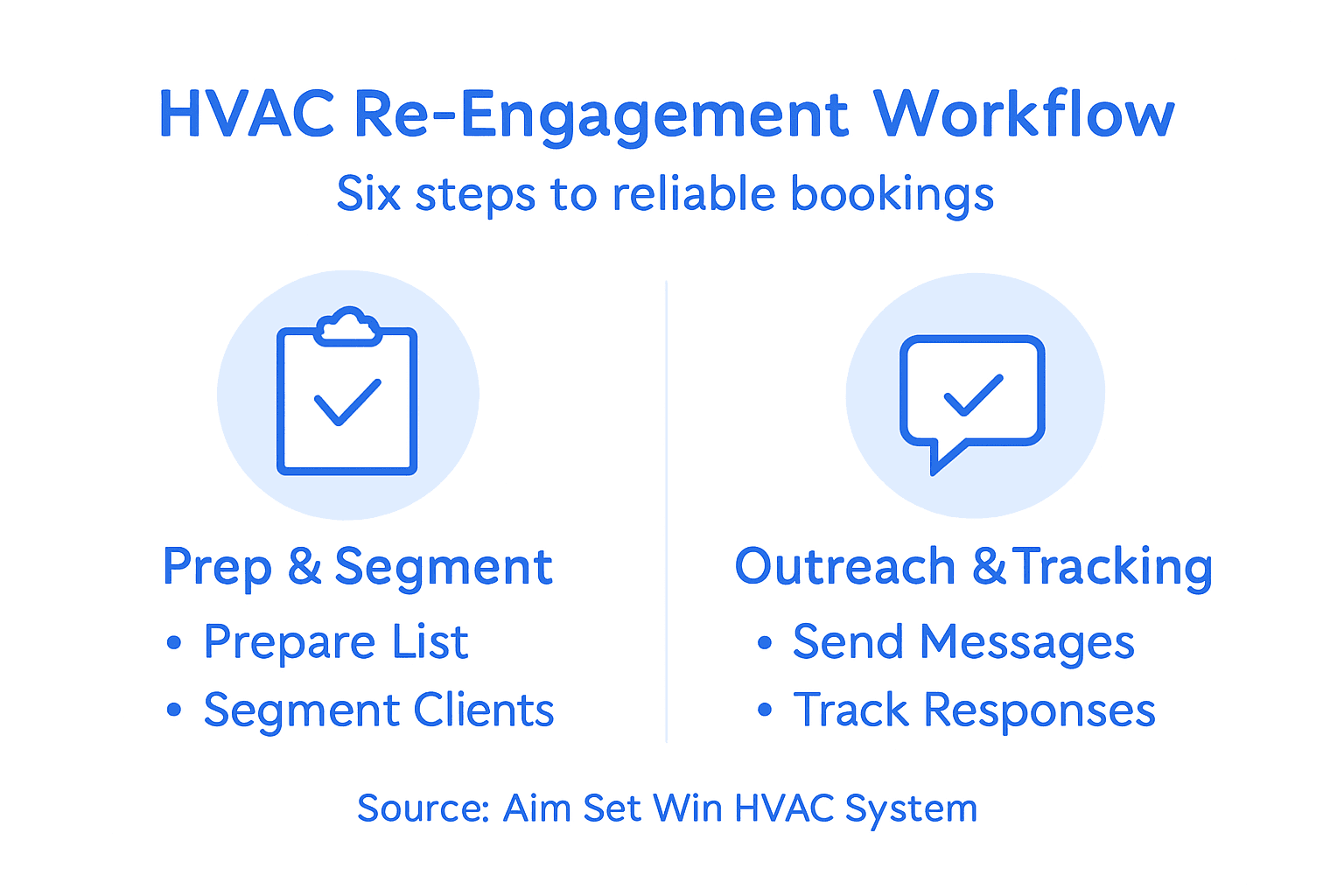
- Step 1: Prepare Your Customer Database
- Step 2: Segment and Prioritize Past Clients
- Step 3: Craft Personalized Outreach Messages
- Step 4: Automate Multi-Channel Re-Engagement
- Step 5: Monitor Responses and Book Appointments
- Step 6: Verify Results and Refine Workflow
Quick Summary
| Key Point | Explanation |
|---|---|
| 1. Clean and Organize Customer Data | Gather all customer records and eliminate duplicates to create a reliable database for effective re-engagement efforts. |
| 2. Segment Past Clients by Value | Identify key customer groups based on their spending, engagement, and historical behavior for tailored outreach strategies. |
| 3. Personalize Outreach Messages | Use specific customer history and tailored offers to increase engagement and response rates in your communications. |
| 4. Automate Multi-Channel Communication | Set up automated workflows that utilize email and text to consistently reach customers without manual intervention. |
| 5. Monitor and Adjust Based on Results | Track responses and booking rates to refine your engagement strategy, ensuring improvement in each subsequent cycle. |
Step 1: Prepare Your Customer Database
Before you can re-engage past customers, you need to know who they are and what matters to them. This step is about cleaning up your customer data and organizing it so you can actually reach people with messages they care about. Without a solid foundation here, your re-engagement efforts will fall flat or waste time on outdated information.
Start by pulling together all customer records from your job history, invoices, payment records, and past service calls. You probably have this scattered across different places, so gather it into one place first. Then go through and remove duplicates, fix obvious errors like misspelled names or phone numbers, and flag records where contact information is missing or looks incomplete. A customer record that’s missing a phone number or email address is useless for re-engagement, so be honest about what you can actually work with. Organize your data by separating customers into groups based on how long it’s been since they last booked with you, what services they purchased, and the frequency of their past jobs. This segmentation matters because a customer who used your services two months ago needs a different message than someone who hasn’t called in three years.
Next, add context to your records. Capturing customer feedback and preferences through past interactions, service notes, and any comments they’ve left helps you understand what these people actually need. If you have notes from technicians about customer preferences, their home setup, or past issues, add that information to your database. This transforms raw contact data into actionable intelligence. Make sure your database includes basic fields like name, phone number, email address, address, service history, last service date, and any notes about their situation. You don’t need to overcomplicate this. Well-structured customer databases with clear fields for interaction history and status make it much easier to run systematic re-engagement workflows that actually produce booked jobs.
Pro tip: Set aside one afternoon to do an initial audit of your best customers, those with the highest lifetime value or most frequent service needs. Start your re-engagement with these people first, since they’re most likely to rebook quickly and give you early wins.
Step 2: Segment and Prioritize Past Clients
Not all past customers are created equal. Some are ready to rebook immediately, while others need more nurturing. This step is about dividing your customer base into logical groups so you can send the right message to the right people at the right time, instead of blasting everyone with the same generic outreach.

Start by looking at your customer data and identifying what actually matters. Strategic analysis of customer behavior and value reveals which people are most likely to respond to your re-engagement efforts. Look at how recently they last used your services. A customer who had work done six months ago is different from someone who hasn’t called in five years. Next, consider how often they’ve booked with you historically. Customers who’ve used your services regularly show they trust you and understand your value, making them prime targets for re-engagement. Then examine the type and cost of services they’ve purchased. A homeowner who spent three thousand dollars on a new HVAC system installation is potentially worth more to you than someone who only came in for a quick maintenance call, but that maintenance customer might rebook faster. Include any notes about their responsiveness too. Did they answer when you called before? Did they reply to messages? Did they seem satisfied with the work? These patterns tell you who’s likely to actually respond when you reach out.
Once you’ve segmented your list, prioritize aggressively. Prioritizing based on customer lifetime value and responsiveness ensures your effort produces the fastest results. Create a tier system where your top tier includes customers with the highest service spend, most recent activity, and best historical responsiveness. These are your quick wins. The second tier includes steady, reliable customers who might take slightly longer to rebook but are very likely to convert. The third tier includes older contacts who may need more touchpoints or different messaging. Attack tier one hard first. Get those booked, prove the system works, and build momentum before moving down the list. You’ll see results faster and your team will stay motivated when early efforts produce actual jobs.
Pro tip: Use your best customers from the last twelve months as your priority list. They know you, trust you, and remember your work, which means they’re most likely to book within your first thirty days of re-engagement.
Here’s a quick comparison of customer segmentation tiers and their business impact:
| Tier Level | Typical Characteristics | Outreach Priority | Expected Booking Speed |
|---|---|---|---|
| Tier One | High spend, recent activity, responsive | Highest | Fastest (same week) |
| Tier Two | Reliable history, moderate engagement | Moderate | Medium (2-3 weeks) |
| Tier Three | Older contacts, low engagement | Lowest | Slowest (month+) |
Step 3: Craft Personalized Outreach Messages
A generic message to every past customer is a waste of time. The difference between a message that gets ignored and one that actually gets a response is personalization. This step is about writing outreach that speaks directly to each customer’s situation, acknowledges their history with you, and gives them a real reason to book.
Start with what you know about them. Pull their service history and remind them specifically what you did for them. Instead of writing “We miss you as a customer,” write “We installed your new air handler back in March 2022, and it’s been three years since we did your last maintenance call.” That specificity signals you actually remember them, not just that their name hit a mass email list. Personalized messaging that reflects individual preferences and addresses specific needs drives significantly higher response rates than generic outreach. Next, address why they might need you now. If they had a compressor replacement in the past, their unit is getting older. If they get seasonal maintenance, it’s probably time for their spring tune up. If they bought a new system, they’re due for annual service. Be specific about what value you’re offering based on their actual situation, not what you hope they need. Then add context about what’s changed. Energy costs are higher now. Equipment reliability matters more. Peak season is coming and wait times will be longer. When you acknowledge their new reality, you show you understand their world, not just your need for bookings.
Your tone matters just as much as your content. Personalized communications that acknowledge customers’ realities and provide relevant solutions build trust and encourage response. Use friendly, conversational language. Say “We’d love to help you stay comfortable this summer” instead of “Increase your system efficiency with our services.” Offer something concrete. A discount on their first service back, a free system inspection, priority scheduling, or a bundle on maintenance packages. Make it easy for them to say yes. Include one clear call to action with a phone number or simple booking link. And keep it short. A customer scrolling their phone won’t read three paragraphs. Two or three sentences plus your offer and your call to action is enough.
Pro tip: Mention the specific service they received and when you last worked with them. Customers forget details, so reminding them builds credibility and jogs their memory about why they trusted you in the first place.
Step 4: Automate Multi-Channel Re-Engagement
You cannot manually reach three hundred past customers one at a time and expect consistent results. Automation is what transforms re-engagement from a scattered effort into a reliable system that produces bookings month after month. This step is about setting up a workflow that sends the right message through the right channel at the right time, without you having to manage each outreach individually.
Start by choosing your channels. Email works well because it reaches people during their day and you can include links they can click to book. Text messages get higher open rates, especially for reminders close to appointment dates. Phone calls work best for your highest value customers or when someone has shown interest but hasn’t booked yet. Social media can work for brand awareness, but it’s less reliable for driving immediate bookings. Coordinated messages across multiple channels like email, SMS, and phone calls create more touchpoints and increase the chance someone sees your message when they’re actually thinking about their HVAC system. Start with two channels if you’re new to this. Email plus text message is a powerful combination that covers most people without overwhelming your process. Set up your automation tool to send an initial email to your top tier customers. Two to three days later, send a text message to the same people. If they respond or book, the automation stops. If they don’t, a follow up email goes out one week later. This cadence keeps you top of mind without being annoying.
The key to automation that actually works is using triggered messages based on customer actions or time intervals instead of blasting everyone on the same schedule. Someone who just opened your email should get a text soon after. Someone who clicked on your booking link but didn’t complete the reservation should get a gentle reminder. Someone who booked should get a confirmation, then a reminder the day before their appointment. These automated workflows save you from having to think about every individual customer while keeping everyone on a consistent track. Your CRM or automation tool should track who has responded, who has booked, and who still needs follow up. This gives you clear visibility into what’s working and where people are getting stuck. You can then adjust your messaging or timing based on what you actually see happening, rather than guessing. Most importantly, automation frees your team to handle calls and texts that come in, answer questions, and close jobs instead of managing outreach.
Pro tip: Start your automation with your tier one customers only. Get that working smoothly, measure your booking results, then expand to tier two. This prevents you from overwhelming yourself and lets you optimize before scaling.
Step 5: Monitor Responses and Book Appointments
Your automation is now running in the background, but your job is far from over. The real work happens when customers start responding. This step is about staying on top of those responses, converting interest into actual booked appointments, and tracking what’s working so you can improve.
Set up a system to monitor incoming messages in real time. Whether they come through email, text, or phone calls, you need to know about them immediately and respond fast. Customers who reach out are warm leads at that exact moment. If you wait hours or until the next day to respond, they may have already called a competitor or moved on. Assign someone on your team to check for responses regularly, or use tools that alert you when messages come in. When someone responds, your goal is simple: get them booked. Don’t make them answer a bunch of questions or jump through hoops. Ask when they’re available and what service they need, then offer them appointment times. Make booking easy by giving them a link they can click or a time they can confirm immediately. Tracking reply rates and engagement metrics provides real-time feedback that helps you see which messages work and which ones miss the mark. Are more people responding to text than email? Are certain message angles getting better response rates? Monitor these patterns and adjust your future outreach based on what you actually see happening.
Beyond monitoring responses, track your booking results. Response monitoring through data analytics helps identify barriers and opportunities for improved service that might slow down your workflow. Which customer segments are booking fastest? Which ones need a follow up call instead of just automated messages? Are people booking but then canceling? These insights tell you where to focus effort. Once someone books, confirm it immediately through email and text. Send them details about what to expect, who will arrive, and how to prepare. This reduces no shows and builds confidence in your business. At the end of your first week, pull your numbers. How many people did you reach? How many responded? How many booked? These metrics become your baseline. In week two, refine your messages based on what worked. Send slightly different wording or offer adjustments and watch how response rates shift. You’re building a system that gets better every cycle.
Pro tip: Assign one person to manage responses during business hours. They should answer every inquiry within two hours maximum, ask the qualifying questions, and attempt to book the appointment that same day while interest is highest.
Step 6: Verify Results and Refine Workflow
You have completed your first full cycle of re-engagement. Customers have responded, appointments have been booked, and work has been done. Now comes the part that separates businesses that get lucky from those that build reliable systems. This step is about measuring what actually happened and using those results to make your workflow better.
Pull together your numbers and look at them honestly. Start with reach. How many customers did you contact across all your tiers? Track response rate next. Out of everyone you reached, how many actually replied or took some action? Then measure booking rate. Out of those who responded, what percentage actually booked an appointment? Finally, calculate your revenue impact. How many jobs came from this re-engagement cycle, and what was the total value? These four metrics tell you everything about whether your system is working. A fifty percent response rate sounds good until you realize only twenty percent of those people actually booked. That gap tells you your messaging is getting attention, but your offer or booking process needs adjustment. Analyzing performance indicators such as booking rates and customer satisfaction gives you clear direction on what to change next.
Now dig deeper. Which customer segment had the best response rate? Which channel drove the most bookings, email or text? Which specific message angle got the most traction? Did your tier one customers respond differently than tier two? Reviewing engagement cycles and adjusting segmentation criteria and message content based on collected data is how you optimize. If text messages are outperforming email by three to one, shift more resources to text. If your tier one customers are mostly booking on the same day but tier two needs a second follow up, adjust your automation rules accordingly. If one message variation about maintenance got thirty percent response but another got twelve percent, use the winning version going forward. Do not guess. Let your actual results guide what you change.
Then run the second cycle with your refinements in place. You should see improvement immediately. Better response rates, faster bookings, higher revenue per cycle. If something got worse, revert that change. Keep what works and cut what does not. Run this process every month for the first three months, then quarterly after that. Each cycle teaches you more about your specific customer base and what actually moves them to book. You are building a re-engagement machine that gets smarter and more profitable over time.
Pro tip: Track your numbers in a simple spreadsheet before and after each refinement. Seeing the improvement from one cycle to the next keeps your team motivated and proves the system is working.
The table below summarizes key metrics to track for ongoing improvement:
| Metric | What It Tells You | How to Use the Data |
|---|---|---|
| Reach | Total customers contacted | Measure outreach coverage |
| Response Rate | % who replied or acted | Assess message effectiveness |
| Booking Rate | % who scheduled appointments | Evaluate conversion success |
| Revenue Impact | Value generated from bookings | Calculate return on effort |
Unlock Reliable HVAC Bookings with Proven Customer Re-Engagement Systems
Re-engaging past HVAC customers can feel overwhelming when managing messy data and crafting personalized outreach. This article highlights how crucial it is to prioritize high-value clients, automate your messaging across channels, and track every response to turn dormant contacts into booked jobs. If struggling to build a consistent workflow that drives quick bookings and maximizes lifetime value sounds familiar, you need a system designed for real-world results.
At Aim Set Win, we specialize in installing a Revenue Recovery System that works quietly behind the scenes to recover missed revenue without relying on new leads or costly ads. Our approach aligns perfectly with the detailed steps in this workflow by focusing on clean customer data, targeted segmentation, and automated multi-touch communication. Combined with measurable outcomes and clear execution, our solutions help HVAC professionals—not just get more bookings but build predictable growth month after month. Learn more about how we help HVAC businesses reclaim their revenue inside our HVAC Archives – Aim Set Win and start transforming your past customers into your most reliable bookings today.
Ready to stop chasing cold leads and start generating consistent HVAC appointments within 30 days? Visit Aim Set Win now to discover hassle-free systems that turn existing demand into revenue. Take the first step toward predictable growth and reclaim your business momentum.
Frequently Asked Questions
How can I prepare my customer database for re-engagement?
To prepare your customer database for re-engagement, start by gathering all customer records and cleaning up the data by removing duplicates and correcting errors. Organize the information into segments based on customer activity and preferences to enable targeted messaging.
What is the best way to segment my past clients for effective outreach?
Segment your past clients by their service history, spending patterns, and engagement levels. Prioritize contacts based on their likelihood to book by categorizing them into tiers according to their last service date and historical responsiveness.
How do I create personalized outreach messages that drive bookings?
Craft personalized outreach messages by referencing specific past services and addressing current needs. Tailor your message to highlight the benefits based on their service history and include an enticing offer to increase the chances of booking.
What channels should I use for automating my re-engagement outreach?
For automating your re-engagement outreach, utilize email and text messaging as primary channels due to their high engagement rates. Set up a sequence that initiates contact via email, followed by a reminder text if no response is received within a few days.
How can I effectively monitor responses and convert them into bookings?
Establish a system to monitor responses in real-time from all outreach channels. Aim to respond quickly, ideally within two hours, to capitalize on customer interest and streamline the booking process by suggesting specific times for their appointments.
What metrics should I track to verify the success of my re-engagement workflow?
Track key metrics such as the total number of customers contacted, response rates, booking rates, and the total revenue generated from these bookings. Regularly analyze these metrics to identify areas for improvement and make data-driven adjustments for future outreach cycles.
Recommended
- HVAC Predictable Growth Process for Reliable Revenue Boost
- Lead Re-Engagement Tools for Texas Plumbers – 2026
- Home Service Business Systems: Unlocking Revenue
- HVAC SEO Services | Top Rankings & Local Leads
Jean runs growth strategy at AimSetWin, a performance marketing agency specializing in local service businesses across Texas. he's helped plumbers, HVAC companies, pest control operators, and home service brands build predictable revenue systems using data-driven advertising and conversion optimization.


