
HVAC marketing terminology explained for Texas business owners. Learn key terms, revenue recovery strategies, channels, and common mistakes to avoid.
Running a Texas HVAC company with hundreds of customers means you face a flood of technical terms every day. From BTU to SEER ratings, industry jargon can confuse both your team and your customers, making clear communication harder than it should be. Understanding the core vocabulary behind system measurements and capacity lets you speak with authority and uncover new revenue opportunities hiding in plain sight.
Table of Contents
- Core HVAC Marketing Terms Demystified
- Differences Between Channels and Campaigns
- Types of Revenue Recovery Strategies
- Measuring Results: Metrics That Matter
- Pitfalls and Misuses in HVAC Marketing Lingo
Key Takeaways
| Point | Details |
|---|---|
| Understand Key HVAC Terms | Familiarize yourself with HVAC terminology to improve communication and establish trust with customers. |
| Differentiate Channels and Campaigns | Recognize the distinction between channels and campaigns to effectively allocate marketing resources and measure success. |
| Implement Revenue Recovery Strategies | Utilize targeted strategies like re-engagement, upselling, and optimization to reclaim uncollected revenue from existing customers. |
| Focus on Relevant Metrics | Track meaningful metrics in acquisition, retention, and performance to improve decision-making and marketing effectiveness. |
Core HVAC Marketing Terms Demystified
When you’re running an HVAC company with 300-plus customers, you need to speak the language of your industry. Your customers, your team, and your marketing partners all use HVAC terminology that can feel like a different dialect entirely. The gap between understanding technical jargon and actually using it to communicate value is where most Texas HVAC companies lose money. You might hear a customer mention BTU requirements or a marketing partner reference load calculations, but without clarity on what these terms actually mean in a business context, you’re making decisions on incomplete information.
The core terminology in HVAC marketing centers around three key areas. First, system measurements and capacity terms like BTU (British Thermal Unit) and SEER ratings tell customers exactly how much cooling or heating power you’re delivering and how efficiently your systems operate. Second, equipment components and functions such as compressors, condensers, and air handlers form the foundation of what you’re actually selling. Third, operational and performance metrics like load calculations and seasonal efficiency ratings directly impact how you position solutions to different customer needs. When you understand HVAC system components and terminology, you can bridge the gap between technical reality and customer value propositions.
Here’s what separates companies that recover revenue from ones that don’t: clarity in communication drives customer trust. A customer asking about their existing system’s efficiency isn’t looking for a physics lesson. They want to know if your upgrade will lower their summer electric bills or make their home more comfortable. When you translate technical terms into business outcomes, you move beyond educating customers and start closing conversations. For example, instead of explaining SEER ratings in isolation, you connect it to actual energy savings they’ll see on their next power bill. Understanding these terms also helps you identify upsell opportunities within your existing customer base, which is exactly where your revenue recovery system finds hidden demand.
Pro tip: Create a simple one-page glossary of ten to fifteen terms your team uses most often, define each in plain language with a business outcome, and train your phone team to use this reference when talking to prospects or existing customers.
Here is a quick reference summarizing key HVAC marketing terms and their impact on business communication:
| Term | Plain Language Meaning | Business Impact |
|---|---|---|
| BTU | Heat output measurement | Helps size systems for customer comfort |
| SEER Rating | Efficiency score for AC | Enables marketing energy savings benefits |
| Load Calculation | System capacity estimate | Assures correct solution is offered |
| Compressor | Moves refrigerant in system | Used to explain repair or upgrades |
| Air Handler | Distributes air throughout | Supports conversations about airflow |
| Seasonal Efficiency | Year-round performance rate | Helps promote long-term cost benefits |
Differences Between Channels and Campaigns
Most HVAC business owners use these two terms interchangeably, and that’s where strategy falls apart. You’ll hear someone say “we’re running a Facebook campaign” or “our email channel is performing well,” and the language blurs together into one confusing pile. But channels and campaigns are fundamentally different things, and understanding this distinction directly impacts how you allocate your marketing budget and measure results. A channel is the medium itself. Email is a channel. Google Search is a channel. Facebook is a channel. Your website is a channel. These are the pathways through which your message reaches customers. A campaign, on the other hand, is the coordinated effort you run within one or more channels to achieve a specific goal. You might run a “Spring Maintenance Special” campaign across email, Google Search, and Facebook simultaneously, or you might run a “New Construction Service Territory” campaign primarily through Google Search ads and your website.

Here’s where this matters for your revenue recovery system. When you’re re-engaging your 300-plus existing customers, you’re not just picking a channel and hoping something sticks. You’re running a specific campaign with a defined objective (book ten seasonal maintenance appointments in the next 30 days), a clear message (your system needs a spring tune-up before peak season), and multiple touchpoints across channels (email reminders, phone outreach, SMS follow-ups). Marketing campaigns employ multiple channels to coordinate messaging and timelines toward specific outcomes. Without this clarity, you end up scattered. You might send an email one week, post on Facebook randomly, and hope your phone rings. Instead, successful HVAC companies run campaigns that orchestrate their channel activity. Your email channel supports your campaign goal. Your paid search supports your campaign goal. Your website supports your campaign goal. Everything points in the same direction.
The practical difference shows up in your reporting too. If you only look at channel performance, you see that email generated 12 leads last month. But did those 12 leads convert to jobs? Were they the right customers? Did they have the budget? A campaign approach asks different questions. Your “Spring Maintenance Special” campaign generated 12 leads across email, search, and website, and 8 of those converted to booked appointments. That’s the metric that matters. For HVAC companies focused on revenue recovery, this distinction means you stop thinking about channels as separate buckets and start thinking about campaigns as coordinated systems that pull from multiple channels to achieve real business outcomes.
Pro tip: Name every marketing effort you run as a campaign with a specific 30-day goal, then assign which channels will support it and track conversion by campaign, not just by channel.
Types of Revenue Recovery Strategies
Revenue recovery isn’t about squeezing more from customers you already have. It’s about reclaiming money that’s already sitting on the table, uncollected. For HVAC companies with 300-plus existing customers, this means identifying three distinct buckets of lost revenue and treating each with a different strategy. First, there’s the re-engagement strategy, where you contact past customers who haven’t used your services in months or years. These are people who already know you, already trust you, and already have HVAC systems that need maintenance or upgrades. Second, there’s the upsell strategy, where you identify existing maintenance customers and introduce them to higher-value services like system replacements, energy-efficient units, or smart controls. Third, there’s the optimization strategy, where you adjust your service pricing, package offerings, or seasonal promotions to match customer demand more precisely. Each strategy targets different revenue leaks in your business.
The re-engagement strategy works because it costs far less to bring back a dormant customer than to acquire a new one. You already have their contact information, their system history, and their trust. A simple email or phone call reminding them that their system is due for spring maintenance or hasn’t been serviced in two years can generate booked jobs within 30 days. The upsell strategy focuses on customers actively using your maintenance services. When you know a customer has a ten-year-old system and they’re paying for annual tune-ups, you have a clear opportunity to introduce a replacement conversation. Revenue optimization strategies involve structuring how you present pricing and service packages to increase the value of each customer interaction. This might mean bundling services, creating seasonal promotions, or introducing financing options that remove budget barriers. The key difference is that optimization isn’t about being aggressive. It’s about making it easier for customers to say yes to the services they actually need.
Here’s what separates companies that recover significant revenue from those that don’t: they treat revenue recovery as a system, not a one-time push. You don’t send one email and hope. You don’t make one phone call per customer and move on. Instead, you create a repeating cycle. Contact dormant customers on a 90-day rotation. Present upsell opportunities at specific service milestones. Test different pricing and messaging quarterly to see what resonates. The companies winning at revenue recovery measure everything. They know exactly how many dormant customers they re-engaged, what percentage converted to jobs, and what the average job value was. They track upsell success rates and understand which customer segments are most likely to upgrade. This data-driven approach transforms revenue recovery from guesswork into reliable, repeatable income that doesn’t depend on new leads or paid advertising.
Pro tip: Segment your customer database into three groups today: dormant (no service in 12+ months), active maintenance (regular tune-ups), and one-time service (never returned). Create a 30-day action plan for each segment with specific contact methods and value propositions tailored to their history.
This table compares the three main revenue recovery strategies for HVAC companies:
| Strategy | Target Customer Group | Main Approach | Primary Business Goal |
|---|---|---|---|
| Re-engagement | Dormant customers | Outreach via calls, emails | Win back lapsed business |
| Upsell | Active maintenance clients | Suggest higher-value services | Increase revenue per customer |
| Optimization | All service segments | Adjust pricing/packages/promotions | Maximize margin and conversions |
Measuring Results: Metrics That Matter
You can’t improve what you don’t measure. This is the fundamental truth that separates HVAC companies generating consistent revenue from those that feel like they’re throwing money at marketing and hoping something sticks. Most Texas HVAC business owners track vanity metrics. They see 47 website visitors last month and feel good about it. They notice 12 phone calls came in and assume the marketing is working. But those numbers tell you almost nothing about actual business impact. Are those website visitors converting to job quotes? Did those 12 phone calls result in booked appointments or just tire-kickers asking questions? Without the right metrics, you’re flying blind.
The metrics that actually matter for HVAC companies fall into three clear categories. First, acquisition metrics measure how many potential customers you’re reaching and converting. This includes cost per lead, conversion rate from lead to estimate, and cost per booked job. Second, retention metrics track how your existing customers behave. This is where revenue recovery lives. How many dormant customers did you re-engage this month? What percentage of re-engagement campaigns converted to bookings? What’s your average revenue per re-engaged customer compared to acquisition cost? Third, performance metrics quantify the results your services deliver. Energy efficiency improvements and cost savings matter to customers because they translate directly to lower utility bills and environmental impact. When you can show a customer that upgrading to a new system will reduce their summer cooling costs by 28 percent, you’re speaking their language. These three metric categories form your complete picture of marketing health.
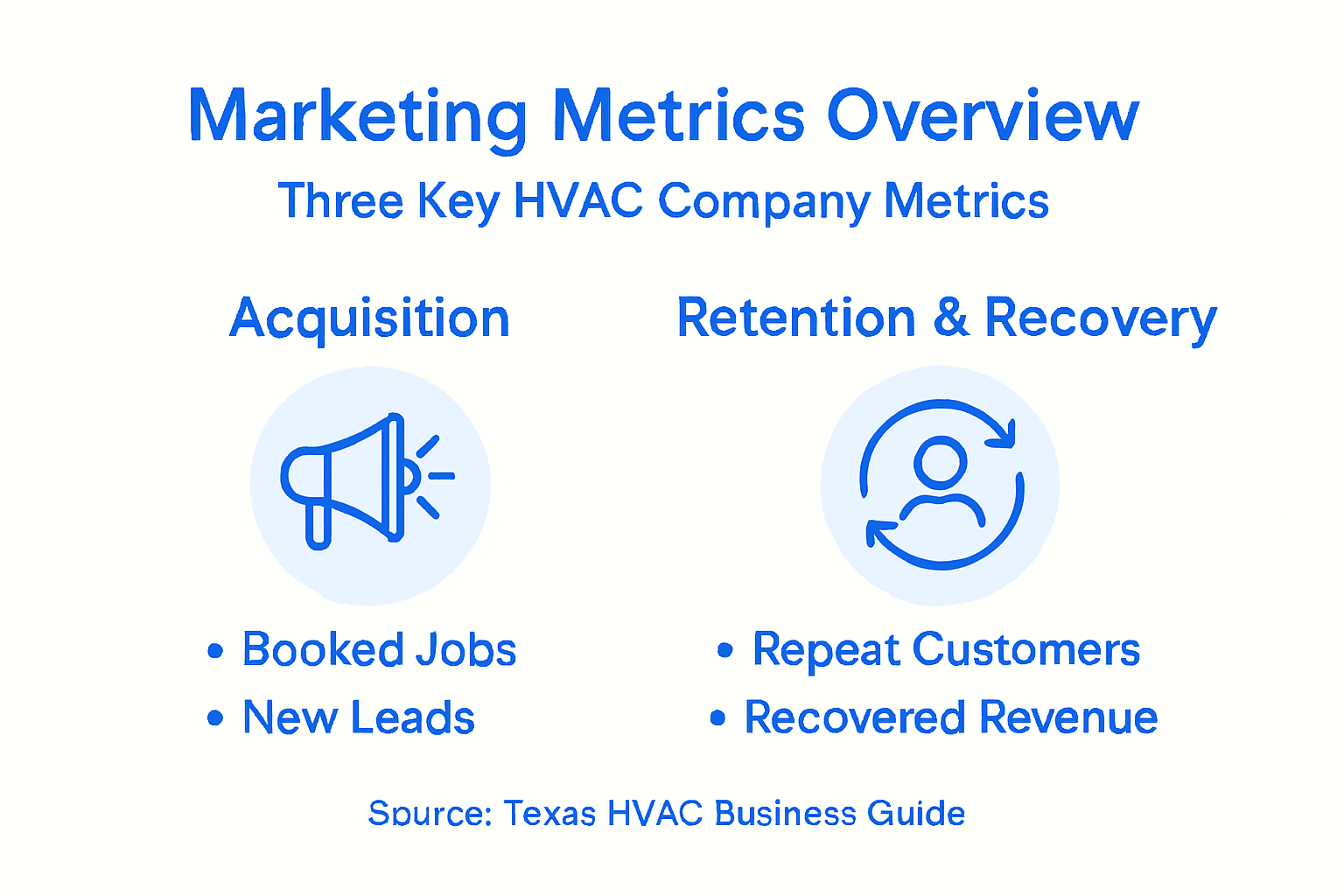
Here’s what separates revenue recovery systems from scattered marketing efforts. A revenue recovery system tracks metrics systematically. You know exactly how many customers are in each segment of your database. You measure the response rate to each re-engagement touch. You track the days between initial contact and booked appointment. You calculate the average job value for re-engaged customers versus new customers. You monitor which messaging resonates with which customer segments. This data reveals patterns. Maybe your dormant customers respond better to email than phone calls. Maybe your maintenance customers are 3.2 times more likely to upgrade systems in spring than fall. Maybe a specific discount offer on spring tune-ups converts 34 percent of contacted customers to bookings. These specific, measurable insights become the foundation of your next campaign.
Start by identifying your three critical metrics this month. Pick one metric from each category: acquisition, retention, and performance. Write them down. Set targets for 30 days from now. Then measure them weekly. The act of measuring creates accountability and reveals what’s actually working. Companies tracking these metrics consistently outpace those that don’t, particularly when revenue recovery is your primary focus. Your existing customer database is your most valuable asset. Treating it like guesswork is costing you thousands in lost revenue.
Pro tip: Set up a simple spreadsheet this week tracking one metric from each category: cost per booked job (acquisition), re-engagement conversion rate (retention), and average job value from re-engaged customers (performance). Review it every Friday and watch your patterns emerge.
Pitfalls and Misuses in HVAC Marketing Lingo
Words matter. When you throw around technical terms without understanding what they actually mean, customers notice. They might not call you out directly, but their trust erodes. They start comparing your offer to competitors. They begin questioning whether you know what you’re talking about. This is where misused HVAC marketing language costs you deals and damages your reputation. The most dangerous pitfall is overpromising efficiency gains without backing them up with actual system design. You’ll hear HVAC companies claim their new system will reduce energy costs by 40 percent or guarantee perfect comfort. These statements sound good on a landing page or in a sales call, but they’re hollow without accounting for proper installation, ductwork design, system sizing, and maintenance requirements. A system installed improperly delivers nowhere near its rated efficiency. Yet the marketing language stays the same. Customers feel deceived when reality doesn’t match the promise.
Another common misuse involves throwing technical jargon at customers who don’t need to understand it. You might talk about load calculations, BTU output, and SEER ratings when what the customer actually cares about is whether their system will keep their upstairs bedroom cool during summer heat. Instead of translating technical terms into customer outcomes, some HVAC marketers use jargon as a barrier to show expertise. It works the opposite way. Customers want clarity. When they hear terms they don’t understand without context, they assume you’re either trying to confuse them or that you don’t know how to explain what you do. Proper HVAC commissioning and performance verification ensure that marketing claims align with actual delivered performance. This distinction matters tremendously. You’re not just selling equipment. You’re selling reliability and results. Marketing language that disconnects from actual service delivery creates angry customers, poor reviews, and lost referrals.
The third major pitfall is using comparisons that don’t hold up under scrutiny. You might say your system is “top of the line” or “best in class,” but without specifics, these claims mean nothing. Top compared to what? Best by which metric? SEER rating, durability, warranty, customer satisfaction? Vague superlatives create skepticism. Specific, measurable claims create confidence. Instead of saying your service is “the best maintenance program,” say your maintenance program includes quarterly inspections, refrigerant checks, and a 24-hour emergency response guarantee. Numbers, specifics, and measurable promises beat flowery marketing language every single time. Companies that win at revenue recovery understand this distinction deeply. They know their existing customers have already experienced their service. Using inflated language now will only remind customers of previous gaps between promise and delivery.
Pro tip: Audit your website, emails, and sales scripts this week for three things: any efficiency or cost-saving claims without specific conditions, any technical jargon without plain-language translation, and any vague superlatives like “best” or “top-rated” without backing metrics.
Unlock Your HVAC Marketing Potential with Proven Revenue Recovery Systems
Struggling to bridge the gap between complex HVAC marketing terms and real business growth? This article uncovers the challenge of translating technical jargon into clear value for your customers while recovering missed revenue from your existing database. If you want to stop guessing which marketing efforts truly drive booked jobs and instead build a predictable system that turns your 300-plus customers into steady revenue, Aim Set Win can help.
Discover how our HVAC Archives – Aim Set Win solutions install a Revenue Recovery System that quietly works in the background to re-engage past customers, delivering booked jobs within 30 days or less without new leads or extra ad spend. Once your revenue recovery is proven, we enhance your growth with laser-focused SEO, paid search, and website conversion strategies—all backed by clear metrics and tight execution. Don’t let confusing terminology or scattered marketing hold you back anymore. Visit Aim Set Win now and start turning your existing demand into reliable revenue today.
Frequently Asked Questions
What does BTU mean in HVAC marketing?
BTU stands for British Thermal Unit and measures heat output. It helps in sizing HVAC systems to ensure customer comfort.
How does SEER rating impact HVAC system efficiency?
SEER stands for Seasonal Energy Efficiency Ratio, indicating how efficiently an air conditioning system operates. Higher SEER ratings mean better energy savings for customers.
What is a load calculation in the HVAC industry?
A load calculation estimates the capacity needed for an HVAC system based on a home’s size, design, and climate. It ensures that the system can adequately heat or cool a space.
Why is understanding HVAC terminology important for effective marketing?
Clear understanding of HVAC terminology helps communicate the value of services to customers, builds trust, and can aid in closing sales more effectively.
Recommended
- Dallas HVAC Digital Marketing | SEO, PPC & Local Ads
- Houston HVAC SEO Services | Rank Higher & Grow Fast
- Austin Plumbing Digital Marketing | Grow Local Visibility
- San Antonio HVAC Digital Marketing: HVAC SEO, PPC & Social Media
Jean runs growth strategy at AimSetWin, a performance marketing agency specializing in local service businesses across Texas. he's helped plumbers, HVAC companies, pest control operators, and home service brands build predictable revenue systems using data-driven advertising and conversion optimization.


