
HVAC revenue recovery explained for Texas contractors. Learn proven methods, billing pitfalls to avoid, and how SEO strategies boost local leads.
Every Texas HVAC business owner knows how tough it can be to stand out and capture every dollar in a crowded market. Competition is fierce and seasonal demand shifts quickly, making operational efficiency a priority. With U.S. HVAC industry revenue surging from $90.3 billion in 2018 to a projected $123.2 billion, the opportunity is real if you can minimize financial leaks and improve your digital visibility. This guide breaks down actionable SEO strategies and proven revenue recovery methods to help you win more leads and secure lasting profitability.
Table of Contents
- What HVAC Revenue Recovery Means For Businesses
- Common HVAC Revenue Recovery Methods And Types
- Avoiding Revenue Leakage And Billing Errors
- Leveraging SEO For Sustained Revenue Growth
Key Takeaways
| Point | Details |
|---|---|
| Revenue recovery is crucial for operational efficiency. | It focuses on capturing all billable work and eliminating wasteful practices, improving profitability without increasing customer volume. |
| Implement systems for accurate invoicing. | Utilize automated billing and field service software to ensure all service completed is billed, preventing revenue leaks. |
| Prioritize preventive maintenance programs. | These programs provide predictable income and reduce emergency repairs, enhancing customer loyalty and revenue stability. |
| Invest in SEO for long-term revenue. | A solid SEO strategy drives organic traffic and connects with customers actively seeking HVAC services, boosting revenue without reliance on ads. |
What HVAC Revenue Recovery Means for Businesses
HVAC revenue recovery sounds like business jargon, but it’s actually straightforward. It means identifying and reclaiming income opportunities you’re currently missing or leaving on the table. Think of it as plugging financial leaks in your operation.
For HVAC contractors in Texas, this isn’t about cutting corners or squeezing customers. It’s about running a tighter ship so you capture every dollar your business legitimately earns.
Understanding the Real Impact
The HVAC industry has exploded. U.S. HVAC revenue grew from $90.3 billion in 2018 to a projected $123.2 billion, according to industry data. That growth matters to you because it shows demand is there. But growing revenue and recovering lost revenue are two different things.
Revenue recovery focuses on operational efficiency and financial discipline. When you recover revenue, you’re not necessarily increasing what customers pay. You’re making sure you actually collect what they owe and eliminate wasteful practices that drain profits.
Consider these revenue drains:
- Unbilled service calls that technicians complete but forget to invoice
- Inaccurate time tracking that undercharges customers for labor
- Jobs quoted incorrectly, cutting into margins before work begins
- Poor maintenance scheduling that forces expensive emergency repairs instead of profitable maintenance plans
- Customer callbacks that eat time without generating additional revenue
Each leak seems small. Together, they can cost you thousands monthly.
Why Recovery Matters Now
Texas HVAC businesses face intense competition. Your neighbors are after your customers. The difference between thriving and struggling often comes down to operational excellence, not just getting more leads.
Effective revenue recovery practices ensure you manage costs optimally while maximizing performance. This means better budgeting, smarter asset management, and financial decisions that strengthen your bottom line.
Recovery also improves customer satisfaction. When you bill accurately and track service properly, customers get clearer documentation. They understand what they’re paying for. That transparency builds trust.
The Three Pillars of Recovery
Think about revenue recovery in three areas:
- Capturing billable work – Make sure every service call, every repair, and every labor hour gets invoiced correctly
- Optimizing operational costs – Reduce fuel waste, material shrinkage, and scheduling inefficiencies
- Aligning practices with standards – Follow industry best practices that successful HVAC companies use consistently
When you get these three right, you don’t just recover lost revenue. You create a foundation for consistent growth.
How This Connects to Your Bottom Line
Let’s say your HVAC business generates $500,000 in revenue annually. A study examining owning and operating costs shows that small operational inefficiencies compound quickly. If you’re losing just 5 percent of billable work through poor invoicing or missed calls, that’s $25,000 gone every year.
Recovering that 5 percent changes everything. That money could fund new equipment, hire another technician, or fund digital marketing that generates more seasonal leads.
Revenue recovery is the fastest way to improve profitability without increasing your customer base.
What This Means Practically
Revenue recovery requires systems. You need clear processes for tracking work, documenting services, and invoicing promptly. You need accountability so technicians know that completing work without billing it isn’t acceptable.
For HVAC contractors specifically, recovery often centers on maintenance plan penetration. Customers who commit to regular maintenance generate predictable revenue and require fewer emergency repairs. A strong recovery strategy maximizes these recurring relationships.
You should also examine your pricing structure. Are you charging enough for emergency calls? Are service plans priced to cover your actual costs plus healthy profit?
Pro tip: Start by auditing your last three months of service calls. Identify which ones weren’t invoiced or were undercharged. That number tells you exactly how much revenue recovery could add to your business immediately.
Common HVAC Revenue Recovery Methods and Types
HVAC revenue recovery isn’t just one tactic. It’s a collection of proven methods that work together to plug financial leaks and boost your bottom line. Understanding each method helps you pick the right combination for your Texas business.
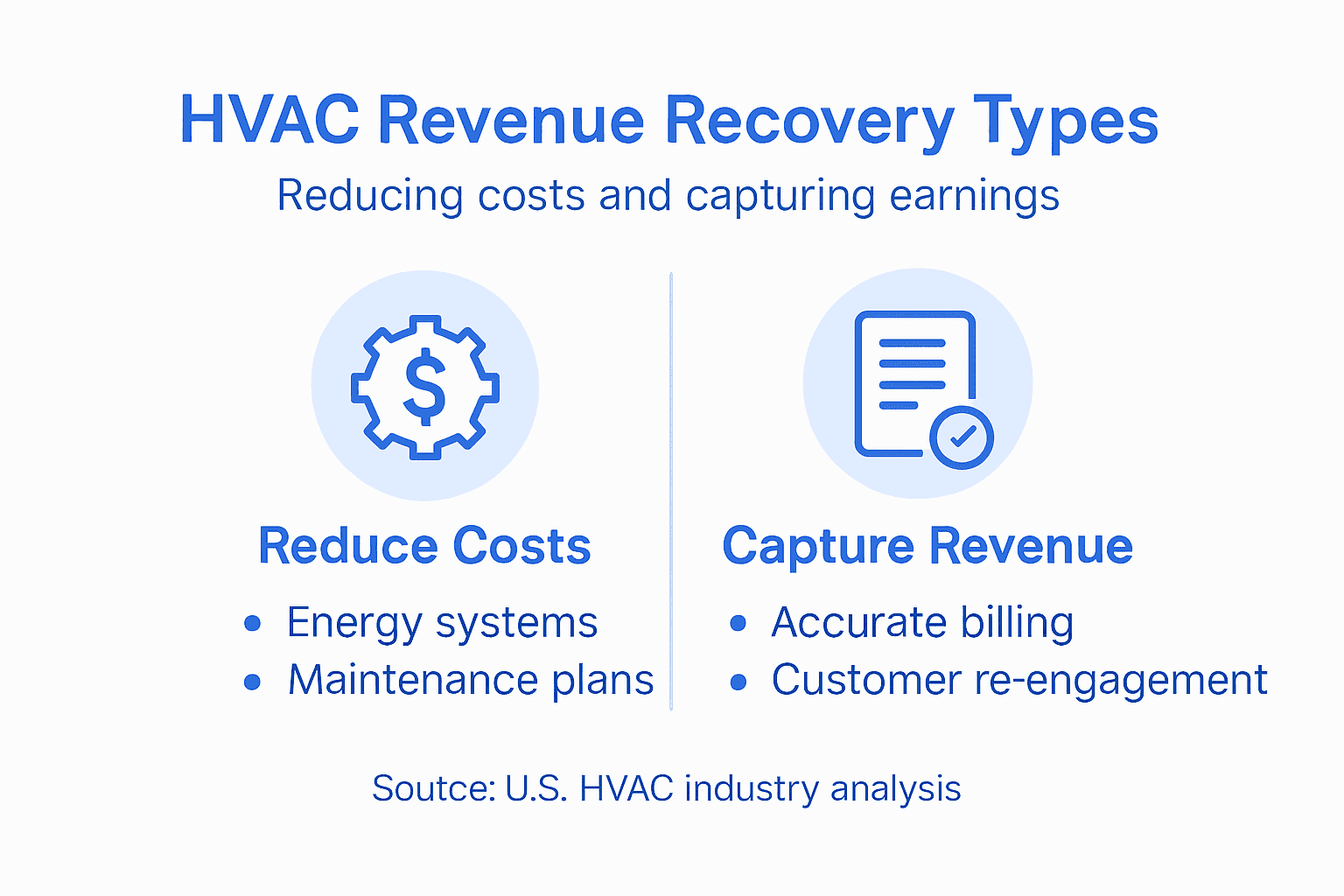
Revenue recovery breaks down into two main categories: reducing what you spend and making sure you capture what you earn. Some methods do both.
Energy Recovery Systems
One of the most effective ways to recover revenue is installing energy recovery devices that lower utility costs. These aren’t theoretical savings—they’re real money customers pay less for, which you can pass along as savings or keep as margin.
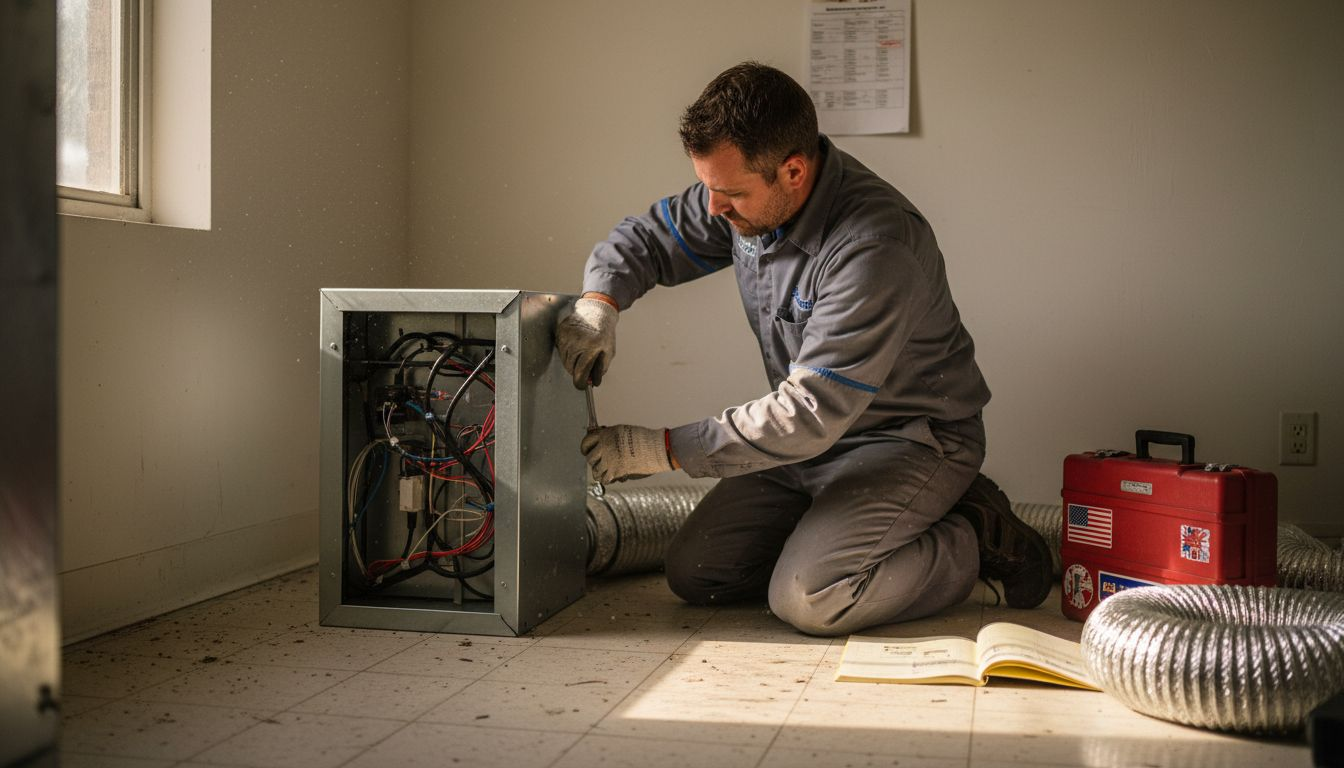
Air-to-air energy recovery systems reduce the load on your heating and cooling equipment by transferring heat and moisture between outgoing exhaust and incoming fresh air. Types include plate heat exchangers, rotary heat wheels, run-around coils, and heat pipe heat exchangers.
Why does this matter for revenue recovery? Lower utility bills mean happier customers who renew maintenance plans. It also positions your business as premium, justifying higher service pricing.
Common energy recovery types:
- Plate heat exchangers for moderate climate control
- Rotary heat wheels for high-efficiency applications
- Run-around coils for flexibility in installation
- Heat pipe heat exchangers for passive heat transfer
Preventive Maintenance Programs
This is the workhorse of revenue recovery. Preventive maintenance stops expensive breakdowns before they happen.
You recover revenue by converting one-time emergency calls into recurring maintenance visits. A customer on a maintenance plan pays predictably every quarter or twice yearly. That’s recurring revenue you can count on.
Maintenance programs also reduce your callback rate. Technicians spend less time fixing problems and more time selling additional services.
Accurate Invoicing and Tracking
This sounds boring, but it’s where many HVAC contractors leave thousands on the table annually.
Invoicing methods that recover revenue include:
- Field service software that ensures every call gets billed
- Time tracking that captures actual labor hours
- Material documentation that prevents unbilled parts
- Service reminders that prompt follow-up work
- Detailed line-item invoices that show customers exactly what they’re paying for
When technicians know their work is tracked and invoiced, they slow down rushing between calls. Quality improves. Callbacks drop. Revenue stays yours.
Lifecycle Costing Analysis
Lifecycle costing and cost-benefit evaluations help you select equipment and systems that minimize expenses over time. This method requires analyzing initial investment, maintenance costs, repairs, and operational efficiency for different options.
For your business, this means recommending the right equipment to customers. You recover revenue by positioning yourself as the expert who understands long-term value, not just upfront cost.
The best revenue recovery methods combine reducing costs and capturing every dollar you’ve legitimately earned.
Customer Re-Engagement
You likely have customers who’ve gone silent. They’re buying from competitors or DIY-ing repairs. Bringing them back is pure revenue recovery—no new customer acquisition cost.
Re-engaging former customers through service reminders, seasonal check-ups, and special offers recovers revenue at a fraction of the cost of finding new customers.
Pricing Optimization
This is delicate but necessary. Review your service rates, maintenance plan pricing, and emergency call charges quarterly.
Are you charging what the market bears? Are your service plans covering your true costs plus profit? Many HVAC contractors underprice out of habit or fear. Recovery means charging correctly.
Pro tip: Implement a monthly audit where you review unbilled work from the previous month. Track the dollar amount lost to missed invoicing, and you’ll have a clear number showing exactly how much revenue recovery could improve your bottom line.
Here’s a summary comparing key HVAC revenue recovery strategies and their business impact:
| Strategy | Main Objective | Typical Benefit | Best Fit For |
|---|---|---|---|
| Energy Recovery Systems | Lower operational energy costs | Enhanced margins, happier customers | Commercial clients |
| Preventive Maintenance | Secure recurring revenue | Predictable income, fewer emergencies | Residential & commercial |
| Accurate Invoicing | Capture all billable work | Higher overall collections | All HVAC businesses |
| Lifecycle Cost Analysis | Long-term cost minimization | Cost savings, better recommendations | High-investment projects |
| Customer Re-Engagement | Win back inactive customers | Revenue growth without new acquisition | Small business operations |
| Pricing Optimization | Align rates with true costs | Higher profits, market competitiveness | Established contractors |
Avoiding Revenue Leakage and Billing Errors
Revenue leakage is silent. It happens while you’re focused on customer service and scheduling. A missed invoice here. An undercharged labor hour there. Unbilled parts that slip through. Add them up over a year, and you’re watching thousands disappear.
Billing errors aren’t intentional. They’re system failures. The good news? They’re preventable with the right processes.
Understanding Where Money Slips Away
Revenue leakage happens in predictable places. Knowing them helps you plug the holes.
Common leakage points in HVAC businesses:
- Service calls completed but not invoiced
- Labor hours recorded incorrectly or partially
- Parts used without documentation
- Service plan renewals that expire and don’t auto-generate invoices
- Discounts applied without authorization
- Warranty work billed to the wrong customer
- No-shows and cancellations that don’t trigger rebooking
- Seasonal services forgotten after peak season ends
Each leak seems small individually. Together over months, they compound into major profit loss.
Compare HVAC revenue leakage sources with recommended prevention measures:
| Leakage Source | Typical Cause | Prevention Approach |
|---|---|---|
| Missed invoice | Technician oversight | Automated field billing |
| Under-recorded labor hours | Manual entry error | Real-time time tracking |
| Unbilled parts | Incomplete documentation | Mobile material records |
| Expired service plans | No renewal process | Auto-generated invoices |
| Unauthorized discounts | Staff misunderstanding | Clear billing guidelines |
Implementing Revenue Assurance Systems
Revenue assurance frameworks focus on detection, prevention, and correction of billing errors. For HVAC contractors, this means three concrete steps.
First, detect leaks by auditing what you’ve billed versus what you’ve completed. Many businesses discover they’re missing 5 to 10 percent of billable work.
Second, prevent leaks through process standardization. Make it impossible to complete work without triggering an invoice. Use field service software that forces documentation before a technician can clock out.
Third, correct leaks by reviewing past months and issuing supplemental invoices for unbilled work. Yes, it feels awkward. Customers understand when you explain the oversight.
Billing System Best Practices
Your billing system is your revenue’s guardian. It needs to work automatically, not rely on memory or habit.
Best practices include:
- Automated invoicing that generates bills immediately after job completion
- Mobile field software that captures all billable information at the job site
- Real-time cost tracking showing materials, labor, and equipment used
- Mandatory job completion forms that cannot be submitted without billing details
- Regular reconciliation comparing completed work to invoiced work weekly
- Clear billing codes so technicians know exactly what to bill for each service type
Automation removes human error. It also removes the temptation to rush invoice creation.
Contract Clarity and Maintenance Standards
Precision in billing and contract clarity prevent costly errors. When customers know exactly what they’re paying for and why, disputes drop dramatically.
Clear contracts include:
- Specific service scope for maintenance plans
- Exact labor rates and material markups
- Emergency service charges and response times
- What’s covered and what costs extra
- Payment terms and due dates
When customers sign clear agreements, follow-up invoices become expected, not surprising.
Training Your Team on Billing Responsibility
Technicians are your front line for preventing leakage. They complete the work. If they don’t document it, you won’t bill it.
Training should cover:
- Why accurate documentation matters to the business
- How to use mobile software correctly
- What information must be captured for every job
- Common mistakes and how to avoid them
- How billing errors affect their commission or bonuses
Make technicians accountable. If they complete work without billing documentation, it comes back to them for correction.
The fastest way to recover revenue is preventing leaks before they happen through automated systems and clear processes.
Reconciliation and Auditing
Monthly reconciliation catches leaks fast. Compare your service schedule to your invoices. Every appointment should have a corresponding invoice.
Quarterly audits go deeper. Pull a random sample of completed work and verify it was billed correctly. You’ll spot patterns in what’s being missed.
Pro tip: Create a weekly reconciliation checklist comparing your appointment calendar to your billing system. Flag any discrepancies the same day they appear, making corrections easier while the work is fresh in everyone’s memory.
Leveraging SEO for Sustained Revenue Growth
SEO is not about vanity metrics or ranking for the sake of ranking. For HVAC contractors in Texas, SEO is a revenue machine. It brings customers to you when they’re actively searching for your services. That’s when they’re ready to buy.
Unlike paid advertising that stops working the moment you stop paying, SEO builds momentum over time. Better rankings mean more calls. More calls mean more revenue. And the traffic keeps flowing even when your ad budget runs dry.
How SEO Drives Consistent Revenue
SEO improves visibility and attracts customers actively searching for HVAC services. When someone in Dallas searches “emergency AC repair near me,” you want your business appearing first. That customer is ready to hire today.
Organic traffic converts better than many other sources because these people are looking for exactly what you offer. They’ve already decided they need HVAC help. Your job is being there when they search.
Effective SEO involves several interconnected strategies that build on each other. They work together to improve rankings and drive revenue.
Core SEO components for HVAC businesses:
- Keyword research targeting what customers actually search for
- Content creation answering customer questions and building authority
- Website optimization ensuring fast loading and mobile-friendly design
- Technical SEO fixing backend issues that hurt rankings
- Local SEO dominating your geographic service areas
- Link building establishing your site as trustworthy and authoritative
Keyword Research and Content Strategy
Keyword research helps identify relevant customer queries your target audience uses when searching for HVAC services. This isn’t guessing. It’s data-driven research showing what people actually search for.
For HVAC contractors, keywords fall into several categories. Seasonal keywords like “air conditioning repair” spike in summer. Emergency keywords like “24-hour HVAC service” convert immediately. Maintenance keywords like “HVAC maintenance plans” bring longer-term customers.
Once you identify keywords, create content answering the questions behind those searches. A customer searching “why is my AC not cooling” needs an answer. Write that blog post. Rank for that query. Convert that reader into a lead.
Technical SEO and User Experience
Rankings depend on both content quality and technical performance. Developing an SEO strategy includes technical optimizations like site speed, mobile responsiveness, and clean site architecture.
Google’s algorithm now prioritizes user experience heavily. If your website is slow or doesn’t work on phones, rankings suffer. More importantly, visitors bounce without calling you.
Technical priorities for HVAC websites:
- Mobile optimization that displays perfectly on phones
- Page speed under three seconds
- Easy navigation that helps visitors find information quickly
- Clear calls to action on every page
- Secure website (HTTPS) protecting customer data
These elements don’t directly generate revenue, but they prevent losing revenue from poor user experience.
Local SEO for Geographic Dominance
Local SEO is where HVAC businesses win big. You’re not competing nationally. You’re fighting for customers within 15 to 30 miles of your service area.
Local SEO tactics include optimizing your Google Business Profile, getting reviews, building citations in local directories, and creating location-specific content. When customers search “HVAC contractor in Austin,” local SEO positions your business prominently.
Consistent SEO effort compounds over months and years, turning into predictable, scalable revenue that doesn’t depend on paid advertising budgets.
Building Authority and Trust
SEO isn’t just about technical factors. It’s about proving to Google and customers that you’re legitimate and trustworthy. Building a link-worthy site through quality content and industry authority accelerates this.
Authority builds when other websites link to you, when you publish original research or insights, and when customers leave positive reviews. Over time, this positions your HVAC business as the expert in your market.
Authority-building activities:
- Publishing original HVAC tips and guides
- Getting featured in local press and industry publications
- Earning customer reviews on Google, Yelp, and industry sites
- Sponsoring community events and nonprofits
- Becoming a trusted resource for HVAC knowledge
The Long-Term Revenue Advantage
SEO requires patience, but it pays dividends. A competitive HVAC market in Texas demands SEO because your competitors are doing it. If you’re not investing in SEO, they’re capturing customers you could be serving.
The businesses that dominate local search today started months or years ago. Starting now means you capture revenue opportunities starting three to six months from today. Waiting means falling further behind.
Pro tip: Start with one high-value keyword you can realistically rank for, create comprehensive content answering every question about that topic, and measure your rankings monthly. Once you rank, expand to adjacent keywords, building momentum over time.
Unlock Hidden Profits with Expert HVAC Revenue Recovery and SEO Solutions
Struggling with revenue leaks from unbilled work or missing out on high-intent leads is a common challenge for many HVAC contractors in Texas. This article clearly shows how critical capturing every dollar through accurate invoicing, preventive maintenance plans, and pricing optimization is to your bottom line. Combine those internal operational improvements with a powerful digital growth system that drives qualified inbound calls, and you have a formula for sustainable profit growth.
At Aim Set Win, we understand that boosting HVAC revenue recovery means more than just internal process fixes. It requires dominating your local market through laser-focused SEO strategies that increase your visibility when customers are ready to book services. From enhancing your Google Business Profile to crafting targeted content for seasonal and emergency HVAC searches, our results-driven approach ensures no opportunity slips away. Explore proven tactics tailored for Texas service businesses in our HVAC Archives – Aim Set Win.

Take control of your revenue today by partnering with a specialized team that prioritizes your measurable ROI. Visit Aim Set Win now to build a predictable lead generation system that transforms every search into a booked job. Don’t wait for revenue recovery to happen on its own—start capturing what’s rightfully yours with our expert guidance and cutting-edge digital marketing solutions.
Frequently Asked Questions
What is HVAC revenue recovery?
HVAC revenue recovery refers to the process of identifying and reclaiming income opportunities that a business may be missing. It focuses on enhancing operational efficiency and financial discipline to ensure that all services rendered are accurately invoiced and collected.
How can I improve invoicing accuracy in my HVAC business?
Improving invoicing accuracy can be done by implementing field service software that tracks all billable work, capturing real-time labor hours, documenting materials used, and sending detailed line-item invoices to customers.
What are some common sources of revenue leakage in HVAC operations?
Common sources of revenue leakage include unbilled service calls, incorrect labor hour tracking, parts used without documentation, expired maintenance plans that aren’t renewed, and missed follow-up service reminders.
Why is preventive maintenance important for revenue recovery?
Preventive maintenance is crucial for revenue recovery because it converts occasional emergency calls into predictable, recurring maintenance visits. This not only stabilizes income but also reduces expensive breakdowns and minimizes callback rates.
Recommended
- 7 Types of HVAC Marketing Strategies for Reliable Growth
- HVAC Marketing Terminology Explained for Texas Pros
- HVAC Industry Trends 2026: Growth, AI, and Revenue Impact
- Automation in HVAC: Boosting Revenue and Efficiency
- How Purifiers Save Cost for Homes and Businesses – Coway Water Purifier
Jean runs growth strategy at AimSetWin, a performance marketing agency specializing in local service businesses across Texas. he's helped plumbers, HVAC companies, pest control operators, and home service brands build predictable revenue systems using data-driven advertising and conversion optimization.


