
Learn what HVAC SEO services cost in Texas, from $800 to $2,500/month, and how to maximize your ROI with the right strategy and provider.
If you run an HVAC business in Texas and you’ve ever tried to price out SEO services, you already know the frustration. One agency quotes you $500 a month, another wants $3,000, and neither fully explains what you’re actually getting. That confusion is expensive. Overspend on the wrong service and you burn cash with no leads to show for it. Underspend on a bargain provider and your competitors own every search result in your city. This guide cuts through the noise and gives you a clear picture of what HVAC SEO actually costs in Texas, what drives those costs, and how to make sure every dollar you invest works toward real revenue growth.
Table of Contents
- What affects HVAC SEO service costs?
- Typical HVAC SEO pricing models explained
- What’s included in a typical HVAC SEO package in 2026?
- How to measure ROI and value from HVAC SEO investment
- Our take: What most HVAC businesses miss about SEO investments
- Ready to amplify your HVAC leads with expert SEO?
- Frequently asked questions
Key Takeaways
| Point | Details |
|---|---|
| Cost factors vary | Your business size, competition, and service scope drive HVAC SEO pricing. |
| Choose the right pricing model | Monthly retainers, project fees, or hourly billing each fits different needs. |
| Demand a full-service package | A quality SEO package covers technical fixes, content, and local optimization. |
| Track ROI smartly | Focus on leads and organic growth, not vanity stats, to judge SEO value. |
What affects HVAC SEO service costs?
Now that we’ve identified this common uncertainty, let’s break down why HVAC SEO pricing isn’t one-size-fits-all. The truth is, SEO pricing depends on business size, service area, and competition, which means two HVAC companies in the same state can have very different investment requirements.
Here are the primary factors that shape what you’ll pay:
- Service scope: A basic on-page audit costs far less than a full-service package covering on-page SEO, off-page link building, local SEO, and content marketing. More services mean more hours and more expertise.
- Local competition level: Ranking in a smaller Texas market like Corpus Christi is a different challenge than competing in Dallas or Houston, where hundreds of HVAC companies are fighting for the same keywords.
- Geographic targeting: Are you targeting one city, a metro area like DFW, or the entire state of Texas? Broader targeting requires more content, more citations, and more technical work.
- Website health: A brand-new site or one with serious technical issues needs more foundational work before SEO can generate results. That upfront investment adds to your cost.
- Agency experience: A seasoned agency with a proven track record of ranking HVAC companies in Texas will charge more than a generalist freelancer. That premium usually pays for itself.
- Pricing model: Monthly retainers, one-time project fees, and hourly billing all carry different cost structures, which we’ll cover in the next section.
Pro Tip: Before you request a quote, audit your own website first. Check your Google Business Profile completeness, your page load speed, and whether you have location-specific pages. Knowing your starting point helps you evaluate proposals more accurately.
One factor that surprises many HVAC owners is how much seasonal demand affects SEO strategy complexity. Texas summers drive massive search volume for AC repair and emergency cooling services. Capturing that demand requires well-timed content, optimized service pages, and a Google Business Profile that’s fully dialed in. Agencies that understand this seasonal rhythm will build it into your HVAC SEO cost factors and your overall strategy. If you want to stay ahead of the curve, reviewing SEO strategies for 2026 can help you understand what the competitive landscape now demands.
Typical HVAC SEO pricing models explained
Having covered the cost drivers, it’s important to understand how these costs are structured by vendors. Most HVAC SEO agencies in Texas offer retainer-based or project pricing based on goals, but each model has a different risk and reward profile.

| Pricing model | Typical range | Best for |
|---|---|---|
| Monthly retainer | $800 to $2,500/month | Ongoing growth and consistent lead generation |
| Project-based | $2,500 to $10,000 | Website relaunches, one-time audits, or market entry |
| Hourly consulting | $75 to $200/hour | Specific fixes or strategy sessions |
Here’s how to think about each one:
- Monthly retainer: This is the most common model for HVAC companies that want steady lead flow. You pay a fixed monthly fee and receive ongoing services like content creation, link building, reporting, and optimization. It’s predictable and compounds over time, which is exactly how SEO works best.
- Project-based pricing: Ideal when you need a defined deliverable, like a full technical audit, a website migration, or a set of location landing pages. You pay once, get the work done, and move on. The downside is that SEO requires ongoing maintenance, so a one-time project rarely sustains results long-term.
- Hourly consulting: Best used for targeted advice or specific troubleshooting. If you already have an in-house team and just need expert guidance, hourly billing gives you flexibility. But it adds up fast if the scope isn’t tightly controlled.
For most growing HVAC businesses in Texas, the monthly retainer model delivers the best return. AI-driven HVAC SEO tools and ongoing data analysis require continuous attention, not a one-time push. If you’re also running paid ads, understanding how SEO and PPC strategy work together can help you allocate budget more effectively across both channels.
The right model depends on where your business is right now. A newer company entering a competitive metro market needs a retainer that builds authority month over month. An established company with a solid site might benefit from a targeted project to fix specific gaps before committing to ongoing spend.
What’s included in a typical HVAC SEO package in 2026?
After reviewing pricing models, it’s equally important to know exactly what your money should secure in an HVAC SEO agreement. Comprehensive SEO packages now include technical SEO, citations, content, and ongoing optimization, and any agency worth your investment should be able to explain each component clearly.
Here’s what a well-built HVAC SEO package should cover:
- On-page SEO: This includes optimizing your site structure, title tags, meta descriptions, header tags, and internal linking. Every service page and location page should be built around keywords your customers actually search.
- Content development: Regular blog posts, location-specific landing pages, and service pages that answer real customer questions. Content is how you capture long-tail searches like “AC repair in Plano TX” or “emergency HVAC service Houston.”
- Google Business Profile optimization: Your GBP listing is often the first thing a local customer sees. A strong profile with accurate categories, photos, service areas, and review responses directly impacts your map pack rankings.
- Link building: Earning backlinks from local directories, industry sites, and regional publications signals authority to Google. Quality matters far more than quantity here.
- Technical SEO: Mobile speed, crawl errors, structured data, and Core Web Vitals all affect how Google ranks your site. These fixes are foundational.
- Reporting and analytics: You should receive clear monthly reports showing keyword rankings, organic traffic, call volume, and lead attribution.
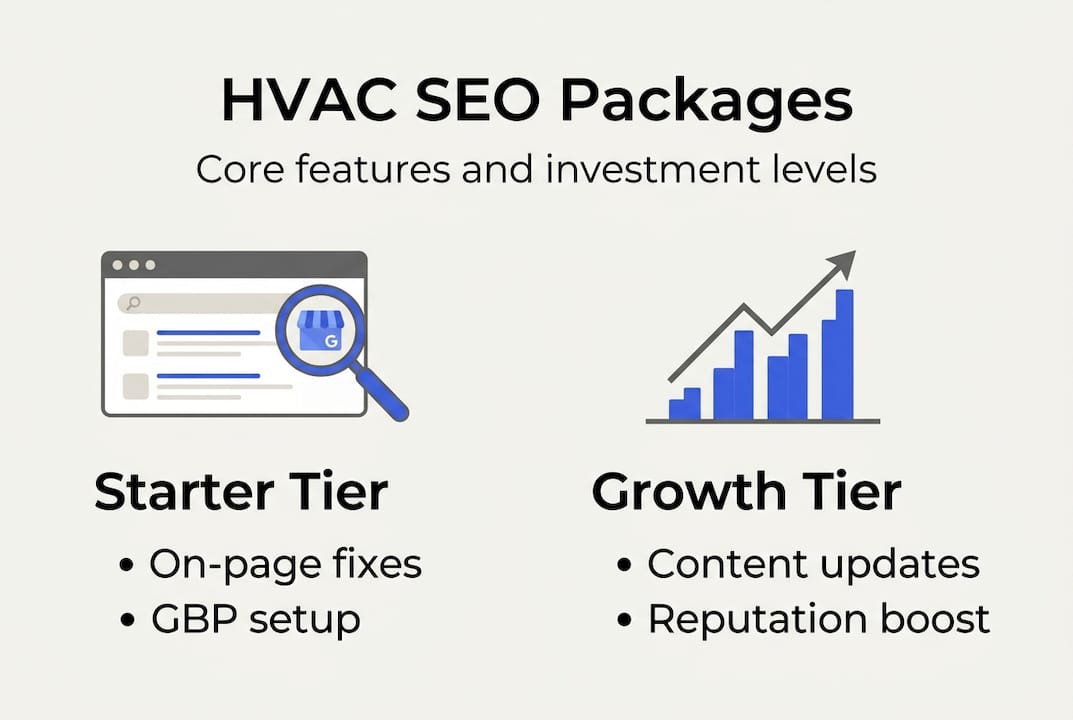
| Package tier | Monthly investment | Core deliverables |
|---|---|---|
| Starter | $800 to $1,200 | On-page fixes, GBP optimization, basic reporting |
| Growth | $1,200 to $2,000 | Content, link building, technical SEO, full reporting |
| Aggressive | $2,000 to $2,500+ | All of the above plus AI analytics, CRO, multi-location |
Pro Tip: Ask any agency you’re evaluating to show you a sample report before you sign. Vague reporting is one of the biggest red flags in this industry. You should be able to see exactly which keywords moved, how many calls came from organic search, and what work was completed each month.
If you want to see what this looks like in practice, reviewing Austin HVAC SEO examples gives you a real-world picture of how these packages translate into results. Understanding local HVAC SEO mechanics also helps you ask better questions when evaluating vendors.
How to measure ROI and value from HVAC SEO investment
Knowing what your SEO package includes, the next step is making sure you actually benefit from your investment. Measuring return on investment (ROI) from SEO requires looking at the right metrics, not just the ones that look impressive in a report.
Here’s a practical framework for tracking your results:
- Establish a baseline first. Before you start any SEO work, document your current organic traffic, keyword rankings, monthly call volume from organic sources, and lead count. You can’t measure growth without a starting point.
- Track leads, not just rankings. Rankings are a means to an end. The real number that matters is how many qualified calls and form submissions your website generates from organic search each month.
- Monitor Google Business Profile activity. Calls, direction requests, and website clicks from your GBP listing are direct indicators of local SEO performance. These numbers should grow consistently over time.
- Calculate lifetime customer value. One new HVAC customer can be worth thousands of dollars over their lifetime through repeat service, maintenance contracts, and referrals. ROI on SEO is best measured by lead growth, organic rankings, and lifetime customer value, not just short-term traffic spikes.
- Set realistic timelines. SEO is not instant. Most HVAC businesses in Texas start seeing measurable improvements in 4 to 6 months, with stronger compounding results developing over 12 months and beyond.
“The businesses that win with SEO are the ones that treat it like a long-term asset, not a short-term expense. Every optimized page, every earned link, and every piece of content adds to a foundation that keeps generating leads even when you’re not actively spending.”
Watch out for these red flags that signal poor ROI ahead: agencies that report only on traffic without tying it to leads, vague deliverables that shift month to month, and providers with no local focus or Texas market knowledge. Reviewing Dallas HVAC SEO performance benchmarks and local service results can help you calibrate what realistic progress looks like in competitive Texas markets.
Our take: What most HVAC businesses miss about SEO investments
With benchmarks set for ROI, here’s a seasoned view on what we see HVAC businesses most commonly misjudge about SEO. The biggest mistake isn’t overspending. It’s undervaluing the process itself.
Many HVAC owners shop for SEO the same way they shop for equipment parts: find the lowest price and move on. That mindset costs far more in the long run. Bargain SEO services often produce thin content, spammy links, and technical shortcuts that can actually trigger Google penalties, setting your rankings back by months.
SEO is not a switch you flip. It’s a system that compounds. The authority your site earns in month three builds on what was done in month one. The content published in the fall drives leads the following summer. That compounding effect is exactly why the businesses that commit to a consistent, well-executed strategy pull so far ahead of competitors who chase shortcuts.
Transparency and proven local wins are what separate serious partners from vendors. Before you commit, ask for case studies specific to Texas HVAC markets. Ask how they adapt strategy as algorithms change. A deep dive on HVAC SEO cost will also show you what fair market investment looks like so you can spot both overpriced fluff and dangerously cheap services.
Ready to amplify your HVAC leads with expert SEO?
If you’re ready to turn insight into results, here’s how to get started with the right partner. Understanding costs and services is only the first step. Putting that knowledge to work with a team that knows Texas HVAC markets is where real growth begins.

At Aim Set Win, we build performance-driven SEO systems specifically for HVAC companies across Texas. Whether you’re looking for a trusted HVAC SEO company to grow your brand statewide, or you need a specialized Houston HVAC SEO agency or Dallas HVAC SEO agency to dominate your local market, we have the strategy, the data, and the track record to deliver. Let’s build your lead generation system together.
Frequently asked questions
How much should an HVAC company budget for SEO in Texas?
HVAC SEO budgets typically range from $800 to $2,500 per month depending on market size, competition, and service scope. Larger metro markets like Houston or Dallas generally require higher investment to compete effectively.
How soon will I see results from HVAC SEO services?
Most HVAC businesses see measurable improvements in traffic and lead volume within 4 to 6 months, with stronger ROI developing over 12 months as content and authority compound.
Are local or national SEO packages better for Texas HVAC businesses?
Local SEO drives relevant leads for service businesses, making it the smarter choice for HVAC companies serving specific cities or regional markets where search intent is tied directly to location.
What are the red flags to avoid with HVAC SEO providers?
Avoid agencies that promise instant rankings, lack transparent reporting, or offer pricing far below market averages. Guaranteed rankings and vague deliverables are warning signs that the work won’t produce real results.
Recommended
- What is HVAC SEO: Boost Texas leads and grow business
- HVAC SEO Services | Top Rankings & Local Leads
- HVAC Revenue Recovery Explained: Boosting Profits Ethically
- SEO Cost for HVAC Companies: The Ultimate Guide
Jean runs growth strategy at AimSetWin, a performance marketing agency specializing in local service businesses across Texas. he's helped plumbers, HVAC companies, pest control operators, and home service brands build predictable revenue systems using data-driven advertising and conversion optimization.


