
Learn proven strategies to optimize your contractor website for Texas local searches, improve Google Maps rankings, and generate qualified leads in 2026.
Texas contractors lose thousands of qualified leads every month because their websites fail to appear in local search results and Google Maps. Your competitors dominate the map pack while your phone stays silent, not because they offer better services, but because they understand local SEO optimization. This guide delivers proven strategies specifically designed for Texas home service businesses to capture high intent local searches, improve map visibility, and convert website traffic into booked jobs throughout 2026.
Table of Contents
- Understanding The Local Search Landscape For Texas Contractors
- Preparing Your Website For Local SEO Success
- Executing Hyperlocal Optimization Strategies For Texas Neighborhoods
- Verifying And Maintaining Your Website’s Local SEO Performance
- Get Expert Help To Dominate Texas Local Searches
- Frequently Asked Questions
Key takeaways
| Point | Details |
|---|---|
| Local searches convert at 80% | Nearly half of all Google searches have local intent, making optimization critical for contractor revenue. |
| Hyperlocal content wins rankings | Neighborhood specific pages outperform generic city level content in suburban Texas markets. |
| Review velocity stabilizes rankings | Recent reviews stabilize Map Pack rankings and signal active business operations to Google. |
| Multiple validation platforms required | Google evaluates service depth, project proof, brand demand, and AI extractability across platforms. |
| Technical foundation enables visibility | Site speed, mobile optimization, and schema markup determine whether Google indexes your location pages. |
Understanding the local search landscape for Texas contractors
The local search environment in 2026 presents both unprecedented opportunity and intense competition for Texas home service contractors. Nearly half of all Google searches have local intent, and an impressive 80% of those local searches convert into actual customers. This conversion rate far exceeds traditional advertising channels, making local SEO the most cost effective lead generation strategy available. Contractor searches are high intent and money driven, meaning users actively seek solutions to immediate problems like burst pipes, broken AC units, or electrical emergencies.
Google’s ranking algorithm has evolved significantly beyond traditional SEO factors. The platform now evaluates social signals, AI optimized content structure, review velocity, project proof visibility, and brand demand across multiple digital touchpoints. Texas contractors face unique challenges in hyperlocal visibility, particularly in suburban neighborhoods where Google treats areas differently than their parent cities. A plumber in Spring, TX discovers their business appears for Houston searches but remains invisible for Spring specific queries, despite physical proximity.
Understanding these dynamics helps you build a comprehensive SEO strategy that addresses both technical requirements and user intent. Your competitors who dominate local search results have mastered these elements:
- Precise business category selection that signals exact service offerings
- Hyperlocal content targeting specific neighborhoods and ZIP codes
- Consistent NAP citations across directories and platforms
- Active review management with prompt responses
- Regular content updates demonstrating business activity
“The difference between page one and page two in local search results represents the difference between a thriving contractor business and one struggling to fill the schedule. Google rewards businesses that demonstrate local authority, technical excellence, and genuine customer engagement.”
Texas markets like Houston, Dallas, Austin, and San Antonio present massive opportunity but require sophisticated approaches to cut through competition. Suburban areas offer less competition but demand hyperlocal optimization strategies that many contractors overlook.
Preparing your website for local SEO success
Your website’s foundation determines whether Google can effectively index, rank, and display your business in local search results. Contractor websites often fail because they rely on one generic Services page instead of creating dedicated pages for each service and location combination. This approach leaves massive ranking opportunities on the table and confuses Google about your actual service offerings and geographic coverage.
Start by auditing your current site structure. Create individual pages for every service you offer: emergency plumbing, water heater installation, AC repair, electrical panel upgrades, roof replacement, and pressure washing. Each page should target specific keywords and include detailed service descriptions, pricing guidance, and local project examples. Then multiply this structure by creating location specific versions for every city and major neighborhood you serve.

Primary Business Category is the strongest signal for Relevance in Google’s local ranking algorithm. Select the most specific category available rather than broad classifications. An HVAC contractor should choose “HVAC Contractor” rather than “Contractor” to signal precise service offerings. Fill out every available category field in your Google Business Profile and website schema markup.
Structure your site navigation for both user experience and SEO crawlability. Use clear hierarchies with services under a main Services dropdown and locations under a Locations section. Implement breadcrumb navigation and internal linking between related service and location pages. This architecture helps Google understand relationships between pages and passes authority throughout your site.
| Approach | Generic Service Page | Specialized Service Pages |
|---|---|---|
| SEO targeting | Broad, unfocused keywords | Specific, high intent keywords |
| Ranking potential | Competes with all contractors | Dominates niche searches |
| Conversion rate | Lower due to vague content | Higher with detailed information |
| Google clarity | Unclear service scope | Crystal clear offerings |
Optimize core technical elements using this comprehensive checklist. Ensure your site loads in under three seconds on mobile devices. Implement responsive design that adapts seamlessly to all screen sizes. Add LocalBusiness schema markup with complete NAP information, service areas, hours, and accepted payment methods. Create XML sitemaps and submit them through Google Search Console.
Pro Tip: Audit your site monthly using PageSpeed Insights and fix any issues immediately. Google prioritizes fast, mobile friendly sites in local search results, and even small improvements can boost rankings significantly.
Follow proven optimization strategies to ensure every page includes optimized title tags, meta descriptions, header tags, and image alt text. Use your target keyword naturally in the first paragraph and throughout the content. Add internal links connecting related services and locations to distribute page authority and guide users through your site.
Executing hyperlocal optimization strategies for Texas neighborhoods
Hyperlocal optimization separates contractors who dominate suburban Texas markets from those struggling for visibility. Google does not treat Spring the same way it treats Houston; Spring is grouped under Houston metro and is ZIP driven. This geographic nuance requires dedicated strategies targeting specific neighborhoods, ZIP codes, and suburban communities rather than relying solely on major city optimization.
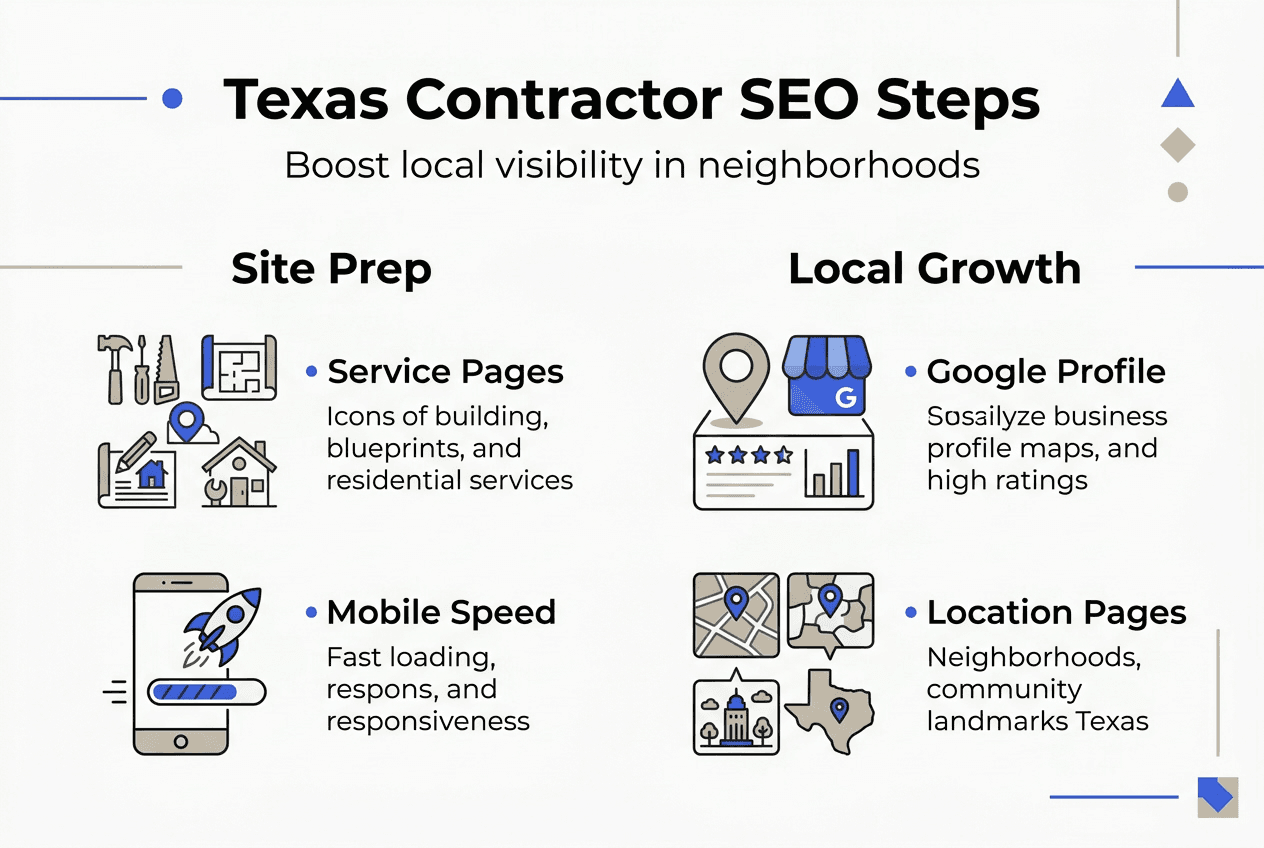
Create dedicated location pages for every neighborhood and suburb you serve. A Houston HVAC contractor needs separate pages for Spring, The Woodlands, Katy, Sugar Land, and Pearland rather than one Houston page. Each location page should include neighborhood specific content: local landmarks, common home types, typical HVAC issues in that area, and recent projects completed nearby. This signals geographic relevance to Google and provides valuable information to potential customers.
Optimizing Google Business Profile with Spring specific details is crucial for local visibility. Update your business description to mention specific neighborhoods served. Add service area cities individually rather than selecting broad regions. Upload photos tagged with location data showing projects in each neighborhood. Post regular updates mentioning local events, seasonal tips for area homeowners, and community involvement.
| Strategy Element | Generic City Targeting | Hyperlocal Neighborhood Targeting |
|---|---|---|
| Geographic scope | Entire metro area | Specific ZIP codes and suburbs |
| Content focus | City level information | Neighborhood specific details |
| Competition level | High, all contractors compete | Lower, niche geographic focus |
| Ranking difficulty | Very difficult in major cities | Achievable with proper optimization |
| Customer relevance | General metro appeal | Highly relevant to local residents |
Implement these hyperlocal optimization steps systematically:
- Research every neighborhood, suburb, and ZIP code within your service area using Google Maps and local government resources.
- Create individual website pages for each location with unique content addressing local customer needs and concerns.
- Optimize your Google Business Profile with neighborhood specific keywords in the business description and service list.
- Build local citations on neighborhood directories, chamber of commerce sites, and community platforms.
- Generate reviews mentioning specific locations to reinforce geographic relevance signals.
- Create location specific content like blog posts addressing seasonal issues in particular neighborhoods.
- Monitor rankings separately for each location to identify optimization opportunities.
Pro Tip: Update your location pages quarterly with fresh content about recent projects, seasonal tips, and neighborhood developments. Google rewards sites demonstrating ongoing local engagement and current information.
Apply these proven local SEO practices consistently across all locations you serve. Ensure NAP consistency between your website, Google Business Profile, and directory listings for every location. Any discrepancies confuse Google and dilute your local authority. Use the exact same business name, address format, and phone number everywhere your business appears online.
Verifying and maintaining your website’s local SEO performance
Optimization without verification leaves you guessing whether strategies actually improve rankings and generate leads. Implement systematic monitoring to track performance, identify issues quickly, and adapt to algorithm changes throughout 2026. Google evaluates service depth, review velocity, local authority, project proof, brand demand, and AI extractability in 2026, requiring ongoing attention to multiple ranking factors simultaneously.
Track your rankings weekly for target keywords in each location you serve. Use tools like Google Search Console, BrightLocal, or SEMrush to monitor position changes. Pay attention to map pack rankings separately from organic results, as these require different optimization approaches. Document which pages rank for which keywords to identify content gaps and optimization opportunities.
Implement a structured review acquisition and management strategy. Recent reviews stabilize Map Pack rankings and signal active business operations to Google. Request reviews immediately after completing jobs while customer satisfaction remains high. Respond to every review within 24 hours, thanking positive reviewers and addressing concerns in negative feedback professionally. Aim for steady review velocity rather than sporadic bursts that appear manipulative.
Display project proof prominently throughout your site to boost engagement metrics and conversion rates. Upload high quality before and after photos with detailed descriptions. Create case studies explaining challenges, solutions, and results for completed projects. Add video testimonials from satisfied customers. This content keeps visitors engaged longer, reduces bounce rates, and provides social proof that converts searchers into customers.
Follow this monthly SEO monitoring checklist:
- Review Google Search Console for indexing errors, coverage issues, and mobile usability problems.
- Check Google Business Profile insights for views, clicks, calls, and direction requests.
- Analyze website traffic sources, top landing pages, and conversion rates in Google Analytics.
- Audit recent reviews across all platforms and ensure timely responses.
- Update location pages with fresh content, recent projects, and current information.
- Verify NAP consistency across top directories and citation sources.
- Test site speed and fix any performance issues immediately.
Pro Tip: Set up automated alerts in Google Search Console and Analytics to notify you immediately of significant ranking drops, traffic changes, or technical issues. Quick responses to problems prevent extended visibility losses.
Adapt your strategy based on performance data and industry changes. Google continuously updates its algorithm, with AI powered search features becoming increasingly prominent. Incorporate natural language and FAQ sections that align with voice search and AI assistant queries. Monitor competitor strategies and identify tactics driving their success. Conduct quarterly comprehensive SEO audits to catch issues before they impact rankings.
Maintain consistent local citations across platforms to retain authority. Audit your top 50 citations quarterly to ensure accuracy. Update information immediately when you change phone numbers, addresses, or service areas. Inconsistent citations confuse Google and weaken your local authority signals.
Get expert help to dominate Texas local searches
Implementing comprehensive local SEO strategies requires specialized expertise, ongoing effort, and deep understanding of Google’s evolving algorithm. Aim Set Win delivers proven results for Texas contractors through AI powered strategies that generate consistent qualified leads and top map pack rankings. Our team understands the unique challenges facing plumbing, HVAC, electrical, remodeling, and roofing businesses across competitive Texas markets.

We build complete digital growth systems combining technical optimization, hyperlocal content, conversion focused design, and data driven strategy. Whether you operate in Houston, Dallas, Austin, San Antonio, or smaller Texas cities, our location specific approach captures high intent searches and converts traffic into booked jobs. Discover why every plumbing business needs SEO, explore our specialized HVAC SEO services, or review our complete contractor SEO guide to see how we help contractors dominate their markets.
Frequently asked questions
What are the best ways to increase Google Maps visibility for contractors?
Optimize your Google Business Profile with complete information, hyperlocal keywords, and specific service categories that match your actual offerings. Gather frequent positive reviews and respond promptly to all feedback, as review velocity directly impacts map pack rankings. Upload regular posts, photos with location tags, and update business hours during holidays to signal active operations.
How often should I update my contractor website content for SEO?
Update service and location pages quarterly or whenever you add services, expand coverage areas, or change pricing structures. Add recent project photos, customer testimonials, and case studies monthly to demonstrate ongoing business activity. Fresh content signals to Google that your site remains current and relevant, improving rankings and user engagement.
Why is having dedicated location pages important for Texas contractors?
Location pages signal precise geographic relevance to Google, dramatically improving rankings for neighborhood specific searches. They capture local queries that generic city pages miss entirely, especially in suburban areas where Google treats neighborhoods differently than parent cities. Each location page targets unique keywords and serves highly relevant content to local searchers.
Can AI optimized content improve my local SEO rankings in 2026?
Yes, Google increasingly favors content structured for AI powered search features and voice assistants. Incorporate natural language, question and answer formats, and FAQ sections that align with conversational search queries. Structure content with clear headers, concise paragraphs, and direct answers to common questions, making it easily extractable for AI search results and featured snippets.
Recommended
- Local service SEO best practices for Texas contractors 2026
- Texas Advertising Agencies: 2026 Guide for Home Services – Aim Set Win
- Why Optimize Website Conversions for Texas HVAC
- Electrician SEO guide: boost Texas leads in 2026
Jean runs growth strategy at AimSetWin, a performance marketing agency specializing in local service businesses across Texas. he's helped plumbers, HVAC companies, pest control operators, and home service brands build predictable revenue systems using data-driven advertising and conversion optimization.


