
Paid search for services boosts HVAC and plumbing bookings. Discover methods, targeting options, real-world usage, costs, and success risks in Texas.
Most American service businesses lose thousands in missed job bookings every year by underusing paid search. As a Texas HVAC or plumbing owner clearing over $30k each month, making every customer interaction count is vital. With more homeowners turning to Google for urgent repairs and replacements, refining your paid search strategy offers a practical edge. Discover how targeted American campaigns can drive more booked jobs from your existing lists without wasted spend.
Table of Contents
- Defining Paid Search for Service Businesses
- Types of Paid Search: PPC, LSA, Retargeting
- How Paid Search Works for Local Services
- Cost, ROI, and Common Pitfalls
- Comparing Paid Search to Other Marketing
Key Takeaways
| Point | Details |
|---|---|
| Effective Paid Search Strategy | Service businesses should utilize a combination of Pay-Per-Click (PPC), Local Services Ads (LSAs), and Retargeting for maximum reach and customer engagement. |
| Cost and ROI Considerations | Businesses must carefully monitor their monthly spend and aim for a minimum 3:1 return on investment to ensure the effectiveness of their paid search campaigns. |
| Importance of Local Targeting | Geo-targeting enhances the efficiency of marketing efforts by ensuring ads reach customers within specific serviceable areas. |
| Adaptability and Optimization | Regularly review and adjust campaigns based on performance metrics to enhance targeting precision and improve conversion rates. |
Defining Paid Search for Service Businesses
Paid search represents a strategic digital marketing approach where service businesses like HVAC and plumbing companies purchase targeted advertising space on search engine results pages. By bidding on specific service-related keywords, these businesses can strategically position their ads to appear when potential customers actively search for their specific services.
Under this marketing model, service businesses pay only when users click on their advertisements, making it a performance-driven strategy. Pay-per-click advertising allows precise targeting based on geographic location, search intent, and service specifics. This means a plumbing company in Austin can display ads exclusively to local homeowners searching for emergency pipe repair or water heater installation.
The core mechanics of paid search involve selecting relevant keywords, crafting compelling ad copy, and designing landing pages that convert clicks into booked jobs. Successful implementation requires understanding search engine algorithms, customer behavior, and creating ads that not only attract attention but also communicate clear value propositions. Service businesses must develop ads that speak directly to customer pain points while highlighting their unique service advantages.
Pro tip: Start with a modest daily budget and closely monitor your click-through rates and conversion metrics to optimize your paid search strategy without overspending.
Types of Paid Search: PPC, LSA, Retargeting
Service businesses today have multiple strategic paid search options to attract potential customers and drive booking conversions. Paid search advertising encompasses three primary approaches: Pay-Per-Click (PPC), Local Services Ads (LSAs), and Retargeting, each designed to target customers at different stages of their purchasing journey.
Pay-Per-Click (PPC) advertising represents the most traditional paid search strategy, where businesses bid on specific keywords related to their services. HVAC and plumbing companies can target precise search terms like “emergency plumber Austin” or “air conditioning repair near me,” paying only when potential customers click their advertisements. This model provides granular control over targeting, budget allocation, and real-time performance tracking.
Local Services Ads (LSAs) offer a more specialized approach for service-based businesses, featuring verified and background-checked professionals directly on Google search results. These ads prioritize local service providers with trust signals like customer ratings, service guarantees, and Google verification badges. LSAs appear at the top of search results, providing enhanced visibility and credibility for local service professionals seeking immediate customer connections.
Retargeting represents a sophisticated paid search technique that re-engages potential customers who previously interacted with a business’s website or digital platforms. By displaying targeted ads to users who have shown initial interest but not completed a booking, service businesses can effectively remind and incentivize these potential customers to return and convert. This approach maintains brand awareness and increases the likelihood of transforming initial website visits into confirmed service appointments.
Pro tip: Develop a comprehensive paid search strategy that combines PPC, LSAs, and retargeting to maximize your digital marketing coverage and capture potential customers at multiple engagement points.
Here’s a comparison of key paid search types for service businesses:
| Approach | Main Advantage | Ideal Use Case | Unique Benefit |
|---|---|---|---|
| Pay-Per-Click | Precise keyword targeting | Driving immediate leads | Full budget and ROI control |
| Local Services Ads | Verified provider visibility | Quick local customer connections | High trust with Google badge |
| Retargeting | Re-engages warm prospects | Recovering missed conversions | Maintains ongoing brand recall |
How Paid Search Works for Local Services
Local search targeting strategies revolutionize how service businesses connect with potential customers by leveraging precise geographic and intent-based advertising techniques. Paid search for local services operates through sophisticated algorithms that match service providers with users seeking specific solutions within their immediate community, transforming digital searches into real-world business opportunities.
The core mechanism of local paid search involves multiple interconnected targeting components. Service businesses like HVAC companies and plumbers can configure their advertisements to appear only to users within specific zip codes, cities, or service radius. This geo-targeting ensures that a plumbing company in Houston, Texas, will only display ads to potential customers within their serviceable area, dramatically increasing the efficiency of marketing spend and reducing wasted impressions.

Location-based search algorithms utilize complex data points to determine ad relevance and placement. These include user location settings, search query specificity, device information, and historical interaction data. For example, when a homeowner searches “emergency water heater repair” on their mobile phone, search engines cross-reference their precise location with verified local service providers, presenting the most relevant and closest professionals at the top of search results.
Paid search for local services typically involves three primary ranking factors: proximity to the user, business relevance, and overall customer trust signals. Businesses can improve their local search performance by maintaining accurate Google Business Profile information, collecting positive customer reviews, and ensuring their service area and offerings are clearly defined in their advertising profiles.
Pro tip: Invest time in creating hyper-local, specific ad copy that includes neighborhood names, local landmarks, and precise service descriptions to improve your local search matching accuracy.
Cost, ROI, and Common Pitfalls
Paid search investment strategies require careful financial planning and strategic execution for service businesses like HVAC and plumbing companies. The cost of paid search advertising varies significantly, typically ranging from $500 to $5,000 monthly, depending on industry competition, geographic market, and specific service offerings.
Most service businesses experience an average cost-per-click between $5 and $20, with keywords related to emergency services or high-value repairs commanding premium rates. Tracking return on investment (ROI) becomes crucial, with successful campaigns targeting a minimum 3:1 conversion ratio – meaning every dollar spent should generate at least three dollars in service revenue. Businesses must implement robust tracking mechanisms, including conversion tracking, call tracking, and detailed analytics to understand the true performance of their paid search investments.
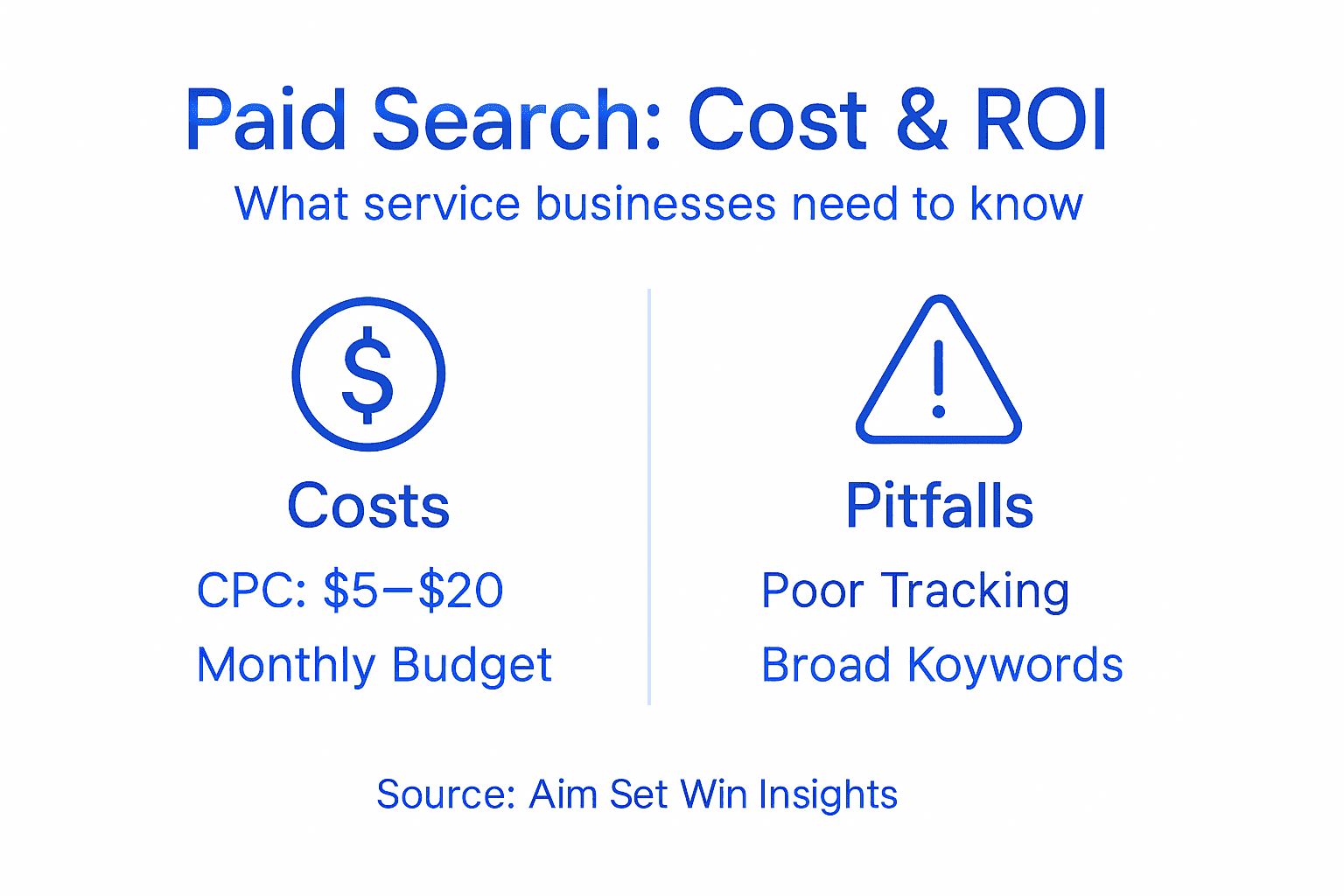
Understanding common pitfalls is essential for maximizing paid search effectiveness. Many service businesses struggle with keyword selection, often bidding on overly broad terms that drain budget without generating quality leads. Precise targeting becomes critical – for instance, a plumbing company should prioritize hyper-local keywords like “emergency plumber in Houston” over generic terms like “plumbing services.” Additional challenges include poor landing page design, inconsistent contact information, and failure to optimize mobile user experiences, which can dramatically reduce conversion rates.
Successful paid search strategies require continuous optimization. Service businesses should allocate approximately 10-15% of their total marketing budget to paid search, with consistent monthly review and adjustment of campaigns. This includes refining keyword lists, analyzing search term reports, testing different ad variations, and maintaining updated service descriptions that accurately reflect current offerings and pricing.
Below is a summary of paid search costs and ROI expectations for service businesses:
| Metric | Typical Range | Key Influence | Best Practice |
|---|---|---|---|
| Monthly Ad Spend | $500–$5,000 | Market competition | Set fixed monthly budget |
| Cost Per Click | $5–$20 | Service urgency, keyword value | Focus on high-intent keywords |
| Ideal ROI Goal | 3:1 or higher | Conversion tracking setup | Measure bookings, not just clicks |
| Optimization Frequency | Monthly reviews | Campaign performance changes | Refine keywords and ad copy often |
Pro tip: Set up conversion tracking with unique phone numbers and landing pages for each paid search campaign to precisely measure lead quality and marketing effectiveness.
Comparing Paid Search to Other Marketing
Marketing strategy comparisons reveal that paid search stands distinctly apart from traditional marketing channels. Unlike broad-based approaches like television advertising or print media, paid search offers service businesses an unprecedented level of precision targeting, allowing HVAC and plumbing companies to connect directly with potential customers precisely when they need services most.
Where social media marketing builds brand awareness and email campaigns nurture long-term relationships, paid search delivers immediate, high-intent customer interactions. Social media might reach thousands of people, but paid search connects businesses with users actively searching for specific services. A homeowner experiencing a burst pipe doesn’t want brand storytelling – they need an emergency plumber immediately, making paid search an unparalleled conversion tool for service-based businesses.
Service business marketing strategies demonstrate that paid search provides unique advantages over other channels. Traditional marketing methods often require substantial upfront investments with uncertain returns, whereas paid search operates on a performance-based model. Businesses only pay when potential customers click their advertisements, creating a more accountable and measurable marketing approach. This pay-per-click structure allows for real-time budget optimization and immediate performance insights that other marketing channels cannot match.
The most effective marketing strategies integrate multiple channels, with paid search serving as a high-conversion cornerstone. While content marketing builds long-term credibility and social media increases brand visibility, paid search drives immediate action. Service businesses can leverage this by using paid search as a rapid lead generation tool while simultaneously developing complementary marketing efforts that build trust and brand recognition.
Pro tip: Allocate 60% of your digital marketing budget to paid search for immediate conversions, while using the remaining 40% for brand-building channels like SEO and social media marketing.
Maximize Your Paid Search Results With Proven Revenue Systems
Many service businesses struggle to convert paid search clicks into actual booked jobs. The article highlights challenges like inefficient keyword targeting and missed conversion opportunities that drain marketing budgets without delivering predictable growth. If you are tired of wasting money on paid search campaigns that fail to produce consistent revenue, it is time to rethink your approach.
At Aim Set Win, we begin by implementing a Revenue Recovery System designed to re-engage past customers and turn existing demand into booked jobs quickly. This quiet, reliable system reduces dependence on new leads or costly ad spend and works seamlessly with paid search, SEO content, and website conversion improvements to scale your results. You get clear processes, measurable outcomes, and growth strategies built around actual bookings instead of just clicks.
See how our Revenue Recovery System builds predictable growth
Take control of your paid search campaigns before budgets get out of hand. Discover how combining proven recovery strategies with targeted paid search can transform your HVAC or plumbing business today. Visit Aim Set Win now to start turning clicks into booked jobs with confidence.
Frequently Asked Questions
What is paid search for service businesses?
Paid search for service businesses is a digital marketing strategy where companies purchase ad space on search engine results pages by bidding on specific service-related keywords. This approach helps them connect with potential customers actively searching for their services.
How does pay-per-click (PPC) advertising work?
Pay-per-click (PPC) advertising allows service businesses to display ads that appear when users search for related keywords. Businesses only pay when someone clicks on their ads, making it a performance-based strategy that offers real-time performance tracking and budget control.
What are Local Services Ads (LSAs) and how do they benefit service providers?
Local Services Ads (LSAs) are a specialized type of paid search advertising that showcases verified service providers directly on Google. They enhance visibility and credibility for service professionals, featuring trust signals like customer ratings, which help connect them with local customers seeking immediate services.
How can service businesses improve their local search performance?
To enhance local search performance, service businesses should maintain accurate Google Business Profile information, collect positive customer reviews, and ensure their service area and offerings are clearly defined. Creating hyper-local ad copy that includes neighborhood names and specific service descriptions can also improve ad relevance.
Recommended
- The Top 5 Reasons Service Businesses Should Prioritize SEO Over Paid Ads in 2025 – Aim Set Win
- Stop the Seasonal Slowdown: Keep Your Lawn Care Business Busy Year-Round – Aim Set Win
- Google Local Service Ads for Plumbers Aim Set Win’s Expert Tips
- Plumbing PPC Strategies in San Antonio That Deliver High-Quality Leads (Not Click Waste)
- Role of PPC in Business Growth and Lead Generation
Jean runs growth strategy at AimSetWin, a performance marketing agency specializing in local service businesses across Texas. he's helped plumbers, HVAC companies, pest control operators, and home service brands build predictable revenue systems using data-driven advertising and conversion optimization.


