
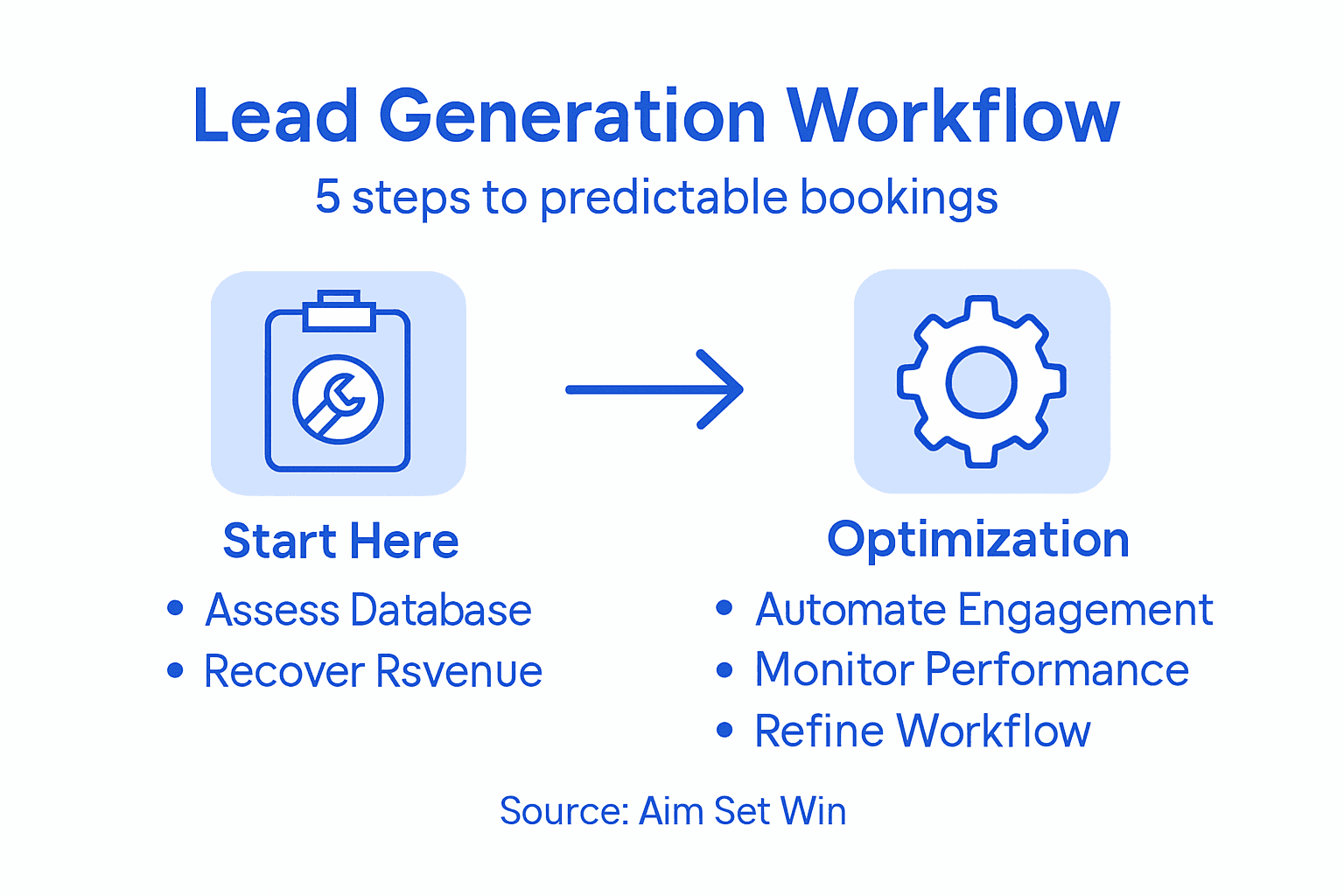
Master the plumbing lead generation workflow with a step-by-step guide to re-engage leads, maximize booked jobs, and build a predictable revenue system for your company.
Managing a busy plumbing operation in Texas often means juggling booked jobs, customer follow-ups, and revenue gaps that drain profit. Owners know every missed opportunity can add up fast. By focusing on efficient revenue recovery workflows that tap into your existing customer base and automate critical tasks, you can keep bookings steady while minimizing ad spend. This guide shares proven strategies to turn your database and existing demand into predictable growth for your plumbing business.
Table of Contents
- Step 1: Assess Existing Customer Database
- Step 2: Implement a Revenue Recovery System
- Step 3: Automate Lead Engagement Workflows
- Step 4: Monitor Conversion and Job Bookings
- Step 5: Optimize Workflow for Consistent Results
Quick Summary
| Key Insight | Explanation |
|---|---|
| 1. Assess Customer Database | Evaluate your customer data to identify high-potential leads and enhance marketing strategies. |
| 2. Implement Revenue Recovery | Develop systems to re-engage past customers for consistent bookings, enhancing revenue without new lead costs. |
| 3. Automate Lead Engagement | Utilize automated workflows to engage leads promptly, improving conversion rates and reducing manual tasks. |
| 4. Monitor Key Performance Metrics | Track conversion rates and other KPIs to inform strategic decisions and optimize lead generation practices. |
| 5. Optimize Workflow Continuously | Regularly refine workflows to eliminate bottlenecks, ensuring more reliable lead generation and job bookings. |
Step 1: Assess Existing Customer Database
Turning your existing customer database into a revenue-generating machine requires strategic evaluation. By thoroughly examining your customer information, you’ll uncover hidden opportunities for targeted lead generation and more effective marketing workflows.
Start by pulling comprehensive data from your customer relationship management (CRM) system. You’ll want to map your customer journey to understand interaction patterns and engagement levels. Focus on gathering key details like:
- Contact information (email, phone, address)
- Purchase history
- Service frequency
- Total lifetime value
- Communication preferences
- Previous interaction notes
Next, segment your database by analyzing specific characteristics. Categorize customers into groups based on factors like:
- Geographic location
- Service history
- Revenue potential
- Response rates
- Preferred communication channels
Effective database segmentation transforms raw data into actionable marketing intelligence.
Utilize database design principles to ensure your information remains organized and accessible. This approach allows you to quickly identify high-potential leads and customize your outreach strategies.
Pro tip: Regularly clean and update your database to maintain accuracy and maximize lead generation potential.
Here’s how key CRM data points drive business results:
| CRM Data Point | Strategic Benefit | Marketing Impact |
|---|---|---|
| Purchase history | Identifies top-value customers | Enables relevant offers |
| Service frequency | Reveals loyalty trends | Aids retention campaigns |
| Communication preferences | Improves engagement rates | Reduces opt-outs |
| Lifetime value | Prioritizes high-potential leads | Optimizes marketing budget |
| Interaction notes | Personalizes outreach | Builds client trust |
Step 2: Implement a Revenue Recovery System
Designing a robust revenue recovery system transforms sporadic booking opportunities into a predictable business growth strategy. Your goal is to create a systematic approach that re-engages past customers and converts existing demand into booked jobs without additional lead generation expenses.
Financial strategies for revenue recovery involve strategic workflows that maximize your existing customer base. Start by developing a comprehensive system that includes:
- Automated customer follow-up sequences
- Targeted reengagement campaigns
- Personalized service reminders
- Loyalty incentive programs
- Segmented communication strategies
Create a multi-channel outreach plan that touches customers through various communication platforms. This might include:
- Personalized email campaigns
- SMS service reminders
- Direct mail postcards
- Targeted social media retargeting
- Scheduled phone check-ins
Effective revenue recovery turns past interactions into future revenue opportunities.
Leveraging EPA guidelines on sustainable revenue streams, design your system to balance cost recovery with customer retention. Track key performance metrics like response rates, conversion percentages, and average customer lifetime value to continuously refine your approach.
Pro tip: Implement a customer relationship management system that automatically tracks and triggers reengagement workflows to maximize recovery potential.
Step 3: Automate Lead Engagement Workflows
Transforming your plumbing business requires creating systematic lead engagement workflows that consistently convert prospects without constant manual intervention. By implementing marketing automation strategies, you can design intelligent systems that nurture leads automatically and maximize conversion potential.
Build your automation framework around strategic touchpoints that keep potential customers engaged. Key components of an effective automated workflow include:
- Instant lead acknowledgment emails
- Segmented communication sequences
- Scheduled follow-up reminders
- Personalized service recommendations
- Triggered content based on lead interactions
Implement workflow triggers that respond to specific customer behaviors. These automated sequences might involve:
- Initial inquiry response within 15 minutes
- Service recommendation email within 24 hours
- Follow-up SMS after one week
- Personalized offer based on interaction history
- Re-engagement campaign for inactive leads
Automated workflows transform sporadic interactions into predictable revenue streams.
Utilize workflow management platforms that allow precise scheduling and monitoring of your lead engagement process. These tools enable you to create complex, multi-step workflows that adapt to individual customer journeys while maintaining consistent communication standards.

Pro tip: Test and refine your automation sequences regularly, tracking conversion rates and adjusting triggers to improve performance.
See how workflow automation compares to manual lead management:
| Aspect | Manual Lead Management | Automated Workflow System |
|---|---|---|
| Speed | Slow, often delayed | Immediate, scheduled |
| Consistency | Varies by team member | Always standardized |
| Follow-up accuracy | Prone to missed tasks | Ensured via triggers |
| Scalability | Limited as business grows | Easily handles high volume |
Step 4: Monitor Conversion and Job Bookings
Tracking your plumbing business’s performance requires a systematic approach to monitoring conversion rates and job bookings. By implementing precise conversion tracking methods, you can transform raw data into actionable insights that drive business growth.
Establish key performance indicators that provide a comprehensive view of your lead generation workflow. Critical metrics to track include:
- Conversion rate from lead to booked job
- Average time between lead generation and booking
- Total revenue per lead
- Customer acquisition cost
- Booking completion percentage
Create a monitoring dashboard that captures real-time performance data. Your tracking system should include:
- Daily lead volume tracking
- Conversion rate analysis
- Job booking success percentages
- Revenue per lead calculation
- Customer interaction touchpoint metrics
Effective monitoring transforms data points into strategic business intelligence.
Utilize workflow monitoring platforms that provide transparent visibility into your entire sales process. These tools enable you to identify bottlenecks, optimize communication strategies, and make data-driven decisions that improve overall booking rates.
Pro tip: Review your conversion metrics weekly and adjust your lead engagement strategies based on the most recent performance data.
Step 5: Optimize Workflow for Consistent Results
Transforming your plumbing lead generation process requires continuous refinement and strategic optimization. By implementing intelligent process intelligence techniques, you can systematically improve your workflow’s performance and predictability.
Identify workflow bottlenecks through comprehensive analysis of your current lead generation system. Critical optimization areas include:
- Automated task redundancies
- Communication response times
- Lead qualification processes
- Conversion pathway efficiency
- Resource allocation strategies
Apply continuous improvement methodologies to streamline your workflow. Key optimization strategies involve:
- Regular performance metric reviews
- Automated process mapping
- Machine learning-driven insights
- Predictive performance modeling
- Dynamic workflow adjustment protocols
Systematic workflow optimization transforms inconsistent results into reliable business growth.
Implement workflow management best practices that provide structured approaches to continuous process refinement. These frameworks enable you to create adaptable systems that evolve with your business needs, ensuring consistent lead generation and booking performance.
Pro tip: Dedicate one hour weekly to analyzing workflow performance metrics and implementing incremental improvement strategies.
Build Predictable Plumbing Bookings with Proven Revenue Recovery Systems
Struggling to turn leads into consistent booked jobs is a common challenge for plumbing businesses. This article highlights the importance of a strategic plumbing lead generation workflow that includes revenue recovery, automated engagement, and monitoring conversion rates to create reliable growth. If you want to stop relying on sporadic leads and instead develop a workflow that consistently converts, it is critical to implement systems that re-engage past customers and maximize existing demand.
At Aim Set Win, we specialize in helping plumbing companies recover missed revenue and build predictable growth systems using our signature Revenue Recovery System. Our approach requires no new leads or ad spend but instead focuses on turning your current customer data into booked jobs within 30 days or less. This system works quietly and reliably in the background so you can focus on delivering outstanding service. Once your revenue recovery foundation is solid, we enhance results further with paid search, SEO content, website conversion improvements, and AI-powered call handling.
Take control of your lead generation and booking workflows today by exploring our tailored solutions for plumbers in the Plumbers Archives – Aim Set Win. Visit Aim Set Win now to see how our proven systems can transform your business growth without unnecessary complexity. Start building predictable revenue streams that deliver measurable outcomes and consistent booked jobs.
Frequently Asked Questions
How can I assess my existing customer database for plumbing lead generation?
Start by pulling comprehensive data from your customer relationship management system. Focus on key details like contact information, purchase history, and communication preferences, and ensure to segment your database based on relevant customer characteristics to identify high-potential leads.
What steps should I take to implement a revenue recovery system for past customers?
Develop a structured approach that includes automated customer follow-up sequences and targeted reengagement campaigns. Consider implementing personalized service reminders and loyalty incentive programs to turn past interactions into new bookings.
How can I automate lead engagement workflows for my plumbing business?
Create systematic workflows using triggers that respond to customer behaviors, such as sending an initial inquiry response within 15 minutes. Set up scheduled follow-ups and consider segmented communication sequences to ensure consistent and timely engagement with potential customers.
What metrics should I monitor to track conversion rates and job bookings for plumbing leads?
Establish key performance indicators like conversion rate from lead to booked job and average time between lead generation and booking. Create a monitoring dashboard to capture real-time data to help you analyze performance and make informed adjustments.
How can I optimize my plumbing lead generation workflow for consistent results?
Identify bottlenecks in your current workflows and apply continuous improvement methodologies. Dedicate time each week to review performance metrics and implement incremental changes that enhance both efficiency and predictability in lead generation and bookings.
Recommended
- 7 Types of HVAC Marketing Strategies for Reliable Growth
- SEO Cost for HVAC Companies: The Ultimate Guide
- Effective Ways to Get Plumbing Leads in 2025 | Aim Set Win
- Demand Generation: Turning Contacts Into Booked Jobs
Jean runs growth strategy at AimSetWin, a performance marketing agency specializing in local service businesses across Texas. he's helped plumbers, HVAC companies, pest control operators, and home service brands build predictable revenue systems using data-driven advertising and conversion optimization.


