
Discover 9 essential PPC ad agency strategies for 2026. Learn how to leverage AI, data, and omnichannel tactics to drive measurable results and future-proof success.
Digital advertising is moving at lightning speed, and agencies that fail to keep pace risk being left behind. The landscape in 2026 is defined by shifting privacy rules, smarter automation, and evolving consumer expectations.
To stay ahead, every ppc ad agency must embrace innovation and adapt to new realities. From AI-driven campaign management to seamless cross-platform integration, the strategies needed for success are more advanced and actionable than ever.
This article uncovers the 9 essential PPC ad agency strategies that will drive real results in 2026. Ready to future-proof your campaigns? Let us guide you through the tactics that will set your agency apart.
The Evolving PPC Landscape in 2026
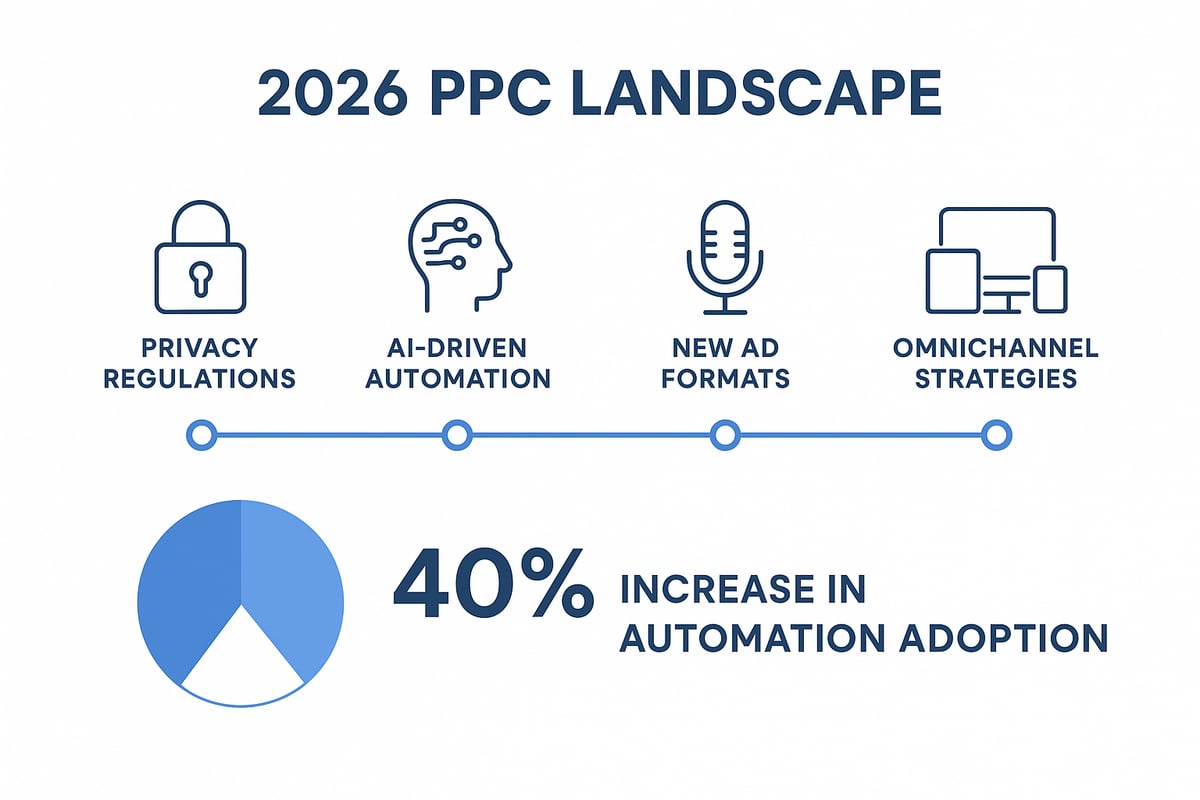
The digital world is transforming rapidly, and the ppc ad agency landscape in 2026 is almost unrecognizable compared to just a few years ago. Agencies must keep pace with sweeping changes in technology, regulations, and consumer expectations to remain competitive.
One of the most significant shifts is the tightening of privacy regulations across the globe. New laws are changing how a ppc ad agency collects, stores, and utilizes consumer data. As third-party cookies disappear, agencies are turning to first-party data strategies to maintain targeting accuracy and comply with evolving privacy standards.
Artificial intelligence and machine learning have become central to campaign management. Automation tools now handle bid adjustments, budget allocation, and audience targeting with remarkable precision. For example, Google’s Performance Max and Meta’s Advantage+ campaigns use AI to optimize ad placements and creative in real time. In 2025 alone, automated campaign adoption grew by 40 percent, signaling a clear move toward hands-off optimization and improved efficiency for every ppc ad agency.
The rise of new ad formats is also shaping the future. Voice and visual search are no longer experimental; they are mainstream. Consumers now interact with brands using smart speakers, image searches, and even AR or VR experiences. Agencies must adapt creative strategies to meet users where they are, ensuring that campaigns are discoverable and engaging across all touchpoints.
First-party data is now more valuable than ever. Ethical data usage, consent management, and transparent communication are non-negotiable for any ppc ad agency. Integrating customer data platforms and CRM systems is essential for building accurate audience profiles and delivering relevant, personalized ads.
The omnichannel approach is becoming the new standard. Modern consumers expect seamless experiences as they move between platforms like Google, Meta, TikTok, and LinkedIn. Effective agencies coordinate messaging and creative assets across these channels, using sophisticated attribution models to track user journeys and optimize performance. According to Omnichannel PPC Campaigns, this holistic strategy is key for driving higher engagement and conversions.
However, these advancements bring challenges. The ppc ad agency of 2026 must balance automation with human oversight, navigate complex privacy requirements, and continually update skills to leverage the latest tools. Success depends on agility, ethical practices, and a commitment to innovation.
9 Essential PPC Ad Agency Strategies for 2026 Success
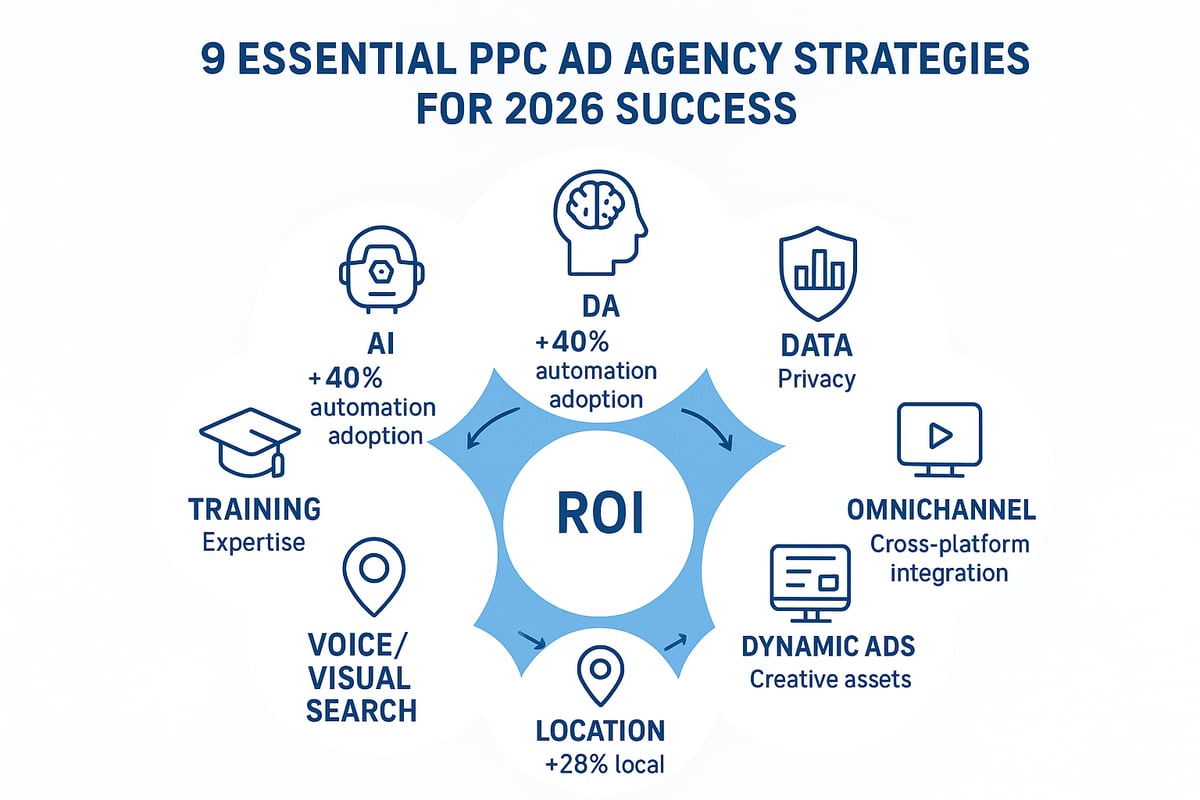
Staying competitive in 2026 requires a ppc ad agency to adopt innovative approaches that align with the industry’s rapid evolution. The following nine strategies are designed to help agencies not only survive but thrive in a complex digital landscape. Each tactic addresses core challenges and leverages new opportunities for growth and measurable results.
1. Leverage Advanced AI and Machine Learning for Campaign Optimization
Artificial intelligence and machine learning are transforming how a ppc ad agency manages campaigns. Automating bid management and budget allocation with AI tools allows agencies to focus on strategy rather than manual tweaks. Predictive analytics help identify high-value audiences, while real-time analysis enables swift adjustments for better performance.
A ppc ad agency can utilize tools like Google Ads’ Performance Max and Meta’s AI-driven targeting to optimize campaigns efficiently. These platforms streamline processes, reduce manual workload, and ultimately boost ROI. According to WordStream (2025), 67 percent of agencies report improved results with AI-powered optimization. The use of AI-Powered Bid Management further enhances efficiency and maximizes outcomes.
However, maintaining human oversight remains crucial. Over-reliance on automation can lead to missed insights or errors if not monitored. Balancing technology with expert intuition ensures a ppc ad agency stays agile and client-focused.
2. Prioritize First-Party Data Collection and Privacy Compliance
The shift to a privacy-first world means a ppc ad agency must rethink data strategies. Third-party cookies are fading, making first-party data collection essential. Agencies should implement consent-driven tactics, such as lead forms and loyalty programs, to gather valuable audience insights.
Integrating this data with CRM or CDP platforms creates a holistic view of each customer, enabling precise targeting and personalization. Staying compliant with regulations like GDPR and CCPA is non-negotiable for every ppc ad agency. Transparency and clear consent management foster trust and long-term relationships.
Investing in robust first-party data approaches delivers measurable results. eMarketer (2025) notes that 58 percent of marketers have increased their spending on these strategies. For a deeper dive, explore First-Party Data Strategies to future-proof your agency’s campaigns.
3. Adopt Omnichannel and Cross-Platform Campaign Strategies
In 2026, a successful ppc ad agency must coordinate campaigns across multiple channels, including Google, Meta, TikTok, and LinkedIn. Consistent messaging and creative assets are vital for brand recognition and user trust. An omnichannel approach ensures customers experience seamless journeys, regardless of where they interact.
Attribution modeling is key for tracking user paths and optimizing touchpoints. Integrating paid search with paid social, for example, covers the entire marketing funnel and boosts conversion rates. According to Think with Google (2025), omnichannel campaigns achieve nearly 19 percent higher engagement than single-channel efforts.
A ppc ad agency that masters cross-platform strategies can maximize reach and frequency, driving better business results. Managing multiple channels may seem complex, but the payoff is clear: higher engagement and stronger client satisfaction.
4. Utilize Responsive and Dynamic Creative Assets
Personalization is no longer optional for a ppc ad agency seeking top-tier results. Dynamic ads that adapt to user behavior and context improve relevance and click-through rates. Responsive ad formats, such as Google Responsive Search Ads and Meta Dynamic Creative, enable agencies to test multiple headlines, descriptions, and images automatically.
A/B testing and multivariate experimentation empower a ppc ad agency to refine creative assets continuously. Tailoring content by audience segment or intent signal enhances campaign performance. For e-commerce, dynamic product ads deliver personalized retargeting, significantly increasing conversion rates.
Google reports that responsive ads achieve a 15 percent higher average CTR in 2025. This data highlights the importance of creative agility for a ppc ad agency aiming to stand out in a crowded market.
5. Implement Automation in Reporting and Performance Analysis
For a ppc ad agency, timely insights are critical. Automated dashboards provide real-time KPI tracking and allow for swift optimization. By integrating platforms like Google Analytics 4, Data Studio, or Looker, agencies can centralize data and streamline reporting.
Custom alerts and anomaly detection tools empower a ppc ad agency to proactively manage campaigns, catching issues before they escalate. Automated weekly performance snapshots keep clients informed and build transparency.
According to Search Engine Journal (2025), 72 percent of agencies cite automation as vital for scaling reporting. This efficiency saves time and ensures your ppc ad agency delivers consistent, high-quality results.
6. Focus on Localized and Hyper-Targeted Campaigns
A modern ppc ad agency must master local relevance to maximize impact. Geo-targeting and location-based bid adjustments help tailor campaigns to specific regions or demographics. Custom ad copy and localized offers boost engagement and drive action.
Platforms like Google Local Services Ads and Facebook Local Awareness Ads are powerful tools for service businesses and franchises. Hyper-local campaigns allow a ppc ad agency to connect with nearby customers at the right moment.
WordStream (2025) found that localized PPC campaigns deliver 28 percent higher conversion rates. Managing multiple locations can be complex, but the rewards for a ppc ad agency are substantial.
7. Integrate Voice and Visual Search Advertising
Search habits are changing, and a ppc ad agency must keep pace. Voice search is growing rapidly, with more users relying on smart speakers and mobile assistants. Optimizing for conversational keywords and natural language queries ensures your campaigns remain discoverable.
Visual search is also on the rise, especially on platforms like Pinterest and Google Lens. Creating engaging visual ads allows a ppc ad agency to capture attention in new ways. For more on these emerging trends, see Voice and Visual Search Advertising.
BrightLocal (2025) reports that 55 percent of users now use voice search for local queries. Agencies should also watch the evolution of AR and VR ad formats, which promise even more interactive experiences for the future of ppc ad agency campaigns.
8. Invest in Continuous Learning and Team Upskilling
The digital landscape evolves quickly, so a ppc ad agency must prioritize ongoing training. Team members should pursue certifications from Google, Meta, or Microsoft, and attend industry workshops to stay ahead of changes.
Fostering a culture of experimentation and innovation is essential. Learning sprints, knowledge sharing sessions, and regular reviews help a ppc ad agency adapt and grow. HubSpot (2025) notes that agencies with structured learning programs see 23 percent higher client retention.
Addressing talent gaps and attracting specialists is also crucial. By investing in people, a ppc ad agency builds resilience against industry disruptions and maintains a competitive edge.
9. Measure Beyond Clicks: Emphasize Business Outcomes and Lifetime Value
A forward-thinking ppc ad agency looks beyond vanity metrics. Focusing on meaningful KPIs such as ROAS, lifetime value, and customer acquisition cost aligns campaigns with real business objectives. Advanced attribution models, like data-driven or multi-touch, provide clearer insights into campaign effectiveness.
Integrating CRM data and tracking offline conversions ensures a ppc ad agency demonstrates tangible business impact. Search Engine Land (2025) reports that 62 percent of agencies now report on outcomes, not just ad metrics.
Communicating results in terms clients care about, such as revenue growth or lead quality, strengthens relationships and underscores the value a ppc ad agency provides.
Future-Proofing Your PPC Ad Agency: Key Considerations for 2026 and Beyond
The digital marketing world never stands still, and a ppc ad agency must stay ahead to thrive in 2026 and beyond. As platforms, regulations, and user behaviors shift, agencies need a proactive mindset. Future-proofing means more than reacting to change, it requires building resilience into every layer of your operations.
Embracing Agility and Building Future-Ready Tech Stacks
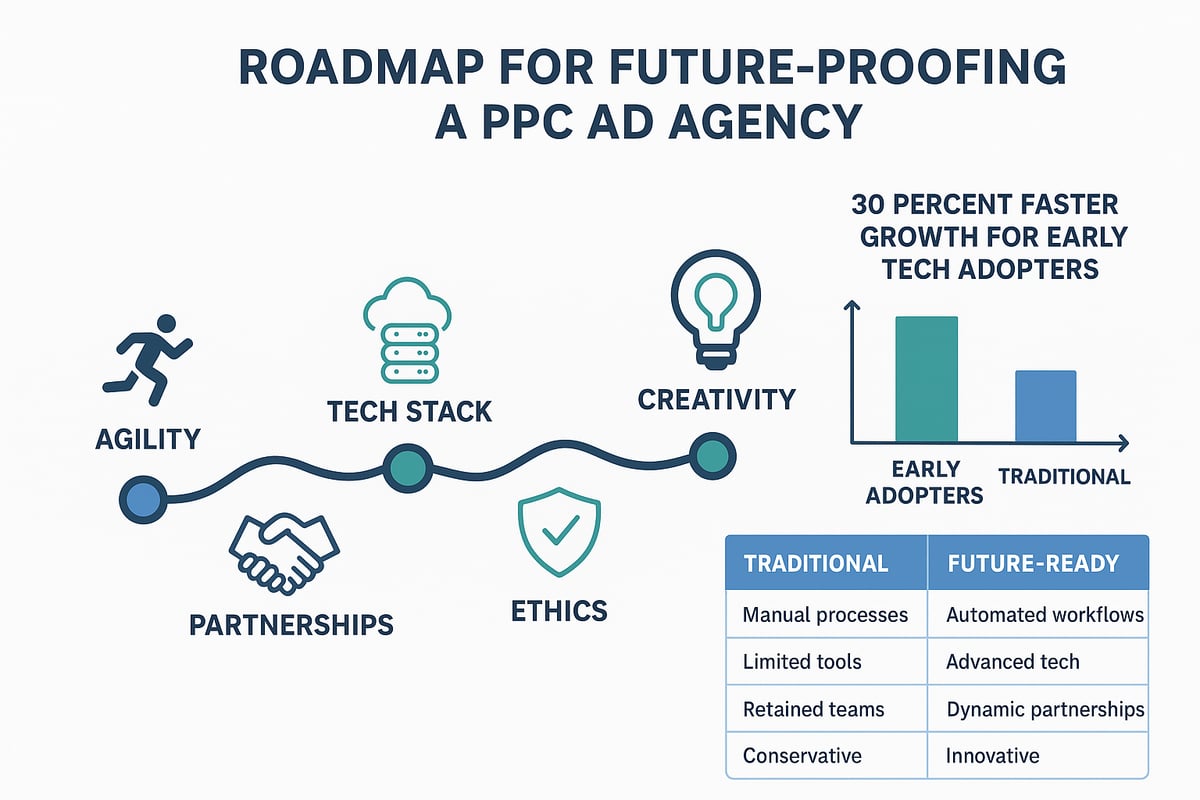
Agility is the foundation for any successful ppc ad agency in 2026. Rapid changes in privacy laws, ad formats, and algorithm updates can disrupt campaigns overnight. Agencies must prioritize flexible workflows and quick decision-making.
Investing in a robust tech stack is non-negotiable. Automation tools, advanced analytics, and seamless integrations enable agencies to manage multiple platforms efficiently. Early tech adopters have been shown to achieve 30 percent faster growth, underscoring the value of staying ahead.
A future-ready ppc ad agency regularly audits its technology, ensuring tools align with business goals. This approach minimizes disruption and maximizes campaign performance.
Key Elements of a Future-Ready Tech Stack
| Component | Purpose | Example Tools |
|---|---|---|
| Automation | Streamline bidding, reporting, alerts | Google Ads Scripts, Zapier |
| Analytics Integration | Unified data for insights | Looker, Google Analytics 4 |
| Cross-Platform Support | Manage campaigns across channels | SEMrush, Supermetrics |
Strengthening Partnerships and Ethical Practices
A modern ppc ad agency cannot operate in a silo. Strategic partnerships with ad platforms and third-party data providers bring early access to new features, support, and insights that drive campaign innovation.
Ethical advertising is now essential. Agencies must commit to responsible data usage, transparent reporting, and compliance with evolving regulations. This builds trust with clients and end users alike.
To remain competitive, agencies should foster a culture of continuous learning and knowledge sharing. Staying ahead of algorithm changes and industry disruptions requires ongoing education, attending industry events, and leveraging resources like the Search Engine Marketing Strategies Guide.
Top Future-Proofing Actions for 2026
- Maintain compliance with privacy laws
- Build strong relationships with platform partners
- Invest in ongoing staff training
- Audit and update processes regularly
Adaptability and ethical standards are not just best practices, they are critical differentiators for any ppc ad agency aiming to lead in the next era.
Balancing Technology with Human Creativity
While automation and AI are transforming the industry, human insight remains irreplaceable. Creativity, strategic thinking, and nuanced understanding of client goals set a ppc ad agency apart in a tech-driven world.
Agencies that blend cutting-edge technology with authentic human expertise deliver campaigns that resonate and perform. Encourage innovation, reward experimentation, and never lose sight of the client’s unique brand voice.
Ultimately, these future-proofing strategies position a ppc ad agency for long-term growth, resilience, and industry leadership in 2026 and beyond.
Jean runs growth strategy at AimSetWin, a performance marketing agency specializing in local service businesses across Texas. he's helped plumbers, HVAC companies, pest control operators, and home service brands build predictable revenue systems using data-driven advertising and conversion optimization.


