
PPC for HVAC boosts lead generation for Dallas contractors. Explore campaign types, ROI strategies, costs, and common pitfalls in competitive markets.
Standing out in the Dallas HVAC market can feel like a constant uphill climb, especially when every contractor is chasing the same seasonal calls. Effective pay-per-click strategies put your business front and center, reaching homeowners the moment they search for urgent heating or cooling services. By refining the right keywords and shifting focus to lead quality instead of click quantity, PPC offers instant visibility and measurable ROI to HVAC contractors ready to outpace competitors each season.
Table of Contents
- PPC Basics for HVAC Contractors
- Why PPC Matters for HVAC Contractors in Dallas
- The Core Components of a PPC Campaign
- Getting Started with Google Ads
- Key Metrics You Must Track
- Key Types of PPC Campaigns for HVAC
- Ad Targeting Strategies That Work
- Calculating ROI and Managing Costs
- Avoiding Common HVAC PPC Mistakes
Key Takeaways
| Point | Details |
|---|---|
| PPC Advertising | Pay-per-click advertising allows HVAC contractors to achieve immediate visibility and reach homeowners actively seeking services, ensuring efficient budget use. |
| Targeted Campaigns | Focus on specific campaign types like search campaigns for high-intent leads and remarketing to re-engage past visitors. |
| Data-Driven Decisions | Monitor key metrics such as click-through rate and cost per conversion to evaluate campaign performance and optimize return on investment. |
| Avoid Common Mistakes | Prioritize effective keyword selection, negative keywords, and conversion tracking to minimize wasted spending and enhance campaign success. |
PPC Basics for HVAC Contractors
PPC stands for pay-per-click advertising, and it’s one of the fastest ways to get calls from homeowners needing HVAC services in Dallas. Here’s what you need to know to get started and dominate your local market.
What Is PPC and How Does It Work?
Pay-per-click (PPC) is a digital advertising model where you only pay when someone clicks your ad. With PPC, your ads appear on search engines like Google or on websites, and you’re charged a small fee each time a potential customer clicks through to your landing page or calls your business.
Unlike traditional advertising where you pay upfront regardless of results, PPC makes you pay for qualified leads, not just ad placements. That’s the beauty of it.
Your HVAC business sets a budget, bids on keywords, and Google displays your ads to people actively searching for heating and cooling services. When someone clicks your ad, they either land on your website or call your business directly.
The biggest advantage of PPC is instant visibility. Unlike SEO which takes months, PPC gets your number in front of people searching for HVAC services today.
Why PPC Matters for HVAC Contractors in Dallas
Dallas homeowners search for emergency AC repair, furnace replacement, and seasonal maintenance services online every single day. PPC puts your business right in front of them at that exact moment.
Here’s why PPC is critical for HVAC contractors:
- Immediate results: You appear in search results within hours, not months
- Local targeting: Show ads only to Dallas area customers searching for your services
- Budget control: Set daily spending limits and adjust based on performance
- Measurable ROI: Track exactly how many calls and leads come from each dollar spent
- Seasonal flexibility: Scale up during peak AC or heating season, scale down in slow months
Searching for HVAC services is high-intent behavior. Homeowners aren’t just browsing; they need your services now. That makes PPC exceptionally profitable for contractors.
The Core Components of a PPC Campaign
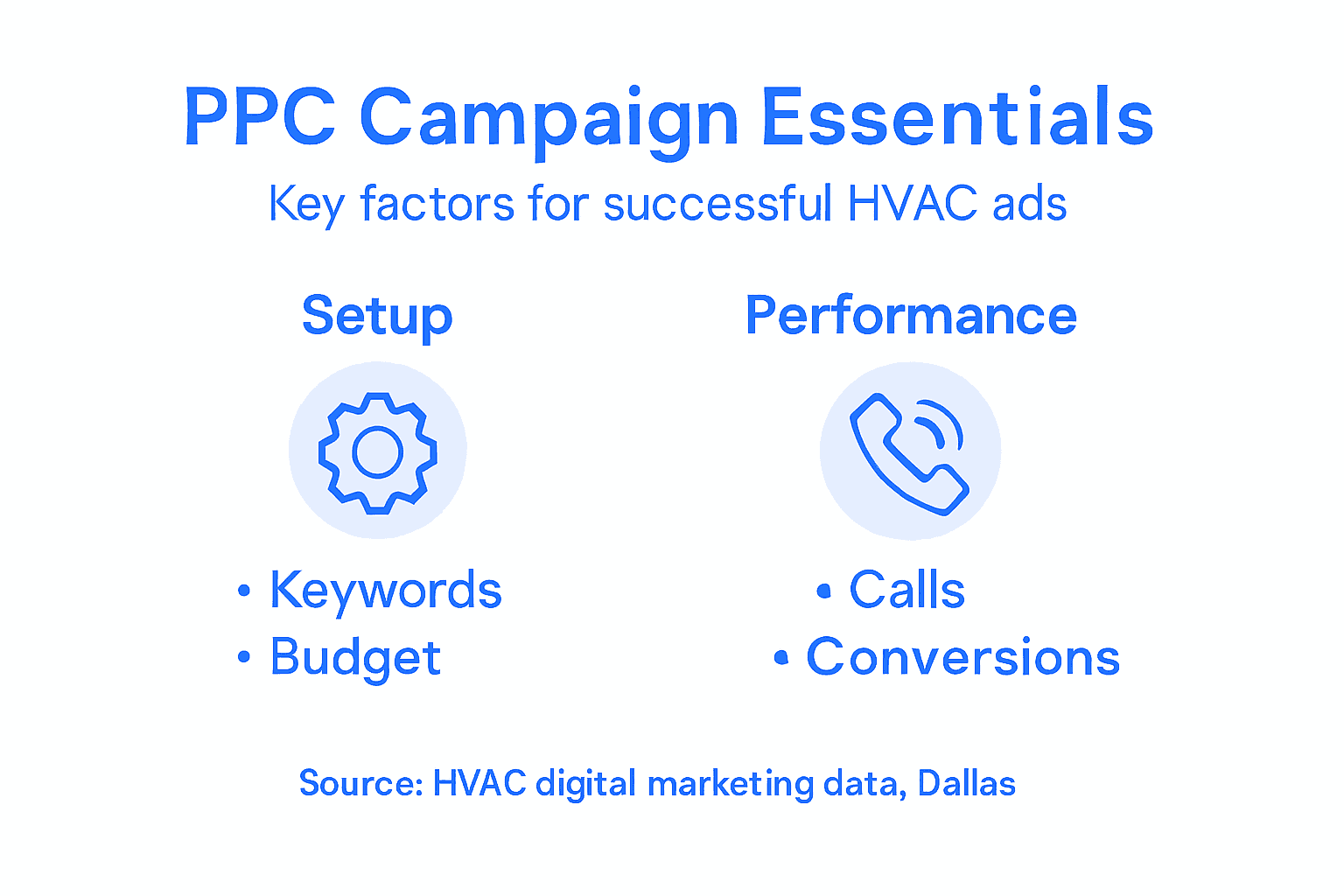
A successful PPC campaign has several moving parts working together. You need keywords, ads, landing pages, and proper budget management.
Your campaign structure looks like this:
- Keywords: The search terms you bid on (“emergency AC repair Dallas,” “furnace replacement near me,” etc.)
- Ad groups: Organized sets of related keywords with matching ads
- Ads: The text or display ads that show when someone searches your keywords
- Landing pages: Where people land after clicking your ad
- Budget: Daily spending limit you set for your campaign
Each piece affects the others. Poor keyword selection tanks your entire campaign. Weak ads mean people won’t click. Bad landing pages waste clicks and money.
Here’s a comparison of PPC campaign components and their business impact for HVAC contractors:
| Component | Purpose | Business Impact |
|---|---|---|
| Keywords | Target specific search queries | Drives qualified leads to your ads |
| Ad Groups | Organize related keywords | Increases ad relevance and quality |
| Ads | Attract clicks from prospects | Improves click-through rate |
| Landing Pages | Convert clicks into actions | Boosts conversion rates and revenue |
| Budget | Control daily ad spend | Maximizes ROI, avoids overspending |
Effective keyword research is where most contractors stumble. You need to target the right search terms that match what Dallas homeowners actually type when they need your services.
When setting up campaigns, remember that quantity of keywords matters less than quality. Five perfectly targeted keywords that convert beat fifty scattered, irrelevant ones.
Getting Started with Google Ads
Google Ads is the dominant PPC platform for HVAC contractors. Most homeowner searches happen on Google, so that’s where your budget should go first.
Your first steps:
- Create a Google Ads account (free to set up)
- Define your campaign goals (calls, website leads, etc.)
- Choose your campaign type (Search campaigns are best for HVAC)
- Research and select your keywords
- Write your ads
- Create or optimize your landing page
- Set your budget and bid strategy
- Launch and monitor performance
Google Ads handles most of the technical work for you. You focus on strategy, messaging, and monitoring results.
Start small, test your approach, then scale what works. A $500-per-month test campaign teaches you more than endless theory.
Key Metrics You Must Track
PPC gives you detailed performance data. Ignore it at your peril.
These metrics matter most:
- Click-through rate (CTR): Percentage of people who see your ad and click it. 2-3% is typical for HVAC.
- Cost per click (CPC): How much you pay each time someone clicks. HVAC CPCs range from $2-$8 in Dallas.
- Conversion rate: Percentage of clicks that become phone calls or qualified leads. 10-20% is solid.
- Cost per conversion: Total ad spend divided by calls or leads generated. This reveals true profitability.
- Quality Score: Google’s rating of your ad quality (1-10). Higher scores mean lower costs.
Track these numbers religiously. They show whether your campaign is working or bleeding money.
Pro tip: Set up call tracking with a dedicated phone number for your PPC ads so you can attribute every incoming call to specific keywords and ads. This transforms guesswork into data-driven decision making.
Key Types of PPC Campaigns for HVAC
Not all PPC campaigns work the same way. Different campaign types serve different purposes in your overall strategy. Understanding which type to use and when separates contractors who waste money from those who dominate their market.
Search Campaigns: Your Primary Lead Generator
Search campaigns are the bread and butter of HVAC PPC. These are the ads that appear at the top of Google search results when someone types “AC repair near me” or “emergency furnace service Dallas.”
Search campaigns target specific keywords that homeowners use when actively looking for your services. When they search, your ad shows up, and if they click, you pay.
These campaigns work because you’re reaching people at the exact moment they need HVAC help. They’re not browsing randomly; they’re searching for a solution.
Search campaigns should be your first priority and your largest budget allocation. This is where most HVAC contractors get their qualified calls.
Search campaigns deliver the highest intent traffic because you only show ads to people actively searching for your services.
Display Campaigns: Building Awareness and Retargeting
Display campaigns show banner ads on websites across the internet. Instead of appearing in search results, your ads pop up on news sites, home improvement blogs, and other pages your potential customers visit.

Display campaigns work differently than search. You’re not catching people mid-search; you’re reaching them while they browse. This makes display better for brand awareness and staying top-of-mind.
Display is also cheaper per click than search, making it good for testing new audiences and geographic areas.
For HVAC contractors, display campaigns are most effective when combined with remarketing. You show ads to people who visited your website but didn’t call or book service yet.
Remarketing Campaigns: Winning Back Warm Leads
Remarketing campaigns follow your website visitors around the internet. If someone visits your site, looks at your services, then leaves without calling, your ads chase them down on other websites.
Remarketing is powerful because these people already know who you are. They’ve seen your website. They’re warm leads, not cold prospects.
You can create different remarketing campaigns for different audiences:
- People who visited your homepage but nothing else
- People who viewed your service pages but didn’t click your phone number
- People who visited your pricing page
- People who visited your reviews page
Marketing campaigns using remarketing strategies reconnect with previous website visitors to drive more calls and conversions. This is why remarketing often has the highest conversion rates and lowest cost per call.
Video Campaigns: Demonstrating Your Expertise
Video campaigns show short video ads on YouTube and across the Google Display Network. Video builds trust fast because homeowners see your team, your trucks, and your professionalism in action.
Video works well for:
- Explaining common HVAC problems and solutions
- Showcasing your team and company culture
- Demonstrating emergency response capabilities
- Building brand recognition in your market
Video ads cost more upfront but generate higher engagement. People who watch your video are seriously interested in your business.
Campaign Types Comparison
Here’s how these campaigns stack up:
| Campaign Type | Best For | Cost | Conversion Rate |
|---|---|---|---|
| Search | High-intent leads | Higher CPC | Highest |
| Display | Brand awareness | Lower CPC | Medium |
| Remarketing | Warm leads | Lowest CPC | Very High |
| Video | Trust building | Highest upfront | Medium-High |
Which Campaigns Should You Start With?
Most HVAC contractors should start with search campaigns. They deliver the fastest results and highest return on investment.
Once search is generating consistent leads, add remarketing to catch visitors who didn’t convert. Then layer in display campaigns for brand awareness.
Video campaigns come later, once you have budget to test them and video content ready to go.
Pro tip: Start with a single search campaign targeting your highest-value keywords like “emergency AC repair Dallas” or “furnace replacement near me,” then expand to other campaign types only after proving your search strategy works and generates positive ROI.
Ad Targeting Strategies That Work
Targeting is everything in PPC. You can write amazing ads and bid on keywords, but if you’re showing them to the wrong people, you waste money. Smart targeting means your ads reach the people most likely to call and book service.
Geo-Targeting: Focus on Dallas and High-Converting Areas
Geo-targeting ensures your ads only show to people in your service area. This is non-negotiable for HVAC contractors.
You don’t want to pay for clicks from someone in Houston or Austin. You want calls from Dallas homeowners who can actually use your services.
Inside Dallas, take it further. Identify neighborhoods with higher homeownership rates, higher average home values, and more single-family homes. These areas convert better because people are more likely to service their HVAC systems.
Some Dallas neighborhoods consistently outperform others. Run your campaigns and track which zipcodes and neighborhoods generate the most calls. Then increase your bid in those areas.
Narrow geo-targeting reduces wasted ad spend and increases the percentage of your budget reaching high-value customers in your service area.
Keyword Match Types: Control When Your Ads Show
Keyword match types determine when Google shows your ads based on what people search. Different match types serve different purposes.
There are four main match types:
- Broad match: Your ad shows for searches related to your keyword (casts widest net, most wasted clicks)
- Modified broad match: Your ad shows when modified keywords are in the search (more control than broad)
- Phrase match: Your ad shows when the keyword phrase appears in the search in that order
- Exact match: Your ad shows only when someone searches that exact keyword (most controlled, fewest clicks)
Use exact match for your most expensive, highest-converting keywords like “emergency AC repair Dallas” or “furnace replacement 75201.” Use phrase match for broader service keywords. Avoid broad match for HVAC unless you’re testing new keywords.
Negative Keywords: Block Wasted Clicks
Negative keywords prevent your ads from showing for irrelevant searches. This saves money instantly.
If you bid on “furnace repair,” your ad might show for “DIY furnace repair” or “furnace repair cost estimates.” Those searches don’t convert to service calls.
Add negative keywords to exclude searches that waste your budget:
- Jobs or careers (“HVAC technician jobs”)
- DIY and how-to searches (“how to fix my AC”)
- Competitor brand names
- Parts only searches (“furnace blower motor”)
- Educational content (“how HVAC systems work”)
Review your search terms weekly and add new negative keywords. This is how top contractors keep their cost per call low.
Demographic and Behavioral Targeting
Understanding target audience data through demographics and behavior empowers you to create personalized PPC ads. Target homeowners by age, income, and previous online behavior.
Better demographic targeting means:
- Showing ads more to homeowners than renters
- Prioritizing higher-income zip codes where emergency service calls are more valuable
- Reaching people who recently searched for home services
- Targeting people in homes with older HVAC systems
Ad Scheduling: Show Ads When People Call
Not all hours are equal. Most HVAC calls happen during business hours and early evening, not at 3 a.m.
Ad scheduling lets you show ads more during peak call times and less during slow hours. This stretches your budget further by concentrating spend on when people actually need service.
During summer and winter peak seasons, you might show ads all day. During shoulder seasons, focus on business hours only.
Keyword Research and Refinement
Keyword research helps identify and refine the right keywords for PPC targeting. Build your keyword list by thinking like a Dallas homeowner with an HVAC problem.
What would they search? “AC repair near me,” “emergency furnace service,” “my air conditioner is not cooling,” “HVAC maintenance Dallas.” These are your targets.
Build a keyword list organized by service type and urgency level. Emergency searches convert faster than maintenance searches. Price-sensitive searches convert slower.
Pro tip: Start with 10-15 highly targeted, exact-match keywords in your first campaign, track which ones generate calls with your lowest cost per conversion, then expand your keyword list based on proven winners rather than guessing at hundreds of keywords upfront.
Calculating ROI and Managing Costs
PPC only makes sense if it generates more revenue than you spend. Calculating your return on investment shows whether your campaigns are profitable or burning cash. Without tracking ROI, you’re flying blind.
Understanding Your PPC Costs
PPC costs include every dollar you spend on ads plus the time and tools needed to manage them. Most contractors forget about management costs and only look at ad spend.
Your total PPC costs are:
- Ad spend (what Google charges for clicks)
- Google Ads management software or platform fees
- Time spent managing campaigns (your hourly rate)
- Call tracking software to attribute calls to campaigns
- Landing page creation or optimization
Add all these together. This is your true investment.
Most HVAC contractors spend $500 to $3,000 per month on Dallas PPC campaigns. Your budget depends on your market, competition, and service area size.
To clarify budgeting and ROI, see typical cost breakdowns for HVAC PPC in Dallas:
| Cost Category | Typical Monthly Range | Business Significance |
|---|---|---|
| Ad Spend | $500 – $3,000 | Main driver of campaign reach |
| Management Tools/Software | $50 – $200 | Streamlines campaign oversight |
| Call Tracking | $30 – $80 | Directly links ads to phone leads |
| Landing Page Development | $100 – $500 | Enhances conversion potential |
Accurate cost tracking is the foundation of ROI calculation. If you don’t know what you’re spending, you can’t measure what you’re earning.
Tracking Conversions and Phone Calls
Conversion tracking connects the dots between ads and actual calls or jobs booked. Without it, you can’t calculate ROI.
Set up call tracking with a dedicated phone number for your PPC ads. When someone calls that number, you know they came from your campaign. This is critical data.
You should track:
- Total calls received from PPC ads
- Calls that convert to booked appointments
- Calls that convert to completed jobs
- Average value of each completed job
Google Ads has built-in conversion tracking. Use it to log every call, form submission, or appointment scheduled through your ads.
Without proper conversion tracking, you’re essentially guessing at campaign performance.
Calculating Cost Per Call and Cost Per Job
Cost per call is your total ad spend divided by calls received. This shows how expensive each potential customer contact is.
Calculate it:
- Total ad spend for the month: $1,500
- Total calls from PPC: 45 calls
- Cost per call: $1,500 ÷ 45 = $33.33 per call
Then calculate cost per job: your total ad spend divided by completed jobs from those calls.
- Total completed jobs from PPC: 12 jobs
- Cost per job: $1,500 ÷ 12 = $125 per job
If your average HVAC job is worth $2,000 to $5,000 in profit, spending $125 to acquire that customer is excellent ROI.
Customer Lifetime Value Changes Everything
Customer lifetime value is the total profit you make from a customer over their relationship with you. Most contractors only think about the first service call.
But a customer who calls you for emergency AC repair in July will likely call you again for furnace maintenance in October and furnace repair in January. That’s multiple jobs and thousands in profit.
Calculating ROI for campaigns using conversion data and customer lifetime value allows contractors to justify PPC investment and optimize budget allocation. A customer acquired for $125 might generate $3,000 to $5,000 in lifetime profit.
When you account for lifetime value, PPC becomes incredibly profitable.
Managing Your Budget Wisely
Start small and scale based on proven results. Don’t dump your entire marketing budget into PPC day one.
Budget management steps:
- Set a monthly budget you can afford to test (start with $500-$1,000)
- Run campaigns for 30 days and track every metric
- Calculate cost per call and cost per job
- If ROI is positive, increase budget by 25-50%
- If ROI is negative, fix targeting and keywords before scaling
- Monitor daily and adjust bids on high-performing keywords
The best contractors constantly optimize. They kill underperforming keywords and increase spend on winners.
Key Metrics to Monitor Weekly
These numbers tell you if you’re making money or losing it:
- Ad spend: Total dollars spent
- Clicks: Total times people clicked your ads
- Cost per click (CPC): Ad spend divided by clicks
- Calls: Total calls generated from ads
- Cost per call: Ad spend divided by calls
- Jobs booked: Calls that turned into appointments
- Jobs completed: Appointments that became paid work
- Revenue: Total dollars from jobs traced to PPC
- Net profit: Revenue minus all costs
Track these in a spreadsheet or Google Sheets. Review them every Friday. Adjust based on what the data shows.
Pro tip: Calculate your “break-even cost per call” by dividing your average job profit by your average conversion rate (calls to jobs), then target a cost per call 30-50% lower than break-even to ensure profitable campaigns with built-in margin for error.
Avoiding Common HVAC PPC Mistakes
Most HVAC contractors lose money on PPC because they repeat the same mistakes. Learning what kills campaigns helps you avoid wasting thousands in your first months.
Mistake One: Poor Keyword Selection
Poor keyword selection is the number one PPC killer. Contractors bid on keywords that sound right but don’t match what customers actually search.
For example, bidding on “HVAC” or “heating and cooling” is too broad. Someone searching those terms might be a student researching systems, not a homeowner needing service.
Instead, bid on intent-based keywords like “emergency AC repair Dallas,” “furnace replacement near me,” or “my AC won’t turn on.” These phrases indicate someone needs your service now.
Poor keyword selection leads to irrelevant clicks wasting budget on unqualified prospects. Research what Dallas homeowners actually search when their AC breaks at midnight.
Mistake Two: Ignoring Negative Keywords
Negative keywords prevent your ads from showing for irrelevant searches. Contractors who skip this waste 20-30% of their budget.
If you bid on “furnace repair,” your ads might show for:
- “DIY furnace repair”
- “Furnace repair cost”
- “Furnace repair near me but I’m actually in Houston”
- “Furnace repair jobs hiring”
None of these convert to calls. Add negative keywords for DIY searches, educational content, jobs listings, and competitor names.
Review your search terms weekly and add new negative keywords constantly. This single action saves thousands annually.
Mistake Three: Weak Ad Copy
Ad copy determines whether someone clicks your ad or ignores it. Weak ads get ignored, wasting your budget on wasted impressions.
Your ads should:
- Highlight what makes you different (same-day service, licensed technicians, 24/7 availability)
- Include a clear call to action (“Call now for emergency service”)
- Address the customer’s problem directly (“AC not cooling? We fix it today”)
- Include your service area (“Dallas, Arlington, Plano”)
Test different ad copy and see what clicks better. Then pause the losers and increase spend on winners.
Mistake Four: No Conversion Tracking
Conversion tracking connects ads to actual phone calls and jobs. Without it, you don’t know if your campaigns work.
Contractors spend $1,500 monthly on PPC, get 50 calls, but don’t track which calls became jobs. They assume the campaign failed when actually it generated $40,000 in revenue.
Set up call tracking now. Use a dedicated phone number for your PPC ads. When someone calls that number, you know they came from PPC.
Without conversion tracking, you cannot optimize campaigns or justify continued spending to decision makers.
Mistake Five: Setting It and Forgetting It
Neglected campaigns decline over time. Algorithms change. Competition increases. Your best keywords become more expensive.
Top contractors check their campaigns daily. They monitor:
- Which keywords generate calls
- Which ads get the most clicks
- Which times of day drive conversions
- Which neighborhoods send the most calls
They adjust bids on winners, pause losers, and test new ad variations constantly.
Campaigns that get active management generate 3-5 times more calls than set-and-forget campaigns.
Mistake Six: Overlooking Local and Seasonal Strategy
Campaign failures result from lack of strategic planning and poor understanding of your target audience. Contractors often fail to localize campaigns or optimize for seasonality.
Dallas summers mean emergency AC calls. Winter means furnace problems. Spring brings maintenance season.
Your campaign strategy should shift seasonally:
- Summer: Bid aggressively on emergency AC keywords
- Winter: Focus on furnace repair and maintenance
- Spring/Fall: Target seasonal maintenance and cleanings
Also localize to neighborhoods, not just Dallas city. Different areas have different demographics and conversion rates.
Mistake Seven: Not Testing Landing Pages
Poor landing pages waste clicks. Someone clicks your ad expecting to see what your ad promised, but your landing page doesn’t match.
Your landing page should have:
- Clear, large phone number at the top
- Headline matching your ad copy
- Quick explanation of your services
- Customer testimonials or trust signals
- Click-to-call button on mobile
Test different landing pages. Send some traffic to one, some to another. Track which converts better.
Pro tip: Audit your campaigns weekly for these seven mistakes, and you’ll automatically outperform 80% of contractors still making them; focus on keyword quality, negative keywords, and conversion tracking first since these three alone account for most PPC waste.
Transform Your Dallas HVAC PPC Results with Proven Digital Marketing Strategies
Managing a successful PPC campaign for your HVAC business in Dallas requires expert keyword selection, precise geo-targeting, and ongoing optimization to reduce wasted spend and maximize calls. If you’ve struggled with tracking conversions or feel overwhelmed by ad management, you are not alone. The challenges of PPC like setting up conversion tracking, refining negative keywords, and boosting ad relevance are exactly where Aim Set Win excels.
Aim Set Win specializes in delivering tailored HVAC SEO and digital marketing solutions that harness local SEO, conversion focused web design, and data driven strategies to drive consistent inbound calls. We focus on creating revenue centered growth systems that complement your PPC efforts by increasing your brand authority, optimizing campaign targeting, and improving landing page conversions.
Get ahead of your competitors and start turning clicks into booked jobs today. Visit our homepage to learn how our Dallas HVAC SEO Agency transforms seasonal demand and emergency service visibility for contractors just like you. Take the next step toward scalable growth by partnering with experts who understand the Texas market and know how to convert search intent into real revenue.
Frequently Asked Questions
What is PPC advertising and how does it benefit HVAC contractors?
PPC, or pay-per-click advertising, is a model where HVAC contractors pay only when someone clicks on their ad. This allows for immediate visibility in search results, attracting homeowners actively looking for HVAC services, which increases qualified leads and potential calls.
How can HVAC contractors target their PPC ads effectively?
HVAC contractors can utilize geo-targeting to focus ads only on specific service areas, ensuring ads reach potential customers who can utilize their services. Additionally, using keyword match types, negative keywords, and demographic targeting helps in reaching the right audience efficiently.
What are the key components of a successful PPC campaign for HVAC services?
A successful PPC campaign includes well-researched keywords, organized ad groups, compelling ad copy, optimized landing pages, and effective budget management. Each component works together to drive qualified traffic and improve conversion rates.
How can HVAC contractors track the effectiveness of their PPC campaigns?
Contractors can track effectiveness using key metrics such as click-through rate (CTR), cost per click (CPC), conversion rate, and cost per conversion. Implementing call tracking with dedicated phone numbers for ads enhances data quality, allowing contractors to measure performance accurately.
Recommended
- Paid Search Basics HVAC: Unlocking Revenue in Texas
- 8 HVAC PPC Tips for Dominating the Online Market
- SEO and PPC: The Ultimate Strategy for Small-Town HVAC Companies – Aim Set Win
- How to Recover Lost HVAC Revenue with Targeted SEO
Jean runs growth strategy at AimSetWin, a performance marketing agency specializing in local service businesses across Texas. he's helped plumbers, HVAC companies, pest control operators, and home service brands build predictable revenue systems using data-driven advertising and conversion optimization.


