
Learn how Texas plumbing contractors can use PPC to generate more local leads with smart targeting, proven campaign setup steps, and optimization strategies.
Many Texas plumbing contractors pour money into PPC ads every month and walk away with little to show for it. The phone barely rings, the cost per click keeps climbing, and the leads that do come in are not the right fit. That is not a PPC problem. That is a strategy problem. Pay-Per-Click advertising, when built around hyper-local targeting and high-intent keywords, can become your most reliable source of booked jobs. This guide walks you through exactly how to make PPC work for your plumbing business in Texas, from setup to optimization.
Table of Contents
- What is PPC for plumbing companies and why it works in Texas
- What you need before launching your first plumbing PPC campaign
- How to set up your first PPC campaign step by step
- Tracking, optimizing, and avoiding common PPC mistakes
- PPC vs. SEO: Why a hybrid approach brings the best local results
- Get more high-quality plumbing leads with expert help
- Frequently asked questions
Key Takeaways
| Point | Details |
|---|---|
| Target urgent searchers | Focus PPC campaigns on high-intent, local searches like ‘emergency plumber near me’ for quick leads. |
| Invest smartly | Set a realistic Texas market PPC budget—expect $8–50 per click and $65–220 per booked job. |
| Optimize and measure | Track all ads, use geo-targeting, and continually test to avoid wasted spend and boost ROI. |
| Use PPC and SEO | Combine PPC for immediate leads with SEO for long-term local dominance in Texas. |
What is PPC for plumbing companies and why it works in Texas
PPC stands for Pay-Per-Click. You pay only when someone clicks your ad. For plumbing companies, this means your budget goes directly toward people who are actively searching for a plumber right now, not people scrolling through a magazine or watching TV. That distinction matters enormously in Texas markets where competition is fierce and customers make decisions fast.
Texas cities like Houston, San Antonio, Dallas, and Austin have dense populations with high demand for emergency plumbing services. When a pipe bursts at 11 PM, that homeowner is not browsing social media. They are typing “emergency plumber near me” into Google. High-intent keywords like “water heater repair San Antonio” and “emergency plumber near me” are exactly what your plumbing PPC services should target to capture that demand instantly.
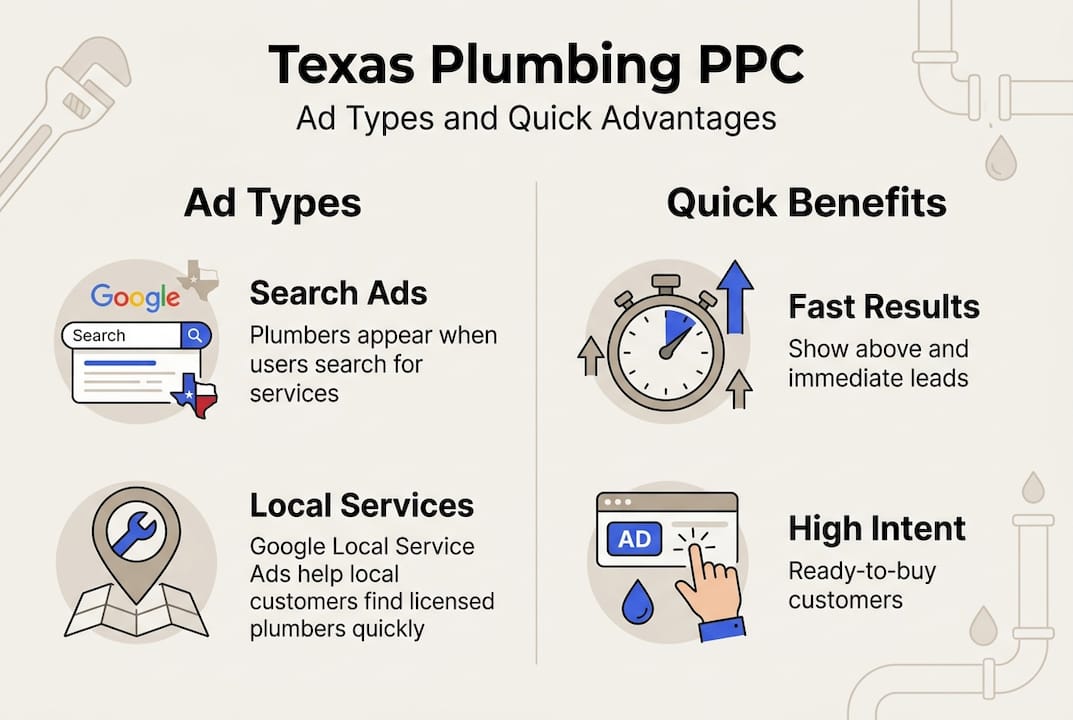
Here are the main types of PPC that work best for plumbers:
- Google Search Ads: Show up at the top of results for specific keyword searches
- Local Services Ads (LSAs): Google-verified listings that appear above regular ads and charge per lead
- Bing Ads: Lower competition and cost, useful for reaching older demographics
- Display Ads: Visual banner ads for brand awareness, less effective for emergency calls
PPC captures emergency service demand the moment it happens. While SEO builds over months, a well-targeted Google Search Ad can put your phone number in front of a panicked homeowner within hours of going live.
For San Antonio PPC strategies specifically, local modifiers and neighborhood-level targeting make a measurable difference in lead quality. Review plumbing PPC benchmarks to understand what results are realistic for your market size.
What you need before launching your first plumbing PPC campaign
Jumping into Google Ads without preparation is how budgets disappear fast. Before you spend a single dollar, you need the right assets in place.
Start with your budget. Average costs for Texas plumbers show a cost per click ranging from $8 to $50, with emergency keywords on the higher end. Monthly budgets typically run from $1,000 to $4,500 for effective coverage, and your cost per acquisition (the amount you spend to book one job) averages $65 to $220 depending on the service type and city.

| Market size | Daily budget | Est. monthly leads | Avg. CPC range |
|---|---|---|---|
| Small suburb | $30 to $50 | 20 to 40 leads | $8 to $20 |
| Mid-size city | $75 to $100 | 50 to 80 leads | $15 to $35 |
| Major metro (Houston, Dallas) | $100 to $150 | 80 to 120 leads | $25 to $50 |
Before you launch, make sure you have these campaign assets ready:
- A fast, mobile-friendly website with a clear call to action
- Dedicated landing pages for each service (not just your homepage)
- Call tracking software to measure which ads drive phone calls
- A verified and optimized Google Business Profile
- A list of target keywords split by urgency (emergency vs. routine)
Pro Tip: Use geo-bidding to increase your bids in high-conversion neighborhoods. In San Antonio, areas like Stone Oak and Alamo Heights tend to have homeowners with higher budgets and faster decision-making. Bidding more aggressively in those zip codes can improve your close rate without inflating your overall spend. See the full San Antonio campaign setup steps for a detailed breakdown.
You can also review Texas plumbing PPC results to benchmark your expectations before committing to a budget.
How to set up your first PPC campaign step by step
Once your assets are ready, here is how to build your campaign the right way.
- Keyword research: Start with high-intent keyword examples like “emergency plumber near me,” “water heater repair [city],” and “drain cleaning [neighborhood].” Group them by service type.
- Match types: Use exact match for your highest-value keywords to control spend. Use phrase match to capture variations without going too broad.
- Build ad groups: Create separate ad groups for each service. One for water heater repair, one for drain cleaning, one for leak detection. This keeps your ads relevant.
- Write ad copy: Lead with the problem your customer has, then your solution, then a clear call to action. “Burst pipe in Houston? Licensed plumbers available now. Call for same-day service.”
- Set geo-targets: Target your service area by city, zip code, or radius. Exclude areas you do not serve.
- Set your budget and bids: Start conservative. You can scale once you see what converts.
- Enable call tracking: Connect a call tracking number to your ads so you know exactly which campaigns are driving calls.
- Launch and monitor: Check performance daily for the first two weeks.
Here is how the main ad types compare:
| Ad type | Pros | Cons | Best use |
|---|---|---|---|
| Google Search Ads | High intent, immediate visibility | Higher CPC, needs management | Emergency and routine services |
| Local Services Ads | Pay per lead, Google Guarantee badge | Limited control over targeting | Trust-building, local visibility |
| Display Ads | Low cost, wide reach | Low intent, poor for emergencies | Brand awareness only |
Combining LSAs with search ads gives you both the trust signal of the Google Guarantee and the keyword-level control of traditional search campaigns. Explore proven PPC strategies and San Antonio-specific tips to sharpen your approach.
Pro Tip: Write two versions of your ad copy, one focused on emergencies (“Available 24/7, same-day service”) and one for routine jobs (“Schedule your annual water heater inspection today”). Test both and let the data tell you which performs better in your market.
Tracking, optimizing, and avoiding common PPC mistakes
Launching your campaign is just the beginning. The real work happens after the ads go live.
Set up conversion tracking inside Google Ads to measure calls, form submissions, and booked appointments. Without this, you are flying blind. Connect your call tracking software so every inbound call is tied back to a specific keyword or ad.
Once data starts coming in, optimize regularly using these steps:
- Add negative keywords: Block irrelevant searches like “plumbing jobs” or “DIY pipe repair” that waste your budget
- Exclude low-performing zip codes: If certain areas never convert, stop bidding there
- Use ad scheduling: Run ads during hours when your team can actually answer the phone
- A/B test your headlines: Small changes in wording can shift click-through rates significantly
- Review search term reports weekly: See exactly what people typed before clicking your ad
A plumbing company in North Texas cut their cost per lead by 34% simply by adding 60 negative keywords and tightening their geo-targets to their actual service area. No budget increase required.
According to lead generation benchmarks, spending $40 per day in a smaller service area can generate 50 to 60 leads per month, while a metro-level budget of $75 per day can push 80 to 100 leads monthly. Those numbers only hold if your targeting is clean.
Common mistakes that drain budgets fast include ignoring mobile optimization (most emergency searches happen on phones), letting campaigns run 24/7 without scheduling, and skipping the negative keyword list entirely. Review the North Texas PPC case study and learn how to cut CPA with local strategies for real-world examples.
PPC vs. SEO: Why a hybrid approach brings the best local results
PPC and SEO are not competitors. They are teammates. Each one fills a gap the other cannot.
PPC delivers results fast. The moment your campaign goes live, your ad can appear at the top of Google. That is critical for emergency services where the customer needs help right now. PPC drives instant leads while SEO builds long-term authority, and using both together is the most effective approach for Texas plumbers.
| Factor | PPC | SEO |
|---|---|---|
| Speed to results | Immediate (hours to days) | Slow (months) |
| Cost structure | Pay per click | Time and content investment |
| Best for | Emergencies, seasonal campaigns | Long-term brand authority |
| Sustainability | Stops when budget stops | Compounds over time |
| Trust signals | Ad label visible | Organic results feel more trusted |
Here is when to prioritize each strategy:
- Prioritize PPC when you need leads immediately, during peak seasons (summer AC season, winter pipe freezes), or when launching in a new service area
- Prioritize SEO when you want to reduce long-term ad spend, build authority in your city, and rank for dozens of service keywords without paying per click
- Use both when you want to dominate the search results page from top to bottom
Pro Tip: Run PPC for your highest-urgency services like burst pipes and water heater failures. Let your plumbing SEO services handle the steady-volume keywords like “plumber in [city]” and “drain cleaning near me” over time. This split keeps your ad spend focused while SEO builds your organic foundation.
Get more high-quality plumbing leads with expert help
Running PPC campaigns while managing a plumbing business is a lot to handle. Most contractors who try to manage ads themselves end up overspending on the wrong keywords, missing optimization opportunities, and leaving leads on the table.
At Aim Set Win, we build revenue-focused PPC and SEO systems specifically for Texas plumbing contractors. We handle keyword research, campaign setup, geo-targeting, ad copy testing, and ongoing optimization so your budget works harder every month. Our plumbing SEO services complement your PPC campaigns by building the organic presence that keeps leads coming in even when ads are paused. If you want to understand why SEO keeps you competitive long-term, or you are ready to explore local plumbing SEO strategies that work alongside your paid campaigns, we are ready to help you build a system that books more jobs consistently.
Frequently asked questions
What’s the average cost per lead for plumbing PPC in Texas?
Most Texas plumbers spend between $65 and $220 per booked job, depending on the service type and how competitive the local market is. Emergency keywords tend to push costs toward the higher end of that range.
Are Local Services Ads worth it for plumbers?
Yes. LSAs attract 13% of local search clicks for plumbing businesses, and you only pay per lead rather than per click, which makes them a cost-efficient complement to standard search ads.
Should I use PPC or SEO to get plumbing leads?
Use PPC when you need leads quickly, especially for emergency services. Use SEO for long-term visibility and lower cost per lead over time. A hybrid approach delivers the best results for most Texas plumbers.
How much should a plumbing company spend on PPC monthly in Texas?
Effective campaigns in most Texas markets require a monthly budget of $1,000 to $4,500. Larger metros like Houston and Dallas typically need budgets on the higher end to stay competitive.
What’s the single biggest PPC mistake Texas plumbers make?
Ignoring geo-targeting. Without it, your ads show to people outside your service area who will never book. Neighborhood-level geo-bidding in areas like San Antonio’s Stone Oak consistently produces higher close rates for plumbing contractors.
Recommended
- Plumbing PPC Services | Drive More Local Leads with Google Ads
- Plumbing PPC Strategies in San Antonio That Deliver High-Quality Leads (Not Click Waste)
- San Antonio Plumber Google Ads: PPC & Pay Per Click Marketing
- PPC for HVAC: Driving More Calls in Dallas
Jean runs growth strategy at AimSetWin, a performance marketing agency specializing in local service businesses across Texas. he's helped plumbers, HVAC companies, pest control operators, and home service brands build predictable revenue systems using data-driven advertising and conversion optimization.


