
Learn how to rank your HVAC business on Google Maps in Texas with a step-by-step local SEO guide covering profiles, website fixes, reviews, and geo-grid tracking.
TL;DR:
- Consistent optimization over 3 to 6 months is needed to rank higher in Google Maps for HVAC in Texas.
- Key strategies include optimizing Google Business Profile, website SEO, reviews, citations, and ongoing geo-grid tracking.
- Long-term success relies on regular updates, review requests, and data-driven adjustments rather than quick fixes.
If you run an HVAC business in Texas and your competitors keep showing up in Google Maps while your phone stays quiet, you already know the frustration. The Map Pack, those top three local results Google shows above everything else, captures the majority of local clicks. Getting there is not luck. It is a repeatable process built on specific technical moves, local relevance signals, and consistent effort over time. This guide walks you through exactly what it takes to rank your HVAC business higher on Google Maps in Texas, from the tools you need to the ongoing habits that separate businesses that grow from businesses that stall.
Table of Contents
- What you need to rank: Essential tools and local SEO prerequisites
- Step 1: Optimize your Google Business Profile for HVAC relevance
- Step 2: Website enhancements that drive local map rankings
- Step 3: Influence local ranking with reviews, citations, and geo-grids
- The uncomfortable truth about Google Maps ranking for HVAC businesses
- Ready to increase your HVAC leads? Specialized SEO support for Texas businesses
- Frequently asked questions
Key Takeaways
| Point | Details |
|---|---|
| Prepare essential tools | You need the right accounts, tracking, and mobile-friendly tools before making changes to your business listing or site. |
| Optimize for local relevance | Hyper-local keywords, proper categories, and Texas-focused content drive more HVAC calls from nearby customers. |
| Speed and reviews matter | Mobile site speed and consistent five-star reviews both strongly influence your position on Google Maps. |
| Track with geo-grids | Monitor your ranking progress and fix ‘red zones’ by tracking every two weeks with grid tools. |
| Results require time | It typically takes three to six months of consistent effort to see meaningful improvement in local search results. |
What you need to rank: Essential tools and local SEO prerequisites
Before you change a single word on your website or your Google Business Profile, you need the right setup. Think of this phase as gathering your gear before a job. Walking onto a site without the right tools wastes time and produces poor results.
Here is a quick reference table of everything you need and why it matters:
| Tool or platform | Purpose | How it is used in this guide |
|---|---|---|
| Google Business Profile | Your Maps listing | Optimized in Step 1 |
| Website CMS login | On-page edits | Used in Step 2 |
| Google Search Console | Track organic performance | Monitor keyword visibility |
| PageSpeed Insights | Mobile speed testing | Identify speed issues |
| Local Falcon | Geo-grid tracking | Verify ranking changes |
| Review profiles (Google, Yelp, BBB) | Reputation signals | Built in Step 3 |
| NAP document | Name, address, phone consistency | Cross-referenced everywhere |
Beyond the platforms, you also need specific business details ready to go:
- Your exact business name, address, and phone number (NAP) written out consistently
- A list of every service you offer, including seasonal ones like AC tune-ups and heating repairs
- Service area cities and zip codes across Texas
- High-quality photos of your team, trucks, and completed jobs
- Your website URL and any existing citation listings
For local SEO for HVAC companies, following a structured technical SEO checklist is the fastest way to avoid common setup mistakes. Per Texas HVAC SEO best practices, your site needs mobile speed under 3 seconds, proper schema markup, and E-E-A-T content, with geo-grid tracking checked every two weeks to verify progress.
Pro Tip: Run your website through Google PageSpeed Insights right now. If your mobile score shows a load time above 3 seconds, fixing that one issue alone can produce a measurable ranking lift before you touch anything else.
Step 1: Optimize your Google Business Profile for HVAC relevance
Your Google Business Profile (GBP) is the single most direct lever you have for Maps visibility. Most HVAC owners set it up once and forget it. That is a costly mistake. Here is a seven-step process to get it working for you.
- Choose the right primary category. Select “HVAC Contractor” as your primary category. Add secondary categories like “Air Conditioning Contractor” or “Heating Contractor” where they apply.
- Write a keyword-rich business description. Include your city, your core services, and Texas-specific language. Mention humidity, heat, seasonal tune-ups, and emergency AC repair naturally.
- Lock down NAP consistency. Your name, address, and phone number must match your website and every citation listing exactly, character for character.
- Define your service areas. Add every city and suburb you actually serve. Do not list areas you cannot reach within a reasonable drive time.
- Upload local photos regularly. Post photos of your team on job sites in recognizable Texas neighborhoods. Google rewards active profiles.
- Set accurate business hours. Include holiday hours and emergency availability if you offer it. Incomplete hours reduce trust signals.
- Populate the Q&A section. Add your own questions and answers covering common HVAC concerns. This controls the narrative and adds keyword relevance.
For deeper context on what HVAC SEO means and how your profile fits into the bigger picture, it helps to understand the full ranking framework before making edits.
Texas markets reward hyper-local ranking strategies because searchers use city-specific and climate-specific terms. Phrases like “AC repair in Katy” or “emergency heat pump service Plano” signal very local intent. Matching that language in your profile description and Q&A earns you relevance points Google uses to decide who shows up.
“Expect 3 to 6 months for movement into the Map Pack in competitive Texas areas. Patience combined with consistent action is what separates businesses that rank from those that wonder why nothing changed.”
Pro Tip: Use Texas weather language throughout your profile. Words like humidity, heat index, and seasonal tune-up connect your listing to the real search behavior of Texas homeowners calling for HVAC help.
Step 2: Website enhancements that drive local map rankings
Your Google Business Profile tells Google where you are and what you do. Your website tells Google you are credible and authoritative enough to show at the top. Both signals must work together.
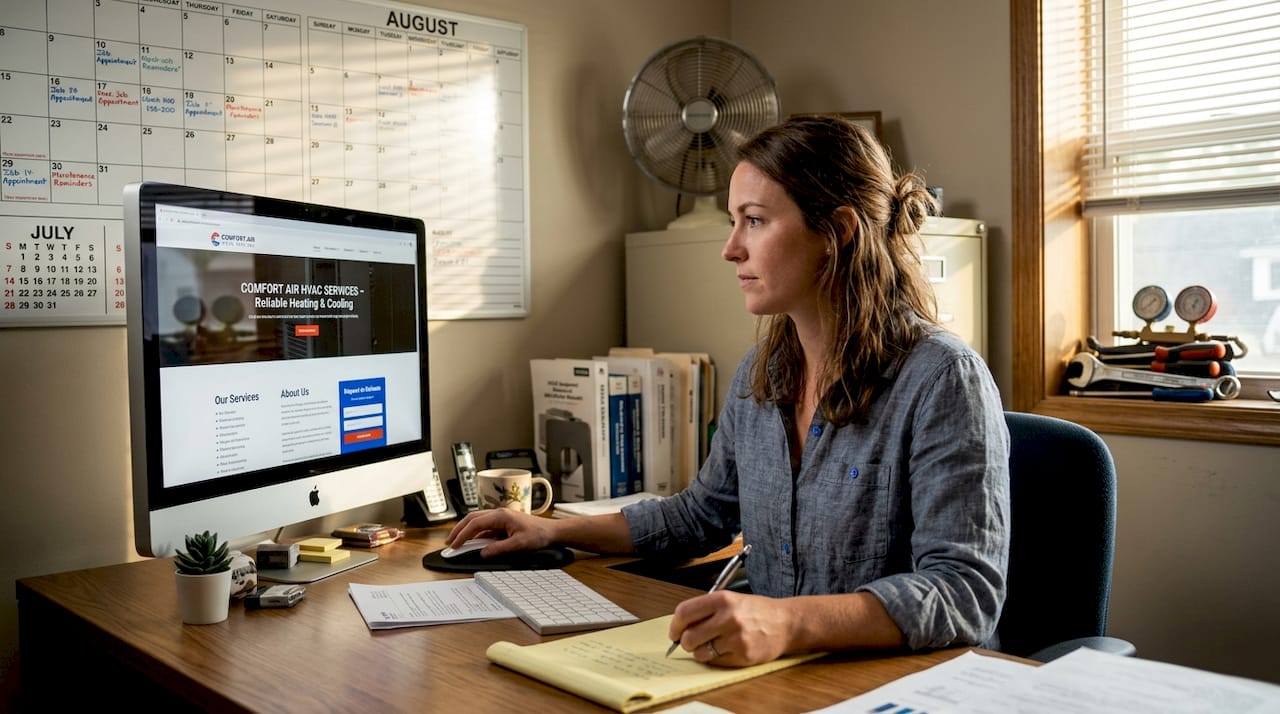
Here is a comparison of must-have website factors versus nice-to-haves for competitive Texas markets:
| Factor | Must-have | Nice-to-have for competitive markets |
|---|---|---|
| Mobile speed under 3 seconds | Yes | Faster is always better |
| Schema markup (LocalBusiness) | Yes | HVAC-specific service schema |
| E-E-A-T content | Yes | Case studies and certifications |
| Texas city landing pages | Yes | Neighborhood-level pages |
| Clickable phone number | Yes | Click-to-text option |
| HTTPS security | Yes | Security trust badges |
| Internal linking structure | Yes | Topic cluster architecture |
The technical SEO improvements that matter most are straightforward. Focus your energy here:
- Make your site load in under 3 seconds on mobile. Compress images and minimize unused scripts.
- Add LocalBusiness schema to your homepage and service pages so Google can read your business data cleanly.
- Create individual landing pages for each Texas city you serve. A page for “AC repair in Fort Worth” performs far better than a generic services page.
- Make your phone number clickable on every page. Mobile users searching for HVAC help want to call immediately.
- Align your website contact information exactly with your Google Business Profile. Even small differences in address formatting can suppress your ranking.
For a full on-page SEO checklist built for home service companies, you can work through each item systematically. Pairing that with current HVAC digital marketing strategies ensures your site stays competitive as Google updates its local ranking signals throughout 2026.
Per HVAC SEO best practices, tracking your geo-grid results every two weeks is the only reliable way to know whether your website changes are producing real ranking movement or just looking good on paper.
Step 3: Influence local ranking with reviews, citations, and geo-grids
You have built a strong profile and a solid website. Now you need to generate ongoing signals that tell Google your business is active, trusted, and locally relevant. This is where most HVAC owners stop short, and it is exactly where your competitors are pulling ahead.
Follow this numbered process:
- Ask every customer for a review. Send a follow-up text or email within 24 hours of completing a job. Include a direct link to your Google review page.
- Respond to every review. Reply to positive and negative reviews within 48 hours. Use the customer’s city name and service type naturally in your response.
- Build citations on authoritative directories. Submit your NAP to Google, Yelp, BBB, Angi, HomeAdvisor, and Texas-specific directories. Consistency is everything.
- Set up geo-grid tracking. Use a tool like Local Falcon to create a grid map of your service area and track where your listing ranks across different locations.
- Review your grid every two weeks. Look for red zones, areas where your ranking drops significantly. These reveal exactly where you need more reviews, better category signals, or stronger content.
Top review sources and citation providers for Texas HVAC businesses:
- Google Business Profile (primary)
- Yelp for Business
- Better Business Bureau (BBB)
- Angi and HomeAdvisor
- Houzz
- Facebook Business
- Texas-specific contractor directories
Tracking with geo-grid tools every 2 weeks reveals the red zones where your ranking drops across your service area. Those red zones are not problems. They are instructions. They tell you exactly which neighborhoods need more review activity or stronger category alignment.
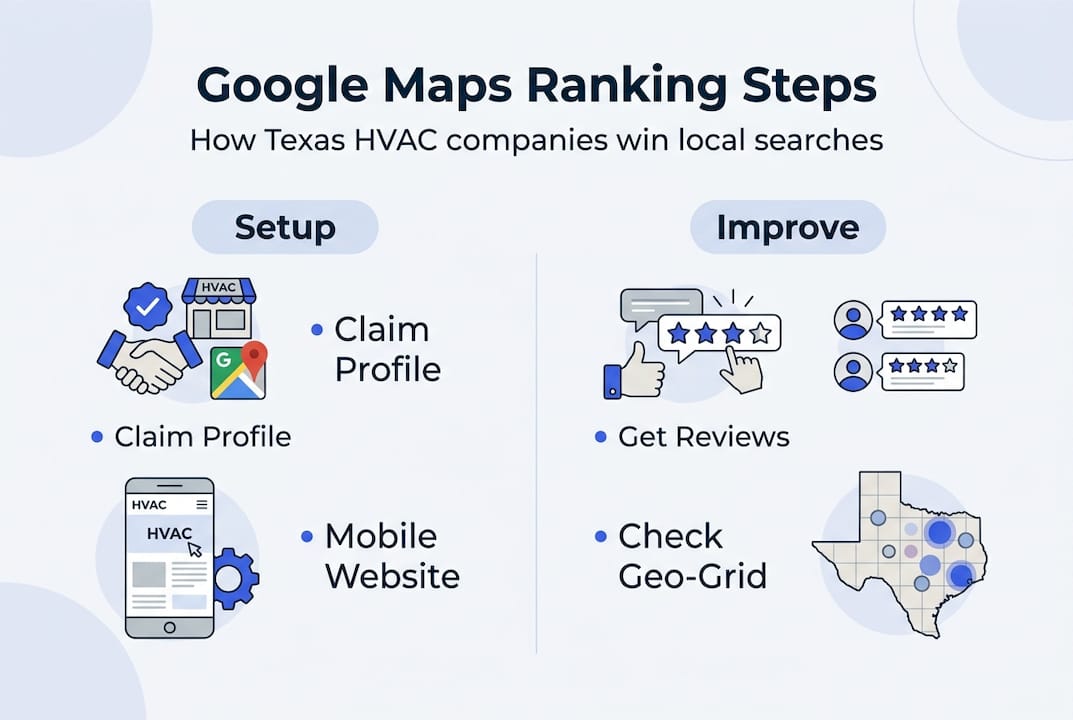
A good SEO audit for HVAC will surface citation inconsistencies you did not know existed. Pairing that audit with local service SEO best practices gives you a clear action list instead of guesswork.
The uncomfortable truth about Google Maps ranking for HVAC businesses
Here is what most guides skip: one round of optimizations will not move the needle in a competitive Texas market. We see HVAC owners make all the right changes, then check their rankings two weeks later, see no dramatic shift, and assume SEO does not work. That thinking costs them real revenue.
The businesses winning the Map Pack in Houston, Dallas, and Austin are not smarter. They are more consistent. They update their profiles monthly. They ask for reviews after every job. They check their geo-grid coverage maps every two weeks and adjust based on what the data shows. They treat Maps ranking as ongoing competition, not a box to check.
The 3 to 6 month timeline for Map Pack movement in competitive areas is real. Expect it. Plan around it. The businesses that succeed are the ones that keep executing through that window instead of chasing shortcuts.
If you want to understand how your competitors are outranking you right now, beating the competition with smarter SEO starts with knowing what signals they are generating that you are not. That gap is closeable. But it requires strategy, patience, and consistent action over time.
Ready to increase your HVAC leads? Specialized SEO support for Texas businesses
If you have worked through this guide and want expert help executing these strategies faster, Aim Set Win builds exactly this kind of system for HVAC companies across Texas.

Our HVAC SEO services are built specifically for heating and cooling contractors who want real lead growth, not reports full of numbers that do not connect to booked jobs. Whether you are based in Houston HVAC SEO experts territory or competing in the Dallas HVAC SEO agency market, we know the local landscape and build strategies around it. We handle the technical work, the content, the citations, and the ongoing tracking so you can focus on running your business.
Frequently asked questions
How long does it take for a Texas HVAC business to rank higher on Google Maps?
Most HVAC companies in Texas see significant improvement within 3 to 6 months, though highly competitive cities like Houston or Dallas may take longer without aggressive local SEO effort.
What are the biggest mistakes HVAC owners make with Google Maps SEO?
The most common mistakes are a slow mobile site, skipping review requests after jobs, and choosing overly broad profile categories. Fixing mobile speed under 3 seconds alone can produce a noticeable ranking improvement.
How can I tell if my ranking efforts are working?
Use a geo-grid tool like Local Falcon and check your grid every 2 weeks to see where your ranking improves and where red zones still need attention.
Do reviews really influence Google Maps rankings for HVAC?
Yes. Frequent, positive reviews shift your listing out of map red zones and signal to Google that your business is active and trusted in the local area.
Recommended
- Top HVAC SEO best practices to boost Texas leads fast
- HVAC SEO Services | Top Rankings & Local Leads
- Houston HVAC SEO Services | Rank Higher & Grow Fast
- HVAC digital marketing in Texas: SEO strategies 2026
- Construction Software for HVAC Contractors | BRCKS
Jean runs growth strategy at AimSetWin, a performance marketing agency specializing in local service businesses across Texas. he's helped plumbers, HVAC companies, pest control operators, and home service brands build predictable revenue systems using data-driven advertising and conversion optimization.


