
Learn what SEO for local services means for HVAC and plumbing companies in Texas. Explore key strategies, costs, risks, and how it drives revenue.
Every service call you miss in Houston or Dallas represents lost revenue that a competitor captures simply because they show up first in local search results. For established HVAC and plumbing businesses in Texas, the fight for visibility is not about national rankings, but staying front and center when nearby homeowners urgently search for help. By mastering the set of strategies known as local SEO, your business can become the top choice for high intent local customers and reclaim the revenue you deserve.
Table of Contents
- Local SEO Defined For Service Businesses
- Core Strategies For Local SEO Success
- Google Business Profile Optimization Essentials
- Website Content And Local Keyword Tactics
- Costs, Risks, And Common Mistakes
- Comparing Local SEO And Paid Search
Key Takeaways
| Point | Details |
|---|---|
| Local SEO is Essential for Visibility | Local SEO strategies help service businesses like HVAC and plumbing get found by nearby customers actively searching for their services. |
| Optimizing Google Business Profile is Crucial | A complete and accurate Google Business Profile acts as a powerful tool for attracting local customers and improving visibility in searches. |
| Customer Reviews Drive Success | The quantity and quality of customer reviews significantly influence local SEO rankings and build trust, making it vital to encourage and manage reviews consistently. |
| Local Keyword Strategy is Key | Targeting local keywords on your website ensures that your content meets the specific needs and searches of potential customers in your service areas. |
Local SEO Defined for Service Businesses
Local SEO is the set of strategies and techniques that help your HVAC or plumbing business get found by customers in your service area who are actively searching for your services online. Think of it as the digital equivalent of being the most visible business on the block. When someone in Austin searches “emergency AC repair near me” at 2 a.m. on a Saturday, local SEO is what determines whether your company appears first or gets buried on page three. It’s not about ranking nationally or competing against national chains. It’s about dominating your local market and converting the customers who are already looking for exactly what you offer.
At its core, local SEO involves managing your online business listings, claiming your Google Business Profile, ensuring your location data is accurate everywhere it appears, and making sure your service area information is crystal clear. For a service business like yours, this means potential customers can instantly see your address, phone number, hours, service radius, and customer reviews without having to hunt for them. It also includes optimizing your website to target the neighborhoods and cities where you actually service customers. If you operate throughout the Dallas metroplex, your SEO strategy needs to reflect that. If you focus on northwest Houston, your digital footprint should match that reality. The goal is straightforward: make it easier for customers in your service area to find and engage with you through localized search engine strategies, which drives the predictable revenue growth your business needs.
What makes local SEO different from regular SEO is that you’re not trying to compete with national companies or rank for broad keywords like “HVAC repair.” You’re optimizing for the customer who’s already close enough to use your services. Someone searching “same day water heater repair in Katy” or “24 hour furnace repair in Conroe” is a much better prospect than someone three states away. These customers have immediate needs, high intent to hire, and are ready to book. They’re not comparison shopping across five states. They need help now, and if your business shows up when they search, you win the job. This is why local SEO produces such predictable revenue for service businesses. You’re not guessing at demand. You’re capturing demand that already exists in your immediate market.
The local SEO system works because it aligns with how customers actually search. Studies consistently show that homeowners search online first before picking up the phone or asking for recommendations. They want to see your reviews, your service area, your pricing transparency, and your availability. If your business is missing from that critical moment, a competitor who invested in local SEO takes the call. Local SEO ensures you’re visible across Google Maps, Google Search, local directories, and review platforms where your potential customers are already looking.
Pro tip: Start by claiming and fully optimizing your Google Business Profile with complete service area coverage, accurate phone numbers, and photos of your actual work. This single asset drives more qualified customer calls than most paid advertising channels and costs nothing to set up.
Core Strategies for Local SEO Success
Local SEO success doesn’t happen by accident. It requires a focused set of strategies that work together like a system. You need to claim and optimize your presence on Google and Bing, build trust through customer reviews, keep your business information consistent everywhere online, target local keywords on your website, and stay active in your community. These aren’t one-time tasks. They’re ongoing efforts that compound over time to build dominance in your local market.
Start with the foundation: claiming your Google My Business and Bing Places accounts. This is non-negotiable. These free accounts are where your business information lives for customers searching locally. Your Google Business Profile is essentially your storefront in the digital world. When someone searches for AC repair in your service area, Google pulls information from your profile to show your hours, phone number, reviews, photos, and service areas. If you haven’t claimed this account, a competitor who has will capture those calls. Next, focus on ensuring consistent Name, Address, and Phone number (NAP) citations across every platform where your business appears. This includes Google, Bing, Yelp, local directories, your website, and any industry-specific platforms. When Google sees your information matching everywhere, it gains confidence that you’re a legitimate, stable business. Inconsistencies create doubt and can hurt your rankings.

Reviews are the currency of local SEO. Unlike traditional SEO where backlinks matter, local SEO is heavily influenced by the quantity and quality of customer reviews on Google, Yelp, and industry directories. A business with 47 five-star reviews will outrank a competitor with perfect SEO but no reviews. This is why encouraging positive local reviews should be part of your weekly operations. After you complete a job, send a follow-up text or email asking satisfied customers to leave a review. Make it easy by providing a direct link. Not everyone will do it, but if even 30 percent of your customers leave reviews, you’ll build a powerful competitive advantage. These reviews serve as social proof that influences both the algorithm and potential customers deciding whether to call you.
Your website content needs to speak directly to your local market. This means optimizing pages with the specific neighborhoods and cities where you operate. Instead of just having a generic “service areas” page, create content that targets the actual searches people in your region are making. Someone in Pearland searching “water heater repair Pearland” should find a page specifically about your water heater services in Pearland. This is where keyword research becomes critical to your strategy. You’re not targeting national keywords. You’re targeting local intent keywords that show customers are ready to hire. Local events and professional networking also matter more than most service business owners realize. Sponsoring a community event or participating in the local Chamber of Commerce builds relationships with other businesses and creates opportunities for referrals. It also gives you content to share on social media, which signals to Google that you’re an active member of your community.
The systems that win in local SEO are the ones that treat it like an ongoing process, not a project. You claim accounts month one. You start collecting reviews month two. You optimize website content month three. You participate in community events month four. You send follow-up emails to past customers month five. By month six, you’re seeing measurable improvement in local rankings and phone calls. By month twelve, you’re competing for every relevant local search in your market.
Pro tip: Set up a monthly review request system where you automatically send text messages or emails to customers within 48 hours of job completion, asking them to leave a review with a direct link. This single system compounds dramatically over time and will become one of your most powerful ranking factors.
Google Business Profile Optimization Essentials
Your Google Business Profile is the single most powerful asset you own for local SEO. It’s not optional. It’s not something to set up and forget. It’s the digital cornerstone of your entire local search presence. When someone in Houston searches “emergency plumbing near me” or “AC repair same day,” Google pulls information directly from your Business Profile to display your business in local results and on Google Maps. If your profile is incomplete, outdated, or missing important information, you’re losing jobs to competitors who invested the time to get it right. Think of your Google Business Profile as a 24/7 salesperson working for you. It shows potential customers your hours, phone number, service areas, customer reviews, photos of your work, and whether you’re open right now. That’s powerful. And it costs nothing to maintain if you stay organized about it.
Start with the basics: claiming your profile and ensuring all information is accurate and complete. Your name, address, phone number, and hours need to match exactly what appears on your website and other directories. Any mismatch confuses Google and hurts your rankings. Add a description that tells potential customers what you actually do. Don’t write generic corporate speak. Write something a customer would search for. For example, instead of “We provide heating and cooling services,” write “24/7 emergency AC and furnace repair in the Greater Houston area. Same day service available. Fully licensed and insured.” This description should include your service areas, your main services, and something that differentiates you from competitors. Upload high-quality photos of your actual work. Show your team in action, finished installations, your van with your company name, your office. Real photos of real work build trust and give Google more content to index. Customers want to see who they’re hiring before they make the call.
Category selection matters more than most business owners realize. Google allows you to select primary and secondary categories that define what your business does. Choose carefully. If you’re an HVAC company, your primary category should be “HVAC Contractor” not “General Contractor.” Your secondary categories might be “Air Conditioning Repair,” “Furnace Repair,” or “Emergency Services.” These categories help search engines understand and display your business more effectively in relevant local searches. Posts are another feature most service businesses ignore. You can post job updates, special offers, holiday hours, or service announcements directly to your Business Profile. A post like “Winter heating maintenance special: 20% off furnace inspections through February” shows up in your profile and on Google Maps. It gives customers a reason to click, and it signals to Google that your business is active. Update your profile with a post every two weeks. Not more, not less. Just consistent activity that shows you’re engaged.
Service areas deserve special attention. If you serve multiple cities or neighborhoods in the Houston, Dallas, or San Antonio areas, list them all in your service areas section. Don’t try to hide or limit this. Google uses service area information to decide which searches should show your business. If you serve Katy, Sugar Land, and Missouri City but only list Houston, you’re missing searches from those other cities. Be specific about which areas you actually service. Overextending your service area can hurt your credibility if customers from outside your range try to contact you.
The visibility of your profile depends heavily on customer reviews and how often your information stays updated. Reviews act as ongoing validation that your business exists, operates successfully, and deserves to appear in local results. The more recent and numerous your reviews, the better your visibility. This is why collecting reviews shouldn’t be a one-time effort. It’s a continuous system. Ask customers for reviews after every job. Make it easy by sending them a text with a direct link to your profile. Even a 15 second investment from a customer becomes a powerful ranking signal.
Pro tip: Add a post to your Google Business Profile twice per month with seasonal offers, maintenance tips, or service highlights. This tells Google your business is active and gives customers current reasons to engage with your profile instead of competitors.
Website Content and Local Keyword Tactics
Your website is where local SEO converts interest into actual phone calls and booked jobs. Google Business Profile gets you visibility. Reviews build credibility. But your website content is where customers decide whether to hire you or call a competitor. This is where local keyword strategy becomes critical. Local keywords are search terms that include geographic qualifiers. Instead of “furnace repair,” think “emergency furnace repair in Spring, Texas” or “water heater replacement near Conroe.” These are the searches your ideal customers actually use when they need help now. They’re searching with intent. They’re ready to hire. And if your website content targets these specific local searches, you capture the job.
The foundation of effective local keyword tactics starts with understanding what your customers actually search for in your specific market. Someone in Friendswood searching for HVAC help might use different terminology than someone in Pearland. One neighborhood might say “air conditioning” while another says “AC.” One area might search “emergency repair” while another searches “same day service.” Understanding your target audience’s local search behavior helps you create content that matches actual customer intent. Build a list of location specific keywords by combining your services with your service areas. For a plumbing company in the Greater Houston area, your keyword list might look like this: “24-hour emergency plumbing Houston,” “water heater repair Spring,” “pipe repair Conroe,” “toilet repair Katy,” “drain cleaning Sugarland.” Each of these keywords represents a customer actively searching for your service in your exact area. Your website needs pages and content targeting these specific combinations.
Content should integrate local keywords naturally into website text, titles, meta descriptions, and blog articles. This doesn’t mean stuffing keywords unnaturally. It means writing content that real customers would want to read while including the geographic qualifiers and service terms they actually search for. If you’re targeting “emergency plumbing in Houston,” create a page titled “Emergency Plumbing Services in Houston” with a clear description of your emergency response capabilities, service areas, and why customers choose your company. Write a few paragraphs about your approach to emergency calls. Include information about your average response time, whether you charge extra for emergency calls, and what makes you different from competitors. This page now targets that keyword while providing actual value to someone searching for exactly that service.
Beyond individual service pages, create location specific content around your neighborhoods and service areas. If you serve ten different cities or neighborhoods, each one deserves its own page or section. A page titled “Plumbing Services in Katy” tells Google your business serves Katy and gives customers from Katy a sense that you understand their specific area. Mention local landmarks, local concerns, or local specifics that show you actually operate in that area. Blog content works similarly. Instead of writing a generic blog post titled “5 HVAC Maintenance Tips,” write “5 HVAC Maintenance Tips for Houston Homeowners During Summer” or “Furnace Maintenance Guide for North Houston Residents.” The geographic specificity signals to Google that your content is relevant to local searches while building trust with customers who see you mention their specific location.
Your service area map on your website should list every city and neighborhood you serve. This tells Google your service areas and creates more opportunities for local search visibility. If you also serve surrounding areas or have expanded your territory, update your content and Google Business Profile to reflect that. Consistency matters. Every reference to your service areas across your website, Google Business Profile, and local directories should match. If your website says you serve Katy but your Google Business Profile doesn’t include Katy, Google will question your legitimacy.
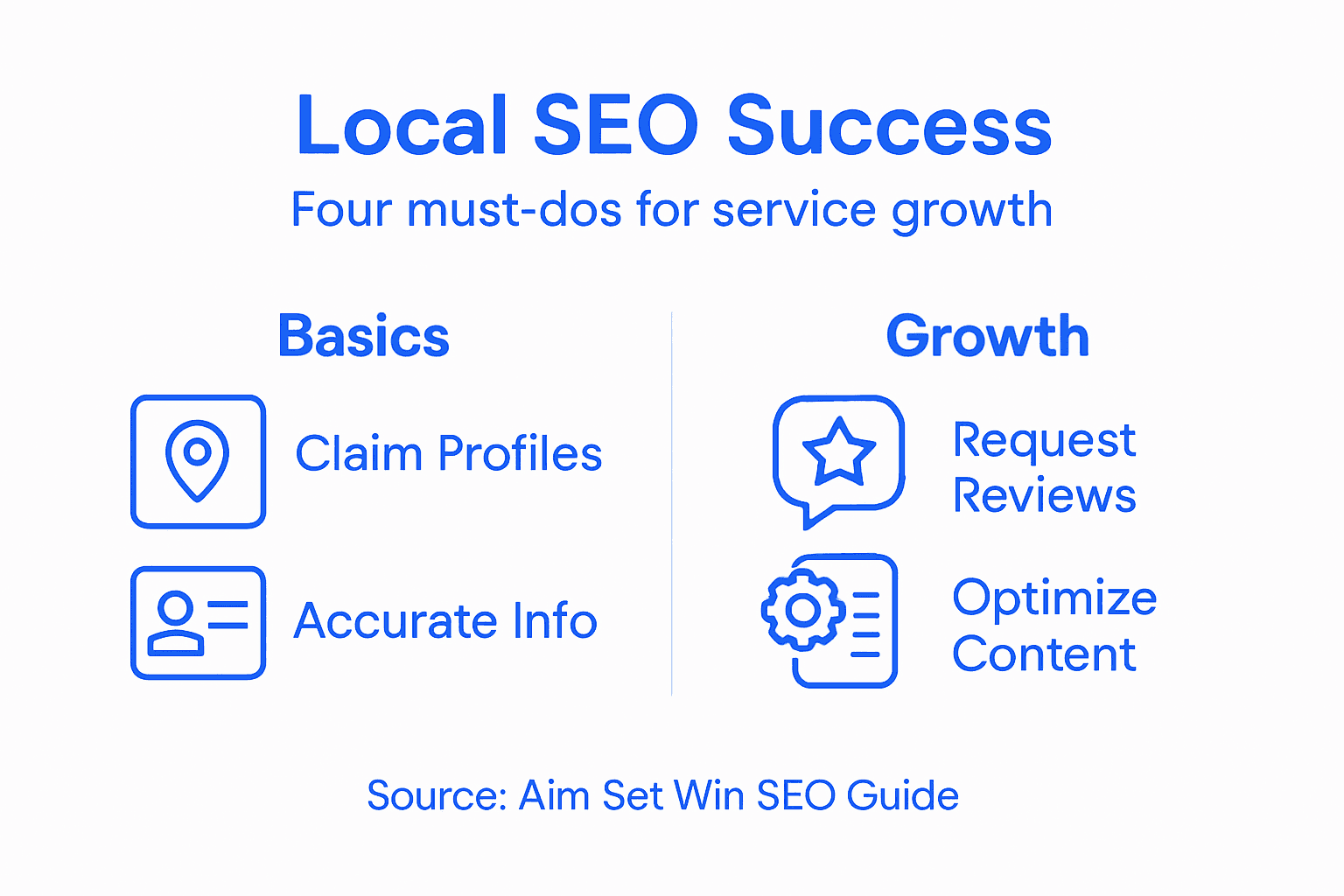
Image optimization is another overlooked local keyword tactic. When you upload photos to your website, add alt text that includes local keywords. Instead of alt text that says “pipe repair,” use “professional pipe repair in Conroe, Texas.” This helps Google understand your content while improving accessibility. Videos work similarly. If you create service videos or testimonial videos, include location information in titles and descriptions.
Pro tip: Create one dedicated page for each major city or neighborhood you serve, targeting searches like “[Your Service] in [City Name].” Write 300-500 words explaining your specific experience in that area, response times, and why local customers choose you. This single tactic compounds across multiple cities and creates dozens of local ranking opportunities.
Costs, Risks, and Common Mistakes
Local SEO is not free, even though some of it costs nothing upfront. Your time has a cost. Content creation has a cost. Tools and software have costs. The bigger risk is not the money you spend. It’s the money you lose by doing local SEO wrong or not doing it at all. A plumbing company in Dallas losing just two jobs per month to competitors with better local SEO is losing between $3,000 and $6,000 monthly in revenue. Over a year, that’s $36,000 to $72,000 in missed income. That’s what’s actually at stake. Understanding where costs come from, what risks exist, and what mistakes to avoid keeps you from wasting money on strategies that don’t work.
Costs in local SEO break down into several categories. Time is your biggest cost if you’re handling this yourself. Claiming and optimizing your Google Business Profile takes a few hours initially, then perhaps an hour per month to maintain. Creating location specific website content takes time. Building and managing a review collection system takes time. If you value your time at $50 per hour, and you’re spending five hours per month on local SEO, that’s $250 monthly just in your labor. Content creation costs money if you hire someone to write pages for your service areas or blog articles. Expect $200 to $500 per page if you hire a professional writer who understands local SEO. Website updates and optimization might require hiring a developer. Tools and software subscriptions for tracking rankings, managing reviews, or analyzing competitors add up quickly. Most of these expenses are modest compared to paid advertising, but they’re real. And they have to produce results. The biggest mistake is spending money without a clear system to measure whether it’s working.
The risks in local SEO fall into two categories: penalties from search engines and opportunity costs from doing it wrong. Google penalizes websites that violate search engine guidelines, including keyword stuffing, hidden text, misleading redirects, and other black hat tactics. A penalty means your visibility drops dramatically. You might disappear from local search results entirely. Getting a penalty lifted takes weeks or months. Some businesses never recover. This is why working with cheap SEO services that promise quick rankings is dangerous. They often use tactics that initially boost visibility but eventually trigger penalties. The opportunity cost is subtler but more expensive. Every month your local SEO isn’t optimized, competitors are capturing customers you should be getting. If your Google Business Profile is incomplete, your website doesn’t target local keywords, and you have no reviews, you’re invisible in local search. A competitor with solid local SEO is getting those calls. That lost revenue compounds.
Common mistakes fall into predictable patterns. Inconsistent business information across platforms is perhaps the most widespread mistake. Your address on your website doesn’t match your Google Business Profile. Your phone number is different on Yelp. Your hours are wrong on a directory. Google uses NAP consistency as a trust signal. Inconsistencies damage your rankings and confuse customers. Another critical mistake is neglecting Google Business Profile optimization entirely. Hundreds of service businesses claim their profile but never fill it out completely. No description. No photos. No service area information. The profile sits empty while competitors with optimized profiles capture all the visibility. Ignoring customer reviews is equally damaging. Negative reviews happen. A single unhappy customer can post a one star review. The mistake is not responding to it. Responding professionally to negative reviews shows potential customers you care about feedback. Not responding looks like you don’t care. Letting reviews pile up without actively asking satisfied customers for positive reviews means your profile stays buried under competitors with dozens of reviews. Poor website structure for local SEO is another common error. Your website has no location pages. It has no local keywords in content. It’s not optimized for mobile devices. Most customers searching locally are on mobile phones. If your website is slow or poorly formatted on mobile, they bounce to a competitor’s site.
Keyword stuffing is a mistake born from misunderstanding how local SEO works. A business owner learns about local keywords and then stuffs every page with the same keyword phrase repeated unnaturally. “We offer plumbing services in Houston. Our plumbing services in Houston include. Call our plumbing services in Houston team today.” This reads like spam. Google recognizes it and penalizes it. Write naturally. Use keywords strategically. Let the content read like it was written for humans, not search engines.
Here’s a summary of common Local SEO mistakes and how to avoid them:
| Mistake | Impact | Simple Solution |
|---|---|---|
| Inconsistent business info | Lower rankings, lost calls | Quarterly audit of all platforms |
| Ignoring Google Business Profile | Missed map and search visibility | Fully complete and update profile |
| Neglecting customer reviews | Fewer leads, weaker trust | Automated review request system |
| Poor website structure | High mobile bounce rates | Mobile-optimized, local pages |
| Keyword stuffing | Possible penalties | Write for humans, not algorithms |
Pro tip: Conduct a quarterly audit of your business information across Google, Bing, Yelp, and your website to catch inconsistencies before they damage your rankings. Use a simple spreadsheet to track your name, address, phone number, and hours across each platform and fix any mismatches immediately.
Comparing Local SEO and Paid Search
Local SEO and paid search are not competitors. They’re tools that serve different purposes in your marketing system. Understanding the difference helps you decide where to invest your money and why both often make sense together. Paid search gets you immediate visibility. You pay Google for every click on your ad. Local SEO builds visibility over time without paying per click. The confusion starts because both appear in search results. Someone searching “emergency plumbing near me” might see paid ads at the top and organic local results below. Both are valuable. But they work differently, cost differently, and deliver results on different timelines. For a service business trying to recover missed revenue and build predictable growth, understanding when to use which strategy separates winners from those wasting money.
Paid search is fast. You set up a campaign, choose your budget, write your ad, and within hours you’re getting clicks from customers searching for your services. A plumbing company in San Antonio can have ads running the same day. Someone searching “water heater repair San Antonio” sees your ad immediately. You pay $5 to $15 per click. If 20 percent of clicks convert to calls, and 30 percent of calls become jobs, you might pay $100 to $250 per job acquired. That’s expensive compared to local SEO but it’s immediate. Paid search offers immediate visibility and targeted advertising based on demographics and location, but requires continuous budget allocation. The moment you stop paying, your ads stop running. You’re getting visibility because you’re buying it. Local SEO is the opposite. You invest time and effort upfront. You optimize your Google Business Profile. You create website content. You collect reviews. You build citations across directories. Nothing happens immediately. But gradually, over weeks and months, your visibility increases. Someone searching “water heater repair San Antonio” starts seeing your organic listing more often. You’re not paying per click. You’re paying once through labor or hiring someone to do the work. Once you’re ranking, the traffic is essentially free.
Cost is where the comparison becomes interesting. Paid search scales with demand. During high demand seasons like summer for HVAC or winter for heating, you’ll spend more because more people are searching and competition increases. During slow seasons, you spend less. Your budget is flexible but active. Local SEO costs differently. Your upfront costs are fixed. Website content costs $200 to $500 per page regardless of season. Google Business Profile optimization is a few hours of labor once. Then maintenance is maybe an hour per month. Over a year, local SEO costs far less than paid search if you’re getting consistent results. A company spending $3,000 per month on paid search might acquire 30 jobs monthly. That same company investing $1,000 in one time local SEO setup and $500 monthly maintenance might be acquiring 25 jobs monthly after three months, with that number growing to 40 jobs monthly after a year as their local SEO rankings improve. The long term math heavily favors local SEO. But in month one, local SEO produces zero results while paid search produces immediate phone calls.
This is why the smartest strategy for established service businesses earning $30,000 monthly or more is not choosing between them but using both strategically. Use paid search to fill the gap while local SEO builds. Paid search enables businesses to reach audience segments rapidly with controlled budgets and detailed targeting, but depends on continuous advertising spend. Invest in local SEO foundation immediately because it’s building long term assets. Your Google Business Profile becomes stronger every month. Your website content stays ranked years after you publish it. Customer reviews accumulate and never disappear. Meanwhile, run paid search to capture demand today while you’re building organic visibility for tomorrow. As your local SEO rankings improve and organic traffic increases, you can reduce paid search spend. Eventually, you might turn off paid search entirely because local SEO is producing enough calls. Or you keep both running because paid search captures customers on high intent searches and local SEO provides steady baseline visibility.
The practical difference is predictability. Paid search is predictable immediately. You know your cost per click and can estimate conversions. Local SEO is unpredictable in timing but reliable long term. You might rank well in three months or eight months. But once you’re ranking, that visibility compounds. A business that invested in local SEO five years ago is now getting dozens of calls monthly from organic search without spending a dollar on ads. A business that spent five years only on paid search has nothing to show for that investment. The traffic stops the moment the budget stops.
Here’s a clear comparison of Local SEO and Paid Search for service businesses:
| Aspect | Local SEO | Paid Search |
|---|---|---|
| Speed of Results | Several months | Immediate, same day |
| Ongoing Cost | Low, after setup | High, per click basis |
| Long-Term Value | Compounds over years | Stops when budget ends |
| Traffic Source | Organic search listings | Sponsored ad placements |
| Ideal For | Building reputation and trust | Quick lead generation |
| ROI Predictability | Grows steadily over time | Immediate but scales with spend |
Pro tip: Start with local SEO immediately as your foundation strategy because results compound over time, but run paid search in parallel for the first 90 days while you’re building organic visibility. This captures immediate revenue while your long term assets develop, then scale back paid search as local SEO kicks in.
Unlock Predictable Growth with Proven Local SEO Systems for Your Service Business
Local SEO for local services can feel overwhelming when you are trying to capture the immediate demand in your service area and build a steady flow of booked jobs without guessing or wasting budget. This article highlights common challenges like optimizing your Google Business Profile, managing consistent online information, and turning customer searches into revenue. If you struggle to turn local search visibility into reliable phone calls or have experienced lost revenue because your business is invisible when it matters most, you are not alone.
Aim Set Win understands these pain points and offers a clear solution with our Revenue Recovery System. This system quietly works in the background to re-engage past customers and convert existing demand into booked jobs in 30 days or less without relying on new leads or costly ad spend. Once your revenue recovery foundation is solid, we build on it with expert SEO strategies that align perfectly with the article’s core concepts. Our approach combines real data, no-nonsense systems, and measurable outcomes so you can finally capture the predictable growth your HVAC, plumbing, or local service business deserves.
Stop losing local customers to competitors with better online visibility. Visit Aim Set Win now to discover how our specialized systems transform missed opportunities into consistent revenue. Ready to reclaim your market share? Start today by exploring our Plumbers Archives or dive into expert local SEO insights at our SEO Archives. Your path to predictable growth begins with taking the right first step.
Frequently Asked Questions
What is local SEO and how does it help service businesses?
Local SEO refers to strategies that ensure your service business appears in local search results when potential customers search for services in your area. It helps attract customers who are actively looking for your services nearby, ultimately driving more targeted traffic and increasing revenue.
How do customer reviews impact local SEO?
Customer reviews significantly influence local SEO by acting as social proof. A higher quantity and quality of reviews can improve your rankings in local search results, making your business more visible to potential customers. Engaging with reviews, both positive and negative, also fosters trust.
What are the key elements to optimize in my Google Business Profile?
Key elements to optimize in your Google Business Profile include your business name, address, phone number (NAP), business hours, a comprehensive description, service area information, high-quality photos, and regular updates through posts. All this information should be accurate and consistent across all platforms.
How can I effectively target local keywords for my website?
To effectively target local keywords, identify specific services combined with your service areas. Create dedicated pages on your website for each location you serve, and include relevant content that speaks directly to the needs and terminology of local customers searching for your services.
Recommended
- The Ultimate Guide to SEO Digital Marketing Services 2026 – Aim Set Win
- 7 Essential Near Me Digital Marketing Agency Picks for 2026 – Aim Set Win
- Home SEO – Aim Set Win
- Paid Search for Services: Turning Clicks Into Booked Jobs
Jean runs growth strategy at AimSetWin, a performance marketing agency specializing in local service businesses across Texas. he's helped plumbers, HVAC companies, pest control operators, and home service brands build predictable revenue systems using data-driven advertising and conversion optimization.


