
SEO for roofing companies in Texas—boost local map rankings, outrank competitors, and generate storm repair leads with conversion-focused strategies.
Every Texas roofer knows the struggle when storms roll through and homeowners rush to Google for help. In crowded markets like Dallas and Houston, being visible online is what separates thriving contractors from those chasing leads. Search engine optimization makes your website more visible to people searching for urgent roof repair and storm restoration. Discover how targeted SEO strategies can help your business stand out, capture high-intent clients, and turn web traffic into actual job bookings in your service area.
Table of Contents
- What SEO Means For Roofing Contractors
- How SEO Directly Impacts Your Bottom Line
- The Core Components Your Roofing Website Needs
- Why Roofing Companies Need SEO Right Now
- Local SEO Tactics For Storm Restoration
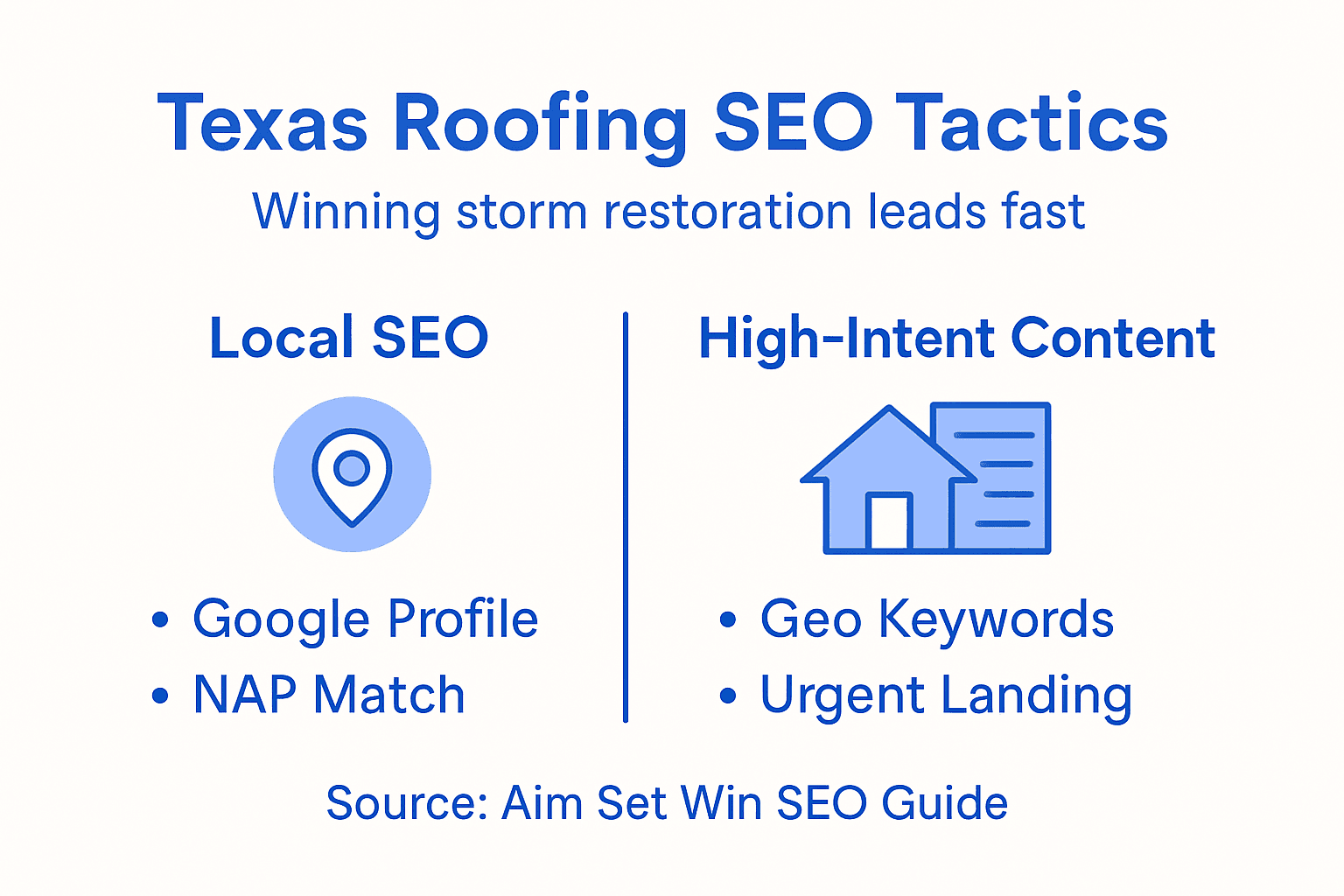
- Core Local SEO Tactics That Win Storm Leads
- Building Authority Through Community Engagement
- Content Strategies That Attract High-Intent Leads
- Google Business Profile And Map Pack Mastery
- Common SEO Mistakes Roofing Firms Face
- Technical SEO Mistakes That Kill Rankings
- Strategic And Content Mistakes
- The Hidden Cost Of Outdated SEO Tactics
- Quick Wins You Can Fix Immediately
Key Takeaways
| Point | Details |
|---|---|
| Importance of SEO | SEO is crucial for roofing contractors to attract potential clients actively searching for services, differentiating them from competitors. |
| Local Focus | Local SEO tactics are essential for roofing businesses, especially during storm seasons, to ensure visibility in geographic searches. |
| High-Intent Content | Creating content that addresses urgent questions from homeowners can convert traffic into leads effectively. |
| Technical Quality | Maintaining a fast, mobile-friendly website with optimized structure is key to improving search rankings and user experience. |
What SEO Means for Roofing Contractors
SEO stands for search engine optimization, and it’s basically the difference between a homeowner finding your roofing company or calling your competitor instead. When someone in Texas searches for “emergency roof repair near me” or “storm damage restoration,” search engines like Google decide which businesses show up first. That ranking depends on SEO.
For roofing contractors, SEO means making your website visible to people actively searching for your services. Think of it this way: you could have the best roofing crew in Dallas, but if nobody can find you online, you’re leaving money on the table. SEO involves optimizing website structure, content, and metadata to improve where your business appears in search results. This includes using roofing-specific keywords throughout your website, making sure Google can crawl and index your pages properly, and building authority through quality backlinks.
How SEO Directly Impacts Your Bottom Line
The real power of SEO for roofing contractors comes down to lead generation and revenue. Here’s what happens when your SEO is working:
- Homeowners searching for roof repairs find you instead of competitors
- Emergency calls come in from people ready to hire (not tire-kickers)
- Your phone rings with high-intent leads during storm season
- You rank on Google Maps for local searches in your service areas
- Your website converts visitor traffic into actual estimates and job bookings
When you invest in proper SEO, you’re not just getting random traffic. You’re capturing people at the exact moment they need a roofer. A homeowner with a leak isn’t browsing casually. They have a problem and they’re searching for a solution right now. That’s your opportunity.
When potential clients search for roofing services in your area, being visible in those results separates thriving contractors from those struggling to fill their schedules.
SEO works 24/7 for you. Unlike paid ads that stop working the moment you stop paying, a well-optimized website keeps generating leads month after month. You build compounding authority over time, meaning your ranking only improves as you continue optimizing and adding quality content.
The Core Components Your Roofing Website Needs
To make SEO work for your roofing business, you need three fundamental pieces in place:
1. Technical SEO Foundation
Your website needs to be fast, mobile-friendly, and easy for Google to understand. Most homeowners now search on phones. If your site loads slowly on mobile or has confusing navigation, potential customers bounce to competitors. Technical issues like broken links, poor site structure, or missing metadata kill your rankings before content even matters.

2. Local SEO Optimization
Roofing is a local business. You don’t serve all of Texas equally. Local SEO means optimizing your Google Business Profile, getting listed in local directories, and targeting geographic keywords. When someone in Houston searches for “roof replacement contractors,” you want to appear. When someone in San Antonio searches, you want visibility there too. Each city, each neighborhood matters.
Proper local SEO tactics include managing your Google Business Profile accurately, collecting client reviews, building local citations, and creating location-specific content. Storm restoration companies especially benefit from local SEO because damage is geographically specific.
3. High-Intent Content Strategy
Content drives everything. People search because they have questions: “How much does a roof replacement cost?” “Can I claim roof damage on insurance?” “What’s the difference between roof repair and replacement?” When you answer these questions better than competitors, you earn trust and visibility.
Your content should target keywords that roofing contractors actually search for:
- Storm damage repair services
- Emergency roof leak fixes
- Residential roof replacement
- Commercial roofing contractors
- Insurance claim assistance for roofing
- Hail damage assessment and repair
Each piece of content should answer specific questions your ideal clients are asking. When your website becomes the authority on roofing topics in your area, rankings and leads follow naturally.
Here is a summary comparing the core components essential for a successful roofing contractor SEO strategy:
| Component | What It Involves | How It Impacts Business |
|---|---|---|
| Technical SEO Foundation | Optimizing site speed, structure, mobile | Ensures site ranks and is usable |
| Local SEO Optimization | Geographic keywords and business listings | Boosts local search visibility |
| High-Intent Content | Answers urgent client questions | Converts visitors into leads |
Why Roofing Companies Need SEO Right Now
The roofing industry in Texas is competitive. You’re not just competing against the guy who’s been roofing for 20 years in your town anymore. National franchises, regional companies, and aggressive digital marketers are all fighting for the same leads. Without SEO, you’re invisible online.
Storm season creates opportunity, but only if you’re visible when people are searching. Hail storms hit randomly. When they do, homeowners immediately search for roofers. If you’ve built SEO authority before the storm hits, you capture that demand. If you wait until after, you’re playing catch-up against companies already ranking.
The role of SEO in home services revenue growth shows measurable impact on contractor profitability. Companies investing in SEO consistently outpace competitors who rely only on word-of-mouth or paid advertising alone.
Pro tip: Start your SEO foundation now, not when storm season hits. Ranking takes time, so begin optimizing immediately to capture leads before peak demand periods when competition intensifies.
Local SEO Tactics for Storm Restoration
When a hail storm or severe weather hits Texas, homeowners don’t search for “best roofing company in Dallas.” They search for “emergency roof repair near me right now.” That’s the difference between generic SEO and local SEO built specifically for storm restoration. Local SEO targets people in your exact service area who have urgent, storm-related needs. It’s about being visible when it matters most.
Storm restoration is hyperlocal. Damage from a hailstorm in North Arlington is different from damage in South Dallas. A contractor in Houston doesn’t need to rank in San Antonio. This is where local SEO becomes your competitive advantage. Optimizing location-specific keywords and maintaining consistent business information across platforms ensures you show up for homeowners searching in your service territories. When you nail local SEO, you don’t just rank higher. You rank in the right places for the right people.
Core Local SEO Tactics That Win Storm Leads
Local SEO for storm restoration involves multiple moving pieces working together. Here are the non-negotiable tactics every roofing contractor needs:
1. Google Business Profile Optimization
Your Google Business Profile is the foundation of local visibility. This is where Google shows your business hours, service areas, photos, and reviews directly in search results. For storm restoration, this is critical because homeowners often search on mobile during emergencies.
Optimize your profile by:
- Listing all service areas clearly (specific neighborhoods and cities you serve)
- Adding storm-related service categories like “emergency repair” and “storm damage restoration”
- Uploading before-and-after photos from past storm restoration projects
- Posting timely updates about storm preparedness and rapid response times
- Encouraging satisfied customers to leave reviews after completion
2. NAP Consistency Across the Web
NAP stands for Name, Address, Phone. If your business information differs across your website, Google My Business, local directories, and social media, search engines get confused. This kills your local rankings.
Conduct an audit of every place your business appears online:
- Your website
- Google Business Profile
- Facebook and other social accounts
- Local directories (Yelp, Better Business Bureau, Angie’s List, Home Advisor)
- Industry-specific sites
- Local Chamber of Commerce listings
Ensure every instance uses identical formatting. If your website says “Dallas, TX 75201” but your directory listing says “Dallas, Texas 75201,” you’ve created inconsistency that weakens rankings.
3. Geo-Targeted Keywords in Website Content
Geo-targeted keywords in meta titles, descriptions, and site content help you appear in local search results. Don’t just target “roof repair.” Target “emergency roof repair in Arlington” or “storm damage restoration in Frisco.”
Create content targeting specific locations:
- Service area landing pages for each neighborhood or city you serve
- Blog posts addressing common storm damage in your region
- Frequently asked questions specific to local weather patterns
- Storm preparation guides customized for Texas weather conditions
When homeowners search “roof damage repair near me” after a storm, your location-specific content makes you visible.
4. Local Citations and Directory Listings
Local citations are mentions of your business on other websites. They signal authority and local relevance to search engines. Get listed in directories relevant to roofing and storm restoration:
- Google Business Profile (highest priority)
- Yelp
- Better Business Bureau (BBB)
- Home Advisor
- Angie’s List
- Local Chamber of Commerce
- Home improvement industry directories
Building Authority Through Community Engagement
Local SEO isn’t just technical optimization. Responding to local reviews and maintaining active community engagement builds trust that drives leads in storm-affected areas.
Respond to every review, positive or negative. Thank customers who left positive reviews. For negative reviews, respond professionally and offer to resolve issues. Google and potential customers notice when contractors engage authentically.
Build community presence by sponsoring local events, supporting neighborhood initiatives, or creating storm preparedness content. When your roofing company becomes a recognized local name, people naturally think of you first when they need storm restoration.
Local SEO creates compounding visibility. The more you optimize for your specific locations, the more your business becomes the default choice for homeowners in those areas when storms hit.
Storm season creates demand spikes, but only contractors with established local authority capture that demand. You can’t build local SEO overnight. Start now, optimize consistently, and by storm season, you’ll have the visibility that drives leads competitors are chasing.
Pro tip: Create storm-specific landing pages for each service area you cover, targeting phrases like “hail damage repair in [city]” and “emergency roof repair [neighborhood],” then update these pages with case studies and before-and-after photos from actual storm jobs in those locations.
Content Strategies That Attract High-Intent Leads
Here’s the hard truth: not all website traffic converts. Someone browsing roofing blogs casually isn’t the same as a homeowner with active hail damage searching for emergency repair contractors right now. High-intent leads are people ready to hire. They’re searching with purpose, comparing options, and ready to make a decision. Your content strategy needs to target these people specifically.
High-intent content speaks directly to someone’s immediate problem. A homeowner with a roof leak doesn’t want a generic article about roofing materials. They want to know how to stop the leak, whether their insurance covers it, and which contractor can fix it today. Producing valuable and relevant content tailored to customer needs at different stages of their buying journey converts browsers into callers. The goal is answering their specific question so thoroughly that they see you as the obvious choice.
Understanding High-Intent Keywords and Search Behavior
High-intent keywords reveal what people actually want right now. Compare these two searches:
- “How much does a roof cost?” (curiosity, early stage)
- “Emergency roof leak repair in Dallas 24/7” (high intent, ready to hire)
The second person is a lead. They’re not researching. They’re looking for a solution. Your content strategy should target these high-intent phrases specifically.
Keywords that indicate users are ready to make a purchase or engage services soon drive conversions. Search for phrases containing:
- “Emergency” or “urgent”
- “Today” or “now”
- “Call” or “quote”
- “Near me” or location names
- “How much” or “cost”
- “Best” or “trusted”
These aren’t vanity keywords. These are the searches that convert into phone calls and estimates.
Building Your High-Intent Content Framework
Effective high-intent content follows a specific structure. Create different content types for different moments in the buying journey:
Service Pages with Clear Calls to Action
Don’t write generic service pages. Write conversion-focused pages targeting specific problems. Instead of “Roofing Services,” create pages like:
- “Emergency Roof Leak Repair in Arlington”
- “Storm Damage Assessment and Restoration”
- “Hail Damage Claims and Repairs”
- “24-Hour Emergency Roof Service”
Each page should clearly state what you do, why you’re different, and include a prominent call to action like “Call for Emergency Service” or “Get Your Free Damage Assessment.”
Location-Specific Landing Pages
Homeowners searching for roof repair in Dallas don’t want to see a generic roofing company website. They want to know you serve Dallas specifically. Create landing pages targeting individual cities or neighborhoods with:
- Service descriptions specific to that area
- Local case studies and before-and-after photos
- Testimonials from customers in that community
- Local contact information and response times
Case Studies and Before-and-After Content
Case studies are gold for high-intent leads. Show real examples of storm damage you’ve repaired:
- Photos of the damage
- Description of the issue
- How you solved it
- Results and customer feedback
Before-and-after photos create visual proof that you deliver results. People trust what they can see.
Testimonials and Reviews
High-intent leads verify credibility before calling. Feature customer testimonials prominently:
- Video testimonials from satisfied customers
- Written reviews with specific details
- Response times and turnaround comparisons
- Insurance claim assistance results
Optimizing Content for Conversions
Producing content isn’t enough. You need to optimize for conversions. Here’s what works:
Make your call to action obvious. Don’t hide it at the bottom of a page. Include prominent buttons saying “Call Now,” “Get Free Quote,” or “Schedule Inspection.” Phone numbers should be clickable on mobile so a single tap dials you.
Answer objections in your content. People worry about cost, timeline, and reliability. Address these directly:
- “Most insurance covers hail damage at no cost to you”
- “We respond to emergency calls within 2 hours”
- “Licensed, bonded, and insured with 15 years of experience”
High-intent content targets people actively searching for solutions, not people casually learning about roofing. Focus on serving the searcher’s immediate need and your conversion rates will skyrocket.
Include a clear path forward. Don’t make people guess what to do next. Say explicitly: “Call today for a free inspection” or “Submit your storm photos for a same-day assessment.”
Test and measure what works. Track which pages convert visitors into calls. Double down on what works and improve what doesn’t.
Pro tip: Create urgency-driven content during storm season with pages like “Hail Damage Detected in Your Area” and “Free Emergency Inspections This Week,” then use geo-targeting to show these pages to people in neighborhoods where storms recently hit.
Google Business Profile and Map Pack Mastery
When a homeowner searches “emergency roof repair near me” on Google, the Map Pack appears first. Three business listings with photos, ratings, and contact information dominate the search results. Getting your roofing company in that Map Pack is the single most valuable piece of local SEO real estate. People clicking Map Pack results are ready to hire. They’re not browsing. They’re calling.
Google Business Profile is how you claim your spot in that Map Pack. It’s the difference between appearing on page one of search results or being invisible. Setting up and verifying your profile with accurate business information, service categories, and photos strengthens your online presence and determines whether Google shows you to local customers searching for roofing services. This isn’t optional. This is fundamental. Every roofing contractor in Texas without a complete, optimized Google Business Profile is leaving leads on the table.
The Non-Negotiable Elements of Profile Mastery
Your Google Business Profile needs specific elements in place. Missing or incomplete information kills your visibility. Here’s what Google demands:
1. Verified and Complete Business Information
Google doesn’t trust incomplete profiles. Every field matters:
- Business name (exactly as it appears legally)
- Full address and service area boundaries
- Phone number (prominent and clickable)
- Website URL (directing to your homepage)
- Business category (select “Roofing Contractor” as primary)
- Service categories (add storm damage, emergency repair, replacements)
- Hours of operation (include emergency hours if applicable)
- Business description (50-250 characters explaining what you do)
Inconsistencies cause problems. If your website says one phone number and your profile says another, Google gets confused. Consistency across all platforms is non-negotiable.
2. High-Quality Photos and Videos
Photos drive visibility and conversions. Add:
- Your team and trucks
- Before-and-after project photos
- Office or workspace photos
- Recent storm restoration work
- Business logo
- Service area imagery
People decide whether to call based on what they see. Poor quality photos signal poor quality work. Professional photos signal professionalism. Update photos regularly, especially after completing major projects.
3. Service Categories and Attributes
Google uses categories to match your business to relevant searches. Select every applicable category:
- Storm damage restoration
- Emergency roof repair
- Roof inspection services
- Residential roofing
- Commercial roofing
- Insurance claim assistance
Add attributes that highlight your strengths. Storm season is coming? Mark “Emergency services available.” Can you handle jobs immediately? Mark “Same-day service available.”
Building Reputation Through Reviews and Engagement
Regularly updating your profile and responding to customer reviews enhances reputation and trustworthiness. Google’s algorithm notices when you engage with customers. It boosts your ranking.
Responding to reviews takes time, but it generates leads. Here’s why:
When you respond to positive reviews, you show appreciation and reinforce your service quality publicly. When you respond professionally to negative reviews, you show you care about fixing problems. Potential customers read these responses and gain confidence.
Respond to every review within 24 hours if possible:
- Thank people for positive reviews and mention specific details
- For negative reviews, apologize, explain your perspective, and offer to resolve issues offline
- Keep responses brief, professional, and focused on the customer experience
- Never get defensive or argumentative
Google Posts are another powerful tool. Use them to:
- Announce special offers or seasonal services
- Share storm preparedness tips
- Highlight recent project completions
- Post emergency service availability
- Link to blog content or service pages
Understanding Google’s Ranking Factors for Map Pack
Three factors determine whether Google shows you in the Map Pack: proximity, relevance, and authority.
Proximity means how close you are to the person searching. If someone searches “roof repair in Fort Worth,” contractors in Fort Worth rank higher than contractors in Austin, even if the Austin contractor is bigger.
Relevance means how well your business matches what they’re searching for. A roofer optimized for “emergency roof repair” appears higher for emergency searches than a general contractor.
Authority comes from review quality and quantity, consistency across the web, backlinks, and how long your profile has existed. A contractor with 150 five-star reviews outranks one with 20 reviews.
Map Pack rankings depend on proximity, relevance, and authority. You control relevance through profile optimization. You build authority through consistent reviews and engagement. Together, they determine whether homeowners find you when storms hit.
You can’t control proximity. A customer searches where they search. But you can dominate relevance and authority by maintaining an impeccable profile and actively managing reputation.
Advanced Tactics for Map Pack Dominance
Top-ranking roofing contractors do more than fill out basic profile information. They use advanced tactics:
Service Area Expansion
If you serve multiple cities, define each service area clearly in your profile. This helps Google show you to people searching in those specific locations. Don’t claim you serve all of Texas if you only operate in the Dallas metro.
Regular Content Updates
Google notices when you post Google Posts consistently. Post once a week with updates, tips, or promotions. This signals activity and keeps your profile fresh.
Photo and Video Strategy
Add new photos monthly, especially from recent projects. Video testimonials and project walkthroughs convert browsers into callers better than static images.
Review Generation System
The contractors ranking highest have systematic approaches to collecting reviews. After completing jobs, follow up asking satisfied customers to leave a review. Make it easy by providing a direct link to your profile.
Pro tip: Create a “storm season” Google Business Profile strategy where you update your profile weekly with new photos and posts highlighting emergency response capabilities, then gather reviews aggressively during storm season to boost authority ranking when competition for leads peaks.
Common SEO Mistakes Roofing Firms Face
You can have the best roofing crew in Texas, but bad SEO decisions will keep you invisible. Most roofing companies don’t realize they’re sabotaging their own rankings. They make mistakes that seemed like good ideas at the time, but modern search engines penalize them harshly. The worst part? These mistakes are fixable. You just need to know what you’re looking for.
Roofing firms often make critical SEO errors without realizing the damage. Some issues are technical, some are tactical, and some are just outdated approaches that worked five years ago but kill rankings today. Common errors include broken links, slow page load speed, and missing or duplicated metadata. Beyond technical problems, keyword stuffing, hidden keywords, and acquiring spammy backlinks are practices that modern search algorithms actively penalize. The good news is that identifying and fixing these mistakes creates immediate opportunities to improve visibility and capture leads competitors are missing.
Technical SEO Mistakes That Kill Rankings
Technical problems are invisible to visitors but scream to Google that your site is broken. Here are the biggest culprits:
Indexing Issues
Google can’t rank pages it can’t find. Some roofing websites accidentally block Google from crawling their site. Check your robots.txt file and ensure you’re not unintentionally hiding pages from search engines.
Duplicate content confuses Google about which version to rank. If your site has multiple versions of the same page, consolidate them or use canonicalization tags to tell Google which is the preferred version.
Mobile Optimization Failures
Over 60 percent of searches now happen on mobile devices. If your website looks terrible on phones, you’re losing leads instantly. Google prioritizes mobile-friendly sites in rankings. Your site must load fast, display properly, and be easy to navigate on small screens.
Slow Page Load Speed
People are impatient. If your page takes more than three seconds to load, visitors bounce. Google notices bounce rates and tanks your rankings accordingly. Compress images, use efficient code, enable caching, and leverage content delivery networks to speed things up.
Broken Links and Missing Pages
Broken links frustrate visitors and signal to Google that you don’t maintain your site. Regularly audit your site for dead links. If you remove pages, implement 301 redirects so visitors and Google know where to find the content.
Strategic and Content Mistakes
Beyond technical issues, roofing companies make mistakes in how they approach content and keywords.
Keyword Stuffing
Don’t cram keywords into your content unnaturally. A page about “roof repair in Dallas” doesn’t need the phrase repeated 30 times. Google sees this and penalizes you for it. Write naturally for humans first, then optimize for search engines.
Neglecting Local SEO Fundamentals
Your NAP information must be consistent everywhere. One listing says “Dallas, Texas 75201” while another says “Dallas TX 75201.” Inconsistency confuses Google and weakens your local rankings. Audit every place your business appears online and standardize formatting.
Building Low-Quality Backlinks
Not all backlinks help. Buying links from low-quality directories or getting links from irrelevant websites can actually hurt your rankings. Focus on earning links naturally from relevant, authoritative websites.
Ignoring Review Management
Old reviews disappear if you’re not actively collecting new ones. Your competitors are aggressively gathering five-star reviews. If your review count stalls, you lose authority ranking signals.
The table below compares typical SEO mistakes with their hidden costs and the opportunities unlocked by fixing them:
| Mistake Type | Hidden Cost | Opportunity If Fixed |
|---|---|---|
| Technical Issues | Lower rankings and lost traffic | Stronger ranking and user trust |
| Keyword Stuffing | Google penalties and less trust | Better engagement, higher ranking |
| Low-Quality Links | Penalties and reputation damage | Improved authority and credibility |
| Review Neglect | Fewer leads, lost local authority | Increased leads from strong reviews |
The Hidden Cost of Outdated SEO Tactics
Outdated SEO tactics don’t just fail to help. They actively harm your rankings. Modern Google algorithms penalize websites using keyword stuffing, hidden text, cloaking, and other manipulative practices.
Some roofing companies hired SEO agencies years ago and never updated their strategy. That agency might have used tactics that worked in 2015 but violate Google’s guidelines today. Over time, your site ranking decreases as penalties accumulate.
The solution is conducting a comprehensive SEO audit. Identify what’s working and what’s hurting you. Fix the technical issues first. Then address content strategy. Finally, build a sustainable approach focused on genuine user experience and value.
Quick Wins You Can Fix Immediately
You don’t need to overhaul everything at once. Some mistakes are quick fixes:
- Add missing meta descriptions to service pages
- Ensure your business name, address, and phone number are consistent everywhere
- Update your Google Business Profile with current information and photos
- Remove or fix broken internal links
- Enable HTTPS if you haven’t already
- Test your site’s mobile responsiveness
- Check your page load speed using free tools
Pro tip: Conduct a free SEO audit using tools like Google PageSpeed Insights and Google Search Console to identify technical errors, then prioritize fixes by impact: indexing issues first, then mobile optimization, then page speed, then content quality.
Take Your Roofing Company To The Top Of Texas Search Results
The article highlights the biggest challenge roofing contractors face today: capturing urgent, local leads at the moment homeowners need emergency or storm damage repairs. With competition heating up across Texas cities and search engines favoring roofing businesses that master local SEO, technical optimization, and high-intent content, it is critical to move beyond basic marketing tactics and build a robust, revenue-driven digital growth system. If you feel invisible to your ideal clients when they search for “emergency roof repair” or “hail damage restoration,” that lost opportunity means fewer calls and booked jobs.
At Aim Set Win, we specialize in helping roofing contractors win these exact battles. Our hands-on approach combines deep local SEO expertise with proven strategies like Google Business Profile mastery and conversion-focused web design to generate consistent inbound calls from high-intent customers ready to hire now. Whether you are targeting Dallas, Houston, or anywhere in Texas, we tailor your growth plan to the unique competitive landscape and search intent in your service areas.
Experience how powerful tailored SEO and strategic content can be today. Explore our full spectrum of home service SEO solutions at Aim Set Win and see how we can elevate your roofing business. For insights specific to service-based companies, visit our Mobile Car Detailing Archives – Aim Set Win and Locksmith Archives – Aim Set Win to discover diverse successful tactics applied across industries.

Ready to own your market during storm season and convert searchers into booked jobs? Connect with Aim Set Win now to build your personalized roofing SEO strategy and dominate Texas leads faster than your competitors. Don’t wait for the next hail storm to find out you are invisible to your best customers.
Frequently Asked Questions
What is SEO and why is it important for roofing companies?
SEO, or search engine optimization, is the process of enhancing a website’s visibility on search engines like Google. For roofing companies, good SEO ensures that potential customers can easily find them when searching for services like roof repairs or storm damage restoration, ultimately leading to more leads and revenue.
How can roofing companies improve their local SEO?
Roofing companies can enhance their local SEO by optimizing their Google Business Profile, ensuring consistent name, address, and phone (NAP) information across online platforms, targeting geographic keywords, and collecting customer reviews to boost visibility in local search results.
What role does content play in SEO for roofing contractors?
Content is crucial for SEO as it helps address the specific questions and needs of potential clients. By creating high-quality, informative content that answers common inquiries about roofing services, contractors can establish authority and improve their search rankings, thereby attracting high-intent leads.
How does technical SEO impact a roofing company’s website performance?
Technical SEO involves optimizing website speed, mobile-friendliness, and site structure. These factors directly affect how Google crawls and indexes a site. A well-optimized website enhances user experience, reduces bounce rates, and improves search rankings, making it easier for potential customers to find the roofing services they need.
Jean runs growth strategy at AimSetWin, a performance marketing agency specializing in local service businesses across Texas. he's helped plumbers, HVAC companies, pest control operators, and home service brands build predictable revenue systems using data-driven advertising and conversion optimization.


