
Learn how to build an SEO funnel that converts search traffic into qualified leads. Step-by-step guide for home service businesses in 2026.
You’re ranking on Google. Traffic is coming in. But here’s the hard truth: most of those visitors leave without calling or booking a service. That’s where an SEO funnel changes everything. Instead of just chasing rankings, a properly built seo funnel guides prospects from their first search all the way to becoming paying customers. For home service businesses like plumbers, HVAC contractors, and electricians across Texas, this strategic approach transforms organic traffic into predictable revenue.
What Is an SEO Funnel and Why Home Service Businesses Need One
An SEO funnel is the strategic path you create that moves people from discovering your business through search engines to becoming paying customers.
Think about how your ideal customer finds you. They don’t just search “plumber near me” and immediately book a $5,000 water heater replacement. They go through stages.
First, they might search “why is my water heater making noise” because they notice a problem. Then they research “water heater replacement cost in Houston.” Finally, they’re ready to compare contractors and make a decision.
Your SEO funnel maps content and optimization to each stage of this journey.
Here’s what makes this different from traditional SEO. Most contractors focus only on bottom-funnel keywords like “emergency plumber Dallas” or “HVAC repair Austin.” Those are important, but they represent a tiny fraction of total search volume.
When you build a complete SEO funnel, you capture people earlier in their journey. You become the trusted resource they remember when they’re ready to buy.
The Four Stages Every Home Service SEO Funnel Needs
Your seo funnel should address four distinct customer stages:
- Awareness Stage: People realize they have a problem but don’t know the solution yet
- Consideration Stage: They’re researching options and educating themselves
- Decision Stage: They’re comparing contractors and ready to choose
- Action Stage: They contact you, book a service, or request a quote
Each stage requires different content, different keywords, and different conversion strategies.
The awareness stage might target searches like “furnace blowing cold air” or “low water pressure upstairs bathroom.” You’re not selling yet. You’re helping and building trust.
The consideration stage targets “how much does AC replacement cost” or “tankless vs traditional water heater.” Now they’re evaluating options.
The decision stage is where you target “best HVAC company in San Antonio” or “emergency plumber near me.” They’re ready to hire someone.
How to Build Your SEO Funnel Foundation With Keyword Mapping
Building an effective seo funnel starts with understanding what your customers actually search for at each stage of their journey.
Most home service businesses make the same mistake. They only optimize for high-intent, bottom-funnel keywords because those seem closest to the sale.
But that’s like only fishing in one tiny corner of a massive lake.
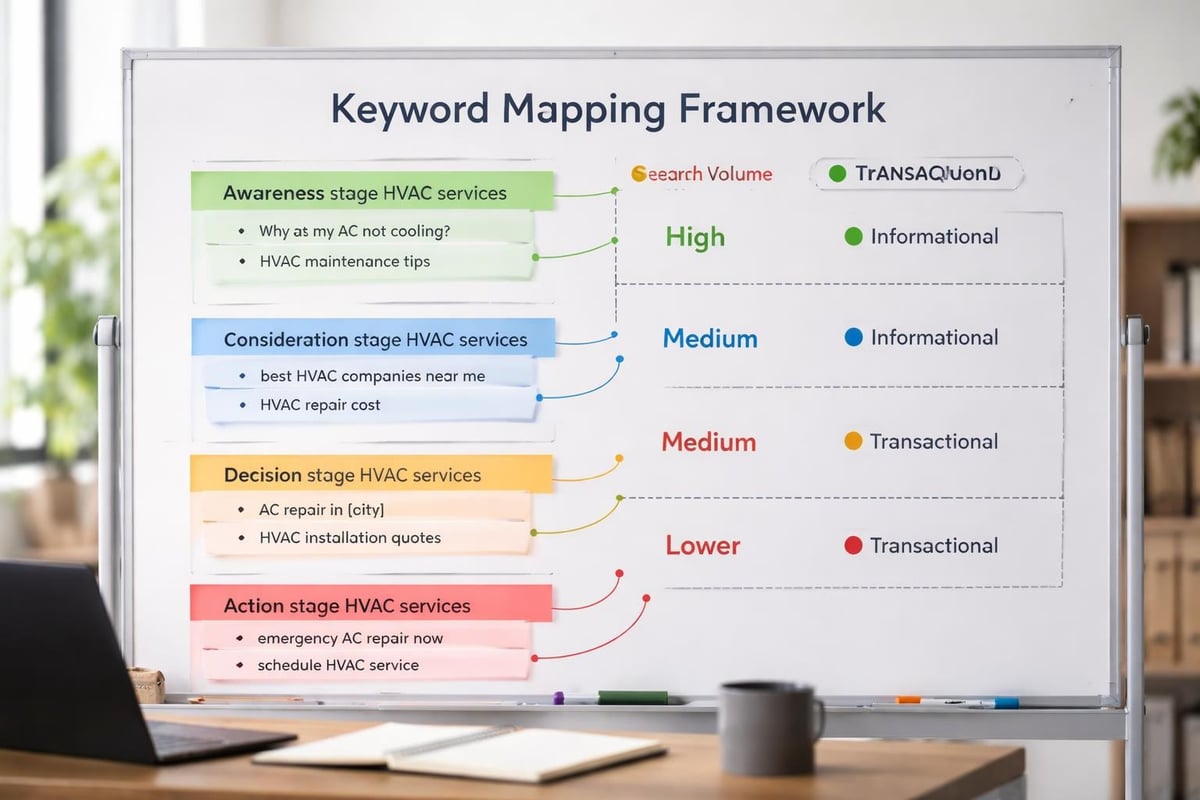
Keyword mapping organizes your target keywords by funnel stage and search intent.
Start by brainstorming every question a customer might ask before hiring you. For an HVAC company, that might include:
- Why is my AC freezing up? (Awareness)
- How long does AC installation take? (Consideration)
- HVAC companies near me (Decision)
- Emergency AC repair San Antonio (Action)
Use tools like Google Search Console to see what queries already bring you traffic. Look for patterns in questions people ask.
Then organize keywords into spreadsheet columns by funnel stage. Include search volume, competition level, and current ranking position if you already show up.
Creating Content That Matches Search Intent
Once you’ve mapped keywords to funnel stages, you need content that actually answers what searchers want.
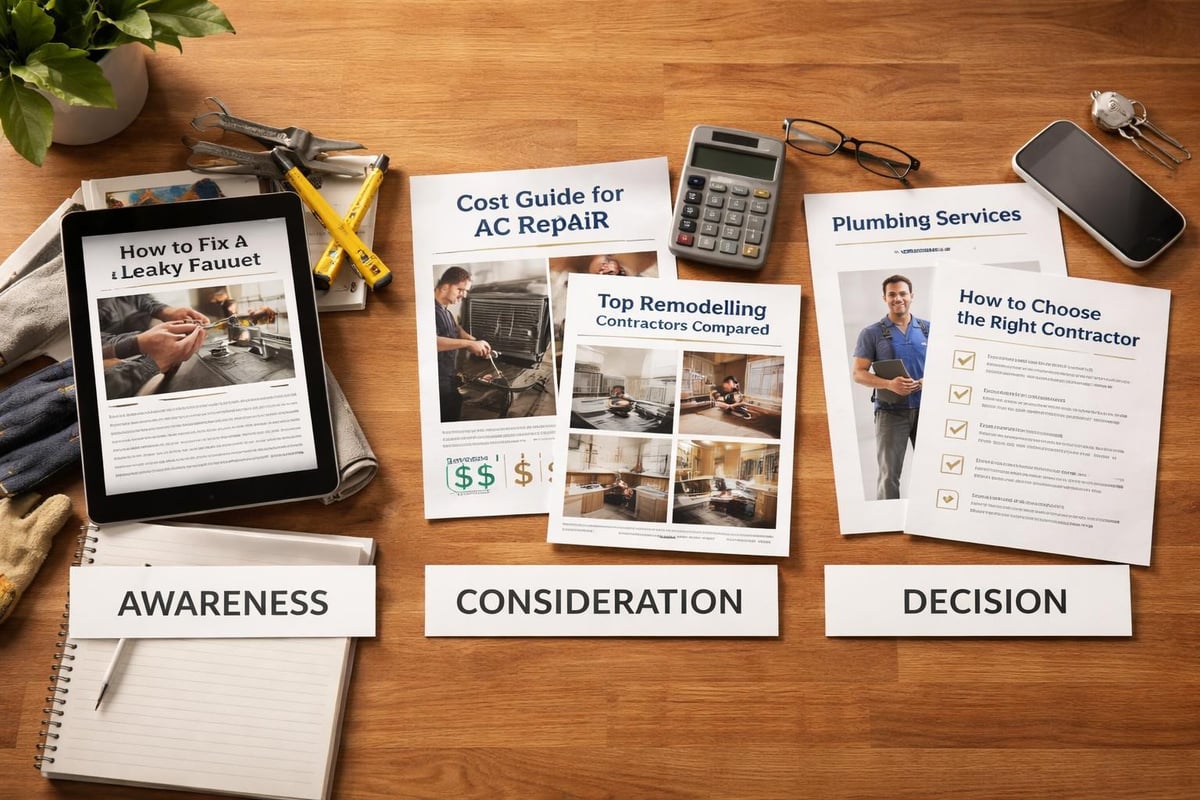
Google has gotten incredibly good at understanding intent. If someone searches “how to fix a leaky faucet,” they want a how-to guide, not a service page trying to sell them plumbing repairs.
Match your content format to what Google already ranks for that query.
Search your target keyword and analyze the top 10 results. Are they blog posts? Videos? Service pages? Product comparisons? Google is telling you what format satisfies that search.
For awareness-stage keywords, create comprehensive how-to guides and educational content. Answer the question completely, even if it means the person might try fixing it themselves.
This builds trust. The person who successfully fixes their leaky faucet with your guide will remember you when they face a bigger problem they can’t DIY.
For consideration-stage content, create comparison guides, cost breakdowns, and buying guides. “Furnace vs Heat Pump: Which Is Right for Texas Homes” targets people evaluating options.
Decision and action-stage content lives on your service pages and location pages. Optimize these for “HVAC repair in Dallas” or “emergency plumber Houston” with clear calls to action, service areas, and conversion-focused design.
Technical SEO Elements That Keep Your Funnel Flowing
Your content strategy means nothing if Google can’t crawl, index, and rank your pages properly.
Technical SEO is the plumbing of your seo funnel. When it works, everything flows smoothly. When it breaks, the whole system backs up.
These technical elements directly impact whether your funnel content can rank and convert:
| Technical Element | Impact on SEO Funnel | Priority Level |
|---|---|---|
| Site Speed | Affects rankings and bounce rate at every stage | Critical |
| Mobile Responsiveness | 70%+ of home service searches happen on mobile | Critical |
| Schema Markup | Enhances visibility with rich snippets | High |
| XML Sitemap | Ensures all funnel content gets crawled | High |
| Internal Linking | Guides users between funnel stages | High |
| SSL Certificate | Required for trust and rankings | Critical |
Start with page speed. Home service searchers are often dealing with emergencies. A slow site kills conversions.
Run your site through Google PageSpeed Insights. Aim for scores above 85 on mobile. Compress images, enable caching, and minimize unnecessary scripts.
Mobile responsiveness isn’t optional anymore. Test every page on actual phones. Can people easily tap your phone number? Do forms work properly? Is text readable without zooming?
Schema Markup: The Secret Weapon for Home Service SEO Funnels
Schema markup tells search engines exactly what your content is about. For home service businesses, this creates rich snippets that dominate search results.
Implement LocalBusiness schema on your homepage and location pages. This displays your business name, address, phone number, hours, and ratings directly in search results.
Use FAQ schema on your educational content. When someone searches “why is my AC not cooling,” your FAQ answers can appear directly in the search results as rich snippets.
Review schema showcases your star rating in search results. This builds trust before people even click through to your site.
Service schema helps Google understand the specific services you offer. Mark up each service page with service type, area served, and price range if applicable.
The SEO funnel framework becomes more powerful when technical implementation is solid. Your awareness content ranks better, your service pages convert higher, and Google understands the relationship between all your content.
Content Strategy for Each Funnel Stage
Your content needs to work harder than just ranking. It needs to move people toward a buying decision while building trust.
Let’s break down exactly what content to create for each stage of your seo funnel.
Awareness Stage Content That Builds Authority
Awareness content targets problem-aware searchers who haven’t decided on a solution yet.
These are your biggest traffic opportunities because search volume is highest at the top of the funnel.
Create comprehensive guides that completely solve informational queries:
- “Why Is My Toilet Constantly Running?” (Problem identification)
- “7 Reasons Your Furnace Keeps Shutting Off” (Troubleshooting guide)
- “Signs You Need to Replace Your Water Heater” (Buying signal education)
- “How to Prevent Frozen Pipes in Texas Winter” (Prevention guide)
Make these articles 1,500-2,500 words. Include step-by-step instructions, images, and videos when possible.
Yes, some people will use your guide to fix their problem themselves. That’s okay. Many will realize it’s beyond their skill level. Others will remember you when they have a bigger issue.
Include soft calls to action like “If this doesn’t solve your problem, our team is available 24/7” with your phone number. Don’t be pushy. Just be available.
Consideration Stage Content That Educates and Guides
Consideration content targets solution-aware searchers who are evaluating their options.
They know they need professional help. Now they’re researching what kind of service, what it costs, and what to look for in a contractor.
Build content that positions you as the expert guide:
- “How Much Does AC Installation Cost in Texas?” (Cost transparency)
- “Tankless vs Traditional Water Heater: Complete Comparison” (Solution comparison)
- “What to Ask Before Hiring an HVAC Contractor” (Buying guide that highlights your strengths)
- “How Long Does Furnace Replacement Take?” (Process education)
These articles should be 2,000-3,000 words. Include pricing ranges (even general ones), timelines, and decision factors.
This is where your HVAC digital marketing strategy differentiates you from competitors who hide information behind form fills.
Transparency at this stage builds trust. When you openly discuss pricing ranges and what affects cost, people see you as honest and helpful, not trying to bait-and-switch them.
Decision and Action Stage Content That Converts
Bottom-funnel content targets people ready to choose a contractor and take action.
Your service pages, location pages, and emergency service pages live here.
Optimize these pages for high-intent keywords and maximum conversion:
- “Emergency Plumber San Antonio” (Geographic + urgent need)
- “AC Repair in Dallas” (Service + location)
- “Water Heater Installation Houston” (Specific service + city)
These pages need different elements than your educational content:
- Clear, prominent phone number above the fold
- Online booking option if you offer it
- Service area map showing exactly where you serve
- Specific services included in this category
- Pricing information or “starting at” ranges
- Customer reviews and testimonials
- Before/after photos or case studies
- Credentials, licenses, and certifications
- Strong call-to-action buttons throughout
- Trust signals like warranties and guarantees
Keep the copy focused on benefits and outcomes, not just features. “Our 24-hour emergency plumbing service means you never have to wait until Monday when a pipe bursts on Saturday night” is stronger than “We offer emergency services.”
Internal linking between funnel stages matters here. If someone lands on your “AC Repair Dallas” service page from Google, link to your “How Much Does AC Repair Cost” guide. Give them the information they need to feel confident calling.
Local SEO Integration Within Your Funnel
For home service businesses, local visibility isn’t optional. It’s the entire game.
Your seo funnel must include location-specific optimization at every stage.
Here’s how local SEO integrates with your funnel strategy:
Most home service searches include location intent, even when the searcher doesn’t type a city name. Google knows where people are searching from and shows local results.
At the awareness stage, create location-specific problem-solving content. “Dealing with Hard Water in San Antonio: Solutions for Homeowners” targets a local problem while building awareness.
For consideration content, include local context. “How Much Does HVAC Installation Cost in Austin?” performs better than a generic cost guide because it matches local search patterns and provides relevant, market-specific pricing.
Your decision stage is where local SEO becomes critical. Every major city you serve needs dedicated location pages, not just one generic service area page.
Google Business Profile Optimization for Funnel Support
Your Google Business Profile is often the first touchpoint in your seo funnel.
When someone searches “plumber near me” or “AC repair Dallas,” the map pack appears above organic results. If you’re not there, you’re invisible to high-intent searchers.
Optimize your GBP to capture and convert local searches:
- Complete every section of your profile 100%
- Choose the most specific business categories (not just “plumber” but “emergency plumbing service” and “water heater installation service”)
- Upload high-quality photos weekly (trucks, team, completed jobs, before/after)
- Respond to every review within 24 hours
- Post weekly updates about services, tips, or special offers
- Add all services you offer in the services section
- Include service area cities in your business description
Use Google Posts to promote your awareness and consideration content. When you publish “5 Signs Your AC Needs Repair,” create a Google Post linking to it. This keeps your profile active and provides value to searchers.
The Q&A section is an underused opportunity. Proactively add questions and answers based on what customers actually ask. This content appears directly in your GBP and can address funnel-stage concerns.
Conversion Optimization Throughout Your SEO Funnel
Getting traffic is only half the battle. Converting that traffic into calls, form submissions, and booked jobs is where revenue happens.
Every page in your seo funnel needs conversion elements matched to its stage.
Awareness stage conversion goals are different from decision stage conversion goals.
On educational, awareness-stage content, your conversion goal might be getting the visitor to:
- Read another article (advancing them through the funnel)
- Sign up for seasonal maintenance tips (building your email list)
- Save your phone number in their contacts (staying top-of-mind)
- Share the article (expanding reach)
Don’t push hard sales on awareness content. Someone reading “Why Is My Faucet Dripping” isn’t ready to book a $3,000 repiping job. But they might save your number for when they are ready.
On consideration content, conversion goals escalate:
- Download a detailed pricing guide (in exchange for email)
- Use a cost calculator tool
- Schedule a free estimate
- Call for a consultation
On decision and action pages, go hard on conversion:
- Click-to-call phone numbers throughout the page
- Online booking calendar embedded on the page
- “Schedule Now” buttons every few scrolls
- Chat widget for immediate questions
- Special offer or limited-time promotion
Phone Call Tracking and Conversion Attribution
You can’t optimize what you don’t measure. Call tracking is essential for understanding which funnel stages actually generate customers.
Many home service businesses use the same phone number across their entire website. This makes it impossible to know which pages drive calls.
Implement dynamic number insertion to track calls by funnel stage and traffic source:
Use different tracking numbers for:
- Organic traffic vs paid ads
- Awareness content vs service pages
- Different service categories
- Different locations
This reveals your actual ROI from SEO efforts. You might discover that your awareness content about “signs of foundation problems” generates more calls than you thought, just with a longer conversion timeline.
Record and review sales calls to understand objections, questions, and what convinced people to choose you. This insight feeds back into your content strategy.
If prospects consistently ask “Do you offer financing?” during calls, add financing information prominently on service pages. If they’re confused about your service area, improve your location pages.
Link Building Strategy for Funnel Authority
Your seo funnel needs authority to rank. Link building remains one of Google’s top ranking factors in 2026.
But not all links are equal, and the approach differs by funnel stage.
Build links to different funnel stages using different strategies:
For awareness and consideration content, target informational links from:
- Local news sites covering home maintenance tips
- Real estate websites with resource pages
- Home improvement blogs
- Local community websites
- Industry publications
Your comprehensive guides about “Preparing Your Home for Texas Summer Heat” or “Water Heater Maintenance Checklist” are natural link magnets for these sites.
For decision stage and service pages, target local business citations and directories:
- BBB, Angie’s List, HomeAdvisor profiles
- Industry associations (PHCC, ACCA, etc.)
- Local chamber of commerce directories
- City-specific business directories
- Niche directories for your trade
Quality matters more than quantity. One link from a trusted local news site beats 100 links from random blog comment sections.
Create linkable assets specifically designed to attract links. Interactive tools like “HVAC Size Calculator for Your Home” or “Seasonal Home Maintenance Checklist” generate natural backlinks.
Original research works too. Survey your customers about common problems, publish the findings, and pitch the story to local media. “Survey Reveals 68% of San Antonio Homeowners Overpay for AC Repairs” becomes a newsworthy story that links back to your site.
Partner with complementary businesses. An electrician, plumber, and HVAC contractor could create a comprehensive “New Homeowner’s Complete Home Systems Guide” together, with each business contributing expertise and linking to the others.
Measuring and Optimizing Your SEO Funnel Performance
You can’t improve what you don’t track. Your seo funnel needs measurement at every stage.
Set up conversion tracking for micro and macro conversions throughout the funnel.
Track these key metrics by funnel stage:
| Funnel Stage | Key Metrics | Success Indicators |
|---|---|---|
| Awareness | Impressions, clicks, bounce rate, time on page | Growing traffic, low bounce rate, 2+ min time on page |
| Consideration | Pages per session, guide downloads, return visitors | 3+ pages per session, 15%+ download rate |
| Decision | Form fills, calls, quote requests | 5%+ conversion rate on service pages |
| Action | Booked jobs, revenue, customer lifetime value | 30%+ quote-to-customer conversion |
Google Analytics 4 tracks the complete user journey. Set up events for:
- Scrolling 75% down awareness articles
- Clicking “Call Now” buttons
- Submitting contact forms
- Downloading guides
- Watching videos
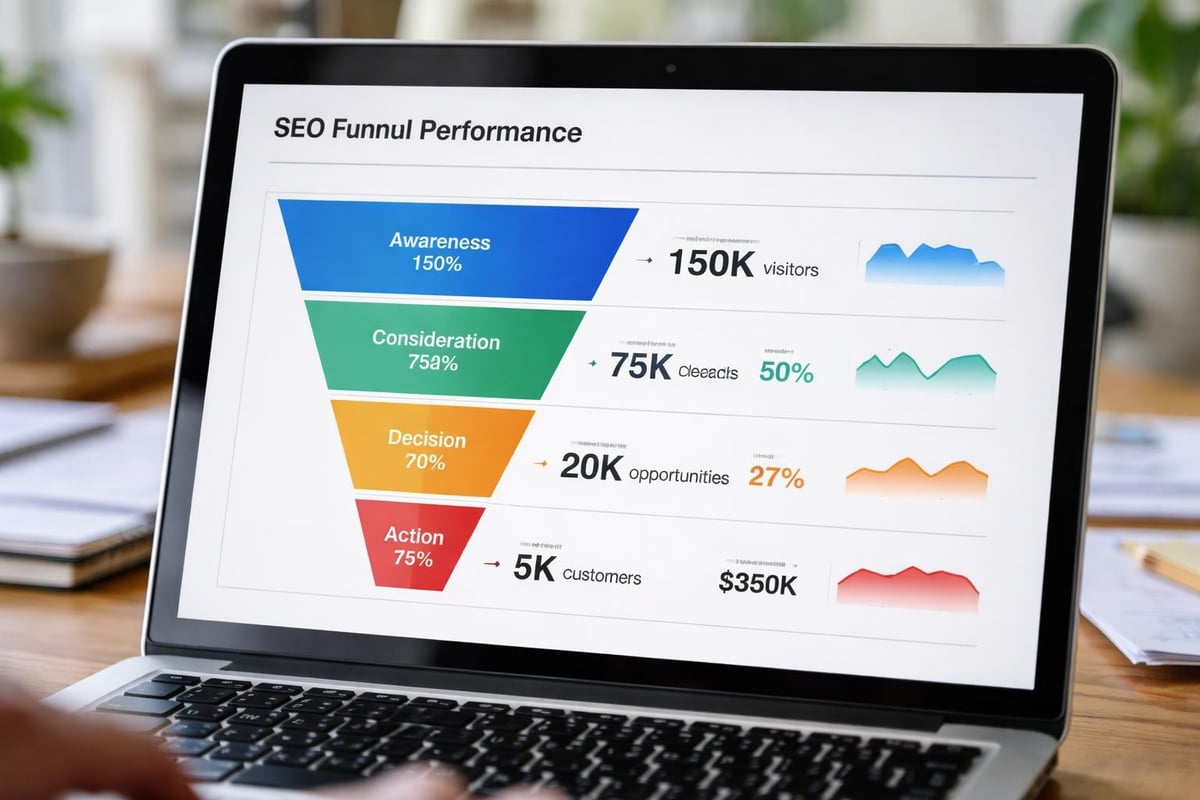
Create custom reports showing traffic and conversion by funnel stage. This reveals where people enter your funnel and where they drop off.
Maybe you’re getting tons of awareness traffic but low consideration engagement. That suggests you need better internal linking from awareness to consideration content.
Or maybe consideration traffic is strong but decision-stage conversions are weak. That points to conversion optimization issues on service pages or call-to-action problems.
A/B Testing Your Funnel Elements
Systematic testing improves funnel performance over time.
Test different elements based on funnel stage:
Awareness content tests:
- Article headline variations
- Featured image types
- Internal link placement
- Content length and depth
Consideration content tests:
- CTA button copy and color
- Form placement and fields
- Guide format (PDF vs interactive)
- Pricing transparency levels
Decision page tests:
- Phone number prominence and color
- CTA button text and placement
- Review display format
- Trust badge positioning
- Special offer messaging
Run one test at a time to isolate variables. Let tests run until statistical significance (usually 100+ conversions per variation).
Small improvements compound. A 2% improvement in awareness-to-consideration movement, combined with 3% better consideration-to-decision conversion, and 5% better decision-to-action conversion, multiplies into significantly more customers.
Review your home service SEO strategy monthly. Look for pages that rank well but convert poorly. These are optimization opportunities.
Identify pages that convert well but don’t rank. These need more SEO attention to capture additional traffic.
Content Refresh Strategy to Maintain Funnel Performance
Your seo funnel isn’t a “set it and forget it” system. Content ages, competitors improve, and Google’s algorithms evolve.
Regular content refreshes keep your funnel performing at peak levels.
Prioritize refreshes based on these factors:
- Pages that dropped in rankings over the past 6 months
- High-traffic pages with rising bounce rates
- Content older than 18 months
- Pages targeting keywords where competitors outrank you
- Seasonal content before its peak season
Update awareness content with:
- Current year in the title and introduction
- New statistics and data
- Additional questions and answers
- Updated images or videos
- Fresh internal links to newer content
Refresh consideration content with:
- Current pricing ranges
- New service options or technologies
- Updated comparison data
- Recent customer testimonials
- Latest industry trends
Optimize decision pages with:
- Recent customer reviews
- Updated certifications or awards
- New service area expansions
- Current special offers
- Fresh before/after photos
When you update content, change the published date. This signals freshness to Google and often results in ranking improvements within days.
The SEO funnel process requires ongoing attention. Think of it as maintaining a revenue-generating machine. Regular tune-ups keep it running efficiently.
Common SEO Funnel Mistakes Home Service Businesses Make
Even with good intentions, many contractors sabotage their seo funnel performance with preventable mistakes.
Avoid these critical errors:
Mistake 1: Only Optimizing Bottom-Funnel Content
Focusing exclusively on “plumber near me” and “emergency HVAC repair” ignores 80% of search volume.
Yes, these keywords have high intent. But competition is fierce and search volume is limited.
Top and middle-funnel content captures earlier-stage searchers when competition is lower, builds your authority, and positions you as the obvious choice when they’re ready to buy.
Mistake 2: Treating All Traffic the Same
A visitor reading “DIY Toilet Repair Tips” has different intent and readiness than someone on your “Emergency Plumbing Services” page.
Your conversion strategy, calls-to-action, and follow-up should match their funnel stage.
Pushing hard for a phone call on awareness content feels pushy and hurts conversion. Not having clear calls-to-action on decision pages leaves money on the table.
Mistake 3: Forgetting About Mobile Experience
Over 70% of “near me” searches happen on mobile devices. If your site doesn’t work perfectly on phones, you’re losing most of your potential customers.
Test every page on actual smartphones. Can people easily tap your phone number? Do forms work without frustration? Is text readable without zooming?
Speed matters even more on mobile. A 3-second load time on mobile drives 53% of visitors away.
Mistake 4: Neglecting the Middle of the Funnel
Many businesses create awareness content and service pages, then wonder why the gap between traffic and conversions is so wide.
Consideration content bridges this gap. Cost guides, comparison articles, and buying guides answer the questions that move people toward a decision.
Without this middle layer, you’re asking people to jump from “learning about a problem” straight to “hiring a contractor” with nothing in between.
Mistake 5: Not Tracking the Full Journey
Installing Google Analytics but never looking at funnel progression data is like buying a GPS and leaving it in the box.
Track how people move between funnel stages. Identify where drop-offs happen. Measure which content types advance people most effectively.
Use Google Analytics 4 exploration reports to visualize the path from first touch to conversion. This reveals which awareness content ultimately leads to customers, even if the conversion happens weeks later.
Advanced SEO Funnel Tactics for Competitive Markets
If you’re in a competitive market like Dallas, Houston, or Austin, basic funnel optimization isn’t enough.
These advanced tactics separate you from competitors with similar strategies.
Video Content Integration Throughout the Funnel
Video dominates search results in 2026. Google frequently shows video thumbnails in organic results, especially for how-to queries.
Create video versions of your best awareness content. “How to Reset a Tripped Circuit Breaker” performs better as a 2-minute video than a text article for many searchers.
Host videos on YouTube with optimization for search, then embed them on your website articles. This captures traffic from both Google and YouTube searches.
For consideration content, create comparison videos and walkthrough tours of your process. “What Happens During Our AC Installation Service” reduces uncertainty and builds confidence.
Decision-stage videos include customer testimonials, team introductions, and facility tours. These build trust and differentiate you from faceless competitors.
Interactive Tools and Calculators
Interactive elements increase engagement and generate natural backlinks.
Build simple calculators for your consideration content:
- HVAC size calculator based on square footage
- Water heater cost estimator
- ROI calculator for energy-efficient upgrades
- Seasonal maintenance checklist tool
These tools provide genuine value, keep visitors engaged longer, and often earn links from other websites in your industry.
The SEO funnel tools you create become owned assets that continue generating traffic and links for years.
Seasonal Content Optimization
Home service demand fluctuates seasonally. Your funnel should anticipate and capture seasonal search spikes.
Create seasonal awareness content 2-3 months before peak season:
- “Preparing Your AC for Texas Summer” (publish in March)
- “Furnace Maintenance Before Winter” (publish in September)
- “Preventing Frozen Pipes During Cold Snaps” (publish in November)
Update and republish this content annually. Add new information, update dates, refresh images, and Google treats it as fresh content.
Time your link building and promotional efforts around these seasonal publications to maximize impact when search volume peaks.
Building an effective seo funnel transforms how your home service business attracts and converts customers online, turning organic search from unpredictable traffic into a reliable lead generation system. When you align content with customer journey stages, optimize for local intent, and track performance at each funnel level, you create a competitive advantage that compounds over time. If you’re ready to build a revenue-focused SEO funnel for your plumbing, HVAC, electrical, or home service business across Texas, Aim Set Win specializes in creating these exact systems with proven results across San Antonio, Houston, Dallas, Austin, and beyond.
Jean runs growth strategy at AimSetWin, a performance marketing agency specializing in local service businesses across Texas. he's helped plumbers, HVAC companies, pest control operators, and home service brands build predictable revenue systems using data-driven advertising and conversion optimization.


