
Learn what measurable marketing is and how Texas home service businesses can use it to track leads, prove ROI, and grow revenue with data-driven strategies.
TL;DR:
- Measurable marketing uses trackable data to identify which efforts generate leads and revenue.
- Key metrics include lead source, cost per lead, conversion rate, and customer lifetime value.
- Digital tools enable real-time tracking and optimization, offering clear ROI compared to traditional advertising.
Only 37-52% of marketers can actually prove short-term ROI from their campaigns. For Texas home service businesses, that gap is costly. You are running ads, posting on social media, maybe even sending out mailers, but you have no clear answer when someone asks, “What is actually bringing in calls?” Measurable marketing solves that problem. It replaces guesswork with real data, showing you exactly which efforts generate leads, booked jobs, and revenue. This guide walks you through what measurable marketing means, which metrics matter most, how to implement the right tools, and why it beats traditional advertising for plumbers, HVAC companies, electricians, and roofers across Texas.
Table of Contents
- What is measurable marketing?
- The key metrics: What should Texas home services track?
- Top techniques: How to implement measurable marketing
- Comparing measurable marketing to traditional marketing
- What most home service businesses get wrong about marketing ROI
- Unlock measurable marketing for Texas home services
- Frequently asked questions
Key Takeaways
| Point | Details |
|---|---|
| Track what matters | Focusing on leads, bookings, and customer lifetime value fuels better marketing decisions. |
| Digital beats guesswork | Measurable marketing outperforms untracked ads by showing exactly what brings results. |
| ROI drives growth | When you measure each campaign, you can invest with confidence and scale your business profitably. |
| Repeat business is power | Measuring lifetime value shows the true impact of loyal, recurring customers in Texas home services. |
What is measurable marketing?
Measurable marketing is exactly what it sounds like: marketing you can track, evaluate, and improve using real data. No more wondering if that billboard on I-35 brought in any calls. No more guessing whether your Facebook posts are converting. As Gartner research confirms, measurable marketing means using trackable data and analytics to continually optimize campaigns for ROI.
For home service businesses, this approach is especially powerful. Your customers are local, your services are often urgent, and repeat business is a major revenue driver. When you know which channel brought in a customer, you can double down on what works and cut what does not.
Common types of measurable marketing include:
- Paid search ads (Google Ads with conversion tracking)
- Local SEO with rank and call tracking
- Email marketing with open rate and click data
- Social media campaigns with engagement and lead metrics
- Content marketing tracked through organic traffic and form fills
Here is a simple example. You run a Google Ads campaign for emergency plumbing in Houston. You assign a unique tracking number to that ad. Every call from that number gets logged. At the end of the month, you know exactly how many leads that campaign produced and what each one cost. Compare that to a flyer drop where you have zero visibility into results.
The key metrics to start with are: leads generated, cost per lead (CPL), conversion rate, and customer lifetime value (CLV). These four numbers tell you the health of your marketing more clearly than any vanity metric like impressions or followers.
For marketing for Texas home services, this data-first mindset is the difference between growing confidently and spending blindly.
Pro Tip: Start with just one trackable channel. Master it, then expand. Trying to measure everything at once leads to data overload and no real action.
The key metrics: What should Texas home services track?
Now that you understand what measurable marketing is, let us get into the specific numbers that actually move the needle for home service businesses in Texas.
Lead source tracking is your foundation. You need to know whether calls come from Google search, a Facebook ad, a referral, or your Google Business Profile. Without source data, you cannot allocate your budget wisely.

Cost per lead (CPL) tells you how much you spend to generate one inquiry. Cost per acquisition (CPA) goes a step further and shows what you spend to close one booked job. Both numbers are essential.
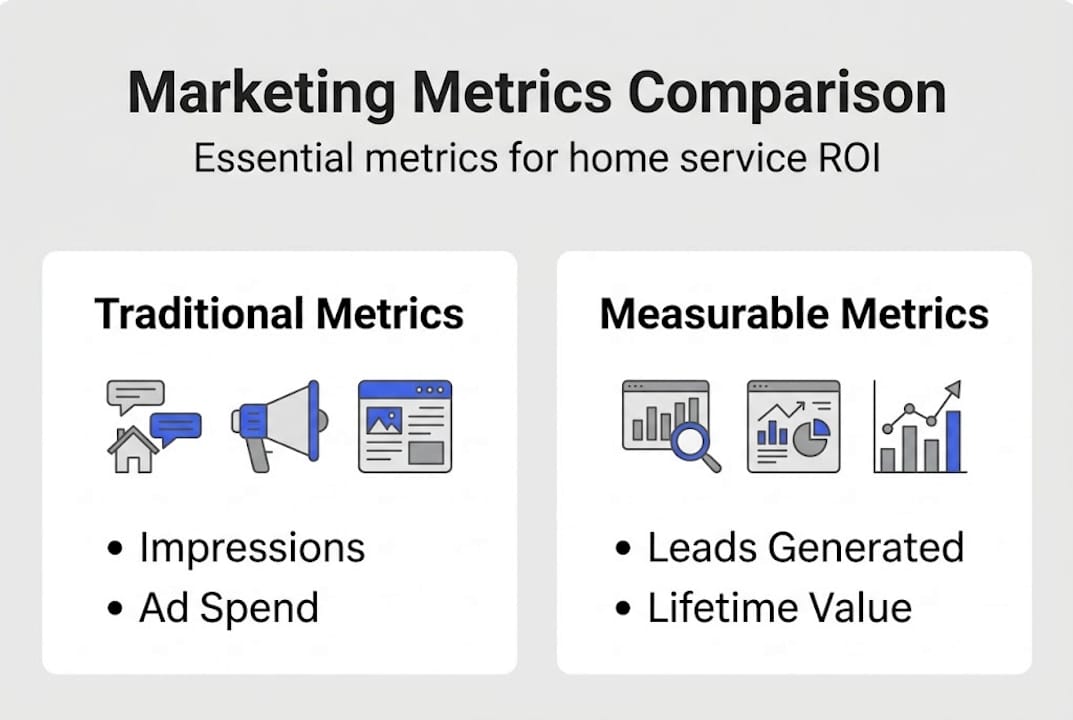
Customer lifetime value (CLV) is often the most underestimated metric in home services. A homeowner who calls you for an AC tune-up might also book a repair, refer two neighbors, and come back every year for maintenance. That single customer could be worth thousands of dollars over five years, not just the $89 tune-up fee.
For plumbing customer retention, CLV is especially important because repeat maintenance visits and emergency calls add up fast.
“The businesses that win long-term are not the ones with the lowest CPL. They are the ones who understand what a customer is really worth over time.”
Here is a sample tracking table to organize your data:
| Channel | Monthly leads | Booked jobs | Total cost | Avg. CLV |
|---|---|---|---|---|
| Google Ads | 45 | 30 | $1,800 | $1,200 |
| Local SEO | 38 | 27 | $900 | $1,200 |
| Direct mailer | 12 | 5 | $1,500 | $900 |
| Social media | 20 | 10 | $600 | $800 |
Looking at this table, SEO delivers the lowest cost per booked job and strong CLV. That is a signal to invest more there.
Other metrics worth tracking:
- Conversion rate from lead to booked job
- Average job value by service type
- Repeat booking rate per customer
- Referral rate from existing clients
You can use digital marketing analytics tools to pull all of this data into one view, making weekly and monthly reviews much faster. Tracking digital marketing ROI consistently is what separates businesses that scale from those that stay stuck.
Pro Tip: Set a monthly CLV benchmark for each service type. If your HVAC maintenance customers average $2,000 in lifetime value, that number should guide every budget decision you make.
Top techniques: How to implement measurable marketing
Knowing what to track is only half the job. You also need the right tools and a clear process to make measurement happen consistently. Here is a step-by-step approach that works for Texas home service businesses.
- Set up call tracking. Use a platform like CallRail or WhatConverts to assign unique phone numbers to each marketing channel. Every call gets automatically tagged by source, so you always know where leads come from.
- Install Google Analytics 4 on your website. This free tool tracks every visitor, form submission, and page interaction. Connect it to your Google Ads account so you can see which keywords drive actual conversions, not just clicks.
- Use a CRM system. A customer relationship management (CRM) tool like ServiceTitan or Jobber lets you log every lead, track its source, and follow the customer journey from first call to completed job. This closes the loop between marketing and revenue.
- Integrate online and offline tracking. If you run a mailer or attend a home show, create a unique landing page URL or phone number for that campaign. Offline marketing can be measured too.
- Build a monthly reporting routine. Every month, review your CPL, CPA, conversion rate, and CLV by channel. Adjust your budget based on what the data shows, not on gut feeling.
Digital tools can help home services directly link marketing spend to booked jobs, which is the clearest proof of ROI you can get.
Common pitfalls to avoid:
- Duplicate counting: Make sure one lead is not logged twice across your CRM and analytics platform.
- Ignoring location data: In Texas, a campaign performing well in Austin may underperform in Laredo. Always segment by city or service area.
- Skipping the review: Data only helps if you act on it. Schedule a fixed time each month to analyze results.
Follow solid marketing measurement guidelines and lean on effective marketing strategies built specifically for home service businesses.
Pro Tip: Even a simple spreadsheet updated weekly beats a fancy dashboard you never check. Consistency in reviewing data matters more than the tool you use.
Comparing measurable marketing to traditional marketing
You have learned how to measure modern marketing. Now let us look at how it stacks up against the classic approaches many Texas contractors still rely on.
Traditional marketing includes print ads in local papers, direct mailers, radio spots, and TV commercials. These channels can build brand awareness, but they share one major weakness: you rarely know what they actually produce in leads or revenue. Traditional channels often lack cost-effective measurement compared to digital tools.
Here is a direct comparison:
| Factor | Traditional marketing | Measurable marketing |
|---|---|---|
| Lead tracking | Difficult or impossible | Automatic and precise |
| Optimization speed | Weeks or months | Days or hours |
| Cost transparency | Low | High |
| Targeting precision | Broad | Hyper-local and intent-based |
| ROI visibility | Estimated | Data-confirmed |
Let us put real numbers on this. A direct mailer campaign targeting 5,000 homes in San Antonio might cost $1,500 and produce 12 calls, with 5 booked jobs. That is a $300 cost per booked job, and you only know those numbers if you use a tracking number on the mailer.
A Google Ads campaign with the same $1,500 budget, properly optimized, might produce 30 calls and 20 booked jobs. You see every click, every call, and every conversion in real time. You can pause underperforming ads the same day.
The core advantages of measurable marketing for home services:
- Real-time feedback so you can adjust fast
- Budget control based on actual performance data
- Proof of ROI you can show to yourself or a business partner
- Scalability because you know exactly what to invest more in
Working with leading digital marketing firms that specialize in home services means your campaigns are built for measurement from day one, not retrofitted later.
What most home service businesses get wrong about marketing ROI
Here is the uncomfortable truth: most Texas home service businesses measure the wrong thing. They obsess over cost per lead and ignore customer lifetime value. That is like judging a fishing trip by how many fish you caught today, while ignoring that you found the best fishing spot in the lake.
A $150 CPL looks expensive until you realize that customer books an annual HVAC maintenance plan, refers two neighbors, and calls you for an emergency repair. Suddenly that $150 investment is worth $4,000 or more. Real ROI for home services comes from measuring the lifetime customer journey, not just first calls.
Another mistake: chasing short-term ROI so aggressively that you cut brand-building efforts entirely. SEO takes months to show results, but it compounds over time. Businesses that only fund what shows immediate returns often find themselves in a bidding war on paid ads with no organic foundation underneath.
The smartest operators we work with track CLV by acquisition channel. They know that customers from advertising that drives ROI tend to have higher repeat rates than cold traffic. That insight shapes every budget decision they make.
Stop measuring marketing like a one-time transaction. Start measuring it like the long-term relationship it actually is.
Unlock measurable marketing for Texas home services
You now have a clear picture of what measurable marketing is and how to use it to grow your home service business. The next step is putting it into action with a system built specifically for your market.
At Aim Set Win, we build performance-focused campaigns for Texas plumbers, HVAC companies, electricians, roofers, and remodelers that track every lead, every call, and every booked job. Our home improvement advertising services are designed around real ROI, not guesswork. Whether you need SEO for Texas plumbing businesses or a full HVAC SEO Houston strategy, we build systems that prove their value every single month. Book a free strategy session and start measuring what actually matters.
Frequently asked questions
What does measurable marketing mean for a plumbing or HVAC business?
Measurable marketing means using trackable campaigns to see exactly which efforts bring leads, jobs, and repeat customers. It removes guesswork and lets you invest confidently in what works.
How do I track where my leads are coming from?
You can use call tracking numbers, website analytics, and CRM software to record every lead source automatically. These tools connect marketing spend directly to booked jobs.
Why do home service businesses in Texas need measurable marketing more than other industries?
Local competition in Texas is intense, and measuring what works helps you spend smarter and capture repeat business from maintenance or repairs rather than constantly chasing new customers.
What is the most important metric to track for ROI?
Customer lifetime value is the most important metric because it reflects the full revenue a customer generates over time, which is especially significant in repeat-service businesses like plumbing, HVAC, and electrical work.
Recommended
- Home Services Marketing Agency: Growth Strategies 2026 – Aim Set Win
- Digital Marketing Results That Actually Matter in 2026 – Aim Set Win
- Best Website Marketing Strategies That Drive Results – Aim Set Win
- Home Services Digital Marketing Agency Guide 2026 – Aim Set Win
Jean runs growth strategy at AimSetWin, a performance marketing agency specializing in local service businesses across Texas. he's helped plumbers, HVAC companies, pest control operators, and home service brands build predictable revenue systems using data-driven advertising and conversion optimization.


