

Discover why engage past customers is key to boosting profits. Learn effective strategies and avoid common pitfalls for real business growth!
TL;DR:
- Most business owners focus their marketing on acquiring new customers, but retention offers far greater growth potential.
- Re-engaging past clients reduces costs, increases repeat sales, and transforms customers into advocates and referral sources.
Most business owners spend the majority of their marketing budget chasing strangers. New leads, new ads, new outreach. But the data tells a very different story about where real growth lives. Understanding why engage past customers matters is not just a philosophical shift. It is a financial one. Acquiring a new customer costs 5 to 25 times more than keeping an existing one. Yet most businesses still treat past customers like a closed chapter. This article breaks down the real reasons to reconnect, the common mistakes that kill repeat business, and the specific strategies you can use starting today.
Table of Contents
- Key Takeaways
- Why engage past customers: the financial case
- Beyond repeat sales: the loyalty and referral payoff
- Common mistakes that kill repeat business
- Practical strategies for winning back past customers
- Tools and technology that make re-engagement easier
- My take on why businesses keep getting this wrong
- How Aimsetwin helps home service businesses grow with re-engagement
- FAQ
Key Takeaways
| Point | Details |
|---|---|
| Retention beats acquisition costs | Keeping past customers is up to 25 times cheaper than finding new ones. |
| Small retention gains, big profit jumps | A 5% increase in retention can grow profits by 25% to 95%. |
| Loyal customers spend more | Repeat buyers spend 67% more per transaction than first-time customers. |
| Most referrals are lost to invisibility | Clients do not refer because they forget you, not because they dislike you. |
| Blend automation with personal outreach | Use tools for scale, but keep human touchpoints for warm relationships. |
Why engage past customers: the financial case
Let’s start with the numbers, because they are hard to argue with.
Repeat customers are 60 to 70% more likely to purchase again and spend 67% more per transaction than first-time buyers. When you combine that with the lower cost of reaching them, the math becomes obvious. A past customer who already trusts you converts at a far higher rate than a cold prospect seeing your ad for the first time.
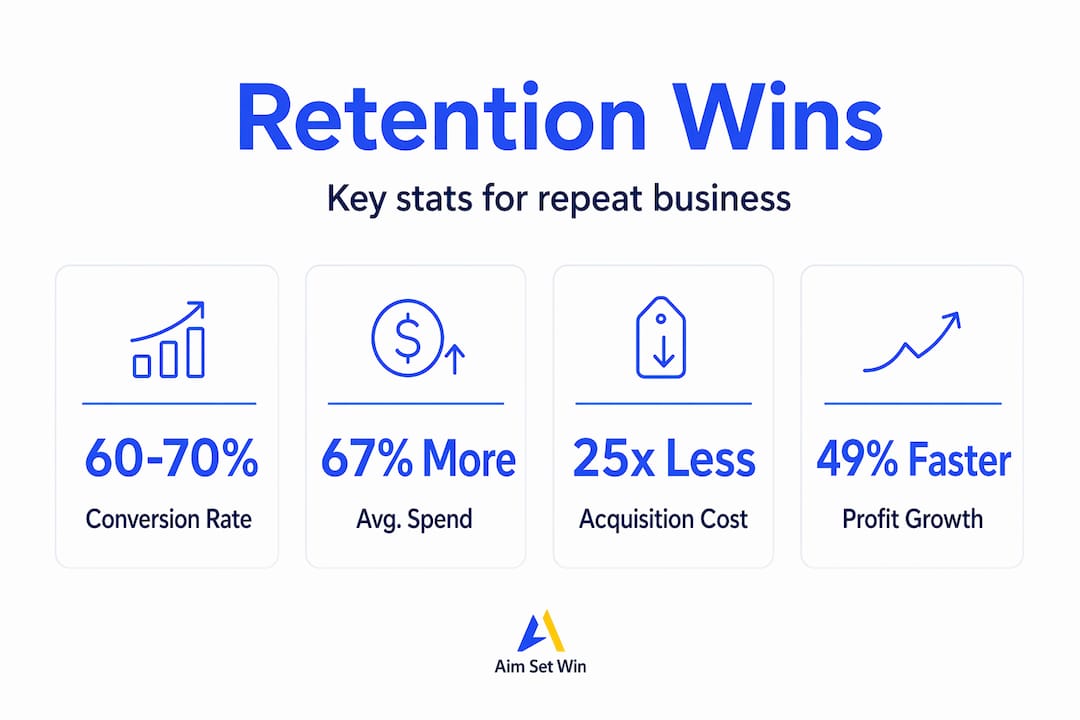
| Metric | New Customers | Past Customers |
|---|---|---|
| Acquisition cost | 5 to 25 times higher | Baseline |
| Conversion likelihood | 5 to 20% | 60 to 70% |
| Average spend per transaction | Baseline | 67% higher |
| Profit impact of 5% retention increase | None | 25% to 95% boost |
That table should stop you in your tracks. The conversion rate alone is not a small difference. It is the difference between a profitable marketing channel and an expensive gamble.
Customer-obsessed companies grow revenue 41% faster and profits 49% faster than businesses that do not prioritize relationships. That is not a coincidence. That is the compounding effect of re-engagement done consistently over time.
Pro Tip: Before you launch another paid ad campaign, calculate what a 10% increase in repeat business from your existing customers would mean to your monthly revenue. Most business owners are shocked by how quickly it adds up.
Beyond repeat sales: the loyalty and referral payoff
Here is what most people miss about the importance of retaining former customers. Loyal customers do not just buy again. They become part of your growth engine in ways that do not show up on a simple invoice.
When a customer has a genuinely good experience and you stay in touch with them after the job is done, something powerful happens. They start advocating for you. They mention you to neighbors, colleagues, and friends. They defend your reputation in online reviews and local conversations. Personalized engagement triggers 60% repeat purchases and increases customer lifetime value by 33%.
“Retention is the lifeblood of growth and must be managed across the entire customer lifecycle, not just post-sale.” — Zendesk on customer retention
There is also a resilience factor that most business owners do not consider. When you have a loyal base of engaged past customers, you are less vulnerable to market swings, ad cost increases, or slow seasons. You have a reliable floor of revenue to work from.
Here is what loyal customers actually deliver beyond repeat purchases:
- Referrals with trust already built. A friend’s recommendation skips all the skepticism that comes with cold advertising.
- Higher tolerance for price increases. Loyal customers care about reliability, not just the lowest bid.
- Faster yes decisions. They already know your process, your team, and your quality. The sales conversation is shorter.
- Organic reputation building. They leave reviews, share posts, and talk about you in community groups.
- Lower complaint rates. Familiarity creates mutual respect. They are more patient when things go sideways.
This is the real reason to connect with past clients. Not just for a second transaction, but for the referral flywheel and reputation protection they provide on your behalf.
Common mistakes that kill repeat business
Most businesses do not lose past customers because of poor service. They lose them because of silence.

44% of businesses still prioritize acquisition over retention, despite data showing retention delivers far better ROI. That is a structural problem in how most companies think about growth. They treat the first sale as the destination, when it should be the starting line.
Here are the most common mistakes that push past customers out the door:
- Going quiet after the job is done. You finish the work, send the invoice, and move on. The customer feels like a transaction, not a relationship.
- Spending all your budget on new leads. Every dollar spent acquiring a stranger is a dollar not spent nurturing someone who already trusts you.
- Assuming no referrals means unhappy customers. This is the most costly assumption in business. Most lost referrals happen because the client simply forgot you, not because they were dissatisfied.
- Treating retention as something you think about later. Retention is not a downstream metric. It is a core revenue driver that needs attention from day one.
- Using mass, impersonal outreach. Sending generic newsletters or batch emails does not rebuild connection. It gets ignored.
Pro Tip: The next time you finish a project, set a calendar reminder for 30 days out to send a personal follow-up. No pitch. Just a genuine check-in asking how everything is going. You will be surprised how many conversations it opens.
Treating each client interaction as isolated is one of the most damaging patterns in service businesses. The shift you need is to see every customer as a long-term partner, not a one-time transaction.
Practical strategies for winning back past customers
Knowing why to re-engage is only half the equation. Here is how to actually do it in a way that feels natural, not desperate.
Personalized follow-ups within 30 days
After you complete any job, send a direct, personal message within 30 days. Not a receipt. Not a survey. A genuine note from you or your team asking how the customer is settling in, how the results are holding up, or if there is anything else they need. This small move signals that you care beyond the paycheck.
Check-ins that deliver value, not just visibility
The reason to follow up with old clients is not to sell them something immediately. It is to stay top of mind so that when they need you again, or know someone who does, your name is the first one that comes to mind. Send a useful tip, a seasonal reminder, or a relevant update. Make the outreach about them, not about you.
Ask for referrals at the right moment
The referral flywheel is not triggered by generic requests. It works when you ask specifically, at the right time, right after a customer has expressed satisfaction. Instead of “Do you know anyone?” try “We’re looking for more homeowners in your neighborhood who need the same type of work. Would you be comfortable passing along our name?” That specificity makes it easy for them to act.
Segment and target your outreach
Not every past customer is the same. Some had large jobs. Some have referred others before. Use what you know about them to tailor your outreach. A customer who spent significantly with you in the last year gets a different type of follow-up than someone who had a small one-time repair. Automated outreach combined with personalized messages based on client history maximizes re-engagement effectiveness.
Here is a quick comparison of passive versus active re-engagement approaches:
| Approach | Passive (what most do) | Active (what works) |
|---|---|---|
| Follow-up timing | None after job close | Within 30 days |
| Message type | Generic newsletter | Personalized check-in |
| Referral request | Never or vague | Specific ask at the right moment |
| Segmentation | No segments | By job size, recency, referral history |
| Tools used | None | CRM with reminders and tracking |
Build loyalty programs or annual service agreements
Give your best customers a reason to stay connected year-round. Annual maintenance agreements, priority scheduling, or seasonal check-in calls all create community stickiness that makes switching to a competitor feel costly, even when there is no logical reason to stay except the relationship.
You can also explore resources like proven retention strategies to see how follow-ups, promotions, and loyalty programs can be structured specifically for home service businesses.
Tools and technology that make re-engagement easier
You do not have to do all of this manually. The right technology stack makes consistent outreach possible without consuming your entire workday.
Here are the key tools every home service business should be using for re-engagement:
- CRM software. A customer relationship management platform like Jobber, ServiceTitan, or HubSpot stores every client’s contact details, job history, and communication timeline. Without a CRM, follow-ups are guesswork.
- Automated email and SMS sequences. Set up post-job sequences that trigger automatically after a job closes. A 7-day follow-up, a 30-day check-in, and a 6-month seasonal reminder can all run without you lifting a finger.
- Review request automation. Tools that automatically request Google reviews from satisfied customers build your online reputation and reinforce trust with future prospects.
- Analytics and tracking. Platforms that track open rates, response rates, and repeat bookings tell you which segments are re-engaging and which ones need a different approach.
Pro Tip: Do not let automation replace the personal touch for your warmest leads. Use technology to handle your cold or medium-warm database. Reserve real phone calls and personal emails for your top clients and recent referrers.
Effective re-engagement blends automation for database management with manual, high-touch conversations for warm leads. That combination is what separates businesses that grow their repeat revenue from those that keep starting from zero every month.
For HVAC and plumbing businesses specifically, you can review the top re-engagement platforms built for this industry to find the right fit for your operation.
My take on why businesses keep getting this wrong
I’ve talked with dozens of home service business owners who will tell you, without hesitation, that their past customers are their best customers. Then I look at their systems and find zero follow-up, zero segmentation, and zero re-engagement outreach.
The gap between what they believe and what they do is striking.
In my experience, the biggest enemy of retention is not bad service. It is “out of sight, out of mind.” The moment the job is done, both sides get busy. The customer moves on. The contractor chases the next lead. And a relationship that could have generated years of repeat business quietly disappears.
What I’ve learned is that the businesses that win long-term treat retention as a discipline, not a reaction. They build it into their operations the same way they build in invoicing or scheduling. It has a process, a tool, and someone accountable for it.
I also believe most people overcomplicate re-engagement. You do not need an elaborate loyalty program on day one. You need a personal follow-up call, a genuine check-in email, and a specific referral ask timed right. That alone puts you ahead of 80% of your competitors.
The mindset shift is this: your past customers are not a closed file. They are your most valuable, lowest-cost growth opportunity. Treat them that way.
— Jean
How Aimsetwin helps home service businesses grow with re-engagement
Re-engaging past customers is one part of a larger growth system. But if those customers cannot find you online when they search again, or when their neighbor asks for a recommendation, you lose the opportunity before it even starts.
That is exactly where Aimsetwin comes in. We build revenue-focused digital growth systems exclusively for home service businesses in Texas, including plumbing, HVAC, electrical, roofing, and pressure washing contractors. Our local SEO strategies make sure your business shows up when past customers, referrals, and new prospects search for your services in your city.
We combine HVAC re-engagement strategies with search visibility to create a full-circle system that turns past customers into repeat bookings. We also provide proven plumbing marketing tactics that complement your outreach efforts with high-intent organic traffic.
If you are ready to stop starting from zero every month, explore how plumbing SEO and HVAC search services from Aimsetwin can build you a predictable, repeat-revenue machine.
FAQ
Why engage past customers instead of finding new ones?
Past customers already trust you, convert at 60 to 70% rates, and spend 67% more per transaction than new buyers, making them far more cost-efficient to re-engage.
How often should you follow up with old clients?
A personal check-in within 30 days of job completion, a 6-month seasonal touchpoint, and an annual outreach are a strong baseline for most home service businesses.
Why do past customers stop referring even when they were satisfied?
Lost referrals are almost always caused by lack of visibility, not dissatisfaction. Consistent, low-cost outreach keeps you top of mind when the referral opportunity arises.
What tools help with re-engaging lapsed customers?
CRM platforms like Jobber or ServiceTitan, automated email and SMS tools, and review request software are the core stack for managing re-engagement at scale without losing the personal touch.
How much can retention really improve profits?
A 5% increase in customer retention rates can improve profits by 25% to 95%, depending on your industry and average customer lifetime value.
Recommended
- HVAC Customer Re-Engagement Guide for Reliable Revenue
- HVAC Customer Re-Engagement Workflow for Reliable Bookings
- Home NEW V.6 – Aim Set Win
- home-7 – Aim Set Win
Jean runs growth strategy at AimSetWin, a performance marketing agency specializing in local service businesses across Texas. he's helped plumbers, HVAC companies, pest control operators, and home service brands build predictable revenue systems using data-driven advertising and conversion optimization.


